While growing up, you likely heard someone say, “Sticks and stones may break my bones, but words will never hurt me.” But, of course, that’s not true. In many ways, words can bring harm at a level that sticks and stones never could. Because words can pierce through to the heart.
I can recall from an early age how much words affected me. There was a time one of my good friends made a joke at my expense, and I can still remember how much that stung to hear someone I looked up to making fun of me. I also remember times that I spoke something hurtful, and I can still see the look of anguish that I caused and still feel the tinge of guilt.
In the documentary Won’t You Be My Neighbor, it is revealed that the beloved Fred Rogers, of the classic children’s show Mister Rogers’ Neighborhood, was once bullied as a child and called “Fat Freddy.” The whole ordeal really hurt the young boy, and it taught him early in life how much power our words can have on others.
Words carry far more weight than we give them credit. They have the ability to cut people so deeply that healing can take a long time. Perhaps you grew up in a household where you heard countless threats, name-calling, insults, and a regular supply of bitter sarcasm directed at you. Such an experience can be debilitating. You can grow up with the sense that you have little to no value in the eyes of others. It can make you wish you were someone else. The whole trajectory of your life can be devastated – all because of words.
However, there is a flip side to all this. Not only do our words carry incredible power to tear down, they also have the power to build up.
The wise author of Proverbs wrote, “The tongue has the power of life and death” (Proverbs 18:21). When your child is hurting, feeling crushed by defeat, or upset about something, your words of encouragement can be like a refreshing spring rain that brings life and joy. Even for an adult, a timely compliment can change the whole mood of the day. And yes, it’s also true that words can kill – in fact, in some tragic cases, they have. People can be driven to despair and angst by the cruel and biting words of another.
Because of their unique role, fathers should especially take all this to heart. Sociologists, psychologists, and historians have written reams about the undeniable impact a father can have on his child’s life – for good or ill. I believe that one of the primary roles God has given to fathers is that they would be there to build up their children with their words. Spending time with your children, hearing them articulate their own thoughts, and telling them why you think they’re so great is such a simple but immensely beneficial act of fatherhood.
The Apostle Paul wrote, “Let no corrupting talk come out of your mouths, but only such as is good for building up, as fits the occasion, that it may give grace to those who hear” (Ephesians 4:29, ESV).
How different our world would be if fathers took this counsel to heart. What if every single dad in the world resolved each morning to only say that which is good, encouraging, and helpful for building up their children? What kind of difference would that make? How many family rifts, embittered hearts, and feelings of despair could be avoided through this simple, daily practice?
This in no way eliminates the need for discipline. Instead, it very purposefully puts all loving discipline of your child in the right framework.
When your little guy is misbehaving, running amok, and causing trails of disaster wherever he goes, it can be hard to restrain your tongue. When your daughter throws a fit in the mall because she didn’t get the candy she was pleading for, it can be a challenge to not thrown your own private fit later. When your son uses your power tools for the eleventh time and leaves them out in the rain, it may seem impossible not to scream about how irresponsible he is. (Some of you are cringing even as I describe these scenarios!)
But how we speak in those moments can mean all the difference in the world for that child. And, trust me, this is coming from a dad who hasn’t always chosen to speak in a way that gives “grace to those who hear.” But giving grace is what we should strive for and, with God’s help, it’s something achievable.
When they don’t get the “A” they studied so hard for or don’t make the team they had dreams of playing on, they may just need Dad to silently sit with them or hug them. But when the time is right, lift their spirits with a word of encouragement. Remind them how much you love them, in the successes and the failures. Give them the boost they need. Leave no room for doubt that you are proud of them nonetheless!
Doesn’t every father need this reminder? Dads, build them up.
Sometimes people assume that the stories found in the Bible are always otherworldly, with every page being filled with outlandish miracles, ethereal heavenly visions, and glorious angelic appearances. They imagine that the Bible might cater well to “dreamers” who enjoy predictable stories but not so well to those who live in the grit and grime of reality. But what really struck me when I began to actually read through the Bible is how incredibly real to life all the narratives truly are.
I learned that it was very much a book written for humans and by humans, even though – I’m convinced – it is ultimately given from God.[1] Some open their Bibles and expect to read about God’s people always succeeding and conquering “the bad guys” in dramatic fashion – all for the glory of God, of course! To be sure, there are “success stories” in the Bible. With God’s help, Joshua soundly defeated Jericho, and David took down Goliath with a single smooth stone.
But on the whole, you don’t find God’s people riding one big wave of victory after the other. Very often, the so-called “good guys” are deeply flawed and have mixed motives. They often struggle with doubt. Sometimes they even get angry at God. And perhaps the thing that makes people in the Bible seem most real is that they suffer.
Take Jeremiah, for example. His nickname is “the weeping prophet.” It’s a pretty unfair moniker, really, considering all that the guy was up against. Pretty much every time God gave Jeremiah a speaking assignment, the prophet obeyed but then was mocked and rejected by his audience. You could sum up Jeremiah’s message to Israel like this: “1) You guys sinned, 2) God will judge you, and 3) But there is still the hope of restoration, if you repent!”
For some reason, the people didn’t really like that message – particularly points 1 and 2. Nearly the whole nation made it clear that they would rather Jeremiah just bug off. They preferred listening to all the false prophets, whose constant message was essentially: “Everything is awesome!” (see Jeremiah 23:16-22). They promised success and victory, but avoided the messy subjects of sin and accountability to God. Due to the city’s unspeakable evil, God determined that the Babylonian army would utterly crush Jerusalem.
Rather than a small band of rebels rising up at the very last moment to defeat the mighty evil empire – as we might expect in a Hollywood script – God’s people don’t win this battle. Jerusalem is decimated by the Babylonians. The book of Jeremiah ends with total defeat, rather than: “And they lived happily ever after.”
In addition to writing the biblical book that bears his name, many scholars believe that Jeremiah may have written the book of Lamentations (see 2 Chronicles 35:25). Given his historical position as an eyewitness of all that took place when Jerusalem fell, this makes sense, but we really don’t know.
In Lamentations, we get a sense for what the Apostle Paul meant when he wrote, “Behold then the kindness and severity of God” (Romans 11:22). God is always good and kind, but He also refuses to leave evil and rebellion unchecked forever.
As he watches the city of Jerusalem fall through tear-filled eyes, the author of Lamentations cries out:
“The Lord determined to tear down the wall around Daughter Zion. He stretched out a measuring line and did not withhold his hand from destroying. He made ramparts and walls lament; together they wasted away.” (Lamentations 2:8, NIV)
Imagine for a moment that the beloved city in which you live was being burned to the ground. How would that make you feel? It gets worse for this grieving man. In raw emotion, he accuses God of ignoring him:
“He has walled me in so I cannot escape; he has weighed me down with chains. Even when I call out or cry for help, he shuts out my prayer.” (Lamentations 3:7-8, NIV)
This is in the Bible! The author continues pouring out his heart with bitter invectives against God – even likening God to a ferocious bear that mauled him and left him for dead (vv. 10-11)!
Maybe you can relate. Perhaps there have been times when you too felt like God was shutting out your prayers. Maybe this even led to a root of bitterness growing within. It’s possible you even accused God of failing to do His job… failing to be the God you need. That’s where this man’s heart was as he wrote this.
But then, something changes… drastically. It’s as though a ray of hope suddenly breaks through the thick clouds overhead and shines upon his wounded soul.
“Yet this I call to mind and therefore I have hope:
The steadfast love of the Lord never ceases; his mercies never come to an end; they are new every morning; great is your faithfulness. “The Lord is my portion,” says my soul, “therefore I will hope in him.” (Lamentations 3:21-24)
The author has wrestled intensely with how God’s goodness and sovereignty fit with the way his world is crumbling to a heap, and now he has broken through that struggle to the truth of God’s loving character on the other side. He has gone through what many have called “the dark night of the soul” and emerged with a clearer perspective on how desperately he needs God. He remembers that “his mercies never come to an end; they are new every morning” (vv. 22-23).
What strikes me about Lamentations is how relatable it is. There’s nothing superficial or hunky dory about it. The author is deeply distressed throughout the entire book. But I also note how the author would have never been able to see the depths of God’s great mercy were it not for his agonizing experience.
Throughout this coronavirus crisis, many have wished they could find a time warp that takes them to the end of this pandemic. Such wishful thinking reminds me of Adam Sandler’s character on the movie Click. (Yes, I really am referencing an Adam Sandler movie in this devotional). In that film, Sandler’s character, Michael, discovers a universal remote control that allows him to pause time or fast-forward through difficult circumstances. In the end, Michael ends up fast-forwarding through his entire life. The lesson to be learned is that you cannot skip or avoid challenges in life, because life is filled with them – even as it is also filled with so much beauty and goodness.
In the same way, God does not intend for us to fast-forward through the challenging times of life. Instead, we are to be fully engaged with every moment He gives us. He calls us to walk through the valleys, not merely to fly from one mountaintop to the next. If it weren’t for the valleys, we would never grow. We’d become self-satisfied and spiritually anemic. Though unpleasant in the moment, trials in life are for our ultimate good.
Having gone through the valley of suffering, the author of Lamentations can now see God’s glory with greater clarity. Although pain and grief are here for a season, God’s love never ceases. “His mercies never come to an end” (v. 22). Every morning brings a fresh supply, and this reservoir of mercy will never run dry. “Weeping may tarry for the night, but joy comes with the morning” (Psalm 30:5). This is a powerful reminder to any who have suffered greatly and felt like God was ignoring them in their pain. When you seem all alone, God is still with you each step of the way. Even in the pain, God will bring new mercies. When all seems silent, God hasn’t forgotten about you. Know that everything your Father allows into your life is designed to ultimately draw you closer to Him.
Charm is deceptive, and beauty is fleeting; but a woman who fears the LORD is to be praised. (Proverbs 31:30)
Last week, on April 27th, my grandmother, Bettie Bramer, went to Heaven. She will be dearly missed.
Without question, Grandma loved me, as she did all her children and grandchildren. And we loved her. She was a strong, faithful, and wise woman. She loved Jesus with all her heart, and she wanted others to know and love Him.
And she loved her husband, Grandpa Jim, so very much. I loved to watch them care for one another, share memories together, and tease each other incessantly, in the way that only a long-married couple can. My grandparents were friends in middle school, sweet hearts in high school, and later wed in 1953. They were happily married for 66 years.
Whenever I saw Grandma, she always took such an interest in me, asking me what was new in my life and how I felt about it. She had a very sharp mind, too, and a quick wit! I remember countless times that she got laughing so hard, along with the rest of us, over a remark someone made. Grandma was also very warm and welcoming from the first time she met my wife, Whitney. And I’m so thankful she got to meet all three of our boys.
And, my goodness, she was the queen of her kitchen! Her vegetable soup always hit the spot. And her rolls – oh, her soft and buttery rolls! – well, they were legendary.
My earliest memory of Grandma is actually pretty funny. My parents were out, and she and Grandpa were watching us kids. I remember her clearly telling me that I needed to lay down for a nap, but I just couldn’t handle the thought of missing out on all the family fun. Mind you, I was probably three or four. Like a prison escapee, I carefully crawled down the hallway, passing the room I thought she was in. Then, to my horror, I realized she was actually in the kitchen – and had spotted me! What was I to do? There was only one option left: I took off running. I swung open the front door and sprinted past a crowd of onlookers – consisting of my siblings and their neighborhood friends – then bolted toward the backyard, hoping beyond hope to find safe haven there. The gate is open! I could see the grass. I was nearly there. I could smell freedom!
But then it happened. I felt an arm wrap around my waist and whisk me off the front lawn. I was fast… but Grandma was faster. My master plan of skipping nap time was utterly foiled.
It’s funny how an early memory like that can shape a young child’s perspective. For a time, I thought of Grandma Bettie as strict and unyielding. But only a couple summers later, that perspective changed. She and Grandpa joined our family for a trip to Disneyland, and I saw how kind, fun, and generous Grandma really was. Over the years, I had the privilege of getting to know Grandma better and better, and I came to see that she was more than just a kind woman who gave me Christmas presents and made delicious food.
Grandma Bettie was a woman who cared deeply about her family, her church, and her community. But most of all, I could see how clearly she loved Grandpa.
One of the challenges right now for my family – and my Grandpa Jim, especially – is not being able to have a memorial service right away, due to COVID-19.
Whenever we lose someone in our lives, there’s always going to be a mix of emotions. It’s common for grieving family and friends to feel everything from sorrow to regret to guilt to peace. Psychologists even talk about the various stages of grieving. I’m convinced it’s not the same for everyone. But ultimately we all need some sense of closure or acceptance of the “new normal,” even while we never forget the incredible impact our loved ones had.
I thank God for my Grandma Bettie. While I miss her very much, I’m grateful for the incredible legacy both she and Grandpa have left for the rest of the family. And it lifts my heart to imagine how glorious life is now like in the presence of Jesus, her Savior. Though her body is lifeless, I promise you, Bettie Bramer has never been more alive.
Jesus said to her, “I am the resurrection and the life. The one who believes in me will live, even though they die; and whoever lives by believing in me will never die. Do you believe this?” (John 11:25-26).
“And hope does not disappoint us, because God has poured out His love into our hearts through the Holy Spirit, whom He has given us.” (Romans 5:5, BSB)
Hope is something our world desperately needs right now. Widespread suffering and bleak economic projections have left people feeling lost and disoriented. Many feel caught in the perpetual cycle of hearing messages of gloom and doom.
Into this dreary darkness, God wants to shine a ray of hope. I love the chorus of a Switchfoot song that goes, “My heartbeat, my oxygen. My banner, my home. My future, my song. Your hope is the anthem of my soul.” Now, perhaps more than ever, Christians must recognize our anthem really is hope.
The beauty of Christianity is that it heralds a message of spectacularly good news especially for dark and dismal times like the present. The message of Jesus Christ carries a hope that nothing in this world can snuff out. What makes it so unstoppable is that it’s a hope that shines all the brighter as the world looks darker. It’s a message for this world precisely because it is a message that transcends this world. It stands above even a global pandemic and urges every person to listen and believe.
This hope found in Jesus does not rest on the success of political campaigns or how quickly a coronavirus vaccine is discovered – which I pray is very soon. The Bible calls this hope “an anchor for the soul, firm and secure” (Hebrews 6:19, NIV), something strong enough to weather even the fiercest storms. In Scripture, hope is something solid and sure – not a whimsical and flimsy pipe dream. Our “hope of eternal life” will never let us down because the “God who cannot lie” promised this “before time began” (Titus 1:2, BSB). We say things like “I hope it won’t rain on Saturday” or “I hope our team makes the Super Bowl,” but such hopes often ring hollow and really belong to the category of wishful thinking. The Christian hope, on the other hand, “does not disappoint us” (Romans 5:5, BSB).
So what is the Christian hope? Many have supposed that Christianity is about God rewarding the faithful. In other words, Jesus came to save the good, moral, and godly among us. What else could they think? After all, aren’t Christians engaged in a culture war eager to impose a biblical morality on the rest of society? I’ve spoken to many who see it that way.
But… what if Christianity’s message is filled with hope and joy, not because it’s first and foremost about moral reform, but about redemption in Christ. The reason I say it’s not about Jesus saving “the good, moral, and godly” is because the Bible itself says, “For while we were still weak, at the right time Christ died for the ungodly” (Romans 5:6). Read it again. Jesus died for the “ungodly” – the immoral, the vile, the perverted.
Does that offend you? Well, it could be that you’ve missed the fact that, according to genuine Christianity, no one is saved except “by grace” (Ephesians 2:8). Grace is a biblical term that means “God’s infinite love to the infinitely undeserving.” The reality is that every last one of us has inherited the brokenness of our first father, Adam. “Therefore, just as sin came into the world through one man, and death through sin, and so death spread to all men because all sinned” (Romans 5:12).
As a human race, we essentially told God to shove off, thinking we could become gods apart from Him. Because of our sinful nature, we all come into this world separated from God and justly condemned. We have all gone wrong, which is why our greatest need is to be reconciled to God and somehow put in the right. But “the wages of sin is death” (Romans 6:23). God’s moral standard cannot change. “The soul that sins shall die” (Ezekiel 18:20). God loves us dearly, but if He failed to punish our sin, this would lead to the moral order of the universe crumbling to a heap. Justice would be out the window forever. So what is God to do?
There is only one way God could save us while remaining perfectly just. He Himself would have to come and bear the punishment for our sin in our place. This is where the hope of the gospel glows with the brightness of heaven itself. You can probably think of someone you’d be willing to die for. But can you imagine dying for your enemy – for someone who has offended you, insulted you, and devalued you incessantly? Because that’s what Jesus did.
“For one will scarcely die for a righteous person – though perhaps for a good person one would dare even to die – but God shows His love for us in that while we were still sinners, Christ died for us. Since, therefore, we have now been justified by His blood, much more shall we be saved by Him from the wrath of God” (Romans 5:7-9). To be justified is to be “declared righteous” by God because when Jesus hung on the cross, He took your sin and gave you His righteousness.
The truly astonishing thing is that while we were plotting to become gods in our rebellion against God, God became a man in order to rescue us. “For if while we were enemies we were reconciled to God by the death of His Son, much more, now that we are reconciled, shall we be saved by His life” (v. 10).
This is the greatest message of hope our world could ever know. The moment you trust in Jesus Christ and His death for you, you are reconciled to God. From that moment on, “the wrath of God” (v. 9) no longer hangs over your head because you are covered in the grace of God. “Therefore, since we have been justified by faith, we have peace with God through our Lord Jesus Christ” (v. 1)
The Bible says that when you know this peace with God, it changes everything. Your whole world turns upside down… or, rather, right side up. Paradoxically, you can now have tremendous joy in the midst of trials.
“…and we rejoice in hope of the glory of God. Not only that, but we rejoice in our sufferings, knowing that suffering produces endurance, and endurance produces character, and character produces hope, and hope does not put us to shame, because God’s love has been poured into our hearts through the Holy Spirit who has been given to us” (vv. 2b-5).
More than that, ours is a “living hope” because Jesus Christ is alive today. This is why Christians celebrate the resurrection of our Lord every Easter. His defeat of death signals to the whole world that the suffering of this world has an expiration date.
Do you see why this is the message of hope the world most needs? Whereas other hopes are dashed on the rocks of adversity, here is a hope that actually is strengthened by suffering. It’s a hope that God is offering you right now, because “Christ died for the ungodly” (v. 6). No matter how badly life looks, the Christian can always have this confidence: Our anthem is hope.
“The LORD is near to the brokenhearted and saves the crushed in spirit.” (Psalm 34:18)
These are tumultuous times. Many are facing job loss or financial difficulties. Weddings and other pivotal gatherings and events have been canceled. Countless are confused, angry, and anxious about the future.
The number of confirmed cases of Coronavirus across the globe just passed 395,000 as I write this, with 17,252 deaths worldwide. The constant refrain in the news seems to be: “The world is a mess!” The ground beneath our feet seems to be cracking and crumbling. So, what can be done about this growing uncertainty?
Now, more than ever, we as a people need to turn to God’s written revelation. The Bible was given to us for all times, and especially for times like this. We need to know that God has not left us alone during this crisis.
When we face unprecedented challenges, we must see God reaching out to us in love. In fact, God gave us a psalm to address unsettled hearts in times of crisis.
Psalm 34 begins with the author David committing in his heart to praise the God over all in every circumstance: “I will bless the LORD at all times; His praise shall continually be in my mouth” (v. 1). God’s honor is not an afterthought for David. It isn’t an “if time allows” item on the agenda. He understands that the right response to crises is to worship the Lord who made us. But why?
Worshiping God: The Real Solution to Times of Crisis
Because we were designed for worship of our Creator, our hearts are most settled and at peace when we are reverently adoring Him for the God He is. When we can worship God in a crisis, we can know that we truly do love Him, not merely the blessings He bestows on us.
Job is known as the righteous sufferer of the Old Testament. Probably only a handful of people have faced more trials than him. He lost nearly all his livestock and possessions to thieves and a wildfire (1:14-17). His children died when a whirlwind caused the house they were in to collapse on them (1:18-19). Then, painful, puss-filled boils covered his entire skin (7:5; 30:17). His wife told him to blaspheme God and find a hole to die in (Job 2:9). And, lastly, his closest friends seemed to think he must have sinned horribly (8:2-7). Oh, and on top of everything else, did I mention he also had a severe case of halitosis – bad breath (19:17)? All this, despite the fact that Job “was blameless and upright, one who feared God and turned away from evil” (Job 1:1).
So, what was Job’s response to this horrendous anguish he faced? He shaved his head, fell to his knees, and worshiped God. Yes, you read that correctly. Job cried out, “Naked I came from my mother’s womb, and naked shall I return. The LORD gave, and the LORD has taken away; blessed be the name of the LORD” (v. 21). This likely seems strange to many readers. Shame, misery, and grief lead him into a worship session? What’s going on here?
Job understood something we often miss. The book’s author tells us what that was at the very beginning: Job feared God (v. 1). Because Job feared God, he understood that He was the Author of life, the only One deserving worship, and the only One we should rely on during times of upheaval. When everything in our lives seems disrupted, we need to rely on the Rock who does not change. “For He is the living God and He endures forever” (Daniel 6:26).
A host of solutions have been proposed in dealing with the current crisis. Some of these are good, but many may not be. Ultimately, they are not the decisive measures that can calm our hearts. Only turning in heart-filled worship to the “Father of mercies and God of all comfort” will give us the supernatural peace we’re all craving right now (2 Corinthians 1:3). “Taste and see that the LORD is good!” (Psalm 34:8).
God Hears Our Prayers and Sends His Angels
Listen to what David said: “I sought the LORD, and He answered me and delivered me from all my fears. Those who look to Him are radiant, and their faces shall never be ashamed” (Psalm 34:4-5). When all is said and done, the question will not be: Did we survive the pandemic? Ultimately, no one gets out of this life alive! The question, rather, will be: In the midst of the pandemic, where did we turn for security? I don’t know about you, but I want to be included among those whom David describes as “radiant” and full of God’s love and peace, not dreading each day with fists clenched tightly.
I love what David says next, because it fits with the financial uncertainty we’re facing: “This poor man cried, and the LORD heard him and saved him out of all his troubles. The angel of the LORD encamps around those who fear Him, and delivers them” (vv. 6-7).
Our tendency in economically volatile times is to look down at our assets, accounts, and accruals. God says, “Lift your eyes up here. My angel will bring perfect peace to you who fix your eyes on Me.” Then David says something that could be baffling: “Oh, fear the LORD, you His saints, for those who fear Him have no lack! The young lions suffer want and hunger; but those who seek the LORD lack no good thing” (vv. 9-10).
What exactly is this psalm promising us? This isn’t a blank check promise that as long as you ask God, you’ll always get what you want. No, it’s meant to be a statement of assurance to those who feel deprived of what they normally can count on. Come what may, for those who seek the Lord, they will find true contentment in Him. They will “lack no good thing” (v. 10).
God Will See You Through to the Very End
“The LORD is near to the brokenhearted and saves the crushed in spirit” (v. 18). This is the statement Psalm 34 seems to be building toward. It calls us to worship the Lord (v. 1). It assures that He hears our every prayer (v. 17). Then, it tells us what we most need to hear: God hasn’t forgotten about you in the midst of this crisis (v. 18). He is so close, in fact, that you can feel his presence right there with you when you quiet your heart.
Elizabeth Elliot, who experienced deep suffering and loss in her life, wrote, “When our souls lie barren in a winter which seems hopeless and endless, God has not abandoned us. His work goes on. He asks our acceptance of the painful process and our trust that He will indeed give resurrection life.”[1]
Psalm 34 ends with a warning and a promise. Many will fall to affliction and cast bitter aspersions on those who seek the Lord (v. 21), but ultimately those who take refuge in the Lord will find ultimate salvation with Him (v. 22). No matter what crises or afflictions come our way in this life, we can be sure that those who trust in the resurrected Lord, Jesus Christ, will also be granted a resurrected life where death is but a distant memory.
If you know your destination, you won’t be lost on the journey. He will see you through to the very end.
[1] Elizabeth Elliot, A Path Through Suffering (Ann Arbor, MI: Servant Publications, 1990), 43.
Fear is a poison that paralyzes us. It locks us in a prison of our own making. It holds us back from walking forward in love. Fear stifles our courage and whispers the lie that we don’t have what it takes to walk in obedience to the Lord.
We’ve all had times where we are plagued by self-doubt. We can sense God calling us into something that terrifies us, and our gut-level response is to shrink back in horror. We think, “What? Little old me? I can’t possibly do that.” Or maybe it’s more like, “Big fat sinner me? I’m not worthy of doing that.” Nevertheless, God wants us to realize His plan for our lives is bigger than we ever dared to dream.
Too often — I can see this in myself — we know God wants us to follow through on something, and the reason we haven’t yet is actually very simple: fear. Fear of failure. Fear of exposure. Fear of losing a friendship. Fear of looking foolish. Fear of falling on our face and never wanting to take a risk again.
Here’s what I think can happen sometimes. We tell ourselves we have good reasons not to walk forward in obedience. We rationalize. We experience the sudden onset of analysis paralysis, thinking, There must be some mistake. With all my faults, flaws, and foibles, I don’t see this working out. I’m notthe right person for the job. As if, somehow, the almighty, all-wise, and all-sufficient God of creation might be mistaken when He calls us to do something. All the stars and galaxies in the night sky follow their orbital path with precision, seamlessly bending to their Maker’s will. But, strangely, His own children won’t budge. We might even label it humility. But in reality, it’s doubting — or, perhaps, ignoring — God’s promises.
Get this picture in your mind. An 80-year-old Middle Eastern shepherd wanders through the craggy rocks of the Sinai Wilderness. After spending decades out in this wasteland, the blazing hot sun has left His face creased with deep wrinkles. He raises a rough brown hand to shade his eyes as he peers up at the towering mountain before him. He notices a strange orange glow emitting near the top. His brow furrows, and he scratches his wiry gray beard. What is that, a fire?
The desert wind howls as he nears the mysterious orange glow. Then he sees it: a desert brush fire is just taking off… or so he thinks. On further examination, he sees the flames are engulfing only one shrub, and, strangely, that shrub is not burning up. His body tremors as his eyes lock on the eerie spectacle.
What happened next? “When the LORD saw that he turned aside to see, God called to him out of the bush” (Exodus 3:3). At this point, the old shepherd is just showing curiosity, but that’s all God needed. Sometimes we just need to do some investigating. We need to show an openness to what God might have for us. As we do that, there’s no telling how our lives might be transformed.
To the shepherd’s astonishment, a voice bellowed from the shrubbery: “Moses, Moses!” You know God is trying to get your attention when He calls your name twice. I imagine Moses’s voice cracking: “Here I am.” His next thought was probably: Wait… I’m talking to a bush! How long have I been out in this heat?
After telling Moses to remove his sandals in His presence, the deep, thunderous yet mellifluous voice continued, “I am the God of your father, the God of Abraham, the God of Isaac, and the God of Jacob” (v. 6). On hearing this, Moses shielded his eyes, as if the radiating spectacle might burn through his retinas. He was actually speaking to the everlasting God. The terror-stricken Moses didn’t know if he would survive this encounter.
Then God spoke in a surprisingly soothing way of assurance: “I have surely seen the affliction of my people who are in Egypt and have heard their cry because of their taskmasters. I know their sufferings, and I have come down to deliver them out of the hand of the Egyptians” (vv. 7-8a). Did you catch what God said? “I know their sufferings.”
We desperately need to be reminded that the living God, our personal Creator, Yahweh, is intimately concerned with us. He knows your deepest fears. He knows everything about you. He put you together in your mother’s womb. He knows the struggles you face. But He doesn’t just know about these struggles; He acts as our Rearguard, our Fortress, and our Deliverer. He responds to our cries for help.
As if Moses wasn’t shocked enough, God then tells this quaking old man: “Oh, and by the way, Moses, I’m going to send you to be my right hand man. Yes, you heard me rightly. You, Moses, are going to be the man I use to deliver my people” (v. 10, my paraphrase).
Moses’s jaw hit the ground. “Who am I that I should go to Pharaoh and bring the children of Israel out of Egypt?” (v. 11). Do you ever hear yourself ask that question: “Who am I? Who am I, Lord, that You would want to use little old me?” Moses had lived eight long decades by this point. At one time, he was a prince of Egypt, but his glory days were over. Now, Moses was little more than a washed up sheepherder who spent long hours under the desert sun.
Moses rattles off several excuses: “What if they don’t listen?” (4:1). “God, don’t You know I’m not all that eloquent?” (v. 10). He’s saying, “God, you’ve got the wrong guy. I’m past my prime. I’ve got so little to offer. Aren’t there thousands of stronger, fitter, and younger fellas that would better serve your purposes?”
Can you hear yourself asking the same kind of questions? God, I’m really not the natural-leader type. God, I’m not so good with my… um… words. God, I’ve got this great person in mind for you — anybody but me!
Remember Moses’s first response? “Here I am.” That’s the right response when God calls our name. God has a way of rerouting paths we thought were certain and remaking plans we thought were set in stone. We often feel off-kilter when God does this, but it’s the way He’s always worked with people like you and me.
God isn’t like the guy who grabs a megaphone and shouts at a crowd, “Okay, I need a couple volunteers! Any takers?”
No, God’s way is much more direct and forthright than that. He prefers to call us by name. We may try to plug our ears, put Him on mute, and drown Him out with white noise, but He keeps calling. God does not settle for the busy signal. Sometimes, He even has to grab us by the scruff of our neck, square us up, and, like a gentle father, say, “Hey, I’m talking to you.”
Our response should not be “Who am I?” but “Here I am.”[1] God is looking for a willing and submissive heart. He has something specific in mind for you and you alone. Do you know what it is yet? Are you still making excuses or turning up the white noise?
When you sense fear rising up, remember the promise that God gave Moses: “I will be with you” (3:12). That’s the only promise we really need. If you’re afraid of what is coming next, get your eyes up. Look at His sufficiency, not your list of excuses. So the next time God calls you to do something outside your comfort zone, turn your “Who am I?” into a “Here I am.” You won’t regret it.
[1] There are, of course, times when “Who am I?” can just be a humble response to God’s grace, as in 2 Samuel 7:18, when David is overwhelmed with God’s favor. My point is that we shouldn’t look to ourselves for our confidence, but to God.
I remember like it was yesterday the drive back from the coast with two of my long-time buddies, Andy and Daniel. We were seniors in high school, and we had just completed our annual trip to Lincoln City, Oregon. As we rounded the bend of the highway, the Toyota Camry I was driving suddenly lurched and sputtered. Very quickly, I realized the gas pedal was no longer responding and we rolled to an undignified stop on the highway’s shoulder.
Gulp! I told the guys I didn’t know what went wrong, but very quickly the truth began to dawn on me. The fact is, I had been putting off an oil change for several weeks now. And, as it turns out, car engines really do need oil to run well. In fact, as any mechanic will tell you, it’s a simple matter of physics: without lubrication, the metal parts of your engine are bound to overheat. And when they overheat, they begin to warp and wear down.
Because of my automotive negligence, not only did I have a hearty portion of embarrassment to swallow, but I also needed to come up with the cash for a new car.
Simply put, some things are bound to self-destruct if you don’t operate them according to their intended use. If you doubt this, just try using your smartphone as a wheel chock. This is not just true of the physical realm but the spiritual realm, too. God designed your soul for a relationship with Him. Just as cars cannot run without gasoline, human beings are dependent on the life that comes from God.
When we try to do life apart from God, we are bound to self-destruct. And yet, according to the Bible, many people don’t live as if this were true.
In Galatians 6:7-8, the Apostle Paul warns, “Do not be deceived: God cannot be mocked. A man reaps what he sows. Whoever sows to please their flesh, from the flesh will reap destruction; whoever sows to please the Spirit, from the Spirit will reap eternal life.”
Paul says, “Don’t be fooled about this,” because, honestly, a lot of us are. In fact, on our own, we all tend to fall for this lie. What lie? That God can be mocked without repercussions. Every single one of us has, at one time or another, believed that we can actually outsmart God. Don’t believe me?
Every time we knowingly disobey God, we are essentially saying to God, “I would make a better god than you.” The essence of sin is making a bid for the throne of the universe. To disregard God’s law is to choose self-sovereignty rather than live under His perfect rule.
Here’s the problem: Going down this road of self-rule never ends well. There is an unalterable law of reality that you will reap what you sow. And God created us to live under His rule, not our own. Paul says, “Don’t be deceived about this one, guys.” You can be wrong about the weather, who will win American Idol, or most of the questions on Jeopardy! But don’t be wrong about this.
One of the most popular falsehoods of our time is this idea that I can do whatever I want without ever being held accountable for my actions. But Scripture everywhere denies this.
“God will repay each person according to what they have done. To those who by persistence in doing good seek glory, honor, and immortality, He will give eternal life. But for those who are self-seeking and who reject the truth and follow evil, there will be wrath and anger.” (Romans 2:6-8, NIV).
God is immeasurably merciful and patient, but this remains God’s universe. Not ours.
“In the past God overlooked such ignorance, but now He commands all people everywhere to repent. For He has set a day when He will judge the world with justice by the man He has appointed. He has given proof of this to everyone by raising Him from the dead.” (Acts 17:30-31, NIV).
Notice: God will judge the world, but He will do so with perfect “justice.” No one will be able to say on that day, “But I didn’t know” or “This isn’t fair.” We will all know God to be the perfectly just Judge that He is.
Let this truth be emblazoned across your heart: God cannot be mocked. If you think you can fool God, you’re only fooling yourself.
The mighty Goliath tried to test this truth when he taunted the armies of the living God (1 Samuel 17). How did that work out for him? He’s forever remembered for being slain by a young shepherd boy without any real military training. Herod encouraged people to worship him as a god. How did he fare? “Immediately, because Herod did not give praise to God, an angel of the Lord struck him down, and he was eaten by worms and died” (Acts 12:23). Yikes! I don’t care who you are, that’s got to be one of the worst ways to go! Throughout Scripture, this same truth is repeated: You and I will reap what we sow.
What does it mean to “sow to please your flesh” (v. 8)?
John Stott writes: “Every time we allow our mind to harbor a grudge, nurse a grievance, entertain an impure fantasy, or wallow in self-pity, we are sowing to the flesh. Every time we linger in bad company whose insidious influence we know we cannot resist, every time we lie in bed when we ought to be up and praying, every time we read pornographic literature, every time we take a risk which strains our self-control, we are sowing, sowing, sowing to the flesh. Some Christians sow to the flesh every day and wonder why they do not reap holiness. Holiness is a harvest; whether we reap it or not depends almost entirely on what and where we sow.”[1]
We may think all our sowing to the flesh won’t have consequences. We may rationalize and downplay the seriousness of the secret sins we harbor. Eventually, however, what we have sown will come to full bloom. If you take the elephant across the old wooden footbridge too many times, eventually it will collapse.
Thankfully, the Bible doesn’t just leave us with this hard truth. If it did, karma, not the gospel, would be the final rule of the universe. We would forever see God in heaven, frowning down on us with arms crossed, saying, “Well, you had it coming.”
But the gospel of Jesus Christ points us the way to find a new life and a new beginning. We don’t need to stay locked up by the shame of our past. The point of this warning about mocking God is to lead us to the foot of the cross at Calvary, where God’s love poured out for rebels like you and me. When Christ shed His blood on the cross, He was in fact reaping what we have sown. This was only possible because of grace. He died in our place and suffered the consequences we justly deserved.
Hear this promise: “If we confess our sins, He is faithful and just and will forgive us our sins and purify us from all unrighteousness” (1 John 1:8). To confess means to get honest before God, humbly prepared to live in a new direction.
Because of Christ’s cross, God does not rule as some kind of karmic dictator. Instead, He reigns in grace, inviting everyone who has arrogantly tried to take His throne to kneel humbly before His throne (Hebrews 4:16).
[1] John R. W. Stott, The Message of Galatians: Only One Way, The Bible Speaks Today (Downers Grove, IL: InterVarsity, 1968), 170.
“That is why a man leaves his father and mother and is united to his wife, and they become one flesh.” (Genesis 2:24)
Perhaps you’ve heard the oft-quoted line that “men are from Mars, and women are from Venus.” This statement highlights the noteworthy differences between men and women.
For many couples, these differences truly surface after the wedding bells ring. The story is told of a boy who asked his father, “Dad, what’s the difference between love and marriage?” The father replied, “Love is blind, but marriage is a real eye-opener!”
Many a young couple could relate to this sentiment. In the days anticipating their wedding, the bride and groom both imagined the blissful life they are about to begin together. Of course, no one told them that their idealistic pictures are likely very different from one another. Perhaps, no one told them how much of marriage involves sacrifice. Perhaps, no one told them how many surprises there would be.
She didn’t know how much he liked working long hours on his car. He didn’t know how much she liked discussing paint colors. One woman was overheard at a garden-club meeting saying, “I never knew what compost was until I met my husband.”
I wonder how her husband interpreted that remark.
Whitney and I are in our seventh year of marriage, and although we know each other so well, I expect we will continue learning new things about one another for the rest of our lives. I think most married couples would agree. Just when you think you’ve solved the puzzle that is your spouse, you discover there’s a lot more pieces you didn’t even know about.
And yet, despite the incredible differences between men and women, marriage really is a beautiful thing.
How do I know? Because it was God’s idea. If You’re the infinite, all-wise, sovereign Creator of the universe, one thing a puny-brained human can’t legitimately accuse You of is a bad idea. Now, one thing we could legitimately say to Him is “God, this is a mystery.” In fact, the apostle Paul used that precise word. Speaking of marriage, he said, “This mystery is profound” (Ephesians 5:32).
So, as we navigate the wonderfully mysterious world of marriage, what wisdom can we glean from Scripture? Here, it is worth looking at the very first marriage. After all, God used Adam and Eve’s nuptials as something of a blueprint for how marriage is supposed to work.
Right after creating the man out of the dust of the earth and breathing life into His nostrils, God made a vast and paradisiacal garden in which he could dwell. Then we read this:
“The Lord God took the man and put him in the Garden of Eden to work it and take care of it. And the Lord God commanded the man, ‘You are free to eat from any tree in the garden; but you must not eat from the tree of the knowledge of good and evil, for when you eat from it you will certainly die’” (Genesis 2:15-17).
God tells him to take his fill of all he wants from the garden. He can sink his teeth into any of the delicious, tantalizing fruits he finds — except, of course, for that one that’ll kill him. Best to leave that one alone.
But aside from this curious prohibition, notice what the text says about man’s job. He has a calling to “work” and “take care of” the lush garden. In other words, God placed Adam there to cultivate the garden. A lot could be said about how this relates to humanity’s purpose in ruling over creation as God’s image-bearing vice-regents — spoken about in the chapter before this (see Genesis 1:26-28). But for now, it’s important to see that God planned for the man to work before sin ever entered the world.
Now, notice what God says next: “It is not good for the man to be alone. I will make a helper fit for him” (Genesis 2:18). In a perfectly good world created by a perfectly good God, this “not good” is a bit jarring. The man has God. He has all the furry animals. He has a beautiful and sumptuous garden full of delicious fruits. Nevertheless, something is “not good.” Adam is one solitary dude. He needs a companion. He needs another human with whom he can relate and do life.
So what did God do? He created woman to be “a helper fit for him.” Don’t be put off by the language of “helper.” It’s actually a term of great honor. In fact, the Bible even calls God “helper” many times (see Psalm 54:4; 118:7). The big takeaway is this: Adam needs help. He cannot do the garden work God called him to all on his own.
Far too many men today are passive about the responsibilities God has given them. They don’t see themselves as having a purpose. They just kind of drift along without any real and clear direction. That’s a tragic thing. God calls us to take initiative in working hard for the good of others. He calls us to be diligent and passionate about improving the world around us.
At the same time, God did not intend for man to go it alone. Although the concept of rugged individualism appeals to many men, it really doesn’t fit with how God wired us. Genesis 2:18 forever stands as a witness to the fact that human beings were made for relationship with one another. And chief among those human relationships is marriage. In marriage, intimacy between two souls reaches its zenith.
But note something else. God said, “I will make a helper fit for him.” That is, God fashioned the woman with the man in mind. In the words of Goldilocks, the man and woman are “just right” for each other. God specially designed the man and the woman foreach other. What makes marriage so powerful is that it taps into God’s genius for how two of his image bearers bond together for life.
In the words of Jesus, “Therefore what God has joined together, let no one separate” (Matthew 19:6). To a world that has embraced no-fault divorce, the Son of God says, “Don’t try to split what God has spliced.” Marriage is not like an old watch that you can discard when it stops working for us. It is more like a precious jewel that you would never even dangle over the edge of a dock. Granted, everyone comes to this text with their unique set of challenges and circumstances. Nevertheless, it remains true that marriage is by nature a binding covenant before God. He never said marriage wouldn’t take some work. He never said it would always be a cakewalk. He did say it was designed for permanence.
Tim Keller wisely said, “Wedding vows are not a declaration of present love but a mutually binding promise of future love.”[1]
When it was clear that none of Adam’s furry friends quite fit the bill, God performed the first surgery to craft the first female.
“So the Lord God caused the man to fall into a deep sleep; and while he was sleeping, he took one of the man’s ribs and then closed up the place with flesh. Then the Lord God made a woman from the rib he had taken out of the man, and he brought her to the man.” (Genesis 2:21-22)
Why did God form the woman from one of the man’s ribs? Consider this for a moment. God could have fashioned the woman any way He saw fit. He didn’t take a portion of the man’s brain (think of the endless jokes there would have been!). He didn’t take a portion of his feet (think of the trouble this could have led to). She came from his rib — from his side. Doesn’t God’s choice to use the man’s rib indicate that the woman was intended to be neither his superior nor his inferior, but instead, his equal? Men and women are distinct, but equal in their intrinsic dignity. Both are made in the image of God (Genesis 1:27).
But they are also made of the same “stuff,” the same flesh. God took from Adam’s body so that Eve’s DNA was inevitably connected to his. They are biologically related. As it turns out, men and women are not from Mars and Venus respectively. But more than merely creating a genetic link between the two, God did it this way so that they could see from the very beginning that He created them for a one-flesh union that they alone can share.
Upon first laying eyes on the feminine beauty before him, Adam impulsively broke into song.
“This is now bone of my bones and flesh of my flesh; she shall be called ‘woman,’ for she was taken out of man.” (Genesis 2:23)
Okay, so maybe the lyrics aren’t your idea of romantic. Nevertheless, it set a pattern, and love songs like Pat Benatar’s “We Belong” and Bruno Mars’ “Marry You” have been a hit ever since.
Then God Himself summarizes, “Therefore a man shall leave his father and his mother and hold fast to his wife, and they shall become one flesh. Adam and his wife were both naked, and they felt no shame” (vv. 24-25). The “therefore” seems to be saying, “The man and woman can unite as one flesh, because woman is made from man’s flesh.” In other words, the man and woman really were made for each other. Nothing and no one should ever come between the husband and his wife, and the union they share.
This one-flesh union of marriage goes beyond sexual intimacy. It is a whole-life covenant that unites the man and woman as a permanent and unique couple who live together, eat together, sleep together, and go through all of life together. To men and women alike, marriage is a mystery. However, in Ephesians 5, Paul goes on to say it is a mystery pointing to the union of Christ and His church. If we needed one more reason to treat marriage as a weighty thing, here it is. It is a powerful, flesh-and-blood picture of the gospel. Thus, we ought to treasure marriage for the incredible gift that it is.
“Blessed be the God and Father of our Lord Jesus Christ, the Father of mercies and God of all comfort, who comforts us in all our affliction, so that we may be able to comfort those who are in any affliction, with the comfort with which we ourselves are comforted by God.” (2 Corinthians 1:3-4)
Have you ever found yourself venting to God? I know I have. For some, it’s like a knee-jerk reaction: “Why God?” For others, it can take the form of a long, tear-filled prayer. Although I typically think of myself as a positive person, I can feel discouraged for a number of reasons. I can vent to God when those I have been praying for haven’t been healed or when something I’ve eagerly anticipated doesn’t happen as expected.
Perhaps you know that sinking feeling I’m talking about. We’ve all had those days where everything seems to go sideways. I remember one day last year where a series of unfortunate events piled up on one day. It started with me opening up an unexpected bill in the morning. On the way to work, I spilled coffee on my shirt. Later, a client got angry with me for a mistake I made. While at work, my wife Whitney called to say that our son Weston’s fever was spiking. After grabbing medicine, I had to move my car, but then discovered a parking ticket on my windshield. On top of all that, when I got home I stubbed my toe so badly it turned a nasty shade of purple. Needless to say, I earned a few gray hairs that day.
To borrow the title of a famous children’s book, it was just a “terrible, horrible, no good, very bad day.” But, of course, in retrospect, it wasn’t really that terrible. I’m sure there were a lot of good things that happened to me that day, too, but I let the not-so-good things overshadow them. It’s crazy how quickly a day of sunshine can flip into a day of downpours, isn’t it?
Just flipping on the news for five minutes can dishearten us. Pointless violence, disease, and hatred run rampant across our world every day. Evil often appears to be winning the day. However … that’s not the whole story. When the tide of discouragement rolls in, what we most need is a fresh word from the “God of all comfort, who comforts us in all our affliction” (2 Corinthians 1:3-4).
How Long, O Lord?
A man named Habakkuk knew what discouragement felt like. Habakkuk was a prophet of God roughly 2,600 years ago. He looked around at the horrendous evil and injustice in his culture with great dismay. “Why aren’t you doing anything, God?” Habakkuk wailed. “Why don’t you care about what’s happening down here?” Maybe you can relate to Habakkuk. He begins his book in the Bible by trotting out a list of complaints.
“How long, O Lord, must I call for help,
    but you do not listen?
Or cry out to you, “Violence!”
    but you do not save?
Why do you make me look at injustice?
    Why do you tolerate wrongdoing?
Destruction and violence are before me;
    there is strife, and conflict abounds.
Therefore the law is paralyzed,
    and justice never prevails.
The wicked hem in the righteous,
    so that justice is perverted.” (Habakkuk 1:2-4)
The same objections ring down through the centuries to today. “How long, O Lord?” Do those words ever find a place on your lips or in your mind? For many of us, those words can surface instinctively. It can happen when your friend with cancer doesn’t heal. It can happen when you get the rejection letter. It can happen when a man you looked up to has a moral failure.
Why does God seem so absent during these dark times? Many have called this dilemma “the problem of evil” or “the problem of pain.” The more we squarely face the reality of evil, the more we need a solid hope to hang on to before the wave of despair sweeps us away.
Here’s the incredible thing: God responded to Habakkuk’s complaint with a word of hope. God didn’t chastise Habakkuk for voicing his discouragement. Instead, God agreed with Habakkuk that the injustice was intolerable. In fact, God hates injustice! Here’s how God responded:
“Look at the nations and watch — and be utterly amazed. For I am going to do something in your days that you would not believe, even if you were told” (Habakkuk 1:5). The Lord goes on to say that He is about to use the Babylonians to bring swift judgment on the treacherous people of Judah.
This is essentially the same response He gives to us today. If you are disheartened by the violence taking place in the world today — take heart! Aslan is on the move. God hasn’t abandoned us. He is still among His people. “If you passionately long to see justice restored,” God says, “know that I care about it even more.”
Interestingly, Habakkuk is still upset. After all, God plans to use an even more wicked nation — Babylon — to accomplish His good judgment of Judah. “Aren’t You the eternally holy God?” Habakkuk asks. “So how can You have anything do with wicked Babylon” (see 1:12-2:1).
Justice Will Surely Come
Remarkably, this turns out to be even more reason for Habakkuk to take heart. Why? Because God’s use of evil Babylon to accomplish His judgment demonstrates God’s sovereign power over evil. This is good news, God says, because evil is not in fact the ultimate power in the universe, even though it may seem that way at times. Babylon is like a tool in His hand. Not only that, but Babylon will have to answer for her crimes, too.
We, like Habakkuk, may feel like God is moving too slowly. But God replies, “If it seems slow, wait for it; it will surely come; it will not delay” (2:3).
Then God reminds Habakkuk of something else. He doesn’t just deal with evil by using the sledgehammer of justice. He also uses the healing balm of grace. That’s good news for us who are discouraged not only by the evil “out there” in the world, but also by the evil residing in our own hearts.
In the wise words of Aleksandr Solzhenitsyn, “If only there were evil people somewhere insidiously committing evil deeds, and it were necessary only to separate them from the rest of us and destroy them. But the line dividing good and evil cuts through the heart of every human being. And who is willing to destroy a piece of his own heart?”[1]
The good news is that through the cross and resurrection of Jesus, God found a way to deal with that evil without destroying us. The judgment for our sin landed, not on us, but on our King. “He Himself bore our sins in His body on the tree, that we might die to sin and live to righteousness. By His wounds you have been healed” (1 Peter 2:24). Through trusting in that sacrifice, we are “healed.” Our moral crimes and misdemeanors are expunged from our record and totally removed from us. God tells Habakkuk justice is surely coming, “but the righteous shall live by his faith” (Habakkuk 2:4). Through faith in Jesus, God renders us righteous and clean — all by sheer grace.
Whether by justice or by grace, God will deal with every trace of evil that exists in the world today. Keeping this truth close to our hearts will give us hope-filled confidence to face another day.
[1] Aleksandr Solzhenitsyn, The Gulag Archipelago (New York: Collins, 1974), 17.
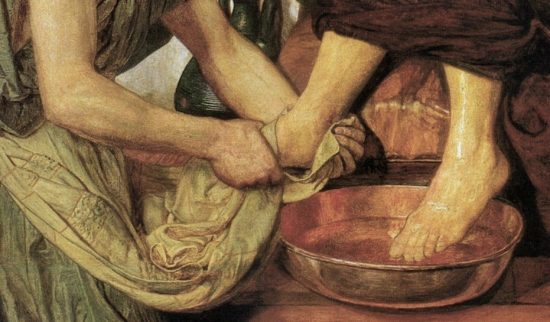
“Jesus, knowing that the Father had given all things into His hands, and that He had come from God and was going back to God, rose from supper. He laid aside His outer garments, and taking a towel, tied it around His waist. Then He poured water into a basin and began to wash the disciples’ feet and to wipe them with the towel that was wrapped around Him.” (John 13:3-5)
Jesus said some outrageous things. Like the time He looked at His closest
friends with a piercing gaze and said, “Whoever wants to be my disciple must
deny themselves and take up their cross and follow Me. For whoever wants to
save their life will lose it, but whoever loses their life for Me will find it”
(Matthew 16:24-25).
Wait a minute. Deny myself? Such
an invitation sounds bizarre, not just to our twenty-first century ears, but to
first century ears, as well. We live in a culture of self-promotion. Ours is
the era of entitlement. We look into the mirror and repeat the motto that we’ve
inherited: “You deserve the best.” Advertisements urge us to have it your way and indulge thyself. Feeling thirsty? Well then, “this Bud’s for you.” Want to look young again? No
problem, this beauty product will remind you that you are a goddess. Want to do something for yourself for a change?
It’s about time. Express yourself!
“I Love Me Some Me”
Did you know that between October 2011 and November 2017, there were 259
selfie-related deaths reported? I’m not kidding. These people died while
attempting to capture an impressive or hilarious snapshot of themselves. Many
were hit by a train. Some fell off a bridge. Even more slipped off a sheer
cliff. According to the 2018 report, men outnumbered women three to one in
selfie-related deaths.[1] To
counter this growing problem, many sightseeing locations around the world have
put up signs prohibiting selfies due to the mortal danger associated with this
risky behavior. Think of it: men and women (mostly young men) are literally
risking their lives in order to capture a one-second pose so they can post it
on social media or share it with friends!
Now, obviously, there is nothing inherently wrong with taking a picture of
oneself. However, we should reflect on how often we have acted foolishly in order to be in the spotlight. We can
laugh at former wide receiver Terrell Owens’ statement, “I love me some me,”
but I say he was just being more honest than most. Although we don’t care to
admit it, we’re all prone to narcissism.
Into this self-intoxicated world, our Lord speaks, turning our entire
outlook on life upside down. “If you try to hang on to your life, you will lose
it. But if you give up your life for my sake, you will save it” (Matthew 16:25,
NLT). To those of us who thought the movie of life is all about us, Jesus flips
the script. It’s not about self-promotion, it’s about self-denial. It’s not
about self-fulfillment, it’s about self-emptying. It’s not about making much of
yourself, it’s about giving yourself to God. That, in fact, is precisely what
Jesus did when He encoded Himself with human DNA to live, love, die, and rise
in this beautiful yet broken world. He surrendered His rights and “emptied
Himself, by taking the form of a servant, being born in the likeness of men”
(Philippians 2:7).
What would it look like if we were to follow in the footsteps of Jesus, who
chose self-denial over self-promotion or even self-preservation?
The Apostle Paul foresaw the coming days when “people will be lovers of
self” (2 Timothy 3:2). Self-love is corrosive; it turns us in upon ourselves —
something love was never intended to do. We need to let Jesus teach us that
there is a beauty to self-denial. As we empty our hearts of self-love, we make
room for receiving God’s love and, in turn, can extend that love to others.
The Servant King
Jesus is the King, but He’s a king who humbly washes the smelly feet of His
followers (John 13:3-5).
When we humans rise to positions of power and influence, it tends to go to our heads. Satisfied with our new power status, we get a bloated sense of self-importance. Like Simba from The Lion King, we “can’t wait to be king” of our own little kingdoms so that, as the cub sings, we are “free to do it all my way.” But not Jesus. Note how counterintuitively this works out in His life. “Jesus, knowing that the Father had given all things into His hands, and that He had come from God and was going back to God, rose from supper… laid aside His outer garments… poured water into a basin and began to wash the disciples’ feet” (John 13:3-5).
Whereas we often look around for servants from our position of power, Jesus took on the role of a servant from His position of power. It’s as if the elderly John is shaking his head in amazement as he recalls what took place in that upper room so many years before. He carefully observes that Jesus did the unpopular job of scrubbing calloused and dusty feet while fully aware that He was the King of the universe — “the Father had given all things into His hands” (v. 3).
Jesus the King chose the way of the humble servant. Not only did He do this to demonstrate His immeasurable love for His followers (John 13:1), but He also did this so we would have a tangible example of what true leadership looks like. “You call Me Teacher and Lord,” He told them, “and you are right, for so I am. If I then, your Lord and Teacher, have washed your feet, you also ought to wash one another’s feet” (John 13:13-14). Rather than exploiting His power to make His life more comfortable, as we are all too prone to do, Jesus used His power to serve others.
Let me guarantee something for you. You will never find a passage in the New Testament where Jesus snaps His fingers and demands that Peter bring Him the hors d’oeuvres. You will look in vain for that passage where He orders John to wash His feet or commands Andrew to pour Him a glass of the wine He’s just made. Scripture says He did not use His divine status and privileges for His own advantage. Instead, He chose the role of a servant, humbly obeying His Father “to the point of death, even death on a cross” (Philippians 2:8).
We need to remember there is great joy in serving others. Jesus endured the
agony of the cross “for the joy that was set before Him” (Hebrews 12:2). Moreover,
Jesus wanted His joy to be fulfilled in us (John 17:13). Despite all the
countless options available to Him, Jesus chose self-denial. We can still see
the effect of that choice in the countless hospitals, orphanages, homeless
shelters, schools, and clinics all over the world that His followers have built
in His name.
So, what about you? What are you clutching tightly to that might serve a
greater purpose if you gave it away? Who is the hurting person in your life?
What if God has blessed you so that you can put a smile on their face? Where is
a place you could go to embody the self-giving love of Jesus for others? You
know that task that nobody in the house or at work wants to do — what if you
chose to do it? Christ chose self-denial so that we could see the beauty of
true love and follow His example. What do you choose?





 Lamp and Light