
Perhaps one of the saddest things to witness is when one spouse says to another, “I just don’t love you anymore.” It’s especially heartbreaking because we know that at one time – perhaps many years ago – the couple shared an intimacy too deep and mysterious for words. Just being near one another would quicken the pulse. And merely hearing the other’s voice would cause the heart to flutter.
Upon hearing that such a love is now dormant, the question we all want to ask is: What happened? We know that such affection is not quickly extinguished. And in fact, when asked why they no longer love their spouse, they will usually say they have gradually, over time, simply drifted apart.
The Love You Had at First
In the last book of the Bible, Revelation, Jesus addresses the church in Ephesus, a church known for enduring persecution for Christ. Jesus had a lot of good things to say about this church. But after commending them for their faithfulness, Jesus delivers these piercing words:
“Yet I hold this against you: You have forsaken the love you had at first. Consider how far you have fallen! Repent and do the things you did at first.” (Revelation 2:4-5, ESV)
How hard it must have been for the Ephesian Christians to hear the Lord say this. “You have forsaken the love you had at first.” It wasn’t as though they’d merely “lost that loving feeling,” as The Righteous Brothers crooned in 1965. Literally, the original Greek says “You have left your first love.” In one sense, they had “drifted” out of love. But Jesus puts it even more starkly. They had actually abandoned their love for Him.
So, what exactly did that first love look like for the Ephesian Christians? From what kind of love had they fallen so far? We read about this in the book of Acts.
A Church on Fire for Jesus
When the Apostle Paul first arrived in the commercial port of Ephesus around AD 53, he went straight to the synagogue to show his fellow Jews and God-fearers from the Hebrew Scriptures that Jesus is their long-awaited Messiah. After preaching boldly there for three months, Paul’s message was roundly denounced by his own kinsmen.[1]
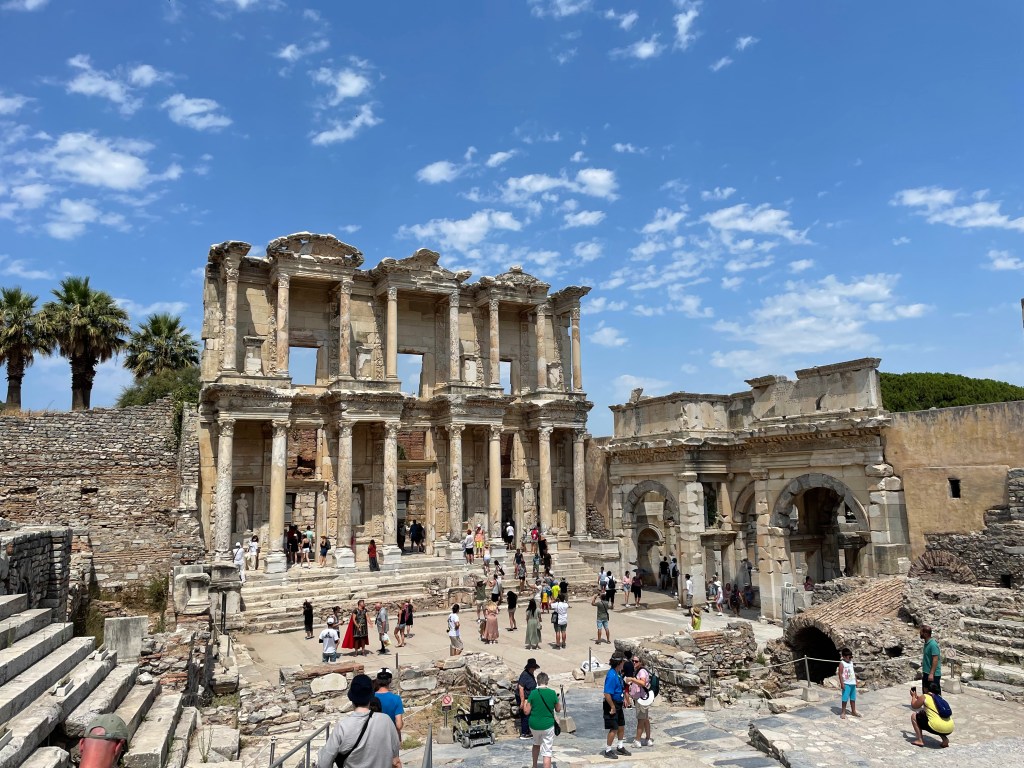
Was it the message where Paul emphasized the Messiah’s sacrificial death for sinners that led to his dismissal? Or maybe it was Paul’s clear teaching on Jesus being not merely a man but the divine Savior from Heaven that led to the Jews’ collective response of “Thanks, but no thanks.” It’s often been said that when God closes one door, He is opening another. And in that very sense, the Jewish Paul found a new opportunity to preach the gospel in a secular setting known as “the lecture hall of Tyrannus” (Acts 19:9). When I visited Turkey (called “Asia” in the Bible) recently, our guide led us to a small theater in Ephesus that is thought to perhaps be this very hall of Tyrannus.
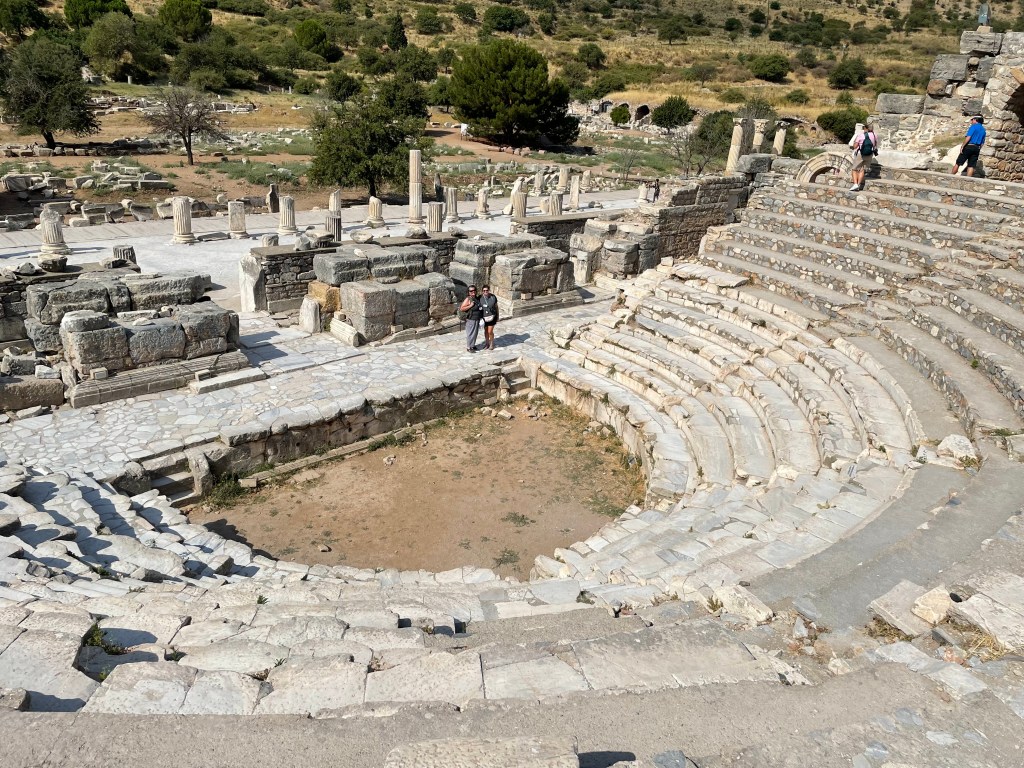
It was here that, for two solid years, the apostle’s ministry was so fruitful that the historian Luke could say that “all the Jews and Greeks who lived in the province of Asia heard the word of the Lord” and that “the name of the Lord Jesus was held in high honor” (Acts 19:10, 17).[2] In fact, many of the Ephesians who formerly practiced sorcery decided to hold an open bonfire where they burned all their incantation scrolls out of their newfound devotion to Christ. These former magicians had found something in Jesus that magic could never deliver. Eternal hope. Total forgiveness. Unconditional love. Peace with God.
These Ephesian Christians were passionately in love with Jesus.
With such a soul harvest, it’s no wonder Paul stayed there for over two years. Luke goes on to tell us something truly remarkable. So many Ephesians had turned from mute idols to the living Lord that a local silversmith named Demetrius complained to his fellow tradesmen that his idol business was tanking. Most notably, these craftsmen’s livelihood was based on selling silver shrines to the Greek goddess Artemis.

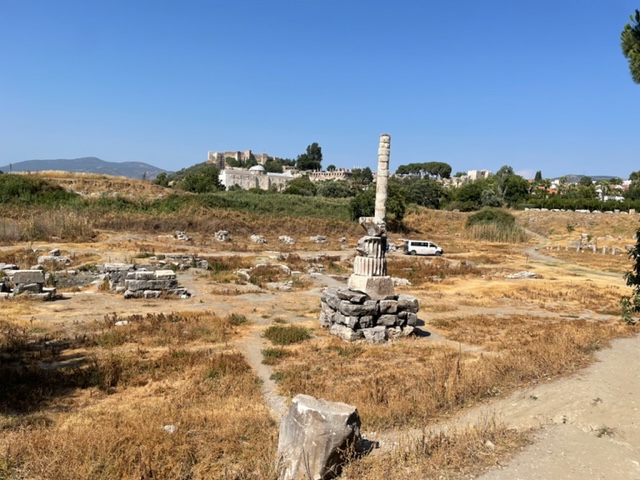

The Temple of Artemis stood proudly just outside the city center of Ephesus. Today, it is little more than a heap of rubble, but in the first century, it was one impressive spectacle – one of the Seven Wonders of the Ancient World, no less.[3] For nearly 400 years, Artemis and her temple were the Ephesians’ pride and joy, and they viewed themselves as the guardians protecting her honor.
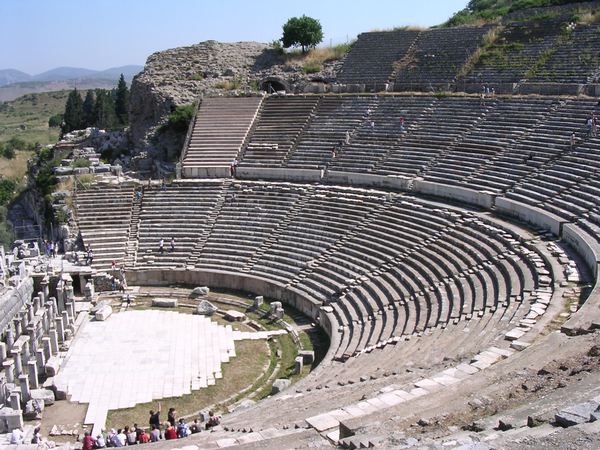
So volatile was the opposition to the gospel Paul preached that a riot broke out in the city’s massive arena (still standing today). The crowd mindlessly chanted for two hours: “Great is Artemis of the Ephesians!” Luke humorously records: “The assembly was in confusion: Some were shouting one thing, some another. Most of the people did not even know why they were there” (v. 32). So much for the wisdom of crowds.
That the message of a crucified and risen Messiah could provoke such a startling reaction in a major city like Ephesus is astounding. It signals the transforming power of the gospel. Hearts once enslaved to idolatry now burned hot for Jesus.
Reigniting Your Love for Jesus
When Jesus addressed this same Ephesian church some 40 years later, that love had grown cold. It’s worth noting that they had sound theology, were quick to spot false teachers, and lived moral lives (Revelation 2:2-3). Outwardly, this church seemed to have it all together, even in the midst of the cultural pushback they’d known since the church’s inception.
Despite all this, their love for Jesus had cooled from a glowing blaze to dying embers. This is a reminder to us that Jesus cares about more than outward performance. “For the Lord sees not as man sees: man looks on the outward appearance, but the Lord looks on the heart” (1 Samuel 16:7). While Jesus commends faithfulness, our Lord is far more concerned with our relationship with Him.
Perhaps you can relate to the Ephesian church. You’ve stayed the course in so many areas of your life. You haven’t indulged in gross immorality. You could stand up to any test of biblical orthodoxy and right beliefs. But there’s something vital missing.
The passion for Christ you once felt so keenly has slowly ebbed away. You serve faithfully in your church, but you often wonder why more aren’t like you. The joy you once had at knowing your sins were forgiven has been replaced by an undercurrent of bitterness and jealousy toward others.
I want to suggest that the way to rekindle the love you once felt so deeply for Jesus is to come back to the simple message of the cross. Jesus tells the Ephesians, “Repent and do the things you did at first. If you do not repent, I will come to you and remove your lampstand from its place” (Revelation 2:5). Repentance is not just for unbelievers. Christians need to repent, too.
Repentance is about acknowledging how you have offended the Lord and then turning to His shed blood on the cross as your only hope. Remember how just the thought of Jesus choosing to love you in spite of your great sinfulness used to ignite your love for Him? In the same way, contemplating His deep love for you will reignite your love for Him.
“This is love: not that we loved God, but that he loved us and sent his Son as an atoning sacrifice for our sins… We love because he first loved us.” (1 John 4:10, 19, NIV)
Have thoughts on this post? Feel free to comment below!
[1] See Acts 19:8-9
[2] Though not explicitly named as the author in Acts, “the beloved physician Luke” (Colossians 4:14) is widely regarded by scholars as the author of both the Gospel of Luke and the Book of Acts.
[3] When listing the Seven Wonders of the Ancient World, Antipater of Sidon had this to say about the Temple of Artemis: “I have set eyes on the wall of lofty Babylon on which is a road for chariots, and the statue of Zeus by the Alpheus, and the hanging gardens, and the colossus of the Sun, and the huge labour of the high pyramids, and the vast tomb of Mausolus; but when I saw the house of Artemis that mounted to the clouds, those other marvels lost their brilliancy, and I said, ‘Lo, apart from Olympus, the Sun never looked on aught so grand.’” Antipater, Greek Anthology IX.58.
 Lamp and Light
Pastor Jason,
Great job writing about the Ephesians and their lost love for the Lord. A good reminder for all of us to stoke the fires of our walk with Christ. It seems a responsive heart to the Word of God each day is vital (Psalm 119:9-11). Thanks for the challenge, to again repent and fully and unashamedly seek our great God fully.
Because of Jesus,
Dad
LikeLiked by 1 person
A great reminder that the many warnings in Scripture are one of God’s means of preserving His elect. We ignore them at our peril. It is sobering and heartbreaking to read Paul commending Demas and then later revealing he had fallen in love with the world. That’s Just one example of apostasy that we see in the Bible.
LikeLiked by 1 person
Great article on remembering what Jesus did on the cross for us – His love for us – to rekindle love for Him!
LikeLiked by 1 person
Jason,
I always enjoy your articles. They certainly get me thinking. This article reminds me of a quote from A.W.Tozer to battle Satan’s attempts to steer believers away from our first love. He said that “Only engrossment with God maintains perpetual spiritual fervor.”
Consider psalm 19:7-11, a small but poignant example of how to feel about God and His word. Stretch this concept across scripture and you have a grasp of what Jesus meant when He said “If you love me you will keep (obey) my commandments.” Saturated (transformed) minds through consistency in the Word is the essential and sole way to maintain and deepen one’s love for the Lord who is our only Savior.
God bless you.
Jim Sheldahl
LikeLiked by 1 person