
By Jason Smith
With great emotion, intensity in his eyes, and a distinct southern drawl, the preacher on television vividly described the scene. “Now he’s in the pit of hell… he’s down there suffering like no man has ever suffered. Death and all hell’s emissaries have piled in there on him to annihilate this one called the Son of God!”[1]
Did Jesus really go to hell to be tortured by demons between His death and resurrection? While you may not be aware of this teaching, this idea is not all that rare. In fact, there’s a line in the famous Apostles’ Creed (not to be confused with Apollo Creed, Rocky’s nemesis) that seems to support what the preacher said: “He [Jesus] descended into hell.”
So what do we make of this? The first thing to determine is whether or not this idea is taught in Scripture. As an evangelical Christian, I love church history and value much of the tradition that has been handed down to believers today. But I also equally confess the Reformation principle of sola scriptura—“Scripture alone.” This principle states that Scripture alone is my final authority on matters of faith and practice. Church tradition, while valuable and important, must submit to the authority of God’s Word.
Even so, it’s worth noting that the phrase “Descendit ad Inferna (He descended into hell)” was not included in the earliest versions of the Apostles’ Creed.[2] And it’s also worth noting that the Apostles’ Creed does not date back to the twelve Apostles themselves, despite what the name may imply.
But, as already mentioned, what really matters is whether or not the concept of Jesus descending into hell is found in the Bible.
Some have wondered if Peter’s sermon on the Day of Pentecost, recorded in the book of Acts, alludes to this event. In the King James Version, Peter quotes Psalm 16:10 as saying, “Because thou wilt not leave my soul in hell, neither wilt thou suffer thine Holy One to see corruption” (Acts 2:27, KJV).
Such a reading does seem to suggest that Jesus’s soul descended into hell prior to His resurrection. The problem here is that the KJV translates the Greek hades as “hell,” when it should be translated as “death” or “the grave.” Most biblical scholars agree that hades largely corresponds with the Hebrew sheol in the Old Testament, and sheol simply means “the grave” in Psalm 16:10. If the author had really wanted to say Jesus descended into hell before rising from the dead, he would have used the word gehenna.
The other passage[3] people often see as a reference to Jesus descending into hell is 1 Peter 3:18-20.
I find it ironic that Peter elsewhere says that his fellow Apostle Paul’s writings “contain some things that are hard to understand” (2 Peter 3:16). That’s one Christ-appointed Apostle saying of another Christ-appointed Apostle, “Sometimes what he says is a bit… confusing.” Of course, I wouldn’t argue with Peter on this point, but I could see Paul replying, “Peter, my friend, the same could be said of you at times.”
Peter writes,
For Christ also suffered once for sins, the righteous for the unrighteous, that he might bring us to God, being put to death in the flesh but made alive in the spirit, in which he went and proclaimed to the spirits in prison, because they formerly did not obey, when God's patience waited in the days of Noah, while the ark was being prepared, in which a few, that is, eight persons, were brought safely through water. (1 Peter 3:18-20, ESV)
What’s going on here? When Peter talks about Jesus “being put to death in the flesh but made alive in the spirit,” I take that to be a reference to Christ’s death and resurrection. Peter seems to be saying that Jesus rose from the dead in the power of the Holy Spirit, a common way for Scripture to refer to the resurrection.[4] [5]
But then comes the tricky phrase: “… in the spirit, in which he went and proclaimed to the spirits in prison, because they formerly did not obey, when God’s patience waited in the days of Noah…” Let’s be real. On first reading, this is a confusing statement. The idea seems to be that just as Jesus was raised in the power of the Holy Spirit, He also went in the power of the Spirit to proclaim His victory to disobedient spirits who have been imprisoned since the days of Noah. Some have interpreted the “spirits” here to be human, but I believe there’s good reason to see these as demonic spirits.[6] But this certainly raises some questions. Like, for instance, why did Jesus feel the need to do this? And why did this event involve these specific demons, which were somehow linked to the flood of Noah?
Here’s what I think is happening. Peter is speaking to a beleaguered group of Christians who have been facing suffering and being maligned for their faith in Christ.[7] He wants to encourage them. And what better way to do it than to remind them of Christ’s total victory over the spiritual forces of darkness. When Jesus declares victory, it’s meant to embolden us to share this gospel of Christ’s victory with others (see 1 Peter 3:15).
But why did Jesus proclaim His victory to these specific demons? This leads us to yet another strange account found in Genesis 6:1-4, which speaks of “the sons of God” having sexual relations with “the daughters of man” and producing offspring known as the Nephilim. That last sentence opens a massive can of worms, but I actually think there’s good biblical precedent for this view.
In almost every instance, “sons of God” means angels in the Old Testament.[8] So these were likely rebellious angels (or demons) that somehow took possession of human male bodies to procreate with human women. Yes, this sounds bizarre, but I think this same event is alluded to elsewhere in the New Testament.
In Peter’s second letter, he writes:
“For if God did not spare angels when they sinned, but cast them into hell (tartarus) and committed them to chains of gloomy darkness to be kept until the judgment; if he did not spare the ancient world, but preserved Noah, a herald of righteousness, with seven others, when he brought a flood upon the world of the ungodly...” (2 Peter 2:4-5, ESV)
Similarly, Jude 6 says:
“And the angels who did not keep their positions of authority but abandoned their proper dwelling—these he has kept in darkness, bound with everlasting chains for judgment on the great Day.” (Jude 6, ESV)
So what does all this mean? These imprisoned demons seem to be the archetype of how God will judge those who side with Satan. Therefore, Peter is saying something like this: “Although satanic forces in the world may persecute you now, God calls you to endure this suffering for Christ, because He has already won the war against them through the cross and resurrection.”
This fits with what Peter says next in verse 22, which says that Jesus “has gone into heaven and is at the right hand of God, with angels, authorities, and powers having been subjected to him” (1 Peter 3:22).
It does appear that Jesus descended to hell (or what Peter calls “Tartarus”) after His resurrection, but not to suffer. He went to declare His total victory over the demons already imprisoned there. However, I’m not a fan of including the phrase “He descended into hell” in the Creed, because it is not treated as a central gospel theme in Scripture. The Bible must always trump tradition.
We know that Christ did not suffer in hell after His death, because Jesus already endured hell when He suffered the punishment for sin on the cross. And it wasn’t demons torturing Jesus (a common misunderstanding of what hell is all about), but the wrath of a holy God that was being poured out on Him. That is why Jesus cried out, “My God, My God, why have You forsaken Me?” (Matthew 27:46)[9]
The Bible says that Jesus’s sacrifice for sins was made “once for all.”[10] And when His atoning work on the cross was complete, Jesus cried out, “It is finished!” The Greek term is tetelestai, which can be translated “paid in full.” Thus, there was no more suffering needed after Jesus bled and died on the cross. The mission was complete and the debt for sin was fully paid.
Some have suggested that Jesus declared His victory in hell while His body was in the tomb. That could be, but Jesus’s own words seem to suggest otherwise. He told the repentant thief on the cross, “Truly I tell you, today you will be with me in paradise” (Luke 23:43, NIV). He also cried out, “Father, into your hands I commit my spirit” (v. 46). This seems to clearly teach that in between the cross and resurrection, Jesus went into the Father’s presence.
Could he have then spoken to the imprisoned spirits immediately after that, prior to the resurrection? It’s possible, but Peter seems to be saying that Jesus was first made alive in the power of the Spirit (see 1 Peter 3:18-19).[11] And wouldn’t it make sense to declare His total victory after overcoming the grave?
All that to say, 1 Peter 3:18-20, though at first confusing, is meant to encourage followers of Christ today. Why? Because though we may be wearied by the world, we can remember that we follow a King who has already won the victory over sin, death, and the devil.
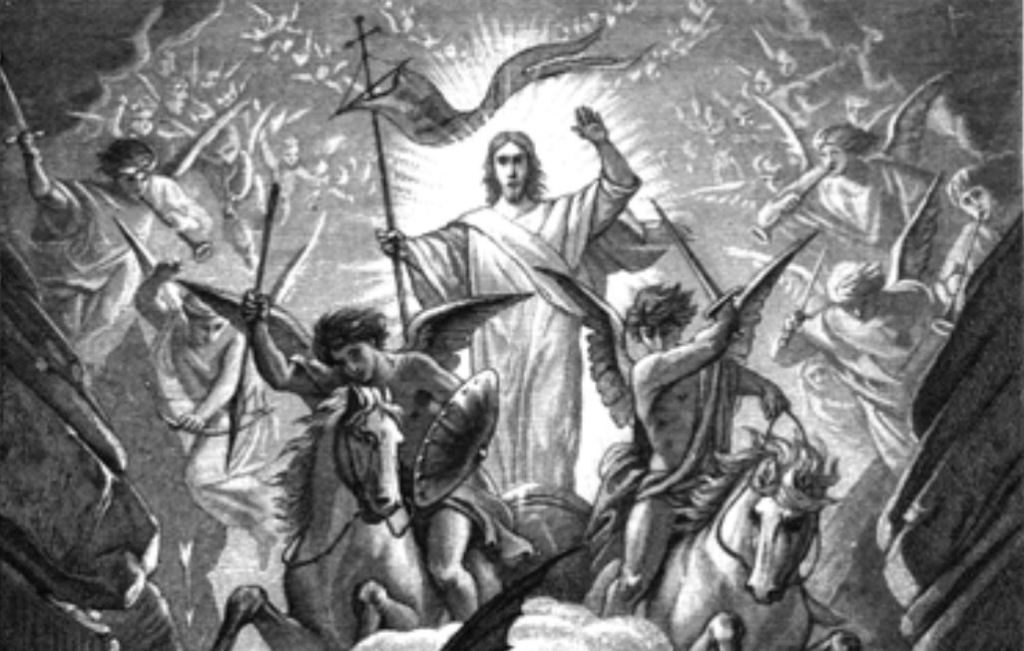
When Christ to Hell is seen to come.
She snarls with rage, but needs must cower
Before our mighty Hero’s power;
He signs—and Hell is straightway dumb.
Before His voice the thunders break,
On high His victor-banner blows;
E’en angels at His fury quake,
When Christ to the dread judgment goes.[12]
[1] The preacher was Kenneth Copeland.
[2] Wayne Grudem, Systematic Theology, Second Edition, 725-727.
[3] Some have also seen Romans 10:6-7 and Ephesians 4:8-9 as references to Christ descending into hell, but that’s a misreading of the text. In Romans 10:6-7, Paul makes the point that Christ is immediately available by faith, that you don’t need to descend into the abyss (probably a reference to the deepest ocean) to find Him. Ephesians 4:8-9 is simply saying that in the incarnation, Jesus descended to “lower regions” of the earth, as opposed to higher regions of Heaven, from which He came.
[4] Romans 1:4, 8:11; 1 Timothy 3:16.
[5] Some have taken the phrase “made alive in the spirit” to mean Jesus was spiritually enlivened while His body was in the grave. But does it really make sense to say the eternal Son of God needed to be “made alive” spiritually? The Greek doesn’t capitalize words for us, so we have to consider the context to determine whether or not the Holy Spirit is being referred to here. That phrase “in the Spirit,” is often used of the Holy Spirit in the New Testament. Also, the weakness of the flesh (sarx) is often contrasted with the power of the Holy Spirit (pneuma).
[6] In almost every case in the New Testament, “spirit” (pneuma) in the plural refers to angels/demons, not humans. However, you never have a case of “spirits” referring to humans without some qualifying description making it clear that humans are in view.
[7] This idea of suffering for Christ’s sake permeates the whole letter, from beginning to end. See 1 Peter 1:6-7; 2:19-25; 3:9-17; 4:1-2, 12-19; 5:10.
[8] See Job 1:6, 2:1, 38:7; Psalm 29:1, 89:6
[9] Other references to Jesus bearing the wrath of God include Romans 3:25, 1 John 2:2, 4:10, and Hebrews 2:17, where “propitiation” means “wrath-bearing substitute.”
[10] See Hebrews 9:26, 28, 10:10-14; 1 Peter 3:18
[11] The NIV even says, “After being made alive, he went and made proclamation to the imprisoned spirits…” (1 Peter 3:19).
[12] Johann Wolfgang von Goethe, “Thoughts on Jesus Christ’s Descent into Hell,” Goethe’s Works, illustrated by the best German artists, 5 vols. (Philadelphia: G. Barrie, 1885). Vol. 1.
 Lamp and Light
Good, as usual!
I agree that we shouldn’t shy away from passages that may seem strange to us.
LikeLike