
At the end of Jim Carrey’s How the Grinch Stole Christmas, the Grinch recognizes that despite taking all the presents of Whoville, he hadn’t truly stopped Christmas from coming. The film is a ridiculous comedy, but I’m always touched as it slowly dawns on old Grinchy: “Maybe Christmas doesn’t come from a store. Maybe Christmas perhaps means a little bit more.”
As I read the New Testament, I might add my own line: “Maybe Christmas isn’t just myth and lore. Maybe Jesus came for the spiritually poor.”
“God with Us”
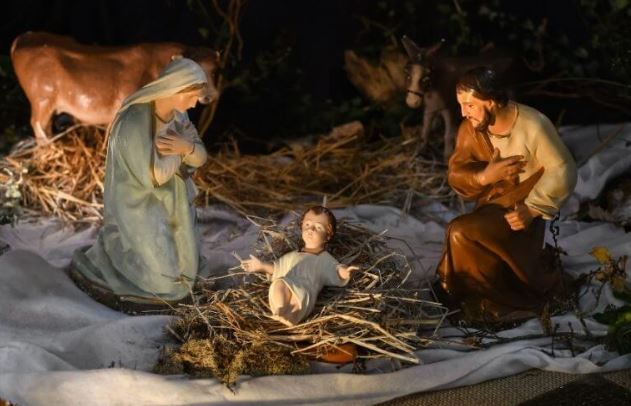
To grasp the true meaning of Christmas, we cannot miss the uniqueness of that baby in the manger. All our wonderful Christmas traditions are for naught if we fail to see that Jesus Christ really is God come in the flesh.
“Behold, the virgin shall conceive and bear a son, and they shall call his name Immanuel.” (Isaiah 7:14)
Immanuel. What a necessary word for every age, including ours. Immanuel means “God with us” (Matthew 1:23). We’ll never outgrow our need to hear this word and peer deeper into its meaning. It captures the heart of Christmas.
The gods of the pagans would sometimes meddle in the affairs of men, but they were always up and out there, aloof and distant from the cares of this world. The New Testament sharply differs from every other faith and tradition by boldly declaring that the transcendent God has become one of us in Jesus Christ. Every other human being who has walked the planet emerged from history, but Jesus is totally unique. Jesus entered into history.
The true light, which gives light to everyone, was coming into the world. (John 1:9, ESV)
Not only so, but the Incarnation was permanent. Jesus chose to forever become one of us—to literally be “God with us.” This theme of Immanuel bookends Matthew’s Gospel. After His final commission to His disciples, Jesus says, “And behold, I am with you always, to the end of the age.”
This is how loving God is: He looked at the human race and saw what a mess we had made of things in our rebellion against Him. And what did He do? Did He decide to move on to something bigger and better—like humanity 2.0? No! In fact, before the foundation of the world Christ had already decided to go down into this sin-stained world and be subject to all the human frailties and struggles that we experience each day (Ephesians 1:4; 1 Peter 1:20). No longer did God merely send prophets to herald His message—He Himself has entered the very world He created.
How can we fathom the profound depths of Immanuel? In terms of magnitude, this could be compared to you stooping so low as to become a grasshopper (see Isaiah 40:22). We are talking about the God who created every last one of the trillions of stars and galaxies. Nothing happens outside His sovereign power! And yet, this same God willingly subjected Himself to all the limitations that we humans face. He got tired, hungry, and thirsty. Jesus wasn’t like Clark Kent, invincible superhero only pretending to be mortal man. Nor was He born with a halo around His head, like we might see on Christmas cards. No, He came out as a crying baby that needed to be fed and changed and nurtured just like every one of us.
Peering Deeper Still
If we really understood the heights of glory from which Jesus came, we would not be unmoved by Christmas. Jesus chose to identify with us, the very ones who have sinned against Him.
“For we do not have a high priest who is unable to empathize with our weaknesses, but we have one who has been tempted in every way, just as we are—yet he did not sin.” (Hebrews 4:15, NLT)
“Since he himself has gone through suffering and testing, he is able to help us when we are being tested.” (Hebrews 2:18, NLT)
Do you see what this means? Jesus knows firsthand what it’s like to suffer as we do, physically, emotionally, and mentally. He knows what it means to be lonely, rejected, and even despised by others (Isaiah 53:3).
Agnostic Bart Ehrman writes, “I came to think that there is not a God who is actively involved with this world of pain and misery—if he is, why doesn’t he do something about it?”[1] But what if God did do something about it? What if God got so involved with this world of pain and misery that He Himself experienced suffering and death in order to one day bring about full redemption of His people and His world?
I’m with John Stott:
“I could never myself believe in God, if it were not for the cross… In the real world of pain, how could one worship a God who was immune to it? I have entered many Buddhist temples in different Asian countries and stood respectfully before the statue of Buddha, his legs crossed, arms folded, eyes closed, the ghost of a smile playing round his mouth, a remote look on his face, detached from the agonies of the world. But each time after a while I have to turn away. And in imagination I have turned instead to that lonely, twisted, tortured figure on the cross, nails through hands and feet, back lacerated, limbs wrenched, brow bleeding from thorn-pricks, mouth dry and intolerably thirsty, plunged in Godforsaken darkness. That is the God for me! He laid aside his immunity to pain. He entered our world of flesh and blood, tears and death. He suffered for us. Our suffering becomes more manageable in light of his.”[2]
In becoming a man, Jesus linked arms with us who have descended from Adam and said, “I’m with them. I know they’re sinners. I know they’ve rebelled against Me. I know they’ve spat in My face. But I choose to identify with them!” God chose to send Jesus not to destroy the human race, but to redeem all who would ever trust in His sacrifice on Calvary.
Some things lose their hold on me after I have given them enough thought. But the more I ponder the Incarnation, the more it blows my mind. But even then I realize that I’m so finite and God is so infinite that I simply cannot hold the wonder of it all in my mind. All I can do is stand back in awe and be thankful that God did not abandon us. He chose to “save His people from their sins” (Matthew 1:21). He chose to become one of us. To be “God with us.”
High and Holy, with the Lowly
Consider what God said of Himself in Isaiah 57:15: “For thus says the One who is high and lifted up, who inhabits eternity, whose name is Holy: ‘I dwell in the high and holy place, and also with him who is of a contrite and lowly spirit, to revive the spirit of the lowly, and to revive the heart of the contrite.’”
Do you see what God is saying here? In His nature, He is completely unlike us! He is majestic, glorious, and holy. We are finite, small, and sinful. There is a Grand Canyon of difference between God and us. And yet, God is saying that though He is holy and far above us, in His grace, He chooses to dwell with those who are humble, contrite, and lowly. This is the incredible grace of God that we find in the gospel. We don’t work our way up to God. What could be more impossible? Instead, He comes down to dwell with us and rescue us from our sin.
“Blessed are the poor in spirit,” Jesus said, “for theirs is the kingdom of heaven” (Matthew 5:3, NIV).
A while back, I heard a pastor sharing about a time when he was talking with a Hindu leader, and they were trying to understand one another’s beliefs. Finally, the Christian pastor said, “Let me see if I understand what you believe. You believe something like this: God is on the top of a vast and tall mountain. And all the religions of the world are climbing this mountain, and their journey is different because they are climbing different faces of the mountain, but they all end up in the same place.”
The Hindu priest’s eyes widened and he said, “Finally, you understand what we believe.” Then the Christian pastor said, “Well, this is where our beliefs are fundamentally different. As a Christian, I believe that though men have tried to scale this mountain to God, none can ever do it. Because we are all carrying too great a weight—that’s our sin. But see, in the Gospel, we learn that this God atop this mountain has descended to us. He didn’t wait for us to try and struggle to come to Him. He knew we would never make it. Instead, He came down to us in order to take our great burden upon Himself on the cross at Calvary.”
This is the wonder of Immanuel. Jesus came not only to suffer with us, but to suffer for us, in our place. May we never stop peering at the meaning of Christmas.
He made the One who did not know sin to be sin for us, so that we might become the righteousness of God in Him. (2 Corinthians 5:21, HCSB)
Have thoughts on this post? Feel free to comment below!
[1] Bart Ehrman, God’s Problem (New York: HarperOne, 2009), 128.
[2] John R. W. Stott, The Cross of Christ (Downers Grove, IL: InterVarsity, 1986), 335-36.
 Lamp and Light