God, the Bible, and Miracles: For My Skeptical Friends

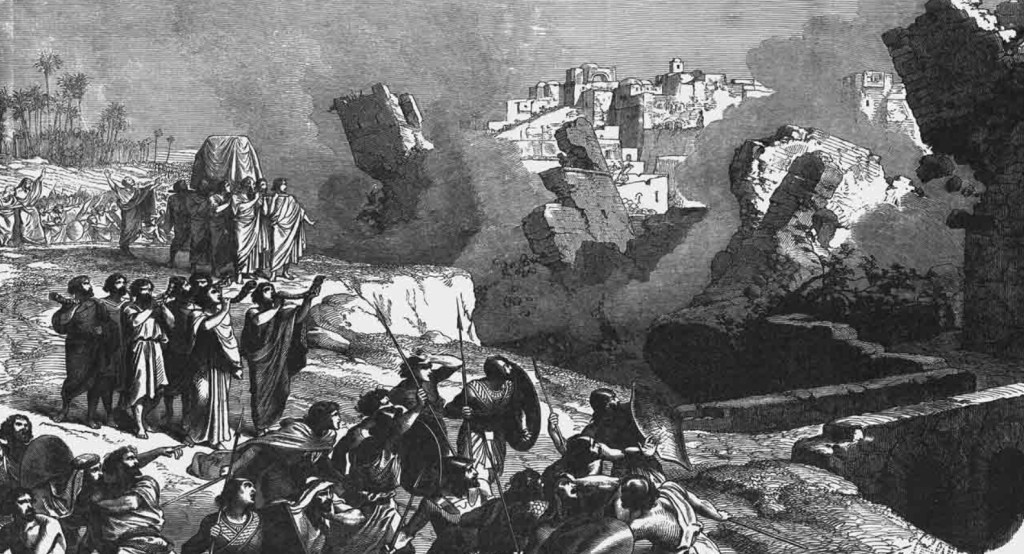
In the last couple months, I have been preaching from the Book of Joshua. Joshua is a book full of epic battles and miraculous events. Ultimately, it’s a book about the character and nature of God. It’s named after Israel’s military leader, Captain Joshua, but Yahweh is the true Hero who drives the story forward. And His majesty and power is what should captivate us.

In Joshua, we learn that Yahweh is a God who does not tolerate injustice and is unshakably committed to His word. His promises are rock solid and worthy of building your life upon. He is a God who demands our total allegiance, but He also is a God that is full of grace toward those who have failed Him countless times. He can destroy an entire army with a single blow, but He is also a God who notices and takes thought of individuals who are fearful, lost, and hurting. Yahweh, the God of Joshua, invites us to share in His victory over evil.

“Have I not commanded you?” God says to Joshua. “Be strong and courageous. Do not be afraid; do not be discouraged, for the Lord your God will be with you wherever you go” (Joshua 1:9, NIV).

One takeaway from studying Joshua is that you need to have a big view of God. A small god lacks the power to rescue you from your biggest fears. A small god has no ability to give you hope and meaning in life. But a big God–the God of Joshua–can save. He has the power to help you overcome all your fears, insecurities, and doubts. He is the God who walks with you in your pain. A small and shallow god abandons you when things get rough. But the awesome God of the Bible has a love for you that is deeper than the ocean, and He will not abandon you.

As you walk through Joshua, you get the most vivid and soul-stirring picture of God fighting for His people and granting them an inheritance in the Bible until we come to Jesus. Before the cross and resurrection, the walls of Jericho came down. Before Jesus promised us a kingdom, God promised Joshua the land of Canaan.

Can Modern People Believe in the Miraculous?

Critical scholars stumble in many places in the Book of Joshua. They say that it’s a myth, that it’s unhistorical, that the incredible events recorded could not happen. Why? Because there are some pretty astounding miracles in Joshua. When was the last time you saw the sun stand still in the sky all day? And if you know anything about our culture, you know there is an antisupernatural bias–especially in academia. 

While a student in college, I had a conversation with a girl who had adopted this skeptical worldview. When I asked her why she didn’t accept that the miracles in the Bible were possible, she told me, “People in ancient times used to dream up these amazing stories of gods and miracles because they lacked any real understanding of the world. They attributed things like hurricanes and lightning to the gods, simply because they didn’t know anything of science.” That narrative is pretty firmly ingrained at a secular university.

I responded that the God of the Bible is not just one god among many. He’s not just responsible for the rain or the wind. He is the God over all of nature. He authored all of it. The whole universe lies in the palm of His hand. The mythical gods were all so humanlike. They warred against each other, lusted after women, and behaved like bigger, grumpier versions of us. But Yahweh–the God of the Bible–is in a category of His own. Perhaps her real issue wasn’t that she didn’t believe in miracles. Maybe she just had too small a god in mind.

What many often forget is how much evidence there is for one great and infinite Creator God. For example, we all enter this world preprogrammed to believe that there is an objective standard of justice to which we are all beholden. Even at the age of three, my boys were saying things like, “That’s not fair!” Why, if we’re just animals with instincts, do we all seem compelled to follow this higher moral order? It only makes sense if there is a moral Lawgiver to whom we’re all accountable. It’s easy to explain away the mythical pantheon of gods from ancient cultures, but what you can’t so easily explain away is the one eternal Creator God of the Bible–the reason nature exists in the first place.

If you struggle to believe in miracles, ask yourself, Is it possible that there is a God who created everything? Does the world look more like the product of design or unguided chaos? Does it seem like we are here without rhyme or reason, or does it seem like we were made for more than a mere 80 to 90 years, then nothing? If God is the reason for our existence, what would prevent Him from performing miracles in the world He created, especially if He had a special, redemptive purpose to overcome human evil?

How Big Is Your View of God?

If you are willing to accept the first statement of the Bible: “In the beginning, God created the heavens and the earth,” there’s no reason not to accept that miracles are possible. And suddenly the book of Joshua doesn’t seem so far-fetched. There are about 120 miracles recorded in the Bible, and I believe they really happened. But here’s what you need to know: the miracles of the Bible are always recorded in a sober, restrained way. They are given in the context of actual historical and factual accounts. They aren’t like Aesop’s Fables or Homer’s Odyssey. The Bible was written as history. And if you have a big view of God, you can accept the reality of miracles.

Furthermore, the best part is that you can actually know this God through committing your life to His uniquely divine Son, Jesus Christ. Despite what you may believe, God is not only real, He loves you and has made Himself available to you. But are you willing to open your heart and life to Him? When your life has been transformed by the God of the Bible, miracles aren’t so hard to believe. 

After one alcoholic became a follower of Jesus, a skeptical friend asked him how he could possibly believe all the nonsense in the Bible about miracles. “You don’t believe that Jesus changed the water into wine do you?” The former alcoholic replied, “I sure do, because in our house Jesus changed the whiskey into furniture.” 

The question is: Just how big is your view of God? You know you have a big view of God when reading sober and historical accounts of miracles doesn’t bother you. It encourages you!

If you have thoughts on this post, I would love to hear from you.

Praying Like Elijah

“For truly I tell you, if you have faith the size of a mustard seed, you will tell this mountain, ‘Move from here to there,’ and it will move. Nothing will be impossible for you.” (Matthew 17:20, CSB)

Prayer is powerful. I don’t say that to be cliché; I say that because Jesus taught us this. Time and time again, He called us to pray boldly and passionately in His Name.

I also cannot deny the ways my wife Whitney and I have been wowed by God’s grace and perfect timing in answering our prayers in incredibly specific ways. There are too many to count but let me just give a few examples.

Before we met, my wife Whitney prayed for the wisdom to find the right man to marry and that this fellow would arrive at her church’s college group with several others so that she wouldn’t know immediately who that man would be. A short time later, I visited that college group with a handful of others, because I was invited by the pastor who led that group while I was working at Applebee’s. The rest, as they say, is history.

Another time, I was in a Bible study, and one man shared that his very young grandson had a brain tumor the size of a golf ball. For several weeks in a row, we prayed for healing each time we met. One morning, he came to our study with amazing news. The tumor had not only shrunk—it was completely gone. Not a trace of it. In fact, I know of numerous cases where someone plagued with life-threatening cancer has been totally healed. Just yesterday, I heard of another answer to prayer of a dear woman who received the glorious news that the latest scan revealed she is cancer free.

I can think of another time when Whitney and I were raising money for a short-term mission trip to Guatemala, and we were a little short on the green stuff. We prayed passionately and specifically that God would supply the money we needed for the trip in whatever way He saw fit. He came through in various ways to provide us with exactly what we needed. I remember my heart swelling with joy as I thought about how God had so lovingly answered our sincere requests so that we could go on this mission trip together as a young married couple before we had any kids.

These are just the tip of the iceberg. I really could go on and on with examples of how God has provided answers to prayers—often in ways we never saw coming.

As these come to mind, I sometimes wonder why I don’t pray more often or more passionately. It’s not as though God has ignored me in the past. Lately, He’s been really challenging me to lead from deep, heartfelt prayer, as opposed to only praying with passion when something goes wrong. The Lord wants me to admit my shortcomings and acknowledge my great need for His power in every aspect of my life.

Jonathan Edwards said that when we ignore prayer, we “live like atheists or like brute creatures,” and “live as if there were no God.” Why would we ignore our direct line to the One who reigns over all?

If anything is worth doing, it must come by God’s power, not my own strength. Therefore, I need to be drawing power from the Lord in everything I do if I want to have an eternal impact. The Bible reminds us, “The prayer of a righteous person has great power as it is working” (James 5:16, ESV). Our prayers have “great power” because they are directed to a God who is known for doing what is humanly impossible (Luke 1:37).

I’m reminded of the story of Elijah. He prayed fervently for God to send the rain when Israel was enduring a drought while the wicked King Ahab was on the throne. In 1 Kings 18, we read:

And Elijah went up to the top of Mount Carmel. And he bowed himself down on the earth and put his face between his knees. And he said to his servant, “Go up now, look toward the sea.” And he went up and looked and said, “There is nothing.” And he said, “Go again,” seven times. And at the seventh time he said, “Behold, a little cloud like a man's hand is rising from the sea.” And he said, “Go up, say to Ahab, ‘Prepare your chariot and go down, lest the rain stop you.’” (1 Kings 18:42-44, ESV)

Elijah didn’t just pray once, see there was nothing, and then give up. No, the text emphasizes how he prayed fervently seven more times for the rainclouds to show up. He understood that God wants us to pray with passion, expectancy, and repetition. At the very first tiny sign that God had answered his prayers (after all, a hand-sized cloud seems like a bit of a letdown), Elijah confidently sent word to Ahab, “Get in your buggy and go, because the rain is a-comin’!” God answered his prayers in such a way that no one in Israel could chalk up the sudden change in weather to mere happenstance.

Imagine an Israelite saying, “Finally! We’re getting rain after three-and-a-half years. How lucky are we!”

Elijah’s prayers made the difference.

Through this prophet’s prayers, God turned the rain off and then back on 42 months later, raised a widow’s son to life, and shot down fire to engulf a thrice-soaked altar to vindicate Elijah’s claims about Yahweh, not Baal, being the one true God of the world. Clearly, we’re meant to see that Elijah’s prayers were powerful. God can change the weather conditions whenever and however He wants. He’s sovereign over this world. But, as in our lives, He chose to change the circumstances in response to the prayer of one of His faithful followers.

When we read about Elijah’s ministry, we are rightly in awe of how the Lord worked through him. However, before we lionize Elijah as a biblical superhero and assume we could never pray like him or see God work wonders before our eyes, we should consider what James says about this.

“Elijah was a man with a nature like ours, and he prayed fervently that it might not rain, and for three years and six months it did not rain on the earth. Then he prayed again, and heaven gave rain, and the earth bore its fruit.” (James 5:17-18, ESV)

James is reminding us that the situation is not so different for us today. At the end of the day, Elijah was just a man; he had a nature like ours. And God Himself hasn’t changed, because He never changes (Malachi 3:6). If Elijah prayed to the same God we pray to today, why should we expect our prayers to be less effective? The whole reason James brings up Elijah as an example is to say, “You too can pray with power.”

So go to the Lord today and pray with passion, boldness, and expectancy like Elijah did. There is no telling what massive changes God will bring about through your prayers. After all, “Elijah was a man with a nature like ours.”

I pray this encourages you. If you have any thoughts or questions about this, I would love to hear from you!

Peace-Loving Wisdom in a World Gone Mad

And a harvest of righteousness is sown in peace by those who make peace.” (James 3:18, ESV)

Our world is full of conflict. Employees look for ways to snub the competition. Politicians launch accusations and bitter invectives against one another. Nations launch missiles and shoot bullets at one another. Spouses tear each other down.

Just this morning I read a news article about a man who was arrested for shooting and killing his neighbor’s son for standing on his property while trimming a tree along the property line. The shooter’s wife said he only meant to scare the younger man. According to the reporter, this was the first altercation between these two men. Think of that. Probably, neither woke up that morning imagining this would transpire. How quickly tempers can flare and change the trajectory of life.

Rejecting God, Embracing Chaos

The Bible says that those who receive divine wisdom will have peace in their hearts and will pursue peace in the world. But to reject God’s wisdom and seek your own way leads to chaos.

“For where jealousy and selfish ambition exist, there will be disorder and every vile practice.” (James 3:16, ESV)

Disorder is a word that describes the world today. Violence and crime are pervasive. Mental illnesses are on the rise. Suicides have skyrocketed, particularly among young people. In fact, the suicide rate for the age range of 10-24 increased 52.2% from 2000 to 2021. Confusion over gender, sexuality, and marriage dominates our culture. Irreversible damage is being done to perfectly healthy bodies in the name of gender affirmation and tolerance. All of this proves the truth of rejecting divine wisdom: it leads to disorder and every vile practice.  

This is not the wisdom that comes down from above, but is earthly, unspiritual, demonic.(James 3:15, ESV)

This is not merely an accumulation of bad human ideas. It is devoid of the Spirit of truth; it is “demonic.” This is essential to understand. When you read about a 52-year-old man who abandons his wife and seven kids so he can live as a six-year-old girl with an adoptive “mommy” and “daddy,” that’s not just looney—that’s demonic.[1]

What can be done about all this disorder and confusion? Why is peace so unattainable in our time?

I agree with Billy Graham: “You will never know the peace with God, peace of conscience, peace of mind, and peace of soul until you stand at the foot of the cross and identify yourself with Christ by faith . . . this is peace with God.”[2]

Wherever the wisdom of God is rejected “there will be disorder and every vile practice” (James 3:16). The word for “disorder” was used to describe a gambler who was swindled out of everything he owned and turned into a raging maniac. Paul uses the same word in 1 Corinthians 14:33, when he says, “God is not the author of confusion, but of peace, as in all churches of the saints” (KJV).

Madness. Confusion. Anger. When people choose the world’s wisdom over God’s wisdom, they end up spending their lives in futility and frustration. They continue to fool themselves into believing they know better than God, but the trail of misery behind them tells a different story.

The Purity of Heavenly Wisdom

After warning us about where worldly wisdom leads, the Bible tells about the purity of heavenly wisdom.

But the wisdom that comes from heaven is first of all pure; then peace-loving, considerate, submissive, full of mercy and good fruit, impartial and sincere. Peacemakers who sow in peace reap a harvest of righteousness.” (James 3:17-18, NIV)

When James writes about “the wisdom that comes from heaven” in v. 17, he uses the present participle for “comes.” In other words, it’s not as though heavenly wisdom comes to us in one big moment, where we just download God’s wisdom on to our hard drive and we never have to look for it again. It’s more like a continually flowing spring that is always available to us, but is something we must continually seek.

“How much better to get wisdom than gold! To get understanding is to be chosen rather than silver.” (Proverbs 16:16, ESV)

Seeking God’s wisdom is an endeavor that lasts a lifetime. We must continually come back to Him, seeking God’s wisdom for our life on a daily basis. And this is a beautiful reminder. The well of God’s wisdom will never run dry; there is always room to learn and grow.

What does heavenly wisdom look like? It is “peace-loving, considerate, submissive, full of mercy and good fruit” (James 3:17). When the Christian’s life pursuit is no longer merely personal success but the glory of God, a supernatural power ignites. The Holy Spirit fills us with a passion for godliness, sinners repent of hidden sin, and believers begin to unite around a common goal that transcends each of them individually.

One film that powerfully captures this idea of unity around a common goal is Remember the Titans. The story is about a newly integrated high school in Virginia during the Civil Rights era. Initially, the coaches and players begin to divide and oppose one another because of their different skin color. But then Coach Herman Boone, played by Denzel Washington, takes the team on an early morning run to Gettysburg.

He points to all the graves marking where both Union and Confederate troops have died. Then Coach Boone says, “If we don’t come together, right now, on this hallowed ground, we too will be destroyed—just like they were. I don’t care if you like each other or not. But you will respect each other.”

“That They May Be One”

Unity is something that is hard won. But there is a difference between unity and union. Just because people are together in the same space doesn’t mean there is unity. There may be union, but not necessarily unity. For example, if you were to tie two cats together by their tails and throw them over a clothesline, you’d have union, but you would most certainly not have unity.

One of the devil’s most ambitious goals is to sow discord among Christians so that the church of Jesus Christ would self-destruct from the inside. He is relentless in this pursuit. He will not rest while the church remains united. Remember, Jesus prayed that His Church would be one, even as He and His Father are one (John 17:11). Thus, the devil is always looking for ways to tear apart followers of Jesus.

True unity is something that can only be achieved by a church that makes the glory of God the foremost pursuit and the highest treasure. It is only when we set aside our own personal and self-centered goals and make God’s glory our goal that we will see genuine growth and change in our hearts. This is what the Bible calls “the unity of the Spirit in the bond of peace” (Ephesians 5:3).

And when James uses words like “peace-loving, considerate and submissive,” he’s saying that heavenly wisdom teaches us to yield to others, to put the needs and interests of others before our own, for the sake of unity. And the result for those who sow peace is a harvest of righteousness (v. 18).

The wicked, on the other hand, are never at peace. They are always bothered, agitated, ready to jump into another fight.

But the wicked are like the troubled sea, when it cannot rest, whose waters cast up mire and dirt. ‘There is no peace,’ says my God, ‘for the wicked.’” (Isaiah 57:20-21, NIV)

But when the Prince of Peace is on the throne of your heart it will be evident to others. You will have a sweet reasonableness about you. You will be approachable, allow for discussion, and open to hear others out. You won’t let pride cause you to fume when things don’t go your way. You’ll recognize that the righteous man is a man of peace.

The peace that Jesus Christ gives us is like a lighthouse. There may be a storm raging, with waves crashing against us, but inside there is a sweet quietness. Children can still run around and have fun. Parents can feel at ease. And all the while, no matter how bad the weather gets on the outside, that inner light continues to shine forth so that others can recognize you belong to Jesus.

Countless people throughout the last 2,000 years have discovered for themselves what I’m describing. When you have Christ in your life, that makes all the difference. To the point that you wonder, “How did I ever face anything without Him?” “You will keep him in perfect peace, whose mind is stayed on You, because he trusts in You” (Isaiah 26:3, NASB).

Velvet Steel

Note again these qualities. Heavenly wisdom is “peace-loving, considerate, submissive, full of mercy and good fruit, impartial and sincere” (James 3:17). The word translated “considerate” can also be translated “gentle.” It carries the idea of being approachable and thoughtful in how you relate to others.

The Lincoln biographer Carl Sandburg described Abraham Lincoln as “velvet steel.” He said Lincoln had the remarkable ability to show steely courage and determination in leadership coupled with a notable gentleness and tenderness in the way he dealt with people. Lincoln tried his best to never tear someone down or humiliate others, but he knew the importance of taking a rock-solid stand against dividing the nation and against slavery.

This is what the follower of Jesus is to be like: velvet steel. Look at what Paul says about this:

And the Lord’s servant must not be quarrelsome but must be kind to everyone, able to teach, not resentful. Opponents must be gently instructed, in the hope that God will grant them repentance leading them to a knowledge of the truth, and that they will come to their senses and escape from the trap of the devil, who has taken them captive to do his will.” (2 Timothy 2:24-26)

Do you see the velvet steel? Christians are to take a rock-solid stand on the truth of God’s Word. We are to hold fast unashamedly to Jesus our Savior and call sin by its name.

But we are also not to be quarrelsome, not looking for a fight. Instead, we are to speak with all gentleness and humility because we recognize that if our opponents are in the wrong, God is the One who can change their heart, not us. So, there’s no reason for us to be vicious or resentful. That’s not the way of Jesus. The wisdom from above teaches us to be both firm in our convictions and gentle in how we relate to others.

Summary:

  1. Worldly wisdom teaches us to be self-exalting and God-denying. Heavenly wisdom teaches us to be humble and self-denying.
  2. Worldly wisdom teaches us how to get ahead in life. Heavenly wisdom teaches us that when we live for the glory of God rather than ourselves, the outcome is peace and unity.
  3. Worldly wisdom teaches us how to smash our opponents. Heavenly wisdom teaches us to be both tough in our convictions and tender in our conversations.

Have thoughts on this post? Feel free to comment below!

Painting by Marco Faria


[1] https://www.dailymail.co.uk/femail/article-3356084/I-ve-gone-child-Husband-father-seven-52-leaves-wife-kids-live-transgender-SIX-YEAR-OLD-girl-named-Stefonknee.html

[2] Billy Graham, Peace with God.