It’s become popular for intellectual types to say things like “the resurrection of Jesus is a symbol of hope.” The problem for many is that it remains just that: a mere symbol, but not reality.
In the film The Shawshank Redemption, the main character Andy tells his fellow inmate, Red (played by Morgan Freeman), that hope is the only thing the prison guards can’t take from them. Red’s response is memorable: “Hope? Let me tell you something, my friend: Hope is a dangerous thing. Hope can drive a man insane.” Red does have a point. If you are in locked in prison for life and there is zero chance of escape, hope can eventually fade into severe disillusionment. In the end, a metaphorical or symbolic hope is no help at all.
The Apostle Peter discusses hope in his first epistle found in the New Testament:
“Blessed be the God and Father of our Lord Jesus Christ! According to his great mercy, he has caused us to be born again to a living hope through the resurrection of Jesus Christ from the dead…” (1 Peter 1:3, ESV)
He starts this sentence saying, “Blessed be” or “Praise be the God and Father of our Lord Jesus Christ!” This is the starting point. For Peter, everything begins and ends in worship, because everything begins and ends with God.
And he says this great God of all has shown unspeakable mercy to us, by causing us to be “born again.” In other words, God is the fountain and source of all spiritual life. We were spiritually lifeless and hopeless, but He stooped down to rescue us. In fact, He not only saved us but made us His own child.
Something we never want to take for granted is the fact that, as followers of Jesus, we are privileged to call God our own Father. For some people, this has taken some getting used to. Maybe you doubt you could ever be worthy of addressing God as “Father.” Or maybe you can’t get past the fact that your earthly father failed you growing up. And it’s hard to understand God as a father.
But let me tell you that there is incredible peace in knowing that, despite all the promises broken and failures of your earthly father, you have a heavenly Father who will never abandon you, never fail you, and will keep every promise perfectly.
God is a Majestic King, a Fearsome Warrior, and Just Judge. But before anything else–for the Christian–God is our loving Father. He loves as only a perfect Father could. He delights in His children and He lavishes us with His love in a way that sometimes seems unthinkable.
Peter says we have been “born again,” meaning we have been given new spiritual life and made a child of God the Father.
“… he has caused us to be born again to a living hope through the resurrection of Jesus Christ from the dead…” (1 Peter 1:3, ESV)
Our hope is alive. Why? Because our Savior is alive. So many people think that the Christian idea of Heaven is just pie-in-the-sky. They assume it’s just a fairytale for grown-ups, to help us cope with life’s hardships. Some even imagine Heaven to be boring.
That may be the case for other religions and philosophies out there, but from the very beginning the Christian church has always had its hope rooted in historical reality. And Heaven is about the reconciliation, redemption, and restoration of all that we hold dear in life. It’s about the satisfaction of all our earthly longings: our longing for justice to be satisfied, love without end, freedom from futility, and purpose for our existence.
Remember what Paul said? After listing all these evidences that Jesus really did rise from the dead (the tomb is empty, He appeared to people at many different times and in different contexts, the birth of the church itself), he added that Jesus even appeared to Paul himself, after His ascension!
And then Paul says something pretty radical:
“And if Christ has not been raised, your faith is futile and you are still in your sins.” (1 Corinthians 15:17, ESV)
He is willing to hang everything on the truth of the resurrection. That is something no other religion or belief system is willing to do. But here he says, “If this one event did not happen, it’s all for nothing… and we have no hope. If the stiff corpse that lay in that tomb for 36 hours didn’t miraculously and supernaturally come back to glorious resurrected life, then we have no hope whatsoever.”
Of course, he goes on to say, “But in fact Christ has been raised from the dead” (1 Corinthians 15:20).
Some of my favorite Christian testimonies are of those who, in God’s providence, set out to disprove Christianity and ended up realizing the evidence actually supported the resurrection.
That’s how it was for Josh McDowell. He was a hardened skeptic who thought Christianity was a bunch of old myths that had no bearing on life.
And some Christians challenged him on that, to do the research and really investigate everything historians know about the resurrection. And so he did just that. He went all over Europe desperate to prove everything about Jesus was a myth: His claims to deity, His resurrection, all of it. Until one night, he found himself in a library in London. Here’s what Josh writes:
“After several hours of research studying some out-of-print books, I leaned back in my chair, rubbed my eyes, and without remembering I was in a quiet library, I spoke out loud, ‘It’s true. It’s true! It’s really true!’”
He is just one example. Many other skeptics have done the same thing and found the evidence actually works against them. That is not to say that you have to go out and become a historian before you can be a Christian. The point is that even for the skeptic who demands compelling evidence for belief, the evidence is available if you’re willing to look.
Because Jesus is alive today, Christians have a living hope rooted in history.
My friend, you need to know that, if you’re not a Christian, the evidence for Jesus conquering death is compelling. Investigating the truth about it might just change your life. And if you are a Christian, you need to know that you have a living hope, because you have a living Savior. If Jesus can beat death itself, then what could possibly stop Him? Who else in history has conquered the grave? And just as He promised ahead of time to rise from the dead, He promised to raise us from the dead. The fact that He already did the first guarantees that He will do the second.
Have thoughts on this post? I’d love to hear from you!
This last Friday (the 4th of July), flash flooding devastated central Texas. As of this writing, there are 104 confirmed deaths, including 27 campers and counselors at Camp Mystic, a Christian girls camp outside Hunt, Texas. My heart breaks for the grieving families. As a husband and father, it’s difficult to imagine what they must be going through right now. Their sense of loss must be unbearable.
In times of tragedy, people ask, “Why would a God of love allow something so terrible to happen?”
I don’t even want to pretend I have an answer to that question. While the question is often asked, my response must be, “I don’t know why God allowed this particular tragedy.” Some things must be left to the inscrutable wisdom of God.
But here’s what I do know. I know that God is not a cold and distant God, unaware or uninterested in what happens in our life. In fact, I have spoken with many people who have told me that it was right in the middle of tragedy and devastating loss that God drew near and made His presence more real to them.
“The LORD is close to the brokenhearted and saves those who are crushed in spirit.” (Psalm 34:18, NIV)
Somehow, in the midst of all the tears and heart-wrenching grief, God Himself comes near in love. He enfolds the crushed in His arms of compassion.
“God is our merciful Father and the source of all comfort.” (2 Corinthians 1:3, NLT)
Ultimately, it is the love of Jesus Christ that can bring healing to our deepest wounds. Although no answer to the “why” can ever bring a daughter or a sister back, it can help to know that our God knows what it’s like to live in a broken world under the curse of sin. When we wonder if God cares about our misery, consider Jesus, who clothed Himself in human flesh and walked this planet alongside the hurting, the broken, and the dying. He Himself experienced the grief of losing His dear friend, Lazarus.
Consider that Jesus didn’t turn away but gazed into the eyes of Mary as she wept for her dead brother. He saw those mourning and felt the deep pangs of emotion stirring in His perfect soul.
When Jesus saw her weeping and saw the other people wailing with her, a deep anger welled up within him, and he was deeply troubled. (John 11:33, NLT)
Jesus wasn’t merely disturbed; He was angry. How can the Son of God be angry at something in the world He created? Jesus felt a keen sense of anger at what sin and death have done to this world of human beings He created. His compassionate heart longed for the day when He would put all things right, when every tear would be wiped away and death would be no more and His creation would be made new (Revelation 21:4-5).
According to the Bible, it is not God but man who brought death into this world, but Christ’s empty tomb proves that death does not get the last word.
“Just as death came into the world through a man, now the resurrection from the dead has begun through another man.” (1 Corinthians 15:21, NLT)
Does God care about the flood in Texas? Does He see those parents mourning the loss of their little girl? Beyond question, He does. If you look at the nail-scarred hands of Jesus, you can know that He endured the agony of sin’s curse at a level we could never know in order to redeem this world from that curse. And one day, He will accomplish the final defeat of death, “the last enemy” to be destroyed (v. 26).
I invite you to pray with me for those grieving families.
Father God, You alone can bring the comfort we most need in the midst of devastating heartbreak. Show Your unfathomable love to those grieving families who were devastated by the Texas flood. We can’t understand why, but we thank You for the great love proved by the Cross. And we thank You for the hope of the resurrection of Jesus. May countless people turn to Your merciful heart in this time of deep loss. In Jesus’ mighty Name. Amen.
If you have thoughts on this post, I would love to hear from you.
Jesus said to her, “I am the resurrection and the life. Whoever believes in Me will live, even though he dies.” (John 11:25, BSB)
The fear of death has long plagued humanity. It’s a universal dread that hangs over the whole world. It’s the knowledge that one day, we won’t wake up. One day, our loved ones, our family members, our favorite pet, all those we treasure most in life, will no longer be here. That’s a sobering thought.
And the fear of death is one that humans have tried to deal with from the beginning. How do we escape this fear? What hope do we have? What answers and assurance are there for us?
In his Gospel, the Apostle John wants us to see that the only remedy for the fear of death is the God of life, whom we meet in Jesus Christ. That’s why John puts so much focus on who Jesus is. He knows that nothing else matters if we get Jesus wrong.
God doesn’t want you to live your whole life in fear of death. He wants to give you the assurance of life found in Christ.
John 8 narrates a high-octane dialogue between Jesus and His biggest critics, the religious leaders of Israel. Jesus makes some astounding claims, calling these leaders “slaves to sin” and saying the devil is their daddy.[1] As you can imagine, those comments didn’t sit well with them.
These religious leaders figured, “Well, we can fight fire with fire!” So, they come back with this attack:
The Jews answered him, “Aren’t we right in saying that you are a Samaritan and demon-possessed?” (John 8:48, NIV)
Calling Jesus a “Samaritan” was supposed to be a racial slur, but that’s not the thing that bothered Jesus. However, calling the holy Son of God “demon-possessed” is outright blasphemy. So why would they do that?
See, it was so hard to deny that something supernatural was happening with Jesus. Even the Jewish Talmud concedes that Jesus was doing some kind of supernatural deeds, but they attribute them to satanic sorcery. Some Jews today still believe that Jesus was in league with the devil.
In fact, Rabbi Daniel Asor, not long ago said, “Jesus was a false prophet, for he acted only through sorcery. He himself is the embodiment of Satanism.”
But today, that’s a minority opinion on Jesus. Most people today think of Jesus as a kindly “Mr. Rogers” type of guy who was just a great example of love and compassion. People like Madonna and Justin Timberlake have worn T-shirts calling Jesus their “Homeboy.” Oprah Winfrey has said that she finds Jesus to be an “inspiration,” and Brad Pitt has said that he “respects” Him. That sounds pretty safe. Who wouldn’t want to get on board with a Jesus who is there to cheer us on and left an example of love and kindness?
Now, it’s true that Jesus was full of love and compassion. In fact, no one else comes even close. But what if this view of Jesus is so watered down that it’s not even recognizable when we look at what the real Jesus said and did?
There’s a sense in which people like Brad Pitt say they “respect” Jesus because it allows them to stay a safe distance away and avoid the biggest truth about who Jesus claimed to be. But Jesus doesn’t merely want to be respected or inspire us to be nice. He came into this world making the most earth-shaking claims imaginable. So, to downplay what Jesus actually said is to ignore the real Jesus.
See, who Jesus really is matters because if Jesus claimed to be God 2,000 years ago, that claim still stands today. If it was true in the first century, it must be true in the 21st century.
So, Jesus sets the record straight.
“I am not possessed by a demon,” said Jesus, “but I honor my Father and you dishonor me. I am not seeking glory for myself; but there is one who seeks it, and he is the judge. Very truly I tell you, whoever obeys my word will never see death.” (John 8:49-51, NIV)
And here Jesus makes an enormous claim. “Whoever obeys [or holds to or commits themselves to] His Word will never see death.”
Jesus is referring to spiritual death: separation from God. He’s speaking in the same sense as when John earlier said, “Whoever believes in the Son has eternal life, but whoever rejects the Son will not see life, for God’s wrath remains on them.”[2]
Jesus is saying that He alone holds the answer to the timeless question of our mortality.
Many philosophers have made the case that the fear of death drives nearly all human behavior. Even when we’re not conscious of it, it’s there under the surface, shaping the way that we approach all of life. Some have said that philosophy itself is the mind’s way of trying to transcend the looming specter of death.
But of course, it’s not just philosophers that have tried to overcome the fear of death.
Here’s what the Bible says. Jesus died for us, “that through death he might destroy the one who has the power of death, that is, the devil, and deliver all those who through fear of death were subject to lifelong slavery” (Hebrews 2:14-15, NIV).
Interestingly, people have tried all sorts of ways to get around death, to stave it off, and avoid it. But God calls us to confront the reality of our own death, so that we will be prepared for what comes next. So, here’s a question: How often do you reflect on your own death? Most people try to avoid the subject as much as possible.
If you were to ask the Bible, “Why do we die?” The answer is that we were never meant to die. Death is an enemy and a foreign invader into God’s good world (1 Corinthians 15:26). It’s here because sin is here (Romans 5:12). When our first parents rebelled against God, death made its first entry. That’s because when you rebel against the God of life, death is the result. This fear of death tells us that things are not as they should be. And people have come up with all sorts of ways to try to deny death.
Believe it or not, there are those today who have the hope that through medical advancements, like stem cell research and nanobots, they will be able to avoid death altogether. The logic goes something like this: We know that death is caused by certain diseases, disorders, or bodily malfunctions, so all we must do is find a cure for every disease and disorder, and we will be able to live indefinitely.
The first Facebook president, Sean Parker, has boasted: “Because I’m a billionaire, I’m going to have access to better healthcare… I’m going to be like 160 and I’m going to be part of this, like, class of immortal overlords.”
He’s not the only one talking this way. In a recent TED talk, British researcher Aubrey de Grey claimed that through nanobot technology, “the first human beings who will live to 1,000 years old have already been born.” As it turns out, the search for the mythical fountain of youth has continued even in the 21st century.
But at the end of the day, I have to say, it’s all incredibly foolish. There’s only One who can save you from death, and I assure you, it’s not nanobots! It’s the One who called Himself “The Resurrection and the Life.”
Have thoughts on this post? I’d love to hear from you!
It is remarkable to consider the numerous testimonies of skeptical scholars who set out to disprove the whole story of Jesus and His resurrection, and, like the hotheaded Saul of Tarsus, were knocked from their high horse only so they could gladly bow the knee to Christ.
“The Book that Refused to Be Written.”
One example is Frank Morrison. Morrison was a skeptical historian utterly convinced that the whole resurrection story was nothing but a hoax that had duped a great portion of the Western world and beyond. In his mind, the resurrection could not be true, simply because it proposed the impossible: that a lifeless corpse laying in a tomb had truly come to life. In Morrison’s mind, such an idea was preposterous from the start. It was ludicrous! Evangelical appeals to believe such a tale were an insult to his intellect.
And yet…
It did bother him that so many people had bought into this story—some of whom were no intellectual lightweights.
How is it, he wondered, that so many people could believe something that was so manifestly impossible? It would be one thing if a small crowd in Jerusalem back in the first century had been taken in by the resurrection tale, and that movement had fizzled and died long ago. But how is it that such a vast number of intellectual giants in the last 2,000 years (Augustine, Aquinas, Galileo, Kepler, Newton, and C. S. Lewis, to name a handful) have taken the claims of the New Testament seriously?
It was this question that drove Morrison to a detailed study of the resurrection accounts in the Gospels. He set out to disprove it all. But in a twist of providential irony, while he was meticulously seeking out holes in the Gospel accounts, he kept coming away from his study with the strange feeling that it all had the ring of truth. He had imagined himself writing a book detailing all the logical flaws and historical errors on the part of the Gospel writers. Instead, he found himself writing a very different book.
In fact, in his best-selling book, Who Moved the Stone?, which chronicles his investigative journey, the name of the first chapter is “The Book that Refused to Be Written.” In his own words, Morrison said that his historical investigation of Jesus’ resurrection kept taking him “in a new and unexpected direction.” He said, “It was as though a man set out to cross a forest by a familiar and well-beaten track and came out suddenly where he did not expect to come out. The point of entry was the same; it was the point of emergence that was different.”[1]
By the end of his research, it was not the whims of wishful thinking but the stubborn facts themselves that convinced him. Jesus Christ truly had risen from the grave!
The Greatest News on Earth
Can you remember the first time it really registered for you? Jesus is alive! He’s the Lord of the universe because He has defeated death! I remember experiencing something similar many years after I had become a Christian. I was reading a book called The Case for the Resurrection of Jesus, and I remember the truth washing over me in a new way. Jesus really is alive. He’s defeated death. That means I have nothing to fear in life or death!
The following Sunday morning I remember tears of joy coming to eyes as we sang about Jesus as the living Lord, and I just kept thinking, Yes! Jesus is alive! The tomb is empty! I live for a resurrected King! Sheer happiness coursed through my veins. I wanted to sing His praises for the rest of the day.
What could possibly be better news than this? Learning your application was accepted at an Ivy League school? Landing the ideal job you’ve been working tirelessly to get? Getting married to the girl of your dreams? As amazing as each of these are, none can compare with knowing deep in your bones that Jesus really has defeated death for you.
I was experiencing Paul’s words in Romans:
“This hope will not disappoint us, because God’s love has been poured out in our hearts through the Holy Spirit who was given to us.” (Romans 5:5, CSB)
The resurrection really does change everything. All other religions and faith systems are built on the teachings of dead guys. No matter how fancy and pristine their tombs might be, their bodies rotted away long ago. Buddha is dead. Muhammad is dead. Krishna is dead. Confucius is dead. Moses is dead. They’re all dead! But Jesus? He’s alive.
“But the one God raised up did not decay.” (Acts 13:37, CSB)
And what’s more is that from the very beginning of the church, Christians have always claimed He is alive. This is the truth that propelled the early church forward with boldness, declaring that “Jesus is Lord! Above all earthly gods. Above Caesar. Above the most powerful people on the planet. Jesus is Lord!”
It’s no surprise that the book of Acts shows the earliest disciples making the resurrection the hub of their whole message. They claimed they had seen the risen Jesus in the flesh. “God has raised this Jesus to life, and we are all witnesses of it,” said Peter (Acts 2:32). Peter and Paul called the resurrection a clear fulfillment of what God had promised through the Hebrew prophets (Acts 2:29-31; 13:34-35). Philip said that when you’re reading Isaiah 53, you’re reading about Jesus (Acts 8:30-35). From the start, their message was all about Jesus’ sacrificial death for the forgiveness of sins, and how Jesus’ resurrection proves that His death was sufficient.
“Now when David…fell asleep, he was buried with his ancestors and his body decayed. But the one whom God raised from the dead did not see decay. Therefore, my friends, I want you to know that through Jesus the forgiveness of sins is proclaimed to you.” (Acts 13:36-38, NIV)
No sacrifice for sins is needed after Jesus, because He made the payment in full.
“But when Christ had offered for all time a single sacrifice for sins, he sat down at the right hand of God, waiting from that time until his enemies should be made a footstool for his feet. For by a single offering he has perfected for all time those who are being sanctified.” (Hebrews 10:12-14, ESV)
And the Father raised Him from the dead because He was satisfied in the Son’s payment.
“Because of our sins he was given over to die, and he was raised to life in order to put us right with God.” (Romans 4:25, GNT)
This was no esoteric message about a transcendent Heaven that had no bearing on our lives today. Everyone who encountered the risen Lord suddenly had a new direction in life. And sometimes, this got them into trouble with the local authorities. That’s why wherever the gospel goes in Acts, a mob quickly follows.
Responses to the Resurrection Message
But why would a message of life attract angry mobs? How did various groups respond?
The self-righteous and political elite were threatened and enraged.
“These men who have turned the world upside down have come here also, and Jason has received them, and they are all acting against the decrees of Caesar, saying that there is another king, Jesus.” (Acts 17:6-7, ESV)
The proud intellectuals debated and mocked the message.
Some of the Epicurean and Stoic philosophers also conversed with him. And some said, “What does this babbler wish to say?” (Acts 17:18, ESV)
But some, like the Bereans, were noble and humble seekers of the truth.
“The people there were more open-minded than the people in Thessalonica. They listened to the message with great eagerness, and every day they studied the Scriptures to see if what Paul said was really true.” (Acts 17:11, GNT)
But one thing was clear. You cannot hear the full truth about the risen Jesus and then shrug your shoulders and walk away. There is no neutrality when it comes to Jesus. How could you ever be neutral about One who has left behind an empty tomb? Whether you love it or hate it, this message will do something to you.
It’s the reason why Paul could say, “To live is Christ! And to die is gain!” He meant something like this: “As long as I’ve got breath in my lungs, I’m living for Christ and sharing the news that Jesus is the Savior. If I get killed, that’s okay with me, because then I get to be with my Lord face to face.” Paul could talk like that because he had met the risen Lord already.
That’s what happens when you are truly gripped by the greatest news on earth.
A. W. Tozer said, “The Christian owes it to the world to be supernaturally joyful.” I agree, and this can only happen as we experience “the power of the resurrection” (Philippians 3:10). The more the reality of Christ’s resurrection has gripped our hearts, the more we see we can no longer face life’s difficulties without reference to this world-changing event.
If you have not yet surrendered to the resurrected King, I urge you to do that today. Only through trusting in the living Jesus is your eternal salvation made secure.
“If you confess that Jesus is Lord and believe that God raised him from death, you will be saved. For it is by our faith that we are put right with God; it is by our confession that we are saved.” (Romans 10:9-10, GNT)
Have thoughts on this post? Feel free to comment below!
With great emotion, intensity in his eyes, and a distinct southern drawl, the preacher on television vividly described the scene. “Now he’s in the pit of hell… he’s down there suffering like no man has ever suffered. Death and all hell’s emissaries have piled in there on him to annihilate this one called the Son of God!”[1]
Did Jesus really go to hell to be tortured by demons between His death and resurrection? While you may not be aware of this teaching, this idea is not all that rare. In fact, there’s a line in the famous Apostles’ Creed (not to be confused with Apollo Creed, Rocky’s nemesis) that seems to support what the preacher said: “He [Jesus] descended into hell.”
So what do we make of this? The first thing to determine is whether or not this idea is taught in Scripture. As an evangelical Christian, I love church history and value much of the tradition that has been handed down to believers today. But I also equally confess the Reformation principle of sola scriptura—“Scripture alone.” This principle states that Scripture alone is my final authority on matters of faith and practice. Church tradition, while valuable and important, must submit to the authority of God’s Word.
Even so, it’s worth noting that the phrase “Descendit ad Inferna (He descended into hell)” was not included in the earliest versions of the Apostles’ Creed.[2] And it’s also worth noting that the Apostles’ Creed does not date back to the twelve Apostles themselves, despite what the name may imply.
But, as already mentioned, what really matters is whether or not the concept of Jesus descending into hell is found in the Bible.
Some have wondered if Peter’s sermon on the Day of Pentecost, recorded in the book of Acts, alludes to this event. In the King James Version, Peter quotes Psalm 16:10 as saying, “Because thou wilt not leave my soul in hell, neither wilt thou suffer thine Holy One to see corruption” (Acts 2:27, KJV).
Such a reading does seem to suggest that Jesus’s soul descended into hell prior to His resurrection. The problem here is that the KJV translates the Greek hades as “hell,” when it should be translated as “death” or “the grave.” Most biblical scholars agree that hades largely corresponds with the Hebrew sheol in the Old Testament, and sheol simply means “the grave” in Psalm 16:10. If the author had really wanted to say Jesus descended into hell before rising from the dead, he would have used the word gehenna.
The other passage[3] people often see as a reference to Jesus descending into hell is 1 Peter 3:18-20.
I find it ironic that Peter elsewhere says that his fellow Apostle Paul’s writings “contain some things that are hard to understand” (2 Peter 3:16). That’s one Christ-appointed Apostle saying of another Christ-appointed Apostle, “Sometimes what he says is a bit… confusing.” Of course, I wouldn’t argue with Peter on this point, but I could see Paul replying, “Peter, my friend, the same could be said of you at times.”
Peter writes,
For Christ also suffered once for sins, the righteous for the unrighteous, that he might bring us to God, being put to death in the flesh but made alive in the spirit, in which he went and proclaimed to the spirits in prison, because they formerly did not obey, when God's patience waited in the days of Noah, while the ark was being prepared, in which a few, that is, eight persons, were brought safely through water. (1 Peter 3:18-20, ESV)
What’s going on here? When Peter talks about Jesus “being put to death in the flesh but made alive in the spirit,” I take that to be a reference to Christ’s death and resurrection. Peter seems to be saying that Jesus rose from the dead in the power of the Holy Spirit, a common way for Scripture to refer to the resurrection.[4][5]
But then comes the tricky phrase: “… in the spirit, in which he went and proclaimed to the spirits in prison, because they formerly did not obey, when God’s patience waited in the days of Noah…” Let’s be real. On first reading, this is a confusing statement. The idea seems to be that just as Jesus was raised in the power of the Holy Spirit, He also went in the power of the Spirit to proclaim His victory to disobedient spirits who have been imprisoned since the days of Noah. Some have interpreted the “spirits” here to be human, but I believe there’s good reason to see these as demonic spirits.[6] But this certainly raises some questions. Like, for instance, why did Jesus feel the need to do this? And why did this event involve these specific demons, which were somehow linked to the flood of Noah?
Here’s what I think is happening. Peter is speaking to a beleaguered group of Christians who have been facing suffering and being maligned for their faith in Christ.[7] He wants to encourage them. And what better way to do it than to remind them of Christ’s total victory over the spiritual forces of darkness. When Jesus declares victory, it’s meant to embolden us to share this gospel of Christ’s victory with others (see 1 Peter 3:15).
But why did Jesus proclaim His victory to these specific demons? This leads us to yet another strange account found in Genesis 6:1-4, which speaks of “the sons of God” having sexual relations with “the daughters of man” and producing offspring known as the Nephilim. That last sentence opens a massive can of worms, but I actually think there’s good biblical precedent for this view.
In almost every instance, “sons of God” means angels in the Old Testament.[8] So these were likely rebellious angels (or demons) that somehow took possession of human male bodies to procreate with human women. Yes, this sounds bizarre, but I think this same event is alluded to elsewhere in the New Testament.
In Peter’s second letter, he writes:
“For if God did not spare angels when they sinned, but cast them into hell (tartarus) and committed them to chains of gloomy darkness to be kept until the judgment; if he did not spare the ancient world, but preserved Noah, a herald of righteousness, with seven others, when he brought a flood upon the world of the ungodly...” (2 Peter 2:4-5, ESV)
Similarly, Jude 6 says:
“And the angels who did not keep their positions of authority but abandoned their proper dwelling—these he has kept in darkness, bound with everlasting chains for judgment on the great Day.” (Jude 6, ESV)
So what does all this mean? These imprisoned demons seem to be the archetype of how God will judge those who side with Satan. Therefore, Peter is saying something like this: “Although satanic forces in the world may persecute you now, God calls you to endure this suffering for Christ, because He has already won the war against them through the cross and resurrection.”
This fits with what Peter says next in verse 22, which says that Jesus “has gone into heaven and is at the right hand of God, with angels, authorities, and powers having been subjected to him” (1 Peter 3:22).
It does appear that Jesus descended to hell (or what Peter calls “Tartarus”) after His resurrection, but not to suffer. He went to declare His total victory over the demons already imprisoned there. However, I’m not a fan of including the phrase “He descended into hell” in the Creed, because it is not treated as a central gospel theme in Scripture. The Bible must always trump tradition.
We know that Christ did not suffer in hell after His death, because Jesus already endured hell when He suffered the punishment for sin on the cross. And it wasn’t demons torturing Jesus (a common misunderstanding of what hell is all about), but the wrath of a holy God that was being poured out on Him. That is why Jesus cried out, “My God, My God, why have You forsaken Me?” (Matthew 27:46)[9]
The Bible says that Jesus’s sacrifice for sins was made “once for all.”[10] And when His atoning work on the cross was complete, Jesus cried out, “It is finished!” The Greek term is tetelestai, which can be translated “paid in full.” Thus, there was no more suffering needed after Jesus bled and died on the cross. The mission was complete and the debt for sin was fully paid.
Some have suggested that Jesus declared His victory in hell while His body was in the tomb. That could be, but Jesus’s own words seem to suggest otherwise. He told the repentant thief on the cross, “Truly I tell you, today you will be with me in paradise” (Luke 23:43, NIV). He also cried out, “Father, into your hands I commit my spirit” (v. 46). This seems to clearly teach that in between the cross and resurrection, Jesus went into the Father’s presence.
Could he have then spoken to the imprisoned spirits immediately after that, prior to the resurrection? It’s possible, but Peter seems to be saying that Jesus was first made alive in the power of the Spirit (see 1 Peter 3:18-19).[11] And wouldn’t it make sense to declare His total victory after overcoming the grave?
All that to say, 1 Peter 3:18-20, though at first confusing, is meant to encourage followers of Christ today. Why? Because though we may be wearied by the world, we can remember that we follow a King who has already won the victory over sin, death, and the devil.
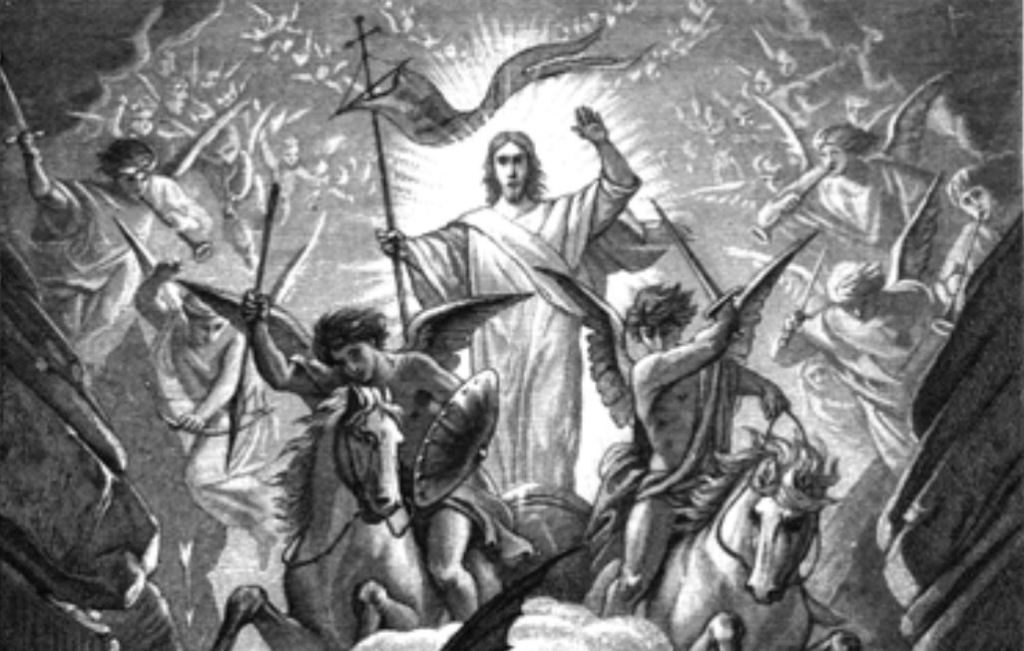
When Christ to Hell is seen to come. She snarls with rage, but needs must cower Before our mighty Hero’s power; He signs—and Hell is straightway dumb. Before His voice the thunders break, On high His victor-banner blows; E’en angels at His fury quake, When Christ to the dread judgment goes.[12]
[2] Wayne Grudem, Systematic Theology, Second Edition, 725-727.
[3] Some have also seen Romans 10:6-7 and Ephesians 4:8-9 as references to Christ descending into hell, but that’s a misreading of the text. In Romans 10:6-7, Paul makes the point that Christ is immediately available by faith, that you don’t need to descend into the abyss (probably a reference to the deepest ocean) to find Him. Ephesians 4:8-9 is simply saying that in the incarnation, Jesus descended to “lower regions” of the earth, as opposed to higher regions of Heaven, from which He came.
[5] Some have taken the phrase “made alive in the spirit” to mean Jesus was spiritually enlivened while His body was in the grave. But does it really make sense to say the eternal Son of God needed to be “made alive” spiritually? The Greek doesn’t capitalize words for us, so we have to consider the context to determine whether or not the Holy Spirit is being referred to here. That phrase “in the Spirit,” is often used of the Holy Spirit in the New Testament. Also, the weakness of the flesh (sarx) is often contrasted with the power of the Holy Spirit (pneuma).
[6] In almost every case in the New Testament, “spirit” (pneuma) in the plural refers to angels/demons, not humans. However, you never have a case of “spirits” referring to humans without some qualifying description making it clear that humans are in view.
[7] This idea of suffering for Christ’s sake permeates the whole letter, from beginning to end. See 1 Peter 1:6-7; 2:19-25; 3:9-17; 4:1-2, 12-19; 5:10.
[9] Other references to Jesus bearing the wrath of God include Romans 3:25, 1 John 2:2, 4:10, and Hebrews 2:17, where “propitiation” means “wrath-bearing substitute.”
[11] The NIV even says, “After being made alive, he went and made proclamation to the imprisoned spirits…” (1 Peter 3:19).
[12] Johann Wolfgang von Goethe, “Thoughts on Jesus Christ’s Descent into Hell,” Goethe’s Works, illustrated by the best German artists, 5 vols. (Philadelphia: G. Barrie, 1885). Vol. 1.
Then Jesus said to Thomas, “Put your finger here and look at My hands. Reach out your hand and put it into My side. Stop doubting and believe.” (John 20:27, BSB)
The apostle Paul made the startling claim that “if Christ has not been raised, your faith is futile and you are still in your sins” (1 Corinthians 15:17). Such a statement is astonishing when you consider the implications. Everything in Christianity, Paul says, everything in the faith depends on the truth that Jesus bodily rose from the dead. If Christ didn’t truly rise from the dead, then He did not conquer death — death conquered Him!
The dark and terrifying shadow still hangs over all mankind (Isaiah 25:7-8), and we have no guarantee that we will ever escape the cords of death. That is, unless Jesus’ resurrection is true. Eternal life with God. Hope beyond the grave. Forgiveness of sins. The deity and identity of Christ. It’s all based on the resurrection of Jesus being true. No resurrection, no Christianity.
The good news is that God has left us compelling evidence that the Easter event is a solid fact of history. Here are five pieces of evidence I encourage you to consider before giving a verdict on the truth of Christ’s resurrection.
Evidence #1: Jesus’ death is an undeniable fact of history
Despite the fact that some may doubt Jesus’ death (such as many Muslims) and some radical scholars will doubt that He even existed (such as Richard Carrier),[1] Jesus’ life and death really are historically undeniable. Both Christian and non-Christian sources from the ancient world confirm that Jesus died as a victim of crucifixion.[2] Roman soldiers were highly trained in executing criminals, and they were motivated to not let a self-proclaimed king survive.
In his Gospel, the apostle John tells us He is an eyewitness of Jesus’ death on the cross.[3] In describing the event, John records something fascinating:
“But when they came to Jesus and saw that he was already dead, they did not break his legs. But one of the soldiers pierced his side with a spear, and at once there came out blood and water. He who saw it has borne witness—his testimony is true, and he knows that he is telling the truth—that you also may believe.” (John 19:33-35)
The fact that he reports seeing both blood and a watery fluid flowing out is powerful evidence that John really did watch Jesus die. Here’s why. Although John had no medical training to interpret what he saw, his eyewitness testimony is exactly what a medical doctor would have expected due to something called pericardial effusion, in which the membrane surrounding the heart fills with fluid as a result of heart failure.[4] John’s testimony stands as 2,000-year-old evidence that he really was an eyewitness of Christ’s death.
Even very liberal scholars, such as John Dominic Crossan, accept Jesus’ death as indisputable fact. He writes, “That [Jesus] was crucified is as sure as anything historical ever can be, since both Josephus and Tacitus … agree with the Christian accounts on at least that basic fact.”[5] Skeptical historian and biblical scholar James Tabor, who has studied the rise of early Christianity in depth, has written, “I think we need have no doubt that given Jesus’ execution by Roman crucifixion he was truly dead.”[6]
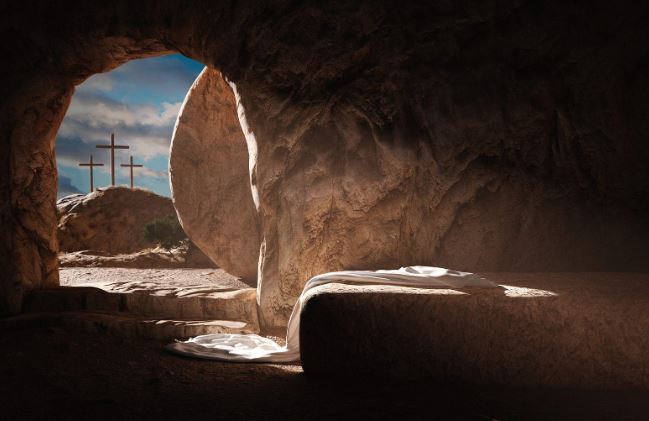
Evidence #2: On the Sunday following Jesus’ crucifixion, His tomb was empty.
All four Gospels record that Joseph of Arimathea, a secret disciple, was the one with the courage to bury Jesus. Since Joseph was a member of the Sanhedrin (Luke 23:50-51), the very council that condemned Jesus to death, it’s very unlikely that Christ’s earliest followers would make this up. We are also told that while the men were hiding from the Jewish authorities, the women followers of Jesus were the faithful ones who wanted to anoint His body in the tomb (Luke 23:55-56). Not only that, but the women are the ones who first discover the tomb is empty.
This, too, demonstrates the Gospels give an authentic record of what happened. In the first century, the testimony of women was not even admitted into court. The Jewish Talmud even says that a woman’s testimony was as valid as a criminal’s![7] To be sure, this low view of a woman’s testimony is not only politically incorrect today, it’s also not found in Scripture. Nevertheless, it was the prevailing view of the ancient world. Here’s the point: if you were making up this whole resurrection story in the first century, you wouldn’t pick women as the first eyewitnesses of the empty tomb. The apostles’ willingness to share this somewhat embarrassing fact demonstrates they were committed to faithfully sharing the truth, despite the awkward position it put them in at the time.
Additionally, history tells us that the counter claim from Christianity’s opponents was always that the disciples must have stolen the body.[8] This was an indirect admission that they knew the tomb was empty. It’s also very telling that we have no contradictory burial account whatsoever from either Christian or non-Christian sources. The fact that the tomb was well-known, as Josephs’ tomb, rules out the possibility that the women or other disciples went to the wrong tomb. If we are not told whose tomb or any details about where Jesus was buried, we might have reason to wonder if they went to the right tomb on that first Easter morning, but there are no competing accounts of another tomb being the real tomb.
Evidence #3: Jesus’ disciples believed they saw Him alive from the dead.
We have every reason to believe that the resurrection appearances that are recorded in the Gospels are based on eyewitness testimony, not legendary accretion over time. The gospel creed that Paul passes on in 1 Corinthians 15:3-7 can be dated to within a few years of the cross, which does not allow time for legendary development. From the earliest records of Christianity, we have people claiming that they truly saw the risen Jesus. The fact that Jesus is recorded as appearing to groups as large as 500 rules out the hallucination theory, because hallucinations are individual experiences that take place in the mind.
We also see the risen Jesus eating with His disciples, cooking them a meal, and telling them to touch the scars on His hands and His side to know He is real.[9] Jesus tells them, “Why are you troubled, and why do doubts arise in your hearts? See my hands and my feet, that it is I myself. Touch me, and see. For a spirit does not have flesh and bones as you see that I have” (Luke 24:38-39). This was an undeniably real and physical Jesus. It’s also very difficult for the historian to make sense of the conversion of Jesus’ brother James, the former skeptic (John 7:5), or Paul the one-time enemy of Christianity (Acts 26:10; 1 Corinthians 15:9). Biases are very powerful and both of them formerly thought of Jesus as a false messiah. Only an appearance of the risen Jesus could have turned their world upside down and convinced them that He really was their Lord and Messiah.
Evidence #4: The apostles were willing to suffer and die for their belief in the resurrection.
We can also safely rule out any conspiracy theory that claims the apostles stole Jesus’ body, because we have numerous historical records proving that these men were willing to suffer and die for the truth of the resurrection. While people of other faiths have been willing to die for their faith, the apostles were in the unique position of knowing for sure whether or not they’d seen the risen Jesus. As Michael Licona says, “Liars make poor martyrs.”[10] Origen (c. 185-c. 254), a church father, wrote that Jesus “so thoroughly persuaded” the apostles that He’d risen that they were willing to endure countless sufferings for His name, knowing that eternal life had been guaranteed them through Christ’s resurrection.[11]
In fact, we have numerous accounts of early Christians writing about Peter, Paul, and other apostles willingly going to their death and refusing to deny that they had seen the risen Jesus in the flesh. Under Nero’s rule, Paul was beheaded and Peter was crucified upside down – his final request was that he not be killed in the same manner as his Lord.[12]
I truly want to be sympathetic to the doubting skeptic. I acknowledge that many people feel they have good reason to doubt the resurrection accounts — at least initially. After all, haven’t we been lied to by numerous public figures? And haven’t we been trained to only accept claims that are rational and scientifically supported? Therefore, we have good reason to not blindly accept what we’re told simply because it’s been believed for a long time by many people.
At the same time, we should consider what it would mean if the disciples did lie and the resurrection was just a big hoax. Ask yourself, what would they gain from lying? People generally tell lies when it benefits them in some way. Either they get something out of it, or it makes them look better. Yet, as we’ve seen, the only things assured for the disciples were persecution and martyrdom.
The evidence is so powerful that the disciples were radically transformed by some kind of experience of seeing the risen Jesus that even agnostic historians will concede that something life-changing must have occurred. Atheist and historian Gerd Lüdemann provides this astonishing admission, “It may be taken as historically certain that Peter and the disciples had experiences after Jesus’ death in which Jesus appeared to them as the risen Christ.”[13]
Evidence #5: The resurrection led the disciples to radically alter their religion.
We need to remember that the first Christians were Jews, and as faithful Jews, they had been taught to never worship a mere man[14] as if he was the transcendent God or call anyone “Creator,” “Savior,” and “Redeemer” other than Yahweh, the one true God of Israel.[15] Thus, by worshiping Jesus as God, they were also risking eternal divine condemnation for promoting blatant idolatry — that is, if they were wrong about Jesus’ resurrection.
N. T. Wright has made the case that no faithful Jew anticipated a dying, let alone rising, Messiah. In fact, the resurrection was never viewed as something that would happen to one individual in the middle of history, but rather as something that happened to everyone at the end of history.[16] The fact that Jesus’ messianic claims got Him crucified should have been the divine signal that Jesus was certainly not the Messiah, because, according to the Jewish law, a man hanged on a tree is “cursed by God” (Deuteronomy 21:23).[17] But the interesting thing is that the disciples didn’t try to muffle this passage from their law. Instead, they shouted it from the rooftops! Peter said of Jesus, “They put him to death by hanging him on a tree” (Acts 10:39, italics added). Paul explains that after Jesus died to fulfill Jewish prophecy, “they took him down from the tree and laid him in a tomb” (Acts 13:29, italics added).
Jesus’ death, the apostles proclaimed, fulfilled God’s promise to put away man’s sin through His substitutionary death. Jesus died in our place, they explained. We must remember, however, that the disciples didn’t come to this conclusion until after they saw the resurrected Christ. In a very real sense, the resurrection gave the disciples permission to worship the man Jesus as God.
In addition to worshiping Jesus as God, the first Christians came to understand that the one true God existed as three distinct persons. They also moved their day of worship from Saturday to Sunday, the day the resurrection took place. They stopped sacrificing animals because they saw Jesus as the final and ultimate Lamb of God. In lieu of the Jewish Passover, they began observing the Lord’s Supper, which remembers not Jesus’ life but His death. For the faithful Jew to suddenly trade in all these long held and treasured religious practices in exchange for new ones has to be explained by the historian. My argument is that it can only be explained by the resurrection of Jesus.
I have been discussing the most important, unique, and defining event in all of history. In a remarkable display of grace and self-sacrifice, Jesus allowed Himself to be swallowed by death for us. But having done so, Jesus then broke the jaws of death from the inside and came forth. As a result, sin and Satan have no claim on the believer, and we no longer need to fear death. We have seen that there are indeed good reasons and evidence for taking the resurrection seriously. If true, we not only have hope for life after death, but for bodily life after death, because Jesus Himself rose bodily from the grave and promises to raise us in like manner.[18] Therefore, you can have a real and solid hope — something you can confidently stake your life on. Jesus’ tomb is empty, and He is alive! Now, what will your response be?
[1] Richard Carrier, On the Historicity of Jesus: Why We Might Have Reason for Doubt (Sheffield, UK: Sheffield Phoenix Press, 2014). Even the skeptical historian Bart Ehrman writes, “Jesus existed, and those vocal persons who deny it do so not because they have considered the evidence with the dispassionate eye of the historian, but because they have some other agenda that this denial serves.” Bart Ehrman, Did Jesus Exist?: The Historical Argument for Jesus of Nazareth (New York: HarperCollins Publishers, 2012).
[2] Josephus, Antiquities 18.64. Josephus in Ten Volumes, vol. 9, Jewish Antiquities, Loeb Classical Library, Louis H. Feldman, trans. (Cambridge, MA: Harvard University Press, 1981); Tacitus, Annals 15.44 (c. AD 115).
[3] John repeatedly emphasizes the importance of his personally witnessing the events of Jesus’ life in his writings: John 19:35; 20:30-31; 21:24-25; 1 John 1:1-5.
[5] John Dominic Crossan, Jesus: A Revolutionary Biography (San Francisco: HarperCollins, 1994), 163.
[6] James D. Tabor, The Jesus Dynasty: The Hidden History of Jesus, His Royal Family, and the Birth of Christianity (New York: Simon & Schuster, 2006), 230.
[7] “Any evidence which a woman [gives] is not valid (to offer), also they are not valid to offer. This is equivalent to saying that one who is Rabbinically accounted a robber is qualified to give the same evidence as a woman” (Talmud, Rosh Hashannah 1.8). The first century Jewish historian Josephus similarly writes, “But let not the testimony of women be admitted, on account of the levity and boldness of their sex, nor let servants be admitted to give testimony on account of the ignobility of their soul; since it is probable that they may not speak truth, either out of hope of gain, or fear of punishment.” (Josephus, Antiquities 4.8.15)
[8] Not only is this the story being spread by the guards and high priests according to Matthew 28:11-15, Justin Martyr writes in his Dialogue with Trypho, written in AD 150-155, that this was still the story being propagated by opponents of Christianity.
[10] Michael Licona, quoted in Lee Strobel, The Case for the Real Jesus (Grand Rapids: Zondervan, 2007) Location 2203 on Kindle edition.
[11] Origen, Contra Celsum, 2.56 in Roberts, Donaldson, and Coxe, eds. and trans., The Ante-Nicene Fathers.
[12] 1 Clement 5:2-7; 42:3; Polycarp, To the Philippians 9:2, Cited and translated in Gary Habermas and Michael Licona, The Case for the Resurrection of Jesus, 54. Also see Scorpiace, 15, in Roberts, Donaldson, and Coxe, eds. And trans., The Ante-Nicene Fathers.
[13] Gerd Lüdemann, What Really Happened to Jesus? Trans. John Bowden (Louisville: Westminster John Knox, 1995), 80.
[14] Numbers 23:19 says, “God is not man, that he should lie, or a son of man, that he should change his mind.” Also see 1 Samuel 15:29; 1 Kings 8:27; Psalm 139:7; Jeremiah 23:24.
“Therefore, we are ambassadors for Christ, God making His appeal through us. We implore you on behalf of Christ, be reconciled to God. For our sake He made Him to be sin who knew no sin, so that in Him we might become the righteousness of God.” (2 Corinthians 5:20-21)
“God’s
power is at its greatest not in his destruction of the wicked but in his taking
all the wickedness of the earth into himself and giving back love.”[1]
I
recently heard in the news about the unfortunate strife that led to the
collapse of a sports team with a lot of talent. Various sports commentators
discussed who was to blame for the team’s gradual demise. One television
personality even gave out certain percentages of blame to various persons
involved in the whole debacle. Before long, various teammates and coaches began
to voice who they thought should be blamed. Interestingly, not one person pointed
his thumb at his chest and said, “Yeah, it’s all my fault.”
Masters at Blame Shifting
Have you ever noticed how powerful your need to justify your own actions is? Why is that so often we are quick to blame in others what we would gladly excuse in ourselves? When the other team cheats or the other person lies, they need to be prosecuted to the fullest extent of the law. But when our team gets caught cheating or we get found out, we shrug and quip, “Well, everybody does it.” Why is it that whenever we are accused of something, our gut reaction is either to go into hiding or fight with all our might to clear ourselves of all blame? Deep in our bones, we know that we cannot shoulder our own guilt. Our troubled conscience testifies to this. We need a way out.
We attempt to write off our guilty feelings as nothing more than social conditioning, or perhaps our parents’ strict disciplinarian methods fobbed off onto our psyche. We tell ourselves that we are not really that bad. After all, it is those other people in our lives that are the real problem. We both subtly and not so subtly affix guilt to our parents, our spouse, our boss, or our children. We even manage to paint them in a negative light with an “understanding” tone. We are masters at blame shifting. Can anyone really argue that this is not true of the human heart? We are constantly scouring the universe for someone else to be the scapegoat, when in our heart of hearts we know we are blameworthy.
The unwillingness to own up to our guilt seems to be a perennial problem. Remember what Pontius Pilate did after sentencing Jesus to death? He washed his hands before the crowds, as if to clear himself of all guilt for the blood of this righteous man. Very similarly, Shakespeare has Lady Macbeth desperately trying to wash her hands clean after her part in the murder of Duncan. “Out, damned spot! Out, I say!” she wails. “Here’s the smell of blood still; all the perfumes of Arabia will not sweeten this little hand.”[2] We see this same dynamic when politicians or corporate executives plead ignorance when investigators catch them in a scandal.
So what does this self-justifying strategy say about us? It says something about our moral condition. The Bible explains our own condition to us. We are made in God’s image, and that is why we know right from wrong (Genesis 1:26-27). We know that guilt demands punishment. We know this. And yet, we also know that we have not even lived up to our own standards of right and wrong — let alone God’s standard of perfection. Scripture makes it clear that every human being finds him or herself in this quandary: we are both those who know what we ought and ought not to do and those who know we have failed to live up to these moral obligations. So, what are we to do about this predicament?
The Intolerable Burden
When we come face to face with the Law of God, we all know we fall short. “Now we know that whatever the law says it speaks to those who are under the law, so that every mouth may be stopped, and the whole world may be held accountable to God” (Romans 3:19). When a shameful thing we have done or said in the past rises to the surface in our mind, we sense the weight of our guilt all over again. We can identify with Thomas Cranmer, when he wrote in The Book of Common Prayer:
“Almighty God, Father of our Lord
Jesus Christ, Maker of all things, Judge of all men, we acknowledge and bewail
our manifold sins and wickedness, which we from time to time most grievously
have committed, by thought, word and deed, against thy Divine Majesty,
provoking most justly thy wrath and indignation against us. We do earnestly
repent and are heartily sorry for these our misdoings. The remembrance of them
is grievous unto us; the burden of them is intolerable.”
In John Bunyan’s allegory, Pilgrim’s Progress, the protagonist Christian bears an “intolerable” burden on his back. The great load represents the weight of his own sin, which grows more burdensome as he reads from a book. “He opened the book, and as he read, he wept and trembled.”[3] That is what Scripture does: it exposes our guilt so that we suddenly see the sinfulness of sin. But — and this is of infinite importance — it does not leave us to wallow in our guilt. It is right at this point that we begin to see our genuine need for the gospel of the crucified and risen Messiah. Our guilt demands punishment, and the more we know of God’s holiness, the more we are desperate to be free… and the more we long to be made new.
God’s Great Love
“Therefore, if anyone is in Christ,
he is a new creation. The old has passed away; behold, the new has come. All
this is from God, who through Christ reconciled us to Himself and gave us the
ministry of reconciliation; that is, in Christ God was reconciling the world to
Himself, not counting their trespasses against them, and entrusting to us the
message of reconciliation” (2 Corinthians 5:17-19).
In a world where we are persistently trying to shift the blame to someone else, God Himself shifted the blame from us to His own Son, Jesus Christ. Why? What could possibly lead a loving Father to do this? God “did not spare His own Son but gave Him up for us all” (Romans 8:32). To spare us from eternal judgment, He could “not spare His own Son.” The only way not to count our trespasses against us was to count our trespasses against Jesus. For God to overlook sin would mean that He would cease to be holy and just. God would cease to be God, and that could never happen. In order for God to uphold the moral order of the universe, He must deal justly with our great offense against Him. Someone had to go through the fire of judgment. God’s great love went out to meet the demands of His perfect justice.
Therefore, the Son of God bowed His head to the Father’s will and did just that. The very “punishment that brought us peace was on Him, and by His wounds we are healed. We all, like sheep, have gone astray, each of us has turned to our own way; and the LORD has laid on Him the iniquity of us all” (Isaiah 53:5-6). Jesus received the cruelty of man and the wrath of God both without protest. Our Lord never once disobeyed His Father. He was utterly pure, spotless, and clean. “Yet it was the will of Yahweh to crush Him” (v. 10). He willingly laid down His life in obedience to His Father’s command.
The Free Gift
“God made him who had no sin to be sin for us, so that in him we
might become the righteousness of God” (2 Corinthians 5:21, NIV).
We long to be in the right before men and women. However, our most urgent need is to be in the right before our Maker. In biblical language, what we need most is righteousness. The marvelous truth of the gospel is that we have God’s own righteousness offered to us through the cross. As Martin Luther put it, a “great exchange” took place at the cross. Christ took our sin, so that we might receive His righteousness. He bears our guilt, and we are clothed in His perfection. Out of His abundant love and mercy, God urges you to lay down your defenses and receive the forgiveness He purchased with His Son’s death.
While
we are anxiously striving to justify ourselves day after day, the gospel is about God justifying us for
all time. The Apostle Paul explained it this way: “But now apart from the
law the righteousness of God has been made known, to which the Law and the
Prophets testify. This righteousness is given through faith in Jesus Christ to
all who believe” (Romans 3:21-22, NIV). Read that last sentence again. Divine
righteousness comes to us as a free gift through simple faith. All we must do
is turn from sin to God, entrusting ourselves to the tender and secure hands of
Jesus.
We do not pay off the great debt we owe. Jesus takes that debt for us. Oh, sweet release! Complete divine forgiveness is offered to us as a free gift! What could possibly be better news than this? The cross answers the great question, “How can I, a sinner, be made right with a holy God?” The answer: through faith in Jesus Christ and His sacrificial death on the cross for us.
Jesus really did die on Calvary for all our sins, but He did not stay dead. The tomb is still vacant. “Fear not,” He says, “I am the first and the last, and the living one. I died, and behold I am alive forevermore, and I have the keys of Death and Hades” (Revelation 1:17b-18). As we approach the celebration of our Lord’s death and resurrection from the grave, let us remember the chief need for every person on the planet is that we be reconciled to the God of love. “Therefore, we are ambassadors for Christ, God making His appeal through us. We implore you on behalf of Christ, be reconciled to God” (2 Corinthians 5:20).
[1] J.
N. Oswalt, “Isaiah,” in New Dictionary of
Biblical Theology (Downers Grove, IL: InterVarsity Press, 2000), eds. T.
Desmond Alexander and Brian S. Rosner, 222.






 Lamp and Light