Is the Bible Still Relevant Today?

“For the word of God is living and active, sharper than any two-edged sword, piercing to the division of soul and of spirit, of joints and of marrow, and discerning the thoughts and intentions of the heart.” (Hebrews 4:12, ESV)

An objection I often hear on college campuses is the charge that the Bible is just an ancient book written by men. Sure, some say, it claims to come from God,[1] but why give it special authority? Think about that question. How would you respond? Well, one thing you could do is show them some of the archaeological evidence or fulfilled prophecy. Those are both very powerful pieces of evidence for it being a divinely given book.

That can be a great approach, but it also can be hard to have all that evidence ready at your fingertips when you’re in a brief conversation with a skeptic. So, another approach I like to go with is to first point to the evidence all around them for the Bible’s uniqueness.

For instance, you can turn this objection around and say, “You’re right: the Bible was written thousands of years ago. Now, isn’t it incredible that the Bible is still the best-selling book of all time? What does that tell you about the Bible that so many people live their lives by its teachings after 2,000 years?”

See, you’re using their very point about the Bible being old and leveraging it to show the uniqueness of the Bible. After all, what other ancient book has 40 different authors yet one consistent story, was written across 1,500 years, and has had so much influence on the way we live and think today? The Bible has stood the test of time. In that sense, its ancient origin is a point in its favor.

Many people in the last 2,000 years have tried to stamp out the Bible’s influence. Some have even tried to destroy the Bible. But God responds:

“Is not my word like fire,” declares the LORD, “and like a hammer that breaks a rock in pieces?” (Jeremiah 23:29, NIV)

Military generals, pagan rulers and emperors have tried to destroy the Bible. But it seems that the more that people try to silence the Bible, the stronger it grows. In the 16th century, Mary, queen of England, also known as “Bloody Mary,” ordered that anyone owning a copy of the Bible should be burned at the stake. Five years after that edict, Bloody Mary was dead and her half-sister Queen Elizabeth I was on the throne. Not only did Elizabeth repeal her sister’s nasty edict, but under her reign, more Bibles were published in England than ever before.

The fact that the Bible, though written thousands of years ago, still has enduring influence in countless societies demonstrates its supernatural origin.

Today, influential thinkers like Jordan Peterson and Jonathan Haidt have increasingly drawn their insights from the wisdom of the Bible. They’ve recognized that while in one sense the Bible is ancient, there’s another sense in which it speaks with a timeless and transcendent authority on all the perennial issues of the human condition. Ironically, most people who have mocked the Bible as outdated don’t realize just how indebted our society is to the Bible.

For example, our society loves the idea of freedom and equality for everyone. But where did this idea that we are all equal come from? It didn’t come from Darwin. If you trace it back, it came from Genesis. Even secular historians have frankly admitted that we owe this idea of equality to the Bible and its teaching that we are all made in God’s image.

One area where we see the powerful influence of the Bible is in our laws.

Sociologists have long recognized that if a society doesn’t have some kind of law by which to live, it will end up self-destructing. We humans need to live under a code of ethics. Without a law to govern us, anarchy and violence is the result.

The historian Will Durant, who is not a Christian, has recognized that many of our laws in Western civilization are derived from the Ten Commandments. For example, the sixth commandment forbidding murder is the basis for all the protections against taking life. The seventh commandment forbidding adultery was designed to protect marriage and the family, and so many of our laws protecting the family are derived from that. The eighth commandment forbidding stealing gave us the concept of private property and our need to protect ownership with various laws.

Professor Israel Drapkin even said:

“The Ten Commandments [are] the moral and legal foundations of Western Civilization.”

But how did the Ten Commandments come to have so much influence across so many countries? Historians are compelled to say that it’s primarily through the spread of Christianity and its high view of Scripture.

One example of this is the Christian Roman Emperor Justinian who came along in AD 482. Justinian ended up taking the Roman law that then existed and throwing out a good portion of it so that he could bring about a new set of legislation that was based on the Law of the Bible.

Will Durant and other historians argue that Justinian’s Code of laws was based on the Bible. And virtually every nation of Western civilization is largely indebted to Justinian’s law code. So, what does that tell us? The Bible is at the root of every major legal system in the Western world.

In fact, have you ever wondered why we have a court system of trial by jury? It’s because Christians witnessed kings presiding over cases and acting as corrupt judges, and they recognized that this contradicted the Bible.

“In righteousness shalt thou judge thy neighbor.” (Leviticus 19:15, KJV)

And in view of that verse, they recognized that a plurality of judges—which we call a jury—is more likely to root out arbitrary convictions. The whole reason for placing your hand on the Bible in a court room was to remind people that they were answerable to a higher authority when giving testimony in a human court.

So, is the Bible relevant today? One of the most powerful pieces of evidence that we’re dealing with a supernatural book is the way countless people have had their lives turned upside down by a powerful encounter with Jesus Christ in its pages. In the words of Hebrews, it is “living and active” and discerns even “the thoughts and intentions of the heart.”[2] Which is why the best case for the Bible’s divine origin is the Bible itself. Countless skeptics have had their eyes opened to its power and authority through finally reading it.

Personally, I’ve experienced this in my own life. The Bible has shaped the way I understand God, myself, and the world I live in. Time after time, I’ve had my priorities reoriented, my perspective challenged, my desire for God fueled, my love for others revived, my soul sustained through trials, and my passion for reaching the world with the good news of Jesus reignited through submitting my mind to the Word of the Lord, and to the Lord of the Word.

I’ve only scratched the surface looking at all the incredible ways the Bible has transformed our world. So, when someone says the Bible is irrelevant to our modern world, they are revealing their ignorance about how powerfully this book has shaped every aspect of life. To push the Bible to the margins is to the push away the basis for freedom, equality, justice, love of neighbor, and everything else good in our society.

And at the level of the individual, the Bible tells us the truth so that we can finally understand ourselves. We were made for a relationship with God, but things have gone badly wrong—not just in the world, but within our own hearts. First and foremost, within our own hearts. And apart from God revealing Himself through this precious Word, we are utterly lost and without hope. Mark this. There is no substitute for the Bible. Though the hubris of man may imagine otherwise, nothing outside of Scripture can ever replace it.

The Bible is more to be desired “than gold, even much fine gold; sweeter also than honey and drippings from a honeycomb” (Psalm 19:10). “Every word of God is pure; He is a shield to those who put their trust in Him” (Proverbs 30:5, NKJV). Applying the biblical book of Deuteronomy, Jesus taught, “Man shall not live by bread alone, but on every word that comes from the mouth of God” (Matthew 4:4).

The Bible doesn’t just tell me about God’s standards and reveal how I’ve failed to live up to those standards. It shows me that there is hope of forgiveness, new life, and peace with God through the good news of Jesus Christ’s substitutionary death for sinners like me and His glorious resurrection.

So, here’s my encouragement. Treasure your Bible by committing to study it regularly, expecting to encounter the living God Himself in a real and powerful way. And what could be more relevant than that?

I pray this encourages you to read the Bible. If you have any thoughts or questions about this, I would love to hear from you!


[1] 2 Timothy 3:16-17; 2 Peter 1:19-21

[2] Hebrews 4:12

Praying Like Elijah

“For truly I tell you, if you have faith the size of a mustard seed, you will tell this mountain, ‘Move from here to there,’ and it will move. Nothing will be impossible for you.” (Matthew 17:20, CSB)

Prayer is powerful. I don’t say that to be cliché; I say that because Jesus taught us this. Time and time again, He called us to pray boldly and passionately in His Name.

I also cannot deny the ways my wife Whitney and I have been wowed by God’s grace and perfect timing in answering our prayers in incredibly specific ways. There are too many to count but let me just give a few examples.

Before we met, my wife Whitney prayed for the wisdom to find the right man to marry and that this fellow would arrive at her church’s college group with several others so that she wouldn’t know immediately who that man would be. A short time later, I visited that college group with a handful of others, because I was invited by the pastor who led that group while I was working at Applebee’s. The rest, as they say, is history.

Another time, I was in a Bible study, and one man shared that his very young grandson had a brain tumor the size of a golf ball. For several weeks in a row, we prayed for healing each time we met. One morning, he came to our study with amazing news. The tumor had not only shrunk—it was completely gone. Not a trace of it. In fact, I know of numerous cases where someone plagued with life-threatening cancer has been totally healed. Just yesterday, I heard of another answer to prayer of a dear woman who received the glorious news that the latest scan revealed she is cancer free.

I can think of another time when Whitney and I were raising money for a short-term mission trip to Guatemala, and we were a little short on the green stuff. We prayed passionately and specifically that God would supply the money we needed for the trip in whatever way He saw fit. He came through in various ways to provide us with exactly what we needed. I remember my heart swelling with joy as I thought about how God had so lovingly answered our sincere requests so that we could go on this mission trip together as a young married couple before we had any kids.

These are just the tip of the iceberg. I really could go on and on with examples of how God has provided answers to prayers—often in ways we never saw coming.

As these come to mind, I sometimes wonder why I don’t pray more often or more passionately. It’s not as though God has ignored me in the past. Lately, He’s been really challenging me to lead from deep, heartfelt prayer, as opposed to only praying with passion when something goes wrong. The Lord wants me to admit my shortcomings and acknowledge my great need for His power in every aspect of my life.

Jonathan Edwards said that when we ignore prayer, we “live like atheists or like brute creatures,” and “live as if there were no God.” Why would we ignore our direct line to the One who reigns over all?

If anything is worth doing, it must come by God’s power, not my own strength. Therefore, I need to be drawing power from the Lord in everything I do if I want to have an eternal impact. The Bible reminds us, “The prayer of a righteous person has great power as it is working” (James 5:16, ESV). Our prayers have “great power” because they are directed to a God who is known for doing what is humanly impossible (Luke 1:37).

I’m reminded of the story of Elijah. He prayed fervently for God to send the rain when Israel was enduring a drought while the wicked King Ahab was on the throne. In 1 Kings 18, we read:

And Elijah went up to the top of Mount Carmel. And he bowed himself down on the earth and put his face between his knees. And he said to his servant, “Go up now, look toward the sea.” And he went up and looked and said, “There is nothing.” And he said, “Go again,” seven times. And at the seventh time he said, “Behold, a little cloud like a man's hand is rising from the sea.” And he said, “Go up, say to Ahab, ‘Prepare your chariot and go down, lest the rain stop you.’” (1 Kings 18:42-44, ESV)

Elijah didn’t just pray once, see there was nothing, and then give up. No, the text emphasizes how he prayed fervently seven more times for the rainclouds to show up. He understood that God wants us to pray with passion, expectancy, and repetition. At the very first tiny sign that God had answered his prayers (after all, a hand-sized cloud seems like a bit of a letdown), Elijah confidently sent word to Ahab, “Get in your buggy and go, because the rain is a-comin’!” God answered his prayers in such a way that no one in Israel could chalk up the sudden change in weather to mere happenstance.

Imagine an Israelite saying, “Finally! We’re getting rain after three-and-a-half years. How lucky are we!”

Elijah’s prayers made the difference.

Through this prophet’s prayers, God turned the rain off and then back on 42 months later, raised a widow’s son to life, and shot down fire to engulf a thrice-soaked altar to vindicate Elijah’s claims about Yahweh, not Baal, being the one true God of the world. Clearly, we’re meant to see that Elijah’s prayers were powerful. God can change the weather conditions whenever and however He wants. He’s sovereign over this world. But, as in our lives, He chose to change the circumstances in response to the prayer of one of His faithful followers.

When we read about Elijah’s ministry, we are rightly in awe of how the Lord worked through him. However, before we lionize Elijah as a biblical superhero and assume we could never pray like him or see God work wonders before our eyes, we should consider what James says about this.

“Elijah was a man with a nature like ours, and he prayed fervently that it might not rain, and for three years and six months it did not rain on the earth. Then he prayed again, and heaven gave rain, and the earth bore its fruit.” (James 5:17-18, ESV)

James is reminding us that the situation is not so different for us today. At the end of the day, Elijah was just a man; he had a nature like ours. And God Himself hasn’t changed, because He never changes (Malachi 3:6). If Elijah prayed to the same God we pray to today, why should we expect our prayers to be less effective? The whole reason James brings up Elijah as an example is to say, “You too can pray with power.”

So go to the Lord today and pray with passion, boldness, and expectancy like Elijah did. There is no telling what massive changes God will bring about through your prayers. After all, “Elijah was a man with a nature like ours.”

I pray this encourages you. If you have any thoughts or questions about this, I would love to hear from you!

Choosing Self-Denial in a Self-Entitled World

By Jason Smith

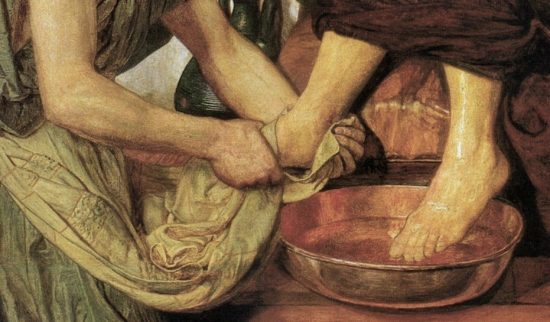
“Jesus, knowing that the Father had given all things into His hands, and that He had come from God and was going back to God, rose from supper. He laid aside His outer garments, and taking a towel, tied it around His waist. Then He poured water into a basin and began to wash the disciples’ feet and to wipe them with the towel that was wrapped around Him.” (John 13:3-5)

Jesus said some outrageous things. Like the time He looked at His closest friends with a piercing gaze and said, “Whoever wants to be my disciple must deny themselves and take up their cross and follow Me. For whoever wants to save their life will lose it, but whoever loses their life for Me will find it” (Matthew 16:24-25).

Wait a minute. Deny myself? Such an invitation sounds bizarre, not just to our twenty-first century ears, but to first century ears, as well. We live in a culture of self-promotion. Ours is the era of entitlement. We look into the mirror and repeat the motto that we’ve inherited: “You deserve the best.” Advertisements urge us to have it your way and indulge thyself. Feeling thirsty? Well then, “this Bud’s for you.” Want to look young again? No problem, this beauty product will remind you that you are a goddess. Want to do something for yourself for a change? It’s about time. Express yourself!

“I Love Me Some Me”

Did you know that between October 2011 and November 2017, there were 259 selfie-related deaths reported? I’m not kidding. These people died while attempting to capture an impressive or hilarious snapshot of themselves. Many were hit by a train. Some fell off a bridge. Even more slipped off a sheer cliff. According to the 2018 report, men outnumbered women three to one in selfie-related deaths.[1] To counter this growing problem, many sightseeing locations around the world have put up signs prohibiting selfies due to the mortal danger associated with this risky behavior. Think of it: men and women (mostly young men) are literally risking their lives in order to capture a one-second pose so they can post it on social media or share it with friends!

Now, obviously, there is nothing inherently wrong with taking a picture of oneself. However, we should reflect on how often we have acted foolishly in order to be in the spotlight. We can laugh at former wide receiver Terrell Owens’ statement, “I love me some me,” but I say he was just being more honest than most. Although we don’t care to admit it, we’re all prone to narcissism.

Into this self-intoxicated world, our Lord speaks, turning our entire outlook on life upside down. “If you try to hang on to your life, you will lose it. But if you give up your life for my sake, you will save it” (Matthew 16:25, NLT). To those of us who thought the movie of life is all about us, Jesus flips the script. It’s not about self-promotion, it’s about self-denial. It’s not about self-fulfillment, it’s about self-emptying. It’s not about making much of yourself, it’s about giving yourself to God. That, in fact, is precisely what Jesus did when He encoded Himself with human DNA to live, love, die, and rise in this beautiful yet broken world. He surrendered His rights and “emptied Himself, by taking the form of a servant, being born in the likeness of men” (Philippians 2:7).

What would it look like if we were to follow in the footsteps of Jesus, who chose self-denial over self-promotion or even self-preservation?

The Apostle Paul foresaw the coming days when “people will be lovers of self” (2 Timothy 3:2). Self-love is corrosive; it turns us in upon ourselves — something love was never intended to do. We need to let Jesus teach us that there is a beauty to self-denial. As we empty our hearts of self-love, we make room for receiving God’s love and, in turn, can extend that love to others.

The Servant King

Jesus is the King, but He’s a king who humbly washes the smelly feet of His followers (John 13:3-5).

When we humans rise to positions of power and influence, it tends to go to our heads. Satisfied with our new power status, we get a bloated sense of self-importance. Like Simba from The Lion King, we “can’t wait to be king” of our own little kingdoms so that, as the cub sings, we are “free to do it all my way.” But not Jesus. Note how counterintuitively this works out in His life. “Jesus, knowing that the Father had given all things into His hands, and that He had come from God and was going back to God, rose from supper… laid aside His outer garments… poured water into a basin and began to wash the disciples’ feet” (John 13:3-5).

Whereas we often look around for servants from our position of power, Jesus took on the role of a servant from His position of power. It’s as if the elderly John is shaking his head in amazement as he recalls what took place in that upper room so many years before. He carefully observes that Jesus did the unpopular job of scrubbing calloused and dusty feet while fully aware that He was the King of the universe — “the Father had given all things into His hands” (v. 3).

Jesus the King chose the way of the humble servant. Not only did He do this to demonstrate His immeasurable love for His followers (John 13:1), but He also did this so we would have a tangible example of what true leadership looks like. “You call Me Teacher and Lord,” He told them, “and you are right, for so I am. If I then, your Lord and Teacher, have washed your feet, you also ought to wash one another’s feet” (John 13:13-14). Rather than exploiting His power to make His life more comfortable, as we are all too prone to do, Jesus used His power to serve others.

Let me guarantee something for you. You will never find a passage in the New Testament where Jesus snaps His fingers and demands that Peter bring Him the hors d’oeuvres. You will look in vain for that passage where He orders John to wash His feet or commands Andrew to pour Him a glass of the wine He’s just made. Scripture says He did not use His divine status and privileges for His own advantage. Instead, He chose the role of a servant, humbly obeying His Father “to the point of death, even death on a cross” (Philippians 2:8).

We need to remember there is great joy in serving others. Jesus endured the agony of the cross “for the joy that was set before Him” (Hebrews 12:2). Moreover, Jesus wanted His joy to be fulfilled in us (John 17:13). Despite all the countless options available to Him, Jesus chose self-denial. We can still see the effect of that choice in the countless hospitals, orphanages, homeless shelters, schools, and clinics all over the world that His followers have built in His name.

So, what about you? What are you clutching tightly to that might serve a greater purpose if you gave it away? Who is the hurting person in your life? What if God has blessed you so that you can put a smile on their face? Where is a place you could go to embody the self-giving love of Jesus for others? You know that task that nobody in the house or at work wants to do — what if you chose to do it? Christ chose self-denial so that we could see the beauty of true love and follow His example. What do you choose?


[1] Agam Bansal; et al, “Selfies: A Boon or Bane?” Journal of Family Medicine and Primary Care (July 2018). 7 (4): 828-831. https://www.ncbi.nlm.nih.gov/pmc/articles/PMC6131996/

Painting: “Jesus Washing Peter’s Feet” by Ford Maddox Brown