
By Jason Smith

“Now, brothers and sisters, I want to remind you of the gospel I preached to you, which you received and on which you have taken your stand. By this gospel you are saved…” (1 Corinthians 15:1-2a, NIV)
Recently, my wife Whitney and I welcomed our son Ryan into the world. A newborn baby is truly a wonder to behold. Their soft hands are already grasping for another hand. Their mouth already seeking nourishment. Their eyes slowly opening and struggling to focus for the first time on the big bright world around them.
With Ryan’s arrival, we have noticed our older two boys (Logan and Weston) acting up a bit more than usual. I don’t think there’s any surprise here. Children often need time adjusting to the arrival of a new sibling. It’s a new era for them. The truth has gradually dawned on them, on a completely new level, that they are not in fact the center of the universe. I find myself wanting to teach them over and over, “It’s not all about you.” Many a parent can relate to this.
Parents rightly see the need to discipline and correct their misbehaving children. But here’s the question I want us to consider: In the midst of discipline, are we teaching our children the gospel of Jesus Christ? Is our method of correction, discipline, and instruction working to support or deny the truth of the gospel? Does the message we are conveying sound more like self-salvation or divine rescue?
No one has to teach their child to be selfish. Parents know firsthand that we all come into this world with a self-centered bent. We want what we want, and we want it now. It’s a shocking truth to learn that the world and everyone we know is not in orbit around us. Even as adults, however, we tend to live as if the story of the universe is all about us. But the gospel of Jesus Christ tells us a better story. It tells us that we were made for a much higher purpose than to live for ourselves. According to Scripture, we exist for God. To worship Him, love Him, and honor Him. It is only in living according to our God-given purpose rather than our self-made plans that we find true and lasting joy. This is precisely the goal of the gospel, the Bible’s central message.
Over and over, Scripture reminds us that we are on this planet to worship and enjoy God. “So whether you eat or drink, or whatever you do, do it all for the glory of God” (1 Corinthians 10:31, NLT). Anything less will leave us empty, beaten up, and dissatisfied. When we live for God rather than self, our actions correspond to our design.
You may remember watching the animated Disney classic Pinocchio as a child. It’s a fascinating story of a puppet that comes to life when his maker wishes upon a star that his little marionette whom he named Pinocchio might become a real boy. That night, a glowing blue fairy partially grants his wish by bringing Pinocchio to life. However, he remains a wooden puppet. Pinocchio awakes and — humorously — is shocked to be alive. The blue fairy tells Pinocchio that if he proves himself “brave, truthful, and unselfish,” Geppetto’s wish will come true. She also assigns the loyal little locust, Jiminy Cricket, to be Pinocchio’s constant companion and voice of conscience.
The tale follows Pinocchio and Jiminy on their many adventures as the puppet sets out to discover what life in the world is really like. While Pinocchio is loved by his “father,” Geppetto, he soon discovers there are many in this world who want to lead him astray. He also learns how easy it is to make wrong choices. I doubt there is another Disney movie that is so chock full of moral lessons and aphorisms, like when the blue fairy says, “You see, Pinocchio, a lie keeps growing and growing until it’s as plain as the nose on your face.”
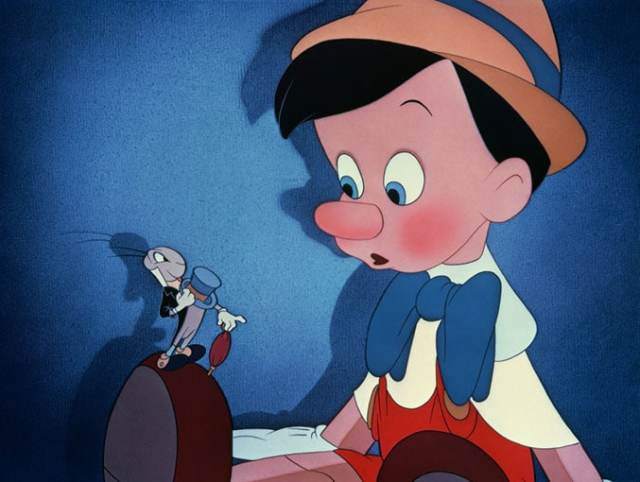
In the film’s darkest moments, Pinocchio and a friend are lured to Pleasure Island, a place where selfish boys can live it up — smoking, drinking, gambling, and doing whatever else they want — all without the moral restraints of parental authority. Unfortunately for Pinocchio and his friend, the island is cursed so that all the naughty boys who travel there transform into donkeys and are eventually sold into slave labor. One boy-turned-donkey desperately cries out for his mother. In a menacing tone, the island’s owner says, “You boys have had your fun. Now pay for it!” Pinocchio barely escapes, but his friend does not.
In a final act of courage, Pinocchio tries to rescue Geppetto from the belly of a sperm whale that swallowed the puppet maker while he was searching for Pinocchio. While Geppetto and Jiminy Cricket survive the whole ordeal, Pinocchio is killed. At the end of the film, there is a touching moment when Geppetto weeps over his broken puppet lying on the bed. Suddenly, the fairy not only resurrects him but transforms him into a real boy. “Father, I’m a real boy!” Pinocchio shouts in amazement. Apparently, Pinocchio’s final act of bravery proved him worthy of life.
In many ways, Pinocchio is something of a parable for how the modern world understands Christianity. Many today, even in the church, see Christianity as a moral prescription for life. God’s law is a list of dos and don’ts that we are to follow. We can think that, like Pinocchio, we must prove ourselves worthy of life. This way of thinking makes sense to us, but it stems from a wrong view of God.
We can think of God as if He were like a giant fairy, watching over our every move, evaluating our lives to see whether or not we really deserve to be accepted as His child. If we know we’ve blown it — spending too much time at Pleasure Island — we can hear God demanding that we pay up for all that we’ve done. Many people today live with this view of God, persistently uncertain of whether they have done enough or are good enough to go to heaven. Even if we see God as kindhearted and encouraging like the fairy, urging us to listen to our conscience, we can think it’s ultimately about us being good enough to meet God’s expectations.
American sociologist Christian Smith called this version of Christianity “Moralistic Therapeutic Deism.”[1] It essentially boils down to this: God is there for us when we are in a bind, but generally lets us go through life relying on our conscience (rather than His Word). The main thing God cares about is that we try to live a good life and be decent individuals, because heaven is the reward for good people when they die. Makes sense, right? The only problem is that this is nothing like the Christianity of the Bible.
What’s wrong with the above description? Well, for starters, there’s no mention of how Christ fits into that version of Christianity! In Moralistic Therapeutic Deism, Jesus is merely an add-on to Christianity, rather than the hub and center around which everything turns. At best, such a view sees Jesus as a good example or a wise teacher. Certainly, He was the supreme example and wisest teacher ever to live, but to reduce Him to these descriptions is to try to have Christ without the cross. It turns a blind eye to the bleeding and dying man staked to the cross. It ignores the miraculous triumph of the empty tomb. It downplays Jesus’ own radical claims: “I am the way and the truth and the life. No one comes to the Father except through Me” (John 14:6).
Here’s the challenge for Christian parents. It is far easier to skip the gospel and address the moral behavior of our children with rewards or threats. “If you obey, I’ll give you…” “You’d better not disobey me, or else…” Honestly, I catch myself relying on this tactic all the time. I’m certainly not saying that all our rules should be thrown out or that we should stop disciplining our kids. Both of these are essential and sadly not practiced by many parents today.
But when we discipline our kids, are we pointing them to the truth of the gospel? Are we merely addressing their outward behavior, or are we striving to address their heart? The heart is the epicenter for all our children’s thoughts and motives. “Above all else, guard your heart, for everything you do flows from it” (Proverbs 4:23). Jesus said that all our evil thoughts and actions spring from our sin-riddled hearts (Matthew 15:19). If all we ever use is rewards or threats in our discipline, we are actually encouraging our kids to ask the self-centered question: “What’s in it for me?”
Whether we like it or not, we are teaching our kids a gospel not just with what we say but with how we act. The only question is whether the gospel we are giving is the true gospel of Jesus Christ or something else. When I discipline my son for stealing cookies or talking back to Whitney or myself (speaking hypothetically, of course), I want him to know that what he’s doing is a serious problem. And this problem has to do with the sin in his heart. He needs to know not only that his sin saddens me, but that it saddens God, too (Genesis 6:6). I also want him to understand that Jesus loved him so much that He did something about the sin in his heart. In fact, He suffered and died for it, so that God can forgive him and scrub his heart clean of all that sin (1 John 1:8-2:2). My son needs to know that no matter how good he strives to be, he can never work off his guilt. Only Jesus can do that. Beyond this, I want him to know that he’s not alone. “Daddy has sin in his heart, too, and needs Jesus just as much.”
I want my sons — even at a very young age — to recognize their great need to be reconciled to God. The Bible says, “It’s your sins that have cut you off from God” (Isaiah 59:2, NLT). “So we are Christ’s ambassadors; God is making His appeal through us. We speak for Christ when we plead, ‘Come back to God!’ For God made Christ, who never sinned, to be the offering for our sin, so that we could be made right with God through Christ” (2 Corinthians 5:21, NLT). We need to explain to our kids that what makes sin so serious is that we were made for a relationship with a holy God. At the same time, our kids can be confident of their standing with God through faith in Jesus (Romans 8:1; Philippians 1:6).
In every generation, there is a danger of losing or distorting the gospel. Most often this drift from the gospel is well intended. After all, it’s not wrong to want to see our kids live good and moral lives. Pinocchio is a story that resonates with some of our most basic moral intuitions. But what our kids need to see is that there is a much greater story, a powerful story of redemption, that is taught in Scripture and centered around Jesus Christ. Teaching our kids to be good boys and girls is too small a goal. We need to teach them to be Christ-centered, Christ-exalting, and Christ-loving kids. We want their obedience to be rooted in love, not self-centeredness.
Above all else, Jesus-following parents need to embrace the truth that they are in the disciple-making business.
Photos Courtesy of Pixabay and Disney.com
[1] Christian Smith and Melinda Lundquist Denton, Soul Searching: The Religious and Spiritual Lives of American Teenagers (New York: Oxford University Press, 2005).
 Lamp and Light