
By Derek L. Jackson and Jason Smith
Our hope in this article is to set the stage for how to think about racism in our nation through a biblical and gospel lens. Racism is so deeply enmeshed in our nation that we cannot afford to ignore it for the problem that it is. We also need to look for peaceful and sustainable solutions. Each of us needs to ask, “How can I do my part in seeing racial reconciliation happen?”
It’s so easy for people of different skin color to talk past one another rather than listen carefully with the goal of understanding. That’s why we made a point of writing this article as a collaborative effort between a black man (Derek) and a white man (Jason). Both of us love Jesus dearly and pray that those in the throes of racial violence may find the hope and peace that only our Lord can give. Although we want to confront some tragic realities in our world, we are also filled with hope because the gospel of God’s grace is greater than all our sin.
Only One Race
We both believe that the Bible is emphatically opposed to any and all forms of racism, bigotry, and hatred. Some have ignorantly claimed that the Bible supports racism by misreading and distorting certain passages, but the reality is that the biblical message offers the only genuine remedy to the plague of racism.
The very first chapter in Genesis, the Bible’s first book, tells us that God created the first man and woman in His image (Genesis 1:26-27). Of all the descriptions of humanity’s origin available, in both ancient and modern literature, you will not find a more magisterial description of our nature. In the Bible alone, we see the fascinating combination of humanity’s extraordinary greatness and tragic depravity. Because we bear God’s image, every person has unfathomable dignity. Because we are fallen, we are all prone to treat our fellow humans in horrendous ways.
The Bible’s teaching on the image of God condemns every form of racism. God did not create a white Adam, a black Adam, and a brown Adam, and so on, so that we might wonder if one is superior to another. Instead, the biblical argument goes like this: If we are all images of God, how can you hate another image of God (James 3:9)? How can you say you love God, whom you have never seen, but hate your brother, your neighbor, God’s image, whom you see every day (1 John 4:20-21)?
According to the Apostle Paul, we all have descended from one man (Acts 17:26). Therefore, we are all blood relatives. The black man and the white man truly are brothers by blood. This doesn’t squelch the beauty of cultural diversity; rather, it affirms the dignity of every person because of our common bond as image bearers of God – a truth that transcends every culture.
The Ultimate Source and Cure for Racism
Many have spoken about the need to end “systemic racism,” and we agree that racial injustice has infected nearly every corner of our nation. However, we also believe that every sin – including racism – begins with the human heart. Our Lord Jesus put it this way, “For out of the heart come evil thoughts, murder, adultery, sexual immorality, theft, false witness, slander” (Matthew 15:19). Therefore, it requires a solution that addresses the heart.
In other words, while new laws and policies certainly must be worked for, they ultimately lack the power to uproot all forms of racism. Each of us personally needs nothing less than a total renovation of the heart. That’s where the gospel of Christ comes in. In Christ, people of every ethnicity, background, and gender are united. The ground is level at the foot of the cross. Jesus died for those of every nation and skin color, and through Him, believers are all brought into the one family of the church together.
Paul writes that Christ Himself “is our peace, who has made the two groups one and has destroyed the barrier, the dividing wall of hostility… His purpose was to create in himself one new humanity out of the two, thus making peace, and in one body to reconcile both of them to God through the cross, by which he put to death their hostility” (Ephesians 2:14-16, ESV).
We all have equal access to God through the one cross. All the racial injustice and prejudice that is all too prevalent in this world is rendered powerless by Christ’s bloody cross, where He absorbed all our sin and reconciled us to our Maker.
The Need to Listen Well
When we hear about racial injustice in the news, we’re often guilty of jumping too quickly to conclusions. I (Jason) know, as a white person, how easy it is to minimize the prevalence of racism in our nation. In many ways, I would like to think that we’ve moved past the racism that has plagued our nation’s history. But in reality the stain of racism has not gone away, and we need to do our part in confronting prejudice wherever we find it, beginning with our own hearts.
We need to listen to those of a different skin tone and background to try and understand and help contribute to the solution. The point of Derek sharing the stories below isn’t to undermine the necessary and noble service of good and faithful police officers, but to give a better understanding of the experience of countless black men and women in America.
There are so many things I (Derek) can say about the death of innocent and/or unarmed black people at the hands of white police officers. I could say that this a new phenomenon, but that would be a lie. It’s being recorded on camera more often, but this has been happening for years. There are television shows and movies that try to shine a light on “The Talk” black parents have with their children, but I don’t know if it is understood by non-blacks that these types of conversations are real.
As a teenager, I was sat down by my father who taught me how to react to police officers who pull you over or seek to question you. “Always make your hands visible, always be polite, always follow directions, and always repeat vocally the directions as you’re doing them.” But the lesson that has always stuck with me is when my father told me that the police will always see me as black first. Not as human, not as a man, not as a person, just black. What’s really sad is that I have now had to have the same conversation with my son, and he’s only 11.
The color of my skin comes with certain stereotypical misconceptions. To some I’m seen as a criminal, dirty, less than, worthless, unintelligent or uneducated, a thief, a murderer, and a gang member. This has been the plight of the black man and woman for centuries.
I will give one example of my run in with law enforcement. As an Oakland, California, native, I know most areas of the city. While in my early twenties, I was in the Rockridge area of Oakland near College Boulevard. It is a more astute area of Oakland. I was coming from a friend’s dance studio in the area one evening, just after dark. The crosswalk light was so fast you would not be able to walk across before it changed. So, as the light turned green, I ran across the street just as a police officer was coming down the street and stopping at the red light. I got into my Honda Accord and waited to see if the police officer would drive past, because in my experience he was going to follow me. He didn’t move after the light turned green. I knew if I could make it to the freeway about a mile away, I’d be fine. So, I started my car and began to drive. Of course, the police officer began to follow behind me.
As I drove towards the freeway, I was extra cautious to follow all traffic laws. The police officer followed me the entire mile. Just before I got to the freeway, he turned his lights on and pulled me over. I remember what my father taught me. Before the officer made it to my door, I already had my wallet out with my license and registration on my dash and my hands on the steering wheel, with window down and engine off. So, when the officer made it to my car’s driver’s side window, he didn’t ask the usual, “License or registration?” He stated, “This car has been reported stolen.”
Now, my little light blue Honda Accord wasn’t much to look at, but it was the first car I bought with my own money and it was in my name. So, how did my car get reported as stolen? The officer then asked for my license. As I gave him my driver’s license, an operator came over his radio stating the car belongs to Derek Jackson. The officer looked at my license, then at me, and reluctantly handed my driver’s license back to me and told me I was free to go as he walked back to his car.
It may not be a big thing to some, but the fear I had at that moment is something that I should not have had. This officer didn’t ask if my car had been stolen, he stated that it had been reported as stolen. I believe if I had not heard what the operator said, it would have been a different story. That, I believe, was God’s protection.
I have other stories, such as being cursed out by a cop for being young and black or another incident of being handcuffed and put in the back of a police car after being pulled over driving to school. I can’t even get into the times I’ve been followed by police or followed in a store. God has protected me because those situations could have ended with someone posting an RIP on their Instagram or Facebook page.
We (Derek and Jason) both thank God for those police officers of every skin color who have faithfully served and protected the citizens under their care with diligence, sacrifice, and justice. We need more like them now more than ever.
What Can We Do About It?
But what about those who have suffered death, beatings, false accusations, and harassment from the police or Caucasians who hate blacks because of their skin color? Neither of us had a say in our skin color, but we exult in the fact that we are “fearfully and wonderfully made” (Psalm 139:14). You were made the way you were on purpose, and we affirm God’s joyful creativity seen in the mosaic of all our varying skin tones. With grieved hearts, we both acknowledge the hatred and racism that can be traced through every era of our nation’s history. From the unjust killings of American Indians to the unspeakable atrocities of the enslavement of African men and women.
Together, we affirm God’s denunciation of hate and racism. He tells us to love our neighbors as ourselves (Matthew 22:39). He doesn’t say, “Love the neighbor who shares your skin color.” He just says, “Love your neighbor.” Your neighbor is anyone you come in contact with. We’re to love as God loves, and He loved us so much He sacrificed His Son on a cross to save us from our sin. The blood of Jesus can wash away the stain of hate, the stain of racism, and the stain of bigotry and discrimination.
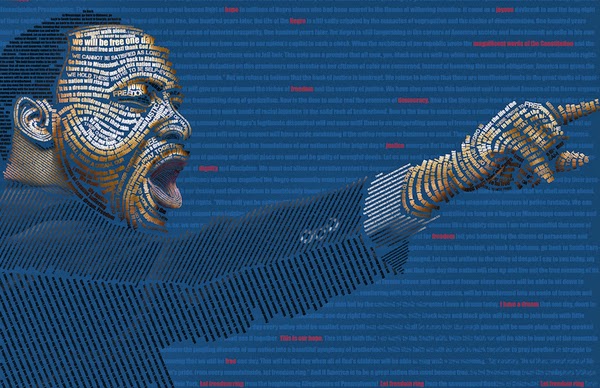
Scripture tells us to speak up for the rights of the hurting and the oppressed (Proverbs 31:8-9). To be silent is to be complicit in the evil happening before our eyes. At the same time, we must not take personal vengeance into our own hands. Violence only begets more violence. Martin Luther King, Jr. said, “Nonviolence is a powerful and just weapon, which cuts without wounding and ennobles the man who wields it. It is a sword that heals.” We must demand justice for those who are oppressed, but we must always do so in love. “Do not be overcome by evil, but overcome evil with good” (Romans 12:21, NIV). Will you join us in working for racial reconciliation today?

 Lamp and Light