Leading Well Is Loving Well

As a pastor, I know I need regular reminders to stay faithful to the Lord, to not compromise my convictions, and to love those I lead.

We have all heard stories of politicians who chose political expediency over fulfilling promises made to their constituencies. At times, all leaders can be tempted to sacrifice convictions when it is convenient. When a leader is driven by selfish ambition rather than love for those they lead, they end up treating their fellow image bearers of God as steppingstones for career advancement. But the best leaders don’t treat people as a means to an end. Instead, they love those they lead and invest in their growth.

I often tell men at my church that all men are called to lead in some sphere, beginning first with leading themselves. Self-rule or “self-control” is a quality the Bible holds in high esteem; it’s a necessary ingredient for leading others with patience and integrity.

“Whoever is slow to anger is better than the mighty, and he who rules his spirit than he who takes a city.” (Proverbs 16:32, ESV)

According to the Bible, leading well is not so much about dominating and ruling over others, but about ruling your own spirit so that you can lead others by example.

And the best leaders are those who first faithfully follow their Master, the Lord Jesus. Jesus chose twelve men—called “Apostles”—to be the leaders of His church after His ascension into Heaven. But before that time, He poured into these men with wise instruction and taught them that His kingdom would be marked by loving service, self-denial, and humble faith.

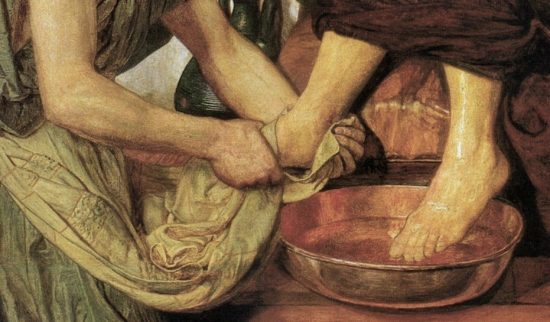
When no one else was willing to do the job of a servant, Jesus showed these guys what true leadership looks like. In a stunning display of humility, Jesus washed their feet. In the Apostles’ minds, this was an act fit for a household slave, not a rabbi. And certainly not a Messiah! Yet Jesus said:

“If I then, your Lord and Teacher, have washed your feet, you also ought to wash one another’s feet. For I have given you an example, that you also should just as I have done to you.” (John 13:14-15, ESV)

“As Goes the Man, So Goes the Family”

Family is the first sphere to practice this Christlike kind of servant leadership. A man leads his wife well, not by bossing her around and expecting to be served, but by sacrificing his time and energy to love her well, listening well as she shares her heart, and caring for her needs so that she will flourish (Colossians 3:19). Dads and moms lead their children by teaching them, certainly, but also by changing diapers, preparing meals, and bandaging a skinned knee.

The greatest Leader of all time said it best:

“Whoever wants to become great among you will be your servant, and whoever wants to be first among you will be a slave to all. For even the Son of Man did not come to be served, but to serve, and to give his life as a ransom for many.” (Mark 10:43-45, CSB)

All men are called to lead, but they can lead best if they first submit themselves to God and His will for their lives. When men fail to lead with strength and service, everyone suffers.

Pastor Tony Evans put it well:

“As goes the man, so goes the family. As goes the family; so goes the church. As goes the church; so goes the community. As goes the community; so goes the nation. So if you want to change the nation; change the community; if you want to change the community change the church; if you want to change the church; change the family; if you want to change the family, change the man.”

A Case Study in Bad Leadership

The biblical book of 1 Kings provides us with numerous examples of leadership gone awry. One such example is the young Rehoboam. The heading for 1 Kings 12 in my Bible is “Rehoboam’s Folly,” so we know immediately things are about to go sideways for this young king. After ascending the throne in place of his now deceased father, Solomon, Rehoboam encounters a crisis early in his political career.

Another young man named Jeroboam (not to be confused with Rehoboam) acts as a union leader and leads the Israelite labor force in demanding some changes occur now that Rehoboam is king, or else they’ll go on strike.

“Your father [Solomon] made our yoke heavy. Now therefore lighten the hard service of your father and his heavy yoke on us, and we will serve you.” (1 Kings 12:4, ESV)

Rehoboam buys some time to consider his next move. So far, so good. When a leader responds impulsively during a crisis, problems can escalate. A good leader knows when to press pause and reassess the situation before making a decision. Rehoboam then meets with some of the senior members of his advisory board, the very men who helped guide his father Solomon. Again, this is a good move. Solomon himself said, “Without wise leadership, a nation falls; there is safety in having many advisers” (Proverbs 11:4, NLT).

These older men had experience and wisdom that Rehoboam lacked. They knew what it took to lead people over the long haul. Here’s what we read:

“They replied, ‘Today if you will be a servant to this people and serve them, and if you respond to them by speaking kind words to them, they will be your servants forever.’” (1 Kings 12:7, CSB)

In other words, these aged advisers recommended servant leadership. “If you serve them, they will serve you. If you love them, they will love you. If you’re in touch with their needs, they will gladly follow your lead.”

Unfortunately, Rehoboam didn’t care for this advice. He was too headstrong and progressive to recognize the wisdom of their words. He wrote them off as old has-beens who were stuck in the past. He then consulted the young men he had grown up with—his childhood friends and frat buddies, who, like him, were privileged and proud.

Their advice was the exact opposite of the older men:

“This is what you should tell them: ‘My little finger is thicker than my father’s waist! Although my father burdened you with a heavy yoke, I will add to your yoke; my father disciplined you with whips, but I will discipline you with barbed whips.’” (1 Kings 12:10-11, CSB)

In other words, “These people feel they’re being worked too hard, huh? Why don’t you tell them there’s a new sheriff in town. It’s time you showed them who’s really in charge. You’ve got to lead with an iron fist. Remind them how puny they are and how much you’ll punish their insolence!”

Rehoboam must have smiled maniacally as he heard these words, because he decided to do exactly what these foolish young men said. Today, this would be a bit like ignoring the sound and biblical wisdom of older generations in your family, church, and community, and instead turning to the latest advice from some rising star on TikTok, who is probably prone to thoughtless narcissism and overreaction.

And because he ignored the advice of the older men, Rehoboam lost the people. They now saw him as the cold-hearted tyrant that he was, unwilling and unfit to lead people well. Nearly the entire nation turned on him, and they made Jeroboam, the one viewed as “a man of the people,” their new king.

Not only that, but Scripture says, “And there was war between Rehoboam and Jeroboam continually” (1 Kings 14:30). That is a painful reminder that tyranny and violence only begets tyranny and violence.

Back in the 1800s, the wise theologian J. C. Ryle made an observation that is just as timely today:

“How common is it to see young men with big heads, high-minded, and not wanting to hear wise counsel! How often they are rude and uncourteous to all around them, thinking they are not valued and honored as they deserve! How often they will not stop to listen to a hint from an older person! They think they know everything. They are full of conceit of their own wisdom. They view elderly people, especially their relations, as stupid, and dull, and slow… And this is all pride.”[1]

Every Leader Is Accountable

There’s an important reminder included in this passage that is easy to miss. The narrator says:

“The king did not listen to the people, because this turn of events came from the Lord to carry out his word.” (1 Kings 12:15, CSB)

In other words, although Rehoboam supposed he was in charge, the reality is that all this came “from the Lord to carry out his word,” because God had already promised in the days of Solomon’s rebellion that the kingdom would be divided. All leaders need to be reminded that ultimately it is the Lord, not man, who truly rules the world. The Book of Revelation tells us that eventually there will be only one Man sitting on the throne, and His name is Jesus.

The lesson for all of us is that good leaders recognize that they are accountable to God for how they lead. Who you are influenced by matters a great deal. And if you lead with domineering and harsh cruelty, you will have to answer for that.

Rather than looking for ways to break the spirit of those we lead, as Rehoboam did, we ought to look for ways to build up others so that they can grow and flourish under the umbrella of our leadership. To lead well we must love well.

Have thoughts on this post? Feel free to comment below!


[1] J. C. Ryle, Thoughts for Young Men, 27.

When a Christian Leader Falls

In the past several months, there has been an outside investigation into sexual misconduct allegations of Ravi Zacharias, who was a well-known and sought after Christian apologist and speaker. The law firm conducting the investigation, Miller & Martin, released some devastating news in recent weeks: the allegations were all true. The firm found “convincing and credible evidence” that Zacharias had indeed engaged in sexual misconduct with multiple women over the course of many years.[1]

This news stunned many Christians. Zacharias was known for his rhetorical eloquence and powerful presentations in defense of the Christian faith. Perhaps even more troubling is that Zacharias, who died in the spring of 2020, never repented of his secret sin.

I for one looked up to Zacharias as an incredible man of faith, who spoke the truth boldly yet with genuine love for others – a truly rare quality. I have been helped by many of his books and talks, and I was equally shocked to read the report.

As I considered this news, two thoughts entered my head. What will be the long-term impact of Zacharias’s sin? Will this devastate the faith of thousands of young men and women that he greatly influenced? Secondly, I considered the pain this must cause his family. I can’t even imagine their grief. I’m praying for their hearts, as they desperately need the comfort and peace only God can give.

Although very saddened, I do have some takeaways from all this.

Sin always has consequences

Although we know this intuitively, it’s so easy for Christians to forget this: sin always has consequences. It always harms both ourselves and those around us. Especially grievous sins – and sexual sin definitely makes the list. It shatters trust. It boggles the mind. It cuts through bonds meant to last a lifetime. It divides couples who promised to love each other no matter what. It tears families apart. And sexual sin is always shrouded in deception. Unless it is quickly confessed and repented of, lies inevitably abound. It also has a distorting effect, twisting the way we view our relationships.

I’ve spoken to a man who cheated on his wife about this. While still feeling numb in the aftermath of his sin coming to light, he shook his head and said, “I never meant to hurt her. I never meant to hurt anyone.” That’s how it always goes. Our tendency as fallen people is to put all our focus on the pleasure of the moment, rather than the long-term consequences of one sinful choice. Only the Holy Spirit can break the power of sin and lead us to walk in faithfulness and self-control.

Christian leaders must hold themselves to a higher standard

It is both sad and reprehensible how some Christian pastors, authors, and thought leaders have not taken the influence they carry seriously. They abuse the power they have been entrusted with by manipulating others or hurting those who oppose them.

Others ignore biblical standards and mock those who still cherish historic Christian teachings. Perhaps they forget all the warnings the Bible gives about those who abuse spiritual influence. “Not many of you should become teachers, my fellow believers, because you know that we who teach will be judged more strictly” (James 3:1, NIV). Whether you are a pastor or teacher or blogger, this verse should be engraved on your heart.

Christian leaders carry a lot of influence among the Lord’s people, and they should not downplay the seriousness of their role. If you lead others, please remember that you will be held accountable for how faithfully you stood against the tide of worldly influences.

After surveying the grandeur of His creation, God says in Isaiah: “But this is the one to whom I will look: he who is humble and contrite in spirit and trembles at my word” (Isaiah 66:2, ESV). Do you still tremble at the thought of teaching God’s sacred Word? Don’t be so concerned with being admired among the cultural elites. Make your aim the faithful teaching of God’s Word. You have been entrusted with the life-changing message of the gospel, and that is no small thing.

It is the better part of wisdom to gather around you wise and godly believers who will have access to you, to correct you when you’re wrong, to ask you the hard questions, and to encourage you to stay the course. You have been put in a position with so much potential to advance God’s kingdom for good. God takes your role seriously; so should you. This is a loving warning all Christian leaders – including myself – need to hear.

Never put yourself in a compromising situation

One stand out example from the Bible is Joseph. Betrayed by his brothers, Joseph ended up as a slave in the house of Potiphar, an officer in Pharaoh’s army. Because Joseph trusted in God and worked hard in his master’s service, Potiphar put him in charge of his whole household. When Potiphar’s wife summoned Joseph to her quarters and tried to seduce him, he responded, “My master trusts me with everything in his entire household. No one here has more authority than I do. He has held back nothing from me except you, because you are his wife. How could I do such a wicked thing? It would be a great sin against God” (Genesis 39:8-9, NLT).

But apparently she didn’t give up easy. “She kept putting pressure on Joseph day after day, but he refused to sleep with her, and he kept out of her way as much as possible” (v. 10). Joseph knew that temptation is something to avoid at all costs – not something to go exploring out of curiosity.

Finally, the time came when Potiphar’s wife catches him alone in the empty house. Once again, she tried to lure him into the bedroom. So how did Joseph respond? Did he stand his ground to see how much temptation he could resist? No! He bolted out of there as if the whole house was about to burst into flames. Joseph understood the importance of avoiding compromising situations. He cared more about God’s honor than his self-serving pleasure. He did exactly what the Bible commands us to do: “Run from sexual immorality!” (1 Corinthians 6:18, HCSB).

Jesus Is the Real Hero of the Story

Never forget that the gospel makes everything about Christ and what He has done – not you or what you have or haven’t done. That doesn’t take away our sense of responsibility, but it does offer us incredible hope. Jesus, through His cross, can overcome all your shame, sin, and failure. His grace allows us to live out of our identity in Christ, not some self-made identity.

Since Jesus is the real hero of the story, we should never put all our hope in a Christian leader. God has put them in our lives to help guide us, but they are not our Lord. They did not die for our sins.

This should make us treasure the perfect life of Jesus. Whereas Christian leaders will always be fallible and inevitably make mistakes in this life, Jesus is the King who will never fail us. If a Christian leader has failed you, keep in mind that this doesn’t change the truth about Jesus. He was, is, and always will be the sinless Savior you and I desperately need. “Jesus Christ is the same yesterday and today and forever” (Hebrews 13:8). Make Jesus your ultimate hero, because He will never let you down.


[1] Daniel Silliman, “RZIM Confirms Ravi Zacharias’s Sexual Misconduct,” Christianity Today: https://www.christianitytoday.com/news/2020/december/rzim-evidence-confirms-ravi-zacharias-sexual-misconduct.html

Choosing Self-Denial in a Self-Entitled World

By Jason Smith

“Jesus, knowing that the Father had given all things into His hands, and that He had come from God and was going back to God, rose from supper. He laid aside His outer garments, and taking a towel, tied it around His waist. Then He poured water into a basin and began to wash the disciples’ feet and to wipe them with the towel that was wrapped around Him.” (John 13:3-5)

Jesus said some outrageous things. Like the time He looked at His closest friends with a piercing gaze and said, “Whoever wants to be my disciple must deny themselves and take up their cross and follow Me. For whoever wants to save their life will lose it, but whoever loses their life for Me will find it” (Matthew 16:24-25).

Wait a minute. Deny myself? Such an invitation sounds bizarre, not just to our twenty-first century ears, but to first century ears, as well. We live in a culture of self-promotion. Ours is the era of entitlement. We look into the mirror and repeat the motto that we’ve inherited: “You deserve the best.” Advertisements urge us to have it your way and indulge thyself. Feeling thirsty? Well then, “this Bud’s for you.” Want to look young again? No problem, this beauty product will remind you that you are a goddess. Want to do something for yourself for a change? It’s about time. Express yourself!

“I Love Me Some Me”

Did you know that between October 2011 and November 2017, there were 259 selfie-related deaths reported? I’m not kidding. These people died while attempting to capture an impressive or hilarious snapshot of themselves. Many were hit by a train. Some fell off a bridge. Even more slipped off a sheer cliff. According to the 2018 report, men outnumbered women three to one in selfie-related deaths.[1] To counter this growing problem, many sightseeing locations around the world have put up signs prohibiting selfies due to the mortal danger associated with this risky behavior. Think of it: men and women (mostly young men) are literally risking their lives in order to capture a one-second pose so they can post it on social media or share it with friends!

Now, obviously, there is nothing inherently wrong with taking a picture of oneself. However, we should reflect on how often we have acted foolishly in order to be in the spotlight. We can laugh at former wide receiver Terrell Owens’ statement, “I love me some me,” but I say he was just being more honest than most. Although we don’t care to admit it, we’re all prone to narcissism.

Into this self-intoxicated world, our Lord speaks, turning our entire outlook on life upside down. “If you try to hang on to your life, you will lose it. But if you give up your life for my sake, you will save it” (Matthew 16:25, NLT). To those of us who thought the movie of life is all about us, Jesus flips the script. It’s not about self-promotion, it’s about self-denial. It’s not about self-fulfillment, it’s about self-emptying. It’s not about making much of yourself, it’s about giving yourself to God. That, in fact, is precisely what Jesus did when He encoded Himself with human DNA to live, love, die, and rise in this beautiful yet broken world. He surrendered His rights and “emptied Himself, by taking the form of a servant, being born in the likeness of men” (Philippians 2:7).

What would it look like if we were to follow in the footsteps of Jesus, who chose self-denial over self-promotion or even self-preservation?

The Apostle Paul foresaw the coming days when “people will be lovers of self” (2 Timothy 3:2). Self-love is corrosive; it turns us in upon ourselves — something love was never intended to do. We need to let Jesus teach us that there is a beauty to self-denial. As we empty our hearts of self-love, we make room for receiving God’s love and, in turn, can extend that love to others.

The Servant King

Jesus is the King, but He’s a king who humbly washes the smelly feet of His followers (John 13:3-5).

When we humans rise to positions of power and influence, it tends to go to our heads. Satisfied with our new power status, we get a bloated sense of self-importance. Like Simba from The Lion King, we “can’t wait to be king” of our own little kingdoms so that, as the cub sings, we are “free to do it all my way.” But not Jesus. Note how counterintuitively this works out in His life. “Jesus, knowing that the Father had given all things into His hands, and that He had come from God and was going back to God, rose from supper… laid aside His outer garments… poured water into a basin and began to wash the disciples’ feet” (John 13:3-5).

Whereas we often look around for servants from our position of power, Jesus took on the role of a servant from His position of power. It’s as if the elderly John is shaking his head in amazement as he recalls what took place in that upper room so many years before. He carefully observes that Jesus did the unpopular job of scrubbing calloused and dusty feet while fully aware that He was the King of the universe — “the Father had given all things into His hands” (v. 3).

Jesus the King chose the way of the humble servant. Not only did He do this to demonstrate His immeasurable love for His followers (John 13:1), but He also did this so we would have a tangible example of what true leadership looks like. “You call Me Teacher and Lord,” He told them, “and you are right, for so I am. If I then, your Lord and Teacher, have washed your feet, you also ought to wash one another’s feet” (John 13:13-14). Rather than exploiting His power to make His life more comfortable, as we are all too prone to do, Jesus used His power to serve others.

Let me guarantee something for you. You will never find a passage in the New Testament where Jesus snaps His fingers and demands that Peter bring Him the hors d’oeuvres. You will look in vain for that passage where He orders John to wash His feet or commands Andrew to pour Him a glass of the wine He’s just made. Scripture says He did not use His divine status and privileges for His own advantage. Instead, He chose the role of a servant, humbly obeying His Father “to the point of death, even death on a cross” (Philippians 2:8).

We need to remember there is great joy in serving others. Jesus endured the agony of the cross “for the joy that was set before Him” (Hebrews 12:2). Moreover, Jesus wanted His joy to be fulfilled in us (John 17:13). Despite all the countless options available to Him, Jesus chose self-denial. We can still see the effect of that choice in the countless hospitals, orphanages, homeless shelters, schools, and clinics all over the world that His followers have built in His name.

So, what about you? What are you clutching tightly to that might serve a greater purpose if you gave it away? Who is the hurting person in your life? What if God has blessed you so that you can put a smile on their face? Where is a place you could go to embody the self-giving love of Jesus for others? You know that task that nobody in the house or at work wants to do — what if you chose to do it? Christ chose self-denial so that we could see the beauty of true love and follow His example. What do you choose?


[1] Agam Bansal; et al, “Selfies: A Boon or Bane?” Journal of Family Medicine and Primary Care (July 2018). 7 (4): 828-831. https://www.ncbi.nlm.nih.gov/pmc/articles/PMC6131996/

Painting: “Jesus Washing Peter’s Feet” by Ford Maddox Brown