God Creates by His Word

By Jason Smith

Photo courtesy of Wikipedia

By faith we understand that the universe was created by the word of God, so that what is seen was not made out of things that are visible.” (Hebrews 11:3)

On Christmas Eve, 1968, the crew of Apollo 8 had the unique privilege of becoming the first human beings to see the far side of the moon. Coming out of their fourth orbit, these astronauts — Frank Borman, James Lovell, and William Anders — were mesmerized by the breathtaking view of earth, with all its beautiful and vibrant colors. It stood in stark contrast to the barren landscape of the moon in the foreground. In that captivating moment, the crew thought it was only fitting to read reverently from the majestic first verse in the Bible: “In the beginning, God created the heavens and the earth” (Genesis 1:1).

Thus begins the grand story of Scripture. How different this account is from all the ancient pagan creation myths. For example, the Babylonian epic, Enuma Elish, speaks of the gods warring with one another and finally forming the worlds out of the carcasses of slain gods. In contrast, this God of Genesis, Yahweh, does not need already existing matter to create His universe. There is no battle raging in Genesis 1. God simply speaks, and a vast universe stretches into existence.

That phrase “the heavens and the earth” is called a merism, where two ends of a spectrum are used to encompass the whole. In Genesis 1:1, we are meant to take “the heavens and the earth” as the entire cosmos being created by the one God. Modern science has now caught up to Genesis in recognizing that there had to have been an absolute beginning to the universe, but for many centuries the consensus among secular scientists was that the universe was eternal. In contrast, Christians and Orthodox Jews have always believed that only God is eternal.

“Before the mountains were brought forth,
or ever you had formed the earth and the world,
from everlasting to everlasting you are God.” (Psalm 90:2)

God Speaks and Things Happen

“And God said, ‘Let there be light.’ And there was light” (Genesis 1:3). God merely speaks and things burst into existence. This same basic pattern is followed throughout the whole first chapter (see verses 6-7, 9, 11, 14-15, 20-21, 24, 26-27). And what’s the point? I think Psalm 33 best captures this.

In Psalm 33:6, we read: “By the word of the LORD the heavens were made, and by the breath of His mouth all their host.” Verse 9: “For He spoke, and it came to be; He commanded, and it stood firm.”

The whole point is that creation was instantaneous, just like the miracles of Jesus. Jesus did not need to take that water from the wedding in Cana, run to grab grapes from a local vineyard, press them down, and wait for the whole process of fermentation to be completed before He finally made wine. No, the whole point of this first “sign” was that Jesus transformed the water into wine in a moment (see John 2:1-11).

In the same way, God did not need long ages of stellar evolution before creating the first star.[1] Genesis offers no rhetorical flourish when describing the creation of those massive gas giants with all their incredible combustion. Almost as an afterthought, we read, “He also made the stars” (Genesis 1:16, NIV).

This instantaneous creation by His word displays God’s infinite creative power. All He has to do is exhale, as it were, and galaxies spin into space, whole worlds take shape, and all the various living creatures fill the earth. Just imagine how much power this Creator must wield!

Photo courtesy of DesktopBackground

God of Infinite Power

Yahweh is not like the gods of the ancient cultures, who needed humans to be their slaves because they were too tired.

“Have you not known? Have you not heard?
Yahweh is the everlasting God,
the Creator of the ends of the earth.
He does not faint or grow weary;
His understanding is unsearchable.” (Isaiah 40:28)

Nor did He need to kill other gods in order to form the worlds. It is simply the awesome power of Almighty God on full display. This is the God we were made to know and with whom we have to do (Hebrews 4:13).

You and I were made to bow down and worship such a God. And after considering His infinite power, this only makes sense.

“Worthy are You, our Lord and God,
to receive glory and honor and power,
for You created all things,
and by Your will they existed and were created.” (Revelation 4:11)

Wired for Glory

But more than that, we were created to know Him. This is the greatest privilege imaginable: to know the Creator. That is why we ought to consider what the Bible says about Him. For knowing God is the key to finding true and abundant life. From the beginning, humankind was designed to be in relationship with this infinite Creator. We are wired for glory. That is why we hunger for glorious experiences, achievements, and relationships. But everything else will ultimately leave us empty and unsatisfied until we come to know the One who authored our life.

“And this is eternal life, that they know you the only true God, and Jesus Christ whom you have sent” (John 17:3).

Eternal life is found in repenting of sin against this Creator and trusting in Jesus Christ alone as Savior from that sin. I invite you to open your Bible and discover this awesome God for yourself.


[1] As an aside, the current theory of stellar evolution that is widely accepted in the secular academy is that stars are born from the elements produced by already existing stars. The problem for the atheist is how those first stars came to be. While the current theory among secular scientists is that the first stars formed from a collapsing cloud of gas, this theory has numerous problems. See Rod Bernitt, “Stellar Evolution and the Problem of First Stars,” https://creation.com/stellar-evolution-and-the-problem-of-the-first-stars. Even the agnostic astrophysicist Neil deGrasse Tyson has admitted: “Not all gas clouds in the Milky Way can form stars at all times. More often than not, the cloud is confused about what to do next. Actually, astrophysicists are the confused ones here. We know the cloud wants to collapse under its own weight to make one or more stars. But rotation as well as turbulent motion within the cloud work against that fate. So, too, does the ordinary gas pressure you learned about in high-school chemistry class. Galactic magnetic fields also fight collapse: they penetrate the cloud and latch onto any free-roaming charged particles contained therein, restricting the ways in which the cloud will respond to its self-gravity. The scary part is that if none of us knew in advance that stars exist, front line research would offer plenty of convincing reasons for why stars could never form.” Neil deGrasse Tyson, Death by Black Hole: And Other Cosmic Quandaries (New York: W. W. Norton & Company, Inc., 2007), 187.

Jesus Is the Promised Seed

By Jason Smith

“I will put enmity between you and the woman, and between your offspring and her offspring; he shall bruise your head, and you shall bruise his heel.”  (Genesis 3:15)

The Bible, from its very beginning, makes sense of the world. It explains why we are both beautiful and wonderful — because God created us in His image — and why we are also deeply flawed and tragic, and indeed why our whole world is in a constant cycle of triumph and failure — because of our sin. Yet, from the beginning of Scripture we are promised a Savior. In only the third chapter of the Bible, our first parents, Adam and Eve, rebel against their Maker by eating the forbidden fruit in act of open defiance. Their generous Creator, Yahweh, gives them the entire Garden of Eden, inviting them to indulge freely in all its variety of delicious fruits.

However, a serpentine traitor and enemy of Yahweh — a one-time captain of the Lord’s hosts — beguiles the human couple by casting God in a negative light as a miser who withholds His very best from them. Charmed by the hiss of the snake, they take of the tree of the knowledge of good and evil — the only tree off limits. In choosing the fruit, they really choose themselves over God and His good authority. Just as they were warned, the consequence of rejecting the Author of life was and always will be death (Genesis 2:16-17). Their revolt against God left a path of destruction in its wake, and we are still feeling the aftershock of humanity’s fall from glory today. Despite our numerous achievements, all of human history is pockmarked with war, famine, disease, suffering, and death — the residual effects of separation from our Creator.

The Snake Crusher

And yet, we cannot miss that in this very chapter — Genesis 3 — the Lord shines the ray of hope into the darkest moment in the storyline of Scripture. No sooner does God bring Adam and Eve under His just curse in Eden than He promises a future “Seed” that will undo the damage wrought by the serpent who tempted them into rebellion. In fact, although the promise is for humanity, He gives the statement in the form of a judgment directed to the serpent: “I will put enmity between you and the woman, and between your seed and her seed; He shall bruise you on the head, and you shall bruise him on the heel” (Genesis 3:15, NASB).[1] The Hebrew term for “seed” here is zera` (זֶרַע) and can be translated as “offspring” or “descendant.”

Writing roughly four thousand years later, the Apostle Paul recalls this precise passage when he tells the Roman Christians, “The God of peace will soon crush Satan under your feet. The grace of our Lord Jesus Christ be with you” (Romans 16:20). Even in this statement there seems to be an assumption that in order for us to be reconciled with this “God of peace,” the serpent, Satan, must be crushed underfoot. Tracing this idea back to Genesis 3:15, we see early hints that this “snake crusher”[2] is also the Savior who will reconcile us back to God, the one we have been running and hiding from (see Genesis 3:8).

Tracing the Promise of a Seed

As we continue in the story of Genesis, we come to Abram, the man Yahweh calls out of pagan idolatry to worship Him as the one true God (Joshua 24:2ff.). In calling Abram, God also made some grandiose promises to him. “Go from your country and your kindred and your father’s house to the land that I will show you,” Yahweh told him. “And I will make of you a great nation, and I will bless you and make your name great, so that you will be a blessing. I will bless those who bless you, and him who dishonors you I will curse, and in you all the families of the earth shall be blessed” (Genesis 12:1-3). God elaborates on this astonishing promise: “To your offspring [zera` (זֶרַע)] I will give this land.”

In the next chapter, the Lord shows Abram the land of Canaan and reiterates the promise: “Lift up your eyes and look from the place where you are, northward and southward and eastward and westward, for all the land that you see I will give to you and to your offspring forever” (13:14b-15). Once again, the word zera` (זֶרַע), “seed,” is used (here translated “offspring”). Given the narrative structure of Genesis, we have an early hint here that the seed of the woman (3:15) is connected to this seed of Abram (13:15). As Abram grows older, he begins to doubt that any offspring will actually come from his loins (15:3). God responds to Abram’s doubt by upping the ante: “Look toward heaven, and number the stars, if you are able to number them… So shall your offspring [zera` (זֶרַע)] be” (v. 5).

When Abram and his wife Sarai attempt their own scheme for getting Abram an offspring by having Abram sleep with their maidservant, Hagar, the result was disastrous. A boy Ishmael is born, but a vicious family feud ensues and God declares that Ishmael is not the “seed” that was promised. Instead, the seed line is to come from Sarai’s womb, despite the fact that she is nearing 90. As it turns out, through a miraculous conception, Sarai (now called Sarah) and Abram (whose new name, Abraham, means “father of many nations”) have a son named Isaac. God assures Abraham that “through Isaac shall your offspring [zera` (זֶרַע)] be named” (21:12).[3]

This promise of a seed to come is repeated throughout the remaining narrative of Genesis (24:7, 60; 26:3-4, 24; 28:4, 13-14; 32:12; 35:12; 48:4). Interestingly, King David is also promised a seed [zera` (זֶרַע), “offspring”] who will both come from his body and reign from his throne forever (2 Samuel 7:12-13). We know Solomon, David’s son and immediate heir, only partially fulfilled this promise (vv. 14-15) because Solomon no longer sits on the throne (v. 16) and his kingdom certainly did not last forever (vv. 12-13). Psalm 89 also makes clear that this ultimate Seed of David will reign in an eternal kingdom (see Psalm 89:4, 29, 36). So after Solomon, Scripture leaves the reader expectantly awaiting this true or ultimate Son of David yet to come. In other places this descendant of David is called “a Righteous Branch” (Jeremiah 23:5; 33:15) and “the Stump of Jesse”[4] (Isaiah 11:1). At times, this promised Seed is simply called “My servant David” (Ezekiel 34:23-24; 37:24; cf. Jeremiah 30:9) as if shorthand for “Son of David.”[5] It is clear by now that the Seed is referring not merely to a generational line of descendants, but more specifically to an individual descendant of both Abraham and David.

The Seed of the Woman

At this point, it is worth reviewing the original promise of Genesis 3:15. The attentive reader will remember that the promised Seed is said to come from the “the woman.” This is very odd considering that the “seed” normally comes from the man.[6] Thus, Genesis 3:15 presents something of a conundrum. Despite it being the first reference to a promised Seed, it does not fit with the normal Jewish understanding of zera` (זֶרַע).

We find a clue concerning how the promised Seed could come from a woman in Isaiah 7. There, Yahweh gives a prophetic sign through Isaiah to Ahaz, a king of Judah with a shaky faith in God. In fact, Isaiah says the prophecy is for the whole “house of David” (v. 13). The prophet then says, “Therefore the Lord Himself will give you a sign. Behold, the virgin shall conceive and bear a son, and shall call His name Immanuel” (v. 14). Significantly, `Immanuw’el (עִמָּנוּאֵל)means “God with us.” A virginal conception was as common in Isaiah’s day as it is today. It would therefore constitute a legitimate divine sign that this little baby is “God with us.”

Now we come to the New Testament, which details the arrival of one called Jesus of Nazareth. In the opening narrative of his Gospel, Matthew describes both the conception and birth of Jesus, making the clear argument that Jesus is the fulfillment of Isaiah’s prophecy.[7] “When His mother Mary had been betrothed to Joseph, before they came together she was found to be with child from the Holy Spirit” (Matthew 1:18). An angel tells Joseph, Jesus’ adoptive father, to name the child “Jesus, for He will save His people from their sins” (v. 21). Matthew then comments, “All this took place to fulfill what the Lord had spoken by the prophet: ‘Behold, the virgin shall conceive and bear a son, and they shall call his name Immanuel’ (which means, God with us)” (vv. 22-23).

Additionally, Luke’s Gospel records what the angel Gabriel told Mary, who wondered how she could bear a son as a virgin: “The Holy Spirit will come upon you, and the power of the Most High will overshadow you; therefore the child to be born will be called holy — the Son of God” (Luke 1:35). It is remarkable that Gabriel also connects Mary’s virgin-born son with the prophecy given to David: “He will be great and will be called the Son of the Most High. And the Lord God will give to Him the throne of His father David, and He will reign over the house of Jacob forever, and of His kingdom there will be no end” (vv. 32-33).

The Promise Keeping God

All that we have seen from Scripture boils down to this startling conclusion: Jesus of Nazareth is the Promised Seed “of the woman” of Genesis 3:15. He is the virgin-born God-man of Isaiah. He is the Son of David, who will reign on His throne forever. He is the Seed of Abraham, who will bring blessings to the nations. The Apostle Paul makes this connection, too: “Now the promises were made to Abraham and to his offspring [Grk. sperma, σπέρμα]. It does not say, ‘And to offsprings,’ referring to many, but referring to one, ‘And to your offspring,’ who is Christ” (Galatians 3:16, emphasis added).[8] Thus, the Promised Seed of Genesis 3, first spoken of in only the third chapter of the Bible and hinted at across the pages of the entire Bible, could only be speaking of the Lord Jesus Christ.

So, how did this Promised Seed crush the head of the serpent under His feet (Genesis 3:15)? Not only did Jesus overcome every temptation of the devil (Matthew 4:1-11), but we are also told that the “reason the Son of God appeared was to destroy the works of the devil” (1 John 3:8b). If Satan’s power is bound up with leading us into sin and condemning us for that sin, then Christ bearing our sin and guilt away on the cross would spell his undoing. Indeed, this is the message of rescue we find in the New Testament: “And you, who were dead in your trespasses… God made alive together with Him, having forgiven us all our trespasses, by canceling the record of debt that stood against us with its legal demands. This He set aside, nailing it to the cross. He disarmed the rulers and authorities and put them to open shame, by triumphing over them in Him” (Colossians 2:13-15).

The “rulers and authorities” here refers to the spiritual forces of darkness. Jesus went to the cross so that “through death He might destroy the one who has the power of death, that is, the devil” (Hebrews 2:14). As our guilt is removed in Christ, the ancient serpent loses all ground for accusing us, and we are rescued from our great enemy. God has been telling His people for ages of this One who would be bruised that we might be healed (Genesis 3:15; Isaiah 53:5). What a marvel it is that our gracious God would pursue us in love even as we ran from Him and promise us One who would “save His people from their sin” immediately after we, in Adam, first turned our back on Him. Just as He always will, God kept His promise.


[1] I am unsure why the NASB does not capitalize the “him” in this sentence, following its convention of capitalizing divine pronouns.

[2] I first saw this term used of Satan in the children’s book The Biggest Story: How the Snake Crusher Brings Us Back to the Garden by Kevin DeYoung and Don Clark (Wheaton, IL: Crossway, 2015).

[3] Hebrews 11:17-19 recalls Abraham’s great faith in this divine promise, emphasizing his recognition that Yahweh can do all things — including raising Isaac from the dead were he to sacrifice his beloved son to the Lord.

[4] Jesse was David’s father, so the prophecy carries the same meaning as promising one from the Davidic line.

[5] It is clear from Isaiah 9:6-7 that this promised Son of David who will reign on David’s throne will be both God and man.

[6] For example, in Genesis 38:8-9, we read that Onan was to have sex with his dead brother’s wife in order to raise offspring on his behalf. Onan, knowing that the “seed” [zera` (זֶרַע), “offspring”] would not be his, spilled his “seed” [zera` (זֶרַע)] on the ground (v. 9). Also see Leviticus 15:16-18, 32; 22:4, where the ESV translates zera` (זֶרַע) as “semen.”

[7] Matthew intentionally begins his Gospel with: “This is the record of the genealogy of Jesus Christ, the son of David, the son of Abraham” (Matthew 1:1).

[8] Similarly, Luke records Peter making this same connection in Acts 3:25-26 when he preaches to the Jerusalem crowds.

The Great Exchange

By Jason Smith

Photo credit: Yeele Photography

“Therefore, we are ambassadors for Christ, God making His appeal through us. We implore you on behalf of Christ, be reconciled to God. For our sake He made Him to be sin who knew no sin, so that in Him we might become the righteousness of God.” (2 Corinthians 5:20-21)

“God’s power is at its greatest not in his destruction of the wicked but in his taking all the wickedness of the earth into himself and giving back love.”[1]

I recently heard in the news about the unfortunate strife that led to the collapse of a sports team with a lot of talent. Various sports commentators discussed who was to blame for the team’s gradual demise. One television personality even gave out certain percentages of blame to various persons involved in the whole debacle. Before long, various teammates and coaches began to voice who they thought should be blamed. Interestingly, not one person pointed his thumb at his chest and said, “Yeah, it’s all my fault.”

Masters at Blame Shifting

Have you ever noticed how powerful your need to justify your own actions is? Why is that so often we are quick to blame in others what we would gladly excuse in ourselves? When the other team cheats or the other person lies, they need to be prosecuted to the fullest extent of the law. But when our team gets caught cheating or we get found out, we shrug and quip, “Well, everybody does it.” Why is it that whenever we are accused of something, our gut reaction is either to go into hiding or fight with all our might to clear ourselves of all blame? Deep in our bones, we know that we cannot shoulder our own guilt. Our troubled conscience testifies to this. We need a way out.

We attempt to write off our guilty feelings as nothing more than social conditioning, or perhaps our parents’ strict disciplinarian methods fobbed off onto our psyche. We tell ourselves that we are not really that bad. After all, it is those other people in our lives that are the real problem. We both subtly and not so subtly affix guilt to our parents, our spouse, our boss, or our children. We even manage to paint them in a negative light with an “understanding” tone. We are masters at blame shifting. Can anyone really argue that this is not true of the human heart? We are constantly scouring the universe for someone else to be the scapegoat, when in our heart of hearts we know we are blameworthy.

The unwillingness to own up to our guilt seems to be a perennial problem. Remember what Pontius Pilate did after sentencing Jesus to death? He washed his hands before the crowds, as if to clear himself of all guilt for the blood of this righteous man. Very similarly, Shakespeare has Lady Macbeth desperately trying to wash her hands clean after her part in the murder of Duncan. “Out, damned spot! Out, I say!” she wails. “Here’s the smell of blood still; all the perfumes of Arabia will not sweeten this little hand.”[2] We see this same dynamic when politicians or corporate executives plead ignorance when investigators catch them in a scandal.

So what does this self-justifying strategy say about us? It says something about our moral condition. The Bible explains our own condition to us. We are made in God’s image, and that is why we know right from wrong (Genesis 1:26-27). We know that guilt demands punishment. We know this. And yet, we also know that we have not even lived up to our own standards of right and wrong — let alone God’s standard of perfection. Scripture makes it clear that every human being finds him or herself in this quandary: we are both those who know what we ought and ought not to do and those who know we have failed to live up to these moral obligations. So, what are we to do about this predicament?

The Intolerable Burden

When we come face to face with the Law of God, we all know we fall short. “Now we know that whatever the law says it speaks to those who are under the law, so that every mouth may be stopped, and the whole world may be held accountable to God” (Romans 3:19). When a shameful thing we have done or said in the past rises to the surface in our mind, we sense the weight of our guilt all over again. We can identify with Thomas Cranmer, when he wrote in The Book of Common Prayer:

“Almighty God, Father of our Lord Jesus Christ, Maker of all things, Judge of all men, we acknowledge and bewail our manifold sins and wickedness, which we from time to time most grievously have committed, by thought, word and deed, against thy Divine Majesty, provoking most justly thy wrath and indignation against us. We do earnestly repent and are heartily sorry for these our misdoings. The remembrance of them is grievous unto us; the burden of them is intolerable.”

In John Bunyan’s allegory, Pilgrim’s Progress, the protagonist Christian bears an “intolerable” burden on his back. The great load represents the weight of his own sin, which grows more burdensome as he reads from a book. “He opened the book, and as he read, he wept and trembled.”[3] That is what Scripture does: it exposes our guilt so that we suddenly see the sinfulness of sin. But — and this is of infinite importance — it does not leave us to wallow in our guilt. It is right at this point that we begin to see our genuine need for the gospel of the crucified and risen Messiah. Our guilt demands punishment, and the more we know of God’s holiness, the more we are desperate to be free… and the more we long to be made new.

God’s Great Love

“Therefore, if anyone is in Christ, he is a new creation. The old has passed away; behold, the new has come. All this is from God, who through Christ reconciled us to Himself and gave us the ministry of reconciliation; that is, in Christ God was reconciling the world to Himself, not counting their trespasses against them, and entrusting to us the message of reconciliation” (2 Corinthians 5:17-19).

In a world where we are persistently trying to shift the blame to someone else, God Himself shifted the blame from us to His own Son, Jesus Christ. Why? What could possibly lead a loving Father to do this? God “did not spare His own Son but gave Him up for us all” (Romans 8:32). To spare us from eternal judgment, He could “not spare His own Son.” The only way not to count our trespasses against us was to count our trespasses against Jesus. For God to overlook sin would mean that He would cease to be holy and just. God would cease to be God, and that could never happen. In order for God to uphold the moral order of the universe, He must deal justly with our great offense against Him. Someone had to go through the fire of judgment. God’s great love went out to meet the demands of His perfect justice.

Therefore, the Son of God bowed His head to the Father’s will and did just that. The very “punishment that brought us peace was on Him, and by His wounds we are healed. We all, like sheep, have gone astray, each of us has turned to our own way; and the LORD has laid on Him the iniquity of us all” (Isaiah 53:5-6). Jesus received the cruelty of man and the wrath of God both without protest. Our Lord never once disobeyed His Father. He was utterly pure, spotless, and clean. “Yet it was the will of Yahweh to crush Him” (v. 10). He willingly laid down His life in obedience to His Father’s command.

The Free Gift

“God made him who had no sin to be sin for us, so that in him we might become the righteousness of God” (2 Corinthians 5:21, NIV).

We long to be in the right before men and women. However, our most urgent need is to be in the right before our Maker. In biblical language, what we need most is righteousness. The marvelous truth of the gospel is that we have God’s own righteousness offered to us through the cross. As Martin Luther put it, a “great exchange” took place at the cross. Christ took our sin, so that we might receive His righteousness. He bears our guilt, and we are clothed in His perfection. Out of His abundant love and mercy, God urges you to lay down your defenses and receive the forgiveness He purchased with His Son’s death.

While we are anxiously striving to justify ourselves day after day, the gospel is about God justifying us for all time. The Apostle Paul explained it this way: “But now apart from the law the righteousness of God has been made known, to which the Law and the Prophets testify. This righteousness is given through faith in Jesus Christ to all who believe” (Romans 3:21-22, NIV). Read that last sentence again. Divine righteousness comes to us as a free gift through simple faith. All we must do is turn from sin to God, entrusting ourselves to the tender and secure hands of Jesus.

We do not pay off the great debt we owe. Jesus takes that debt for us. Oh, sweet release! Complete divine forgiveness is offered to us as a free gift! What could possibly be better news than this? The cross answers the great question, “How can I, a sinner, be made right with a holy God?” The answer: through faith in Jesus Christ and His sacrificial death on the cross for us.

Jesus really did die on Calvary for all our sins, but He did not stay dead. The tomb is still vacant. “Fear not,” He says, “I am the first and the last, and the living one. I died, and behold I am alive forevermore, and I have the keys of Death and Hades” (Revelation 1:17b-18). As we approach the celebration of our Lord’s death and resurrection from the grave, let us remember the chief need for every person on the planet is that we be reconciled to the God of love. “Therefore, we are ambassadors for Christ, God making His appeal through us. We implore you on behalf of Christ, be reconciled to God” (2 Corinthians 5:20).


[1] J. N. Oswalt, “Isaiah,” in New Dictionary of Biblical Theology (Downers Grove, IL: InterVarsity Press, 2000), eds. T. Desmond Alexander and Brian S. Rosner, 222.

[2] William Shakespeare, Macbeth, Act 5, Scene 1.

[3] John Bunyan, Pilgrim’s Progress (Philadelphia, PA: Charles Foster, 1891, rev. ed. 2014), 1.

The Remarkable Compassion of God

By Jason Smith

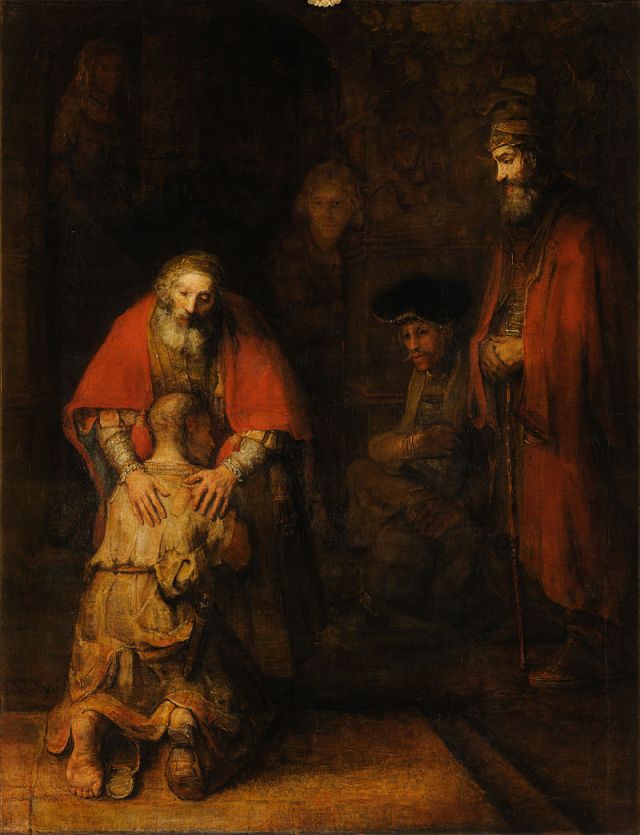
The Return of the Prodigal Son by Rembrandt van Rijn

But while he was still a long way off, his father saw him and felt compassion, and ran and embraced him and kissed him… “For this my son was dead, and is alive again; he was lost, and is found” (Luke 15:20, 24).

Is it possible for any one of us to be too far gone from God’s perspective? Some may think so. They imagine God to be patient with people, but that eventually His patience runs out. In Christian circles, I often hear people describe certain individuals as “the hard cases” — those who seem so stubbornly resistant to God and His love that they are, we imagine, beyond hope.

I recently heard a man tell his story of Jesus rescuing him when he was at his absolute lowest point in life. He had been living on the streets, was addicted to heroin, and despised anything with a whiff of Christianity. Yet, to his astonishment, he crossed paths with a young woman who told him about the love God had for him in Jesus Christ. Many years later, in God’s marvelous timing, this man cried out to God for mercy, and God opened his heart to receive Christ. Although change in his life took time, he was immediately aware that he was a new man. Over the next few years, his life transformed dramatically. Thinking back to what God had done in his life, he said he now felt like “God’s trophy” of grace that God could show off to the world, as if to say, “Look what I can do in someone’s life.”

Relationship over Religion

When Jesus of Nazareth showed up on earth, He said some strange things. For example: “I have not come to call the righteous, but sinners to repentance” (Luke 5:32). To many, this sounded confusing. Wait, Jesus wants to hang out with those who rebel against God? I thought He only wanted to be with the morally upright?  They even nicknamed Jesus “friend of tax collectors and sinners” (Matthew 11:19). It was meant as an insult. Jesus pointed these Pharisees (admired for their obedience to the law) back to Hosea 6:6, where God says, “I desire steadfast love and not sacrifice, the knowledge of God rather than burnt offerings.” In other words, God was saying, “I don’t merely want your ritualistic sacrifices thoughtlessly brought to me like Baal or one of the countless other pagan gods. I want you to know Me.”

Jesus told a story to some of the religious elite in His day that captured what the heart of God is really like. These religious do-gooders imagined that they were on God’s good side. “After all,” they seemed to say, “Surely God will take into account all our moral efforts.” What they missed, however — and what I fear many who grew up in the church miss — is that God is more interested in a relationship with His children than with religious compliance.

A Lost Son

“There was a man who had two sons,” Jesus began (Luke 15:11). The younger, impetuous son had the audacity to ask his father for his share of the inheritance that was coming to him. Even today, if someone asked a parent for his inheritance early, they would be frowned upon. In ancient times, however, this would have been the equivalent to saying, “Father, I wish you were dead.” The younger son wanted his father’s stuff, but cared little for the father himself. But it is even more surprising that the father actually complied with his son’s wishes. The community would expect the father to revoke any expected inheritance and shun his son as an insolent boy.

Jesus goes on to say this foolish son travels to a “far country,” presumably so he can get away from his father and out from under all the household rules and restrictions. Now, in this land of the Gentiles, this Jewish boy was free to gratify every desire that was forbidden in his father’s house. No doubt this young man attracted many. He wore the finest robes, ate the most scrumptious meals, and had everything money could buy. This young fool squandered all his father’s hard-earned wealth on prostitutes and whatever else he craved in the moment (v. 30).

But eventually, this fool began to reap what he had sown. Just as he spent his final coin, a terrible famine afflicted the land. Therefore, Jesus says, “he began to be in need” (v. 14). The harsh realities of the fleeting satisfaction of sin, the transitory nature of wealth, and the unpredictable vagaries of life in a fallen world all came crashing down on him in a moment. In desperation, “he went and hired himself out to one of the citizens of that country, who sent him into his fields to feed pigs” (v. 15).

Jews considered swine “unclean” (Leviticus 11:7). To be hired by a Gentile to feed such animals was just shameful. It gets worse though: “He was longing to be fed with the pods that the pigs ate, and no one gave him anything” (Luke 15:16). Here was a man at the lowest of lows. Only a short time ago, he was the envy of the neighborhood, as he spent his wealth on every thrill and entertainment imaginable. Now, he sat in his rags, wallowing in the mud like a beast, envious of filthy swine because they at least had their pig slop.

He Came to Himself

It was in that pigsty that a thought occurred to him. For a season, the young man had attempted to push away any thought of his father altogether. But now, the thought of the man he had once so brazenly scorned entered his mind. “How many of my father’s hired servants have more than enough bread,” he mused, “but I perish here with hunger!” (v. 17).

Jesus says, “He came to himself,” finally recognizing what a fool he had been. All the so-called friends he had acquired recently came and went with his cash. None of them had even the slightest care for him now that he was nothing but a miserable worm in their eyes. The painful thought dawned on him: he had turned his back on the one man who genuinely loved him. But after such a gross display of rebellion, would his father ever take him back, this son who had so impudently slapped him across the face by wishing he was dead?

As he starts the long journey home, the young man prepares his “I’m sorry” speech, reciting in his mind: “Father, I have sinned against heaven and before you. I am no longer worthy to be called your son. Treat me as one of your hired servants” (vv. 18-19). The confession is sincere, no doubt, but from his plea we can hear the sickly strain of legalism. He calls himself “unworthy,” and he was certainly right, so far as that goes. But he imagines his only hope is for his father to graciously hire him as a slave. Perhaps he imagines he can one day pay off his grievous debt as a last-ditch effort to gain his father’s approval. It is significant that the only reason he’s willing to return home, with head hanging in shame, is his realization that the one he once called “Abba” is unlike anyone else he knows. His father is a generous man, eager to bless others.

His Father Saw Him

“And he arose and came to his father. But while he was still a long way off, his father saw him and felt compassion,” (v. 20). Oh, what precious words are these! While this pitiful son was still in the distance, perhaps before he ever saw his father, his father saw him. The father, who had been faithfully gazing at the horizon, finally saw that for which he had long hoped. But what a miserable looking fellow: dressed in rags, weak and starving frame, and covered in filth and shame. He was perhaps the most wretched and unlovely creature his father had ever seen. And yet, his father “felt compassion, and ran and embraced him and kissed him” (v. 20).

The ancient Greeks loved to show off their calves, but for a Jewish nobleman to gather up his flowing robes and race down the road in a dead sprint would have been unheard of. In fact, it would have brought him dishonor in the eyes of others. Do you see what is happening here? Whereas before the shameful sight would have been this stumbling reject returning to his home, now the father has, in a sense, traded places with his son. Because of his great love for his son, he is now the one bearing the shame. The son would return home not alone, but under the protective arm of his father.

The onlookers must have stared in amazement. Had not this pathetic fool spat in his father’s face? And now his father receives this rebel without a cause with open arms? Before the broken man can get a word out, his father is holding him against his chest and planting a kiss on his head. In fact, in the original Greek, it says, the father “kept on kissing him.” Can you imagine a more lavish display of acceptance? When was the last time you were greeted this way at a family reunion?

With quivering lips, the son tries to get out his confession and make his plea, but before he can even ask to be made a slave, the father interrupts him. “Bring quickly the best robe,” he commands the nearest servant, “and put it on him, and put a ring on his hand, and shoes on his feet” (v. 22). The robe, the ring, and the shoes all symbolize one thing: this young man is the master’s son, not slave.

Though tears no doubt fill the father’s eyes, he loudly proclaims a feast will be held in his son’s honor. This is no time to mourn. It is time to celebrate! “For this my son was dead, and is alive again! He was lost, and is found!” As the New Living Translation puts it: “So the party began” (v. 24).

Our Compassionate Father

What follows at the end of this grand story that Jesus tells is actually the most disturbing. The elder brother, who is working out in the fields (as always), learns of his brother’s return and, rather than rejoicing, he responds with smug self-righteousness. How dare this foolish sinner show his face around here again!

The father, in yet another display of compassion and grace, goes out to the field and pleads for his elder son to come home. But, with curled lip, the elder son replies, “Look, these many years I have served you [literally, “slaved for you”], and I never disobeyed your command, yet you never gave me a young goat, that I might celebrate with my friends. But when this son of yours came, who has devoured your property with prostitutes, you killed the fattened calf for him!” (vv. 29-30). The elder son’s bitter tone betrays his failure to ever really love his father. He sees all his acts of obedience as joyless slavery. He wanted to celebrate with “friends,” but never to delight in the father himself.

The tragedy is that although this elder son stayed home, he was just as lost as the younger son once was. The father tells him, “All that is mine is yours.” In other words, if you had only asked to delight in what is mine, I would have gladly celebrated with you. The younger son, though a wretched sinner, had returned to the arms of his father, recognizing the generosity of this old man. “It was fitting to celebrate and be glad, for this your brother was dead, and is alive; he was lost, and is found” (15:32).

Jesus told this parable so that we would have a renewed understanding of God. Norval Geldenhuys has rightly said, “So inexplicably wonderful is the love of God that He not merely forgives the repentant sinner, but actually goes to meet him and embraces him in His love and grace.”[1] No matter how long a sinner has lived in staunch rebellion, God is always eager to welcome him or her home. He runs out to meet the one hanging their head in shame. How vital it is to remember that all we have is by sheer grace, and when yet one more prodigal son finds grace in the arms of our compassionate Father, it is only right that we should celebrate.


[1] Norval Geldenhuys, The Gospel of Luke, New International Commentary on the New Testament (Grand Rapids: Eerdmans, 1951), 408.


The Holy Mystery of Christmas

By Jason Smith

Worship_Advent-Wreath4_2015

“He made himself nothing by taking the very nature of a servant, being made in human likeness. And being found in appearance as a man, he humbled himself by becoming obedient to death— even death on a cross! Therefore God exalted him to the highest place and gave him the name that is above every name, that at the name of Jesus every knee should bow, in heaven and on earth and under the earth, and every tongue acknowledge that Jesus Christ is Lord, to the glory of God the Father” (Philippians 2:7-11, NIV)

I was reading from one of my heroes, Dietrich Bonhoeffer, recently. Bonhoeffer was a German Lutheran pastor who took a stand against Nazism’s cruelty during the Third Reich’s reign of terror. In one of his Christmas sermons, he reminded his listeners to contemplate the “holy mystery” of Christmas. Rather than trying to “figure out” how God could become a human or domesticating Christmas to a quaint little Nativity scene, complete with a smiling baby Jesus and cute little barn animals looking on, he said we ought to be filled with wonder during this season.

Bonhoeffer reminds us that Christmas is about God entering this world and being rejected even at the birth of Christ. Our Lord was placed in a manger — a feeding trough — not because it matched the décor of His nursery back home in Nazareth, but because no one was willing to give up their bed for Him or even His very pregnant mother.

In Matthew’s account, we read of the sinister King Herod who, upon learning of Jesus’s birth, immediately sought to destroy Him. An entire town suffered the loss of their male babies, simply because a jealous king thought he could undo the saving plan of God. Like Hitler in Bonhoeffer’s day, Herod was willing to slaughter the weak, underprivileged, and oppressed in order to assert his power over others. Sure, the biblical portrait of our Lord’s arrival puts less emphasis on having a “holly jolly Christmas,” but doesn’t Scripture give us a much more realistic portrait of our problem, and therefore what we truly need? In fact, the Bible offers a picture of hope that our world is desperate for today.

Holy Scripture tells us just what was happening that first Christmas so long ago: “The true light, which gives light to everyone, was coming into the world” (John 1:9). That is one reason our family hangs Christmas lights and lights candles every year. Those tiny lights serve as a reminder that on that cold night long ago, the true Light was coming into this world, piercing the darkness. This thought is staggering. Into a world being ripped apart by hatred, selfishness, racism, oppression, and greed, Jesus came. “And that is the wonder of all wonders,” Bonhoeffer writes, “that God loves the lowly … God is not ashamed of the lowliness of human beings. God marches right in.”[1]

The Gospel of John continues, “He was in the world, and the world was made through Him, yet the world did not know Him. He came to His own, and His own people did not receive Him” (John 1:10-11). This is not so much an indictment on the Jewish people as it is on the entire human race. We all need to own up to our disregard of God in our lives. Even those who cherish Jesus as their precious Savior and Lord today didn’t always do so. And still today most of the world rejects Jesus for who He truly is: the Son of God and Savior of the lowly.

Despite the hostility this world had toward Him, Jesus still came. He knew the cost of sharing in our humanity and experiencing the consequences of our brokenness. He knew that loving us to the end would mean dying a sacrificial death in our place. And yet, Jesus still came. But why did He come? Why go through all the trouble of living in this distressed and hurting world?

This brings us to the great hope of the gospel. John says, “But to all who did receive Him, who believed in His name, He gave the right to become children of God, who were born, not of blood nor of the will of the flesh nor of the will of man, but of God” (John 1:12-13). God came as a little baby, but He did not stay a baby. Jesus grew to full manhood, loving both God and neighbor each step of the way. All the way, in fact, to the cross.

The holy mystery of Christmas is that despite all the reasons He could have left us to ourselves, Jesus still came, in obedience to His heavenly Father’s will. And because He was the obedient Son, we who have “believed in His name” are granted the overwhelming privilege of becoming children of God Most High. This is where the true joy and peace of Christmas is found. Stop and wonder at the mystery of it all this Advent season.

[1] Dietrich Bonhoeffer, God Is in the Manger, trans. Jana Riess (Louisville, KT: Westminster John Knox Press, 2010), 23.

What Is God Like?

By Jason Smith

“‘To whom then will you liken Me that I would be his equal?’ says the Holy One” (Isaiah 40:25).

beautiful-sunrise-banjarmasin-1492545578 - Rose Barraza

Theologian A. W. Tozer once said, “What comes into our minds when we think about God is the most important thing about us.” That is a thought-provoking statement, isn’t it? There seems to be a whole world of ideas resting on Tozer’s conclusion. He went on to say, “For this reason the gravest question before the Church is always God Himself, and the most portentous fact about any man is not what he at a given time may say or do, but what he in his deep heart conceives God to be like. We tend by a secret law of the soul to move toward our mental image of God.” [1]

In other words, our view of God will always influence what we, His image-bearers, aspire to be — whether we are aware of it or not. How we answer the single question “What is God like?” tells us a great deal about ourselves. As many have put it, we become like what we worship.

So what is your view of God? Is He stern and demanding? Is He persistently jovial like Santa Claus? Is He loving? Is He distant? Is He everywhere but still hard to find? Is He even real? Is He disappointed all the time? Or what about this one: is He so incredibly compassionate that He is willing to suffer with you and even die for you? I wonder how you might answer any one of these questions. When you stop to think about it, to ask such questions is to put your finger on the most fundamental issue of life. What is God like? What could possibly be a more important question to consider? The purpose of the entire universe hinges on God’s existence, nature, and character.

In the Beginning

The Gospel of John begins with this astounding claim about Jesus of Nazareth: “In the beginning was the Word, and the Word was with God, and the Word was God. He was in the beginning with God. All things were made through Him, and without Him was not anything made that was made” (John 1:1-3). Then John tells us that this Word who “was God” did something we struggle to even wrap our minds around. “And the Word became flesh and dwelt among us, and we have seen His glory, glory as of the only Son from the Father, full of grace and truth” (v. 14). The unseen Creator (v. 3) and Son of God (v. 14) made Himself visible to the world.

At this point, our minds, hungry for answers, begin to bump up against their limits. How does the infinite, all-powerful God of perfect majesty become a helpless and tiny human baby, completely dependent on His young mother? John does not say the Word ceased being the infinite God; instead, He added humanity to His divinity. In this way, the God of the universe made Himself approachable, tangible, and truly knowable. To the average Joe, this Word-made-flesh would have looked so ordinary. He did not hover above the ground everywhere He went. His face did not emit a paranormal glow. And He certainly wasn’t ensconced in an effervescent cloud everywhere He traveled. Instead, this God-man not only appeared every bit as human as you and me, He actually was.

In verse 17, John elaborates: “For the law was given through Moses; grace and truth came through Jesus Christ.” The great deliverer Moses revealed certain things about who God is, through the law. The law expressed God’s goodness, justice, and holiness. It also expressed His compassion. When Moses brazenly pled with God to show him His glory, God rejected his request — at least partially (Exodus 33:18-20). Essentially, God told him, “I can’t do that, Moses. You’d die if you came into contact with the fullness of My glory.”

Yahweh, Yahweh

Therefore, God revealed Himself to Moses in a different way, by pairing His eternal Name “Yahweh”[2] (which He first revealed to Moses back in Exodus 3) with a description of His character. God took Moses up onto a mountain and “covered” him with His hand while the full radiance of His divine being passed by. The quivering Moses would only be allowed to witness the tail end of God’s glory so that he could live another day. But in that mountaintop experience God Himself proclaimed to Moses — and, by extension, to us — what He is like.

“Yahweh, Yahweh, a God merciful and gracious, slow to anger, and abounding in steadfast love and faithfulness, keeping steadfast love for thousands, forgiving iniquity and transgression and sin, but who will by no means clear the guilty, visiting the iniquity of the fathers on the children and the children’s children, to the third and fourth generation” (Exodus 34:6-7).

Here, in the law (or Torah), God’s perfect character is revealed. Yahweh tells us He is merciful, gracious, slow to anger, abounding in steadfast love, faithful, and forgiving. Yet, here is where we meet one of Scripture’s classic paradoxes. Right after saying He is both ready and eager to forgive sin, God tells us He “will by no means clear the guilty” (v. 7). How are we to make sense of this? Doesn’t a willingness to forgive imply a willingness to clear the guilty? No, and here we see the coming together of two fundamental truths about God. He is more gracious, loving, and forgiving than we could ever dare to imagine. However, He is simultaneously more just, holy, and pure than we ever thought possible. So where does this leave us? How do we solve this apparent enigma?

Scripture repeatedly affirms that we have a big problem, and that is our sin. The Bible tells us “there is no one who does not sin” (1 Kings 8:46). Although we are prone to think of ourselves as good people (Proverbs 20:6), God knows our hearts. And His verdict is clear: “If we say we have no sin, we deceive ourselves, and the truth is not in us” (1 John 1:8). When we consider all this, there seems to be one disturbing conclusion: we are the guilty of Exodus 34:7. Therefore, we each have much at stake in understanding how God can be both forgiving and just.

Grace and Truth

Jumping back to the first chapter of John’s Gospel, let’s see that statement in verse 17 once again. “For the law was given through Moses; grace and truth came through Jesus Christ.” Now think about this. Grace and truth are really the twin concepts above that we are trying to reconcile. God is supremely gracious by nature and eager to forgive sin. On the other hand, if even a human judge decided to let a serial killer go free because he showed himself sufficiently sorry, you would not accept that. You would not call such a judge extraordinarily forgiving; you would call him corrupt. Why? Because to let the murderer go would be unjust.

Similarly, overlooking sin would be unjust because it would be treating the serious crime of rebellion against the King of Heaven as a minor infraction, which it is not. It would not be in keeping with the truth. John is telling us that grace and truth are fully realized, revealed, and reconciled in Jesus Christ alone. In a sense, the paradox of God’s statement about His own character in Exodus 34 has been hanging in tension all through Scripture — that is, until the arrival of Jesus.

In Jesus, God’s character is embodied and illuminated with vivid and vibrant colors in high definition. “No one has ever seen God; the only God, who is at the Father’s side, He has made Him known” (John 1:18). In the original Greek, it actually says that Jesus has exegeted or fully explained God. That is, in Jesus we see what God is really like. That is why Jesus can later refer to Himself as “I Am” (Yahweh) (8:58) and even tell His disciples, “Whoever has seen me has seen the Father” (14:9).

Look at Jesus

But again, how can God both forgive sin and not overlook sin? How can grace and truth be reconciled? When Jesus first began His earthly ministry, John the Baptist heralded Him as “the Lamb of God, who takes away the sin of the world!” (1:29). With that statement, John pointed ahead to the cross, where Jesus, like a sacrificial lamb, would lay down His life for the world. 700 years before Christ’s crucifixion, the prophet Isaiah wrote:

“But He was pierced for our transgressions;
He was crushed for our iniquities;
upon Him was the chastisement that brought us peace,
and with His wounds we are healed.” (Isaiah 53:5)

We can be forgiven of our sin, but only if we believe in the One who bore our sin for us and was punished in our stead. That is why God’s character is never more vividly portrayed for all the world to see than in the cross of Jesus Christ, where both His astounding love and His perfect justice are on full display. As the psalter so beautifully writes, “Lovingkindess and truth have met together; Righteousness and peace have kissed each other” (Psalm 85:10). Scripture says that when we place all our trust in Christ’s sacrificial death and victorious resurrection, we are forgiven, cleared of all guilt, and found righteous in Christ (Romans 10:9-10; 2 Corinthians 5:21; Galatians 2:16).

So how do we know what God is like? Look at Jesus. More specifically, look at Jesus on the cross. There, on Calvary, with hands outstretched to embrace a world that has rejected Him, we see what God is like.

Photo credit: Rose Barraza

[1] A. W. Tozer, The Knowledge of the Holy (Zeeland, MI: Reformed Church Publications, 2017), 1.

[2] In most English translations, the Hebrew name of God, “Yahweh,” is translated simply as “the LORD” (all caps), but a closer translation is more like “I Am” or “He Is.” In other words, Yahweh is the self-existent, eternal, and personally present Creator.

How Should Christians Vote?

By Jason Smith

“Let every person be subject to the governing authorities. For there is no authority except from God, and those that exist have been instituted by God” (Romans 13:1).

Vote-Here-Marg Johnson

You might be wondering if I really have the gall to tell you how you should vote in the sense of recommending for whom or what specifically you should vote. But that is not my intention here. In fact, to do so would undermine much of what I have to say in this post. Instead, my aim is to challenge followers of Jesus Christ to consider thoughtfully both the manner and mindset with which they will vote this year.

It is a painful truism to say that our nation is deeply divided, particularly in the sphere of politics. Rarely has our nation witnessed such stark and severe polarization between conservatives and liberals. In the United States, one’s “political party” has practically become a euphemism for which side of the nation’s battle lines you have decided to take your stand. In the wake of the 2016 presidential election, a seemingly endless stream of vitriolic verbal attacks were lobbed back and forth like hand grenades on social media. In the midst of all the upheaval, many simply tried to duck for cover, fearing the next venomous insult might strike them.

How did it come to this? While the two-party structure has been in place in the United States since before the Civil War, rarely has so much hatred been spewed between the two parties. Like a sailor struggling to cross the deck of a ship being rocked by an intense storm, the nation feels unsteady. The Right and the Left have become ideological fortresses so cemented in their way of thinking that there seems to be no signs of fruitful dialogue. As a nation, I fear we have lost the art of civil persuasion. Instead, we have resorted to mindless mud-slinging and sardonic put-downs. Simply put, we need help.

I want to encourage you to think carefully about who you are as a Christian and how this should utterly transform the way we approach the voting booth. To do this, we need to look at Scripture. God has offered us the help we so desperately need in these politically trying times.

Christians Should Vote Biblically

The Christian’s source for truth and wisdom is Scripture. Therefore, in every area that we vote, we should be asking, “What does the Bible say on this matter?” The Bible is an ancient book, but it is never outdated. “All Scripture is God-breathed and is useful for teaching, rebuking, correcting, and training in righteousness, so that the servant of God may be thoroughly equipped for every good work” (2 Timothy 3:16-17, NIV). That statement is as true today as it was when Paul wrote it. It is because of that first clause — all Scripture is God-breathed — that everything else follows. We can be fully “equipped for every good work” (including voting) because our God has actually spoken to us and not left us to work out everything according to our own fallible wisdom. Political opinions come and go. Cultural controversies have their day in the sun. But “the word of our God will stand forever” (Isaiah 40:8, ESV). On any issue we vote on, we should make it our goal to seek biblical wisdom on the matter.

Your Identity Is in Christ, Not a Political Party

This world is constantly trying to stuff people into certain categories, be they social, political, economic, or ethnic. You must be this and not that. But the cross of Jesus Christ forever stands as a witness against this way of thinking. “There is neither Jew nor Greek, there is neither slave nor free, there is no male and female, for you are all one in Christ Jesus” (Galatians 3:28). Your most fundamental identity is not dictated by whether you check the red or the blue box. Rather, it is found in Christ alone.

Don’t fall into the trap of thinking of yourself most fundamentally as belonging to either the Republican party or the Democratic party. Recognize the deeper and eternal reality underneath all those transitory layers. Here’s an important question to consider: At the absolute core of who you are, do you identify more as an American or as a follower of Jesus Christ? Just remember that earthly kingdoms, by their very nature, will not stand forever. Only the kingdom of God will last into eternity.

Your Vote Is Important, but Not Ultimate

When Jesus stood before Pilate, bleeding and in chains, the Roman governor viewed his own power as ultimate. Did he have to answer to Caesar? Of course, but Caesar was over 1,000 miles away. When Jesus refused to respond to his interrogation, Pilate was indignant.

So Pilate tried another tactic, reminding Him who was in charge here. “You will not speak to me? Do you not know that I have authority to release you and authority to crucify you?” (John 19:10). In today’s vernacular, Pilate was confidently asserting, “Just remember, I’m the big cheese around here.” As is often the case for those in seats of power, Pilate hoped Jesus would at least acknowledge his supremacy.

Instead, Jesus calmly turned to him and replied, “You would have no authority over me at all unless it had been given you from above. Therefore he who delivered me over to you has the greater sin” (v. 11). Wow. In other words, “Pilate, you wouldn’t even be standing in this position unless My Father had given it to you. You are actually a servant of God’s greater purposes in spite of yourself.” This is true of every government official according to Romans 13:1: “Let every person be subject to the governing authorities. For there is no authority except from God, and those that exist have been instituted by God.”

Our votes are important, but they are not ultimate. Why? Because human governments are not ultimate. God alone is sovereign over the nations (see Psalm 2). As Daniel said of the one true God while living in a land full of false gods, “Blessed be the name of God forever and ever, to whom belong wisdom and might. He changes times and seasons; He removes kings and sets up kings; He gives wisdom to the wise and knowledge to those who have understanding” (Daniel 2:20-21). The only reason anyone is in any government position at all is because God determined it so. “He removes kings and sets up kings.”

Pilate was a wicked man willing to slaughter Jews in order to reassert his power (Luke 13:1). Yet Jesus says that God had good purposes for this evil man in office. Voting matters, but only because God can use even the most heinous persons to accomplish His mission in the world. Human freedom does not nullify the sovereignty of God. So vote, but vote with the recognition that ultimately you do not place anyone in any position of authority. That is the job of our sovereign God alone, and we should be thankful for that.

Vote with the End in Mind

Politicians promise many things. After a while, many of these promises seem a bit empty. However, there are promises found in Scripture that the follower of Jesus can bank their life on. The brightest, fullest, and most audacious hope one can ever dream of is found in the pages of Scripture. I’m talking about resurrection, the ultimate goal of the Christian life. On that Day, when the curtain rolls back, the world will see Jesus for who He truly is, and His kingdom will be unveiled and finally consummated in full. It will be said, “Behold, the dwelling place of God is with man. He will dwell with them, and they will be his people, and God himself will be with them as their God. He will wipe away every tear from their eyes, and death shall be no more, neither shall there be mourning, nor crying, nor pain anymore, for the former things have passed away” (Revelation 21:3-4).

Even today, however, Jesus rules from His throne in heaven. He’s not in the tomb; He hasn’t been for nearly 2,000 years. From the moment He conquered death in history, Jesus “must reign until he has put all his enemies under his feet. The last enemy to be destroyed is death,” (1 Corinthians 15:25-26). As we vote this year, followers of the risen Lord must vote with this hope in mind. This settled peace and assurance will keep us from angry name-calling and hostile aggression whenever the volatile topic of politics comes up. Ultimately, we are not awaiting our candidate’s election. We are awaiting the trumpet blast, and the return of our now reigning Lord (v. 52).

Photo Credit: Marg Johnson

Love Must Be Genuine

By Jason Smith

Let love be genuine. Abhor what is evil; hold fast to what is good” (Romans 12:9).

five-friends-smiling-Petar Chernaev

“In my experience, the church has done more harm than good,” the young man told me. The words sounded a bit calloused and unmeasured at the time. In response, I began pointing out all the good the church has done over the last 2,000 years. I asked him if he knew how the first hospital came to be. He said he did not.

I told him about how leprosy (often called Hansen ’s disease today) was a common malady during the first several centuries of the church. Since leprosy is contagious and there was no known cure at the time, lepers were banned from society and restricted to camps where they languished in isolation, cut off from basic provisions and medical care. A leprous person was labeled “unclean,” and therefore, unwanted. During the fourth century, a church father named Basil of Caesarea felt compelled to do something about this. Although he feared contracting leprosy, he saw the way the Jesus of the Gospels treated lepers. He loved and accepted them. In a world that deemed every leper unclean and untouchable, Jesus was willing to do the unthinkable.

“A leper came to Him and knelt before Him, saying, ‘Lord, if You will, You can make me clean.’ And Jesus stretched out His hand and touched him, saying, ‘I will; be clean.’ And immediately his leprosy was cleansed” (Matthew 8:2-3).

After pondering this account, a light bulb went on in Basil’s head. “What if we build a place to love and care for lepers? They don’t have money. They don’t even have to pay for it. We’ll raise the money.”[1] This idea led to the founding of the very first hospital.

After sharing this story, I studied the young man’s reaction. I hoped for at least a flicker of a changed opinion regarding the church. Instead, he shrugged and, with a curt smile, said, “That’s cool that that guy did that, but that doesn’t change my experience.” He had a point. Despite all the incredible acts of kindness and love the church has done throughout history, this really had no bearing on this young man’s experience with the church.

The reality is that the church is filled with imperfect people. It was in Basil’s day, and it is today. This interaction reminded me just how painful and destructive hypocrisy in the church can be. Hurtful experiences in one particular church have led not a few to walk away from the church altogether. It’s a tragic thing, but it reminds me just how essential it is for followers of Christ to never rest on our laurels but to live out His love in each generation. Hypocrisy is something we must persistently guard against in our own hearts.

The thorny weed of hypocrisy often grows out of the soil of a heart that has not been regularly tilled by the gospel. The gospel is a message of sheer grace, reminding us that even while we were weak, sinful, and undeserving, God chose to love us and sent Jesus to die in our place — not because there was something good in us, but in spite of the fact that there was not (Romans 5:6-8).

Hypocrisy often has its roots in legalistic tendencies that focus on outward appearance rather than a transformed heart. When looking good in front of others begins to internally outweigh the importance of loving others, the ugly seed of hypocrisy is sure to germinate. And much like leprosy, hypocrisy can spread rapidly when it begins to infect a community. It can begin with subtle inconsistencies, which in time breed a self-satisfied religiosity that ultimately forgets what it means to be a follower of Jesus.

Basil of Caesarea reminds us that to be Christ’s church is to be called to a life consistent with Christ’s teaching and example. Jesus calls His followers to genuinely love not merely those who look, talk, and vote like us, but even our enemies (Matthew 5:44).

Jesus clearly identifies with the church (Acts 9:1-5), and we are called His ambassadors (2 Corinthians 5:20). Therefore, we should listen closely to Jesus’s opinion of hypocrisy. Although we often think of Jesus as gentle and mild, tenderly holding a little lamb in His arms, this is far from the complete picture. In fact, it is fair to say that almost nothing in the Gospels draws Jesus’s righteous ire like religious hypocrisy and self-satisfied legalism.

“Woe to you, scribes and Pharisees, hypocrites! For you are like whitewashed tombs which on the outside appear beautiful, but inside they are full of dead men’s bones and all uncleanness. So you, too, outwardly appear righteous to men, but inwardly you are full of hypocrisy and lawlessness” (Matthew 23:27-28).

That’s not a passage you typically see printed on the side of a mug sold at a Christian bookstore. Nevertheless, they are the words of Jesus. At the same time, Jesus showed astonishing love toward self-righteous hypocrites (Mark 10:21). Therefore, those who claim to follow and represent Him in this generation must commit to love the Other genuinely, ensuring that the words of our lips and the actions of our hands align with the will of our Lord.

Prayer: Lord Jesus, help me learn to live out what it means to genuinely love others — especially those most unlike me — in the same manner You do (Romans 12:9).


Photo Credit: Petar Chernaev

[1] John Ortberg, Who Is This Man? (Grand Rapids, MI: Zondervan, 2012), 39.

Eyes to See the Hurting

By Jason Smith

“Whoever oppresses a poor man insults his Maker, but he who is generous to the needy honors him” (Proverbs 14:31).

Sad Man (Cameron Cretney)

We’ve all been there. We pull up to the intersection and notice a man or woman on the corner holding a cardboard sign telling you of their distressing situation in life. A backpack or a dog can often be seen next to them. The temptation for us — for myself at least — is to look the other way. To pretend not to notice. Maybe we feel awkward, not knowing what to give or what to say. But if we are honest with ourselves, it can often be that we don’t want to notice them.

Here’s a radical thought: God always notices them. He takes note of their situation. God sees the homeless person, the hurting person, and the hungry person as just that: a full-fledged person. According to the Bible, every single human on the planet bears the image of God and therefore has inestimable value (Genesis 1:26-27). You can’t calculate the worth of someone who is made to know and reflect the God of infinite worth.

At the beginning of Acts 3, we read an interesting account about two of Jesus’s disciples encountering a beggar at the entrance of the temple. Most people passing by probably ignored the man, eager to get inside the temple — the place where one could really show one’s devotion to God. A lot could be said about the temple. However, it is worth noting the fascinating connection that Luke, the author of Acts, makes here. Like a master storyteller, Luke pulls several different plotlines together to show that what happens in this scene perfectly fits with God’s wise plan from eternity.

In the first chapter of Acts, Jesus’s final charge to His followers before His ascension into the clouds is to wait for the Holy Spirit (Acts 1:5, 8). The Holy Spirit’s arrival meant that God’s very power and presence would “come upon” them — not in the flash of a mere moment but permanently. In this way, God’s people would be empowered to rightly represent God’s character and share God’s message of how to be reconciled to Him. In Acts 2, several Jesus followers gather in one house, as if waiting expectantly for God’s next move. The Holy Spirit does indeed arrive with the blast of a localized hurricane and, oddly, with little tongues of fire hovering over each person’s head. Without any context, this would look pretty bizarre — like something out of a Harry Potter novel. And yet, we must remind ourselves, God always has His reasons.

In the Old Testament, fire often indicated the presence of God (Exodus 3:1-5; 19:18; 24:17). When the children of Israel streamed out of Egypt in the exodus, a pillar of fire led them by night, signaling God’s presence with His people. After the tabernacle in the desert was built, the same pillar of fire hovered above it, reminding the people daily of their Creator’s nearness and desire to dwell with mere mortals (Exodus 40:38). Years later, when the temple is built in Jerusalem, once again fire shows up, visibly manifesting the presence of an invisible God (2 Chronicles 7:1). With Acts 2 and the arrival of the Holy Spirit, Luke highlights the same truth: God has come near. However, now He is not just dwelling with but in His people. In other words, the people of God are the new tabernacles and temples.

Fast forward to Acts 3, and we find Peter and John, now indwelled by the Holy Spirit, heading toward the temple. They are on their way to church, yet they don’t let their piety obscure their view of the lame beggar. Luke writes, “Seeing Peter and John about to go into the temple, he asked to receive alms. And Peter directed his gaze at him, as did John, and said, ‘Look at us’” (Acts 3:3-4). The beggar makes himself visible, and Peter does not look the other way. In fact, he looks him square in the eyes and tells the beggar, “Look at us.” This man who had been “lame from birth” needed to see that he was seen (v. 2). Throughout his life, this man had probably gotten used to being overlooked. In all those years of being carried around everywhere, perhaps he’d decided he was more a burden than a blessing to others. Nevertheless, with eyes locked on the man, Peter tells him, “Look at us. We notice you.” And more importantly, by implication, God notices you.

Peter and John, now filled with God’s presence and love, had eyes to see this man in a new and supernatural way. Rather than barring this man from the temple, the place where God’s glory traditionally dwelled, Peter and John drew near, letting him know God was present outside the temple too. No longer was he seen as just a drain on society, or even someone to pity but not value. Peter noticed the man and offered him not money — he had none — but healing “in the name of Jesus Christ of Nazareth” (v. 6). In short order, the man began “walking and leaping and praising God” (v. 8). Perhaps with a tear of joy trickling down his face, this grown man bounded around like a kid in a candy store for the very first time. More than “silver and gold,” which do not last, what this man most needed was the touch of God. The miraculous healing offered Peter the rapt attention of the stupefied onlookers. So he seized the opportunity to point them to God’s compassionate character seen in the cross and resurrection of Jesus (vv. 12-26).

When we have eyes to see the hurting around us each day, who knows what might happen? Rather than offering a prescription detailing how to love each hurting person you encounter, I simply want to point out from Acts 3 the importance God places on seeing the hurting person in the first place. I suspect that God will lead you from there to love that person after the pattern of Jesus.

Prayer: Father God, please open my eyes to see the hurting person as You see them. Remind me that when I honor the poor I am honoring You (Proverbs 14:31).

Photo credit: Cameron Cretney