Death I Do Not Shrink From

For most people in the world, the grave is a terrifying prospect. Not many like to even think about it, but we all know deep down that these bodies don’t last forever. We all know the shadow of death looms on the horizon, inching its way toward us. No matter how much exercise we get or kale we eat, we won’t live forever!

One journalist, Tom Chivers, wrote: “I’m terrified of death; my own, my loved ones, everyone’s … 100 years after my death, no one will really know who I was. Do you even know your great-grandparents’ names?” Some think of death as the final end to our existence. Former CNN broadcaster, Larry King, once said, “My biggest fear is death, because I don’t think I’m going anywhere.” More humorously, Mel Brooks put it this way, “If Shaw and Einstein couldn’t beat death, what chance have I got? Practically none.”

As a human race, we try to push away the thought of death because it’s terrifying to think of life as we know it coming to an end and departing from our loved ones forever. At the same time, we also have this nagging sense that there is something beyond the grave. The Bible teaches that every single person who has ever existed is headed to one of two places: eternal joy in Heaven or eternal ruin in Hell. This is true for you, me, and everyone you have ever known.

In one very clear statement, Jesus said:

“Then he will say to those on his left, ‘Depart from me, you cursed, into the eternal fire prepared for the devil and his angels… And these will go away into eternal punishment, but the righteous into eternal life.'” (Matthew 25:41, 46, ESV)

A Fixed Day on God’s Calendar

What if reminders of death are actually a gift from God, urgent warnings meant to get our attention? Every time we attend a funeral, we are granted one more nudge about the brevity of life. Through these cues, God puts us on notice to be ready for death and what comes after.

Hebrews 9:27 says, “People are destined to die once, and after that to face judgment.” The real reason humanity fears death is because God has given us a sense that we will all stand before the bar of judgment one day. No one gets to call in sick for this exam day. The Lord of all will judge every one of us by His perfect and holy standard.

And therein lies the rub. This is our great predicament. God urges us not to shrug off this idea of a coming judgment. You can be casual with what you wear, but don’t be casual about one day facing God. Paul proclaims:

“So having overlooked the times of ignorance, God is now proclaiming to mankind that all people everywhere are to repent, because He has set a day on which He will judge the world in righteousness through a Man whom He has appointed, having furnished proof to all people by raising Him from the dead.” (Acts 17:29-31, NASB)

When God sets a day on His calendar, it is irrevocably fixed and certain. And on this day, you and I will have to stand before God and give an account of the life we’ve lived. Once you have felt the weight of this truth, your need for Jesus should become crystal clear. Because it’s at that precise point of our failure to ever measure up to God’s righteous standard that the gospel of God’s free grace becomes the most precious thing imaginable.

Perfect Righteousness in Christ

Many have seen they don’t measure up, so their solution has been to “get religious” and work as hard as they can to live a life pleasing to God, hoping that this will help them fare better on this coming day. Many even consider Jesus to be the One that helps them become the person they need to be, still aspiring to be good enough for God.

But the standard for entering Heaven isn’t “good enough;” it is perfection. We need a perfect righteousness, but only Jesus Christ, the God-man, is perfectly righteous. So our only hope is to be found in Christ.

In Jesus Christ, God offers us perfect forgiveness. When we repent and trust in Jesus alone as our Savior, all our sins are washed away in His blood—all our sins—because He bore them in our place on the cross. At the cross, the judgment for our sins fell on Jesus, so that by faith in Him we wouldn’t have to fear the judgment to come.

If you have found refuge in the Lord Jesus Christ, having cast yourself on His mercy alone to save you, you no longer need to fear death. Your eternity will be secure in His loving hands.

“Instead, clothe yourselves with the Lord Jesus Christ, and make no provision for the desires of the flesh.” (Romans 13:14, BSB)

When we are “clothed” in the righteousness of Christ, we are justified in Christ and reconciled to God. To be justified in Christ means that God declares us to be as righteous as Christ Himself, because we are united to Him by faith.

To Live Is Christ

Above, I quoted men who have dreaded the thought of death. In contrast, consider these remarkable words from Paul:

“For to me to live is Christ, and to die is gain. If I am to live in the flesh, that means fruitful labor for me. Yet which I shall choose I cannot tell. I am hard pressed between the two. My desire is to depart and be with Christ, for that is far better.” (Philippians 1:21-23, ESV)

Understand that Paul is not saying he’s longing for death itself. This is not the murmuring of someone contemplating suicide. He’s not looking forward to death itself, but to what comes after death. He says, “I am torn between the two. I so want to stay on with all of you and encourage your faith, but even more than that, what I really want is to just be with Christ. I want to be with my Savior, for that is far better.”

At the end of the day, Paul yields to whatever God sovereignly determines for his life. But if it were solely up to him, Paul would rather go through death, because nothing beats being in the presence of his Savior. This is not something true only of Paul, but of every person who has found refuge in Christ. Paul is simply taking eternal truth out of the abstract realm and applying it to how he faces every circumstance in life—including death.

When a Christian dies, there’s no soul sleep or purgatory that he or she must pass through. These teachings are man-made and not found in the Word of God. No, at the very moment of death, you are immediately ushered into the Savior’s presence (2 Corinthians 5:8).

But what does Paul mean when he says he eagerly expects and hopes to honor Christ “whether by life or by death” (Philippians 1:20). How will Paul’s death honor Jesus Christ? If he dies as one who is confident in his Savior’s power—not as one terrified of the grave—but as one assured that he will see his Savior face to face, he glorifies Jesus in his death.

When Paul says, “to live is Christ,” he’s saying, “As long as I’m here, I’m all in for Jesus. I live for His glory wherever he has me—whether preaching in the streets or in the court of Caesar or writing letters in a stinky jail cell.” When we come to Christ, we yield our lives to Him. Every follower of Jesus can say with Paul, “To live is Christ and to die is gain,” because at death we finally reach our reward—being with Jesus in Heaven.

Every day, millions of people live for something other than Jesus—entertainment, comfort, pleasure, career. But when you live for something other than Jesus, death results in the loss of everything. On the other hand, if Jesus is our Supreme Treasure in life, death results in gaining everything.

He Is No Fool

When we live all in for Jesus, He removes all fear of death. Death is no longer that looming specter that promises to take everything we hold dear. Strange as it may seem, death now becomes the doorway to joy, because all we could possibly want is found in Christ Himself.

John Chrysostom, an early church father, was known for criticizing the wealthy of his time for their lack of love for the poor. He was constantly getting into trouble because of the things he said. In fact, the authorities banished him twice. One of his followers once asked him if he feared for his life.

Here’s how Chrysostom responded:

“What can I fear? Will it be death? But you know that Christ is my life, and that I shall gain by death. Will it be exile? But the earth and all its fullness is the Lord’s. Will it be the loss of wealth? But we have brought nothing into the world, and can carry nothing out. Thus all the terrors of the world are contemptible in my eyes; and I smile at all its good things. Poverty I do not fear; riches I do not sigh for. Death I do not shrink from.”[1]

The great preacher Dwight L. Moody once said, “Some day you will read in the papers that D. L. Moody, of East Northfield, is dead. Don’t you believe a word of it! At that moment I shall be more alive than I am now.”[2]

It is this undying confidence in the Savior’s power to save that has compelled missionaries into grave dangers all over the world. Christians can die with courage, not because we are so great, but because we know a great Savior who loves us.

The martyr Jim Elliot put it best: “He is no fool who gives what he cannot keep to gain that which he cannot lose.”[3] For each of these godly men, their firm conviction about the life to come meant they could live boldly for Christ in this life. In the same way, Paul did not shrink back from death, if that’s what God has appointed. He continues:

“But to remain in the flesh is more necessary on your account. Convinced of this, I know that I will remain and continue with you all, for your progress and joy in the faith, so that in me you may have ample cause to glory in Christ Jesus, because of my coming to you again.” (Philippians 1:24-26, ESV)

Paul says, “I’m not afraid to die. In fact, I’d gladly go to Heaven now. To die is gain. However, it seems that God isn’t ready to call me home. He has some work for me to do first.”

And here’s what I want you to see. Because Paul had this eternal perspective, where God could call him home at any moment, he could be most effective for Christ. If he had an earthbound focus where all he cared about was the here and now and what he could accumulate for himself in this life, he would not be prepared to serve. The fact that Paul knew he had a great reward coming compelled him to spend his life for the glory of Jesus rather than himself. And this made him fearless in the face of death and danger.

Have thoughts on this post? Feel free to comment below!


[1] Robert Wheler Bush, The Life and Times of Chrysostom (London, England: Religious Tract Society, 1885), 245.

[2] The Autobiography of Dwight L. Moody, 1.

[3] Quote found in Jim Elliot’s journal.

Why Should I Be Baptized?

Jordan River Today

With the sun beating down on his head, a bronze-skinned man steps out onto the river bank. His lower half is still drenched and dripping with the Jordan River. He’s wrapped in a tunic made of camel’s hair. Hair and beard look unkempt. He seems to lack all sense of social convention. He is a portrait of a desert wanderer. The surrounding crowd on the shoreline cannot help but stare and listen to his brazen call to repent of wickedness. Having just emerged from the water, some are still soaked from head to toe.

He picks up his staff in one hand and raises the other toward the crowd. A knobby finger points like a dagger at a group of men in long clean robes: the Pharisees and Sadducees.

“Brood of vipers!” The desert man’s voice echoes off the stony river bank. All eyes are now staring at the religious leaders, who grimace with distaste.

“Who warned you to flee from the wrath to come!” the man bellows. While some are shocked, others recognize his boldness to confront sin is a clear sign of his prophetic calling of God. If John is a prophet, then he’s merely God’s mouthpiece. What he has to say truly comes from the Almighty. And yet, here he was confronting the religious aristocracy, the paragons of purity.

In one sense, these Pharisees and Sadducees carried an air of power and respectability wherever they went. The people noted their stringent piety and rigorous law-keeping. Nevertheless, the people so admired John the Baptist that these holy men looked like tongue-tied schoolchildren in his presence. They come only to observe, not to be baptized in the filthy river.

“Show fruit consistent with repentance!” John continued, eyes blazing like fire.

John’s Ministry of Baptism

Apparently, John didn’t have a public relations consultant. Why did he call these highly esteemed religious leaders a “brood of vipers”? Because they ignored the warnings of the wrath to come and led others to destruction. And, as John says, they didn’t bear fruit, showing they had not truly given their lives to the Lord.

This was John the Baptist’s entire ministry. He called people to repent of sin, return to faith in the one true God, and be baptized in the Jordan River.

John said, “I baptize you with water for repentance, but He who is coming after me is mightier than I, whose sandals I am not worthy to carry” (Matthew 3:11).

This One “coming” was the Lord of the cosmos Himself. John the Baptist was always pointing others to look to Christ, not himself, for hope. He humbly confesses he’s not worthy to even carry the sandals of Jesus. But it’s not just humility; it’s a right view of how supremely worthy Jesus is.

Then he says of Jesus: “He will baptize you with the Holy Spirit and fire…”

It’s important to realize that even though John says that he baptizes with water and Jesus will baptize with the Holy Spirit and fire, this doesn’t mean that water baptism is no longer necessary today. At the end of Matthew, Jesus Himself gives the command: “Go therefore and make disciples of all nations, baptizing them in the name of the Father and of the Son and of the Holy Spirit…” (Matthew 28:19).

Though Christians don’t always agree on the purpose of baptism, Jesus seemed to present baptism as the inaugural event marking a new disciple of Christ.

Why Be Baptized?

It is important to understand that baptism does not save you. We are saved by grace alone through faith in Jesus Christ alone (Ephesians 2:8-9). Though Christians are called to good works, no good work—not even baptism—could save us from the tyranny of sin. Paul made the point that he was not sent with the primary objective of baptizing others, but of preaching the gospel of Jesus Christ (1 Corinthians 1:17).

The thief on the cross had no opportunity to be baptized before he died, yet the Lord assured him of his place in Paradise with Him that very day (Luke 23:43). It is only repentance toward God and faith in Jesus Christ that reconciles us to God. Having said that, followers of Christ are commanded by God to be baptized. The Bible never treats it as an optional “extra.” Local churches are called to baptize new believers after the pattern of the New Testament (Acts 2:38-41; 10:47; 16:14-15).

Baptism pictures our need for cleansing and restoration. But it also pictures our identification with Christ. Going down into the waters, we are identifying ourselves publicly with Christ’s death and our own death to sin. Coming out of the waters portrays both Christ’s resurrection and our resurrection with Him to new life (Romans 6:3-4). As we are baptized individually and as we see others baptized, we are reminded that Christ’s sacrifice on the cross was for us personally.

And, as John says here, when we trust in Christ personally, we receive the Holy Spirit.[1]

The Winnowing Fork of Judgment

Why are repentance and baptism so important? John says of Jesus: “His winnowing fork is in His hand, and He will clear His threshing floor and gather His wheat into the barn, but the chaff He will burn with unquenchable fire” (Matthew 3:12).

In ancient Israel, there was a practice called winnowing which allowed the farmer to separate the grain (or seeds) from the chaff, which were the husks that cover the seeds. When the farmer tossed the grain and the chaff into the air with the winnowing fork, the Middle Eastern wind would carry the lighter chaff to the side and the heavier grain would fall to the ground. He would gather the grain together to keep, and the chaff he would sweep together and toss into a fire.[2]

John is giving us a vivid picture of judgment. On the coming day of judgment, Jesus will gather the grain—those who are His own—to Himself. And the rest, He will cast into what He calls “the unquenchable fire.” This is a sobering and serious reminder that a judgment is coming, and if we don’t belong to Jesus, we are destined for eternal damnation (Matthew 10:28; Mark 9:43). John is making it clear that it is eternal by saying it is a fire that never goes out.

I want you to understand that the idea of eternal judgment was no more popular in Jesus’s day, 2,000 years ago, than it is today. While some may say that it is unloving to tell people about hell, John recognized that what would be truly unloving is not to warn people that a judgment is coming.[3]

God Himself pled with unrepentant Israel to return to Him and avoid judgment:

“As I live, declares the Lord God, I have no pleasure in the death of the wicked, but that the wicked turn from his way and live; turn back, turn back from your evil ways, for why will you die, O house of Israel?” (Ezekiel 33:11, ESV)

This life is infinitesimally short in light of eternity. God says in His Word that your life is nothing more than a mist that appears for a little while and then vanishes (James 4:14). But eternity—that lasts forever! So where we spend eternity matters immensely.

This is why I, too, want to warn others. If Scripture is right that there is a coming judgment and that our own conscience testifies to this truth, then for me not to speak about hell would be unloving. I make a point to speak about it because I, too, am a sinner and have been rescued from judgment—Jesus has saved me. And so, I want to point to my Savior and say this offer of salvation is for all. No matter what you have done or where you have been in life, this free gift of salvation is offered to you!

Why Was Jesus Baptized?

Then Jesus came from Galilee to the Jordan to John, to be baptized by him. John would have prevented him, saying, “I need to be baptized by you, and do you come to me?” But Jesus answered him, “Let it be so now, for thus it is fitting for us to fulfill all righteousness.” Then he consented. (Matthew 3:13-15)

So, if water baptism represents cleansing from sin, why in the world is Jesus coming to the Jordan River be baptized here? After all, Jesus is the sinless Son of God in human flesh. Scripture always affirms that Jesus was and is “without sin” (Heb. 4:15). So why did He submit to baptism?

I think we see a clue as to why Jesus did this way back in the prophecy found in Isaiah 53:10. There we read that the sinless sufferer was “numbered with the transgressors.” Or, it could be translated as “[He] was counted among the rebels.”

Even though Jesus was perfect and sinless, He willingly chose, out of love, to identify with sinful mankind. Beginning with His coming at Christmas, to His baptism, and all the way to the cross, Jesus was humbly and lovingly saying, “I have come to identify with the very people who have rebelled against Me.” He came to die for the very rebels who were cursing Him, mocking Him, and crucifying Him. From the cross, He said, “Father, forgive them for they know not what they do” (Luke 23:34). In the context, He was speaking of the Jews and Romans that had Him killed. But in reality, He says that of all of us. We all have committed treason against the God who made us. We all deserve death. But Jesus was perfect. He willingly died in our place so that we could be forgiven and spared from all judgment.

In humbly consenting to water baptism, Jesus marked out a pattern for all His disciples to follow. In this way, He is not asking of us anything that He Himself did not willingly do.

And when Jesus was baptized, immediately he went up from the water, and behold, the heavens were opened to him, and he saw the Spirit of God descending like a dove and coming to rest on him; and behold, a voice from heaven said, “This is my beloved Son, with whom I am well pleased.” (Matthew 3:16-17, ESV)

Scripture teaches that the one true God is three persons: Father, Son, and Holy Spirit. And here we see all Three in view. Jesus submitting to baptism, the Spirit descending upon Him to empower Him for ministry, and the Father’s voice from heaven saying: “This is my beloved Son, with whom I am well pleased.”

If Jesus had never been baptized, this moment would have been missed. Now all who have repented and trusted in the Lord Jesus are reconciled to God, made new by the Holy Spirit, and are loved in the Beloved—even as Christ is loved by the Father (John 17:26). And if that’s you, friend, you are called to be baptized.

Have thoughts on this post? Feel free to comment below!


[1] “For in one Spirit we were all baptized into one body—Jews or Greeks, slaves or free—and all were made to drink of one Spirit” (1 Corinthians 12:13, ESV). Also see Romans 8:9-11.

[2] Thanks to David Platt for his explanation of this process in his commentary Exalting Jesus in Matthew.

[3] See Ezekiel 33, where the Lord says that the watchman who sees the sword of judgment coming but fails to warn others will have their blood on his hands.

Did Jesus Descend into Hell?

By Jason Smith

With great emotion, intensity in his eyes, and a distinct southern drawl, the preacher on television vividly described the scene. “Now he’s in the pit of hell… he’s down there suffering like no man has ever suffered. Death and all hell’s emissaries have piled in there on him to annihilate this one called the Son of God!”[1] 

Did Jesus really go to hell to be tortured by demons between His death and resurrection? While you may not be aware of this teaching, this idea is not all that rare. In fact, there’s a line in the famous Apostles’ Creed (not to be confused with Apollo Creed, Rocky’s nemesis) that seems to support what the preacher said: “He [Jesus] descended into hell.”

So what do we make of this? The first thing to determine is whether or not this idea is taught in Scripture. As an evangelical Christian, I love church history and value much of the tradition that has been handed down to believers today. But I also equally confess the Reformation principle of sola scriptura—“Scripture alone.” This principle states that Scripture alone is my final authority on matters of faith and practice. Church tradition, while valuable and important, must submit to the authority of God’s Word.

Even so, it’s worth noting that the phrase “Descendit ad Inferna (He descended into hell)” was not included in the earliest versions of the Apostles’ Creed.[2] And it’s also worth noting that the Apostles’ Creed does not date back to the twelve Apostles themselves, despite what the name may imply.

But, as already mentioned, what really matters is whether or not the concept of Jesus descending into hell is found in the Bible.

Some have wondered if Peter’s sermon on the Day of Pentecost, recorded in the book of Acts, alludes to this event. In the King James Version, Peter quotes Psalm 16:10 as saying, “Because thou wilt not leave my soul in hell, neither wilt thou suffer thine Holy One to see corruption” (Acts 2:27, KJV).

Such a reading does seem to suggest that Jesus’s soul descended into hell prior to His resurrection. The problem here is that the KJV translates the Greek hades as “hell,” when it should be translated as “death” or “the grave.” Most biblical scholars agree that hades largely corresponds with the Hebrew sheol in the Old Testament, and sheol simply means “the grave” in Psalm 16:10. If the author had really wanted to say Jesus descended into hell before rising from the dead, he would have used the word gehenna.

The other passage[3] people often see as a reference to Jesus descending into hell is 1 Peter 3:18-20.

I find it ironic that Peter elsewhere says that his fellow Apostle Paul’s writings “contain some things that are hard to understand” (2 Peter 3:16). That’s one Christ-appointed Apostle saying of another Christ-appointed Apostle, “Sometimes what he says is a bit… confusing.” Of course, I wouldn’t argue with Peter on this point, but I could see Paul replying, “Peter, my friend, the same could be said of you at times.”

Peter writes,

For Christ also suffered once for sins, the righteous for the unrighteous, that he might bring us to God, being put to death in the flesh but made alive in the spirit, in which he went and proclaimed to the spirits in prison, because they formerly did not obey, when God's patience waited in the days of Noah, while the ark was being prepared, in which a few, that is, eight persons, were brought safely through water. (1 Peter 3:18-20, ESV)

What’s going on here? When Peter talks about Jesus “being put to death in the flesh but made alive in the spirit,” I take that to be a reference to Christ’s death and resurrection. Peter seems to be saying that Jesus rose from the dead in the power of the Holy Spirit, a common way for Scripture to refer to the resurrection.[4] [5]

But then comes the tricky phrase: “… in the spirit, in which he went and proclaimed to the spirits in prison, because they formerly did not obey, when God’s patience waited in the days of Noah…” Let’s be real. On first reading, this is a confusing statement. The idea seems to be that just as Jesus was raised in the power of the Holy Spirit, He also went in the power of the Spirit to proclaim His victory to disobedient spirits who have been imprisoned since the days of Noah. Some have interpreted the “spirits” here to be human, but I believe there’s good reason to see these as demonic spirits.[6] But this certainly raises some questions. Like, for instance, why did Jesus feel the need to do this? And why did this event involve these specific demons, which were somehow linked to the flood of Noah?

Here’s what I think is happening. Peter is speaking to a beleaguered group of Christians who have been facing suffering and being maligned for their faith in Christ.[7] He wants to encourage them. And what better way to do it than to remind them of Christ’s total victory over the spiritual forces of darkness. When Jesus declares victory, it’s meant to embolden us to share this gospel of Christ’s victory with others (see 1 Peter 3:15).

But why did Jesus proclaim His victory to these specific demons? This leads us to yet another strange account found in Genesis 6:1-4, which speaks of “the sons of God” having sexual relations with “the daughters of man” and producing offspring known as the Nephilim. That last sentence opens a massive can of worms, but I actually think there’s good biblical precedent for this view.

In almost every instance, “sons of God” means angels in the Old Testament.[8] So these were likely rebellious angels (or demons) that somehow took possession of human male bodies to procreate with human women. Yes, this sounds bizarre, but I think this same event is alluded to elsewhere in the New Testament.

In Peter’s second letter, he writes:

“For if God did not spare angels when they sinned, but cast them into hell (tartarus) and committed them to chains of gloomy darkness to be kept until the judgment; if he did not spare the ancient world, but preserved Noah, a herald of righteousness, with seven others, when he brought a flood upon the world of the ungodly...” (2 Peter 2:4-5, ESV)

Similarly, Jude 6 says:

“And the angels who did not keep their positions of authority but abandoned their proper dwelling—these he has kept in darkness, bound with everlasting chains for judgment on the great Day.” (Jude 6, ESV)

So what does all this mean? These imprisoned demons seem to be the archetype of how God will judge those who side with Satan. Therefore, Peter is saying something like this: “Although satanic forces in the world may persecute you now, God calls you to endure this suffering for Christ, because He has already won the war against them through the cross and resurrection.”

This fits with what Peter says next in verse 22, which says that Jesus “has gone into heaven and is at the right hand of God, with angels, authorities, and powers having been subjected to him” (1 Peter 3:22).

It does appear that Jesus descended to hell (or what Peter calls “Tartarus”) after His resurrection, but not to suffer. He went to declare His total victory over the demons already imprisoned there. However, I’m not a fan of including the phrase “He descended into hell” in the Creed, because it is not treated as a central gospel theme in Scripture. The Bible must always trump tradition.

We know that Christ did not suffer in hell after His death, because Jesus already endured hell when He suffered the punishment for sin on the cross. And it wasn’t demons torturing Jesus (a common misunderstanding of what hell is all about), but the wrath of a holy God that was being poured out on Him. That is why Jesus cried out, “My God, My God, why have You forsaken Me?” (Matthew 27:46)[9]

The Bible says that Jesus’s sacrifice for sins was made “once for all.”[10] And when His atoning work on the cross was complete, Jesus cried out, “It is finished!” The Greek term is tetelestai, which can be translated “paid in full.” Thus, there was no more suffering needed after Jesus bled and died on the cross. The mission was complete and the debt for sin was fully paid.

Some have suggested that Jesus declared His victory in hell while His body was in the tomb. That could be, but Jesus’s own words seem to suggest otherwise. He told the repentant thief on the cross, “Truly I tell you, today you will be with me in paradise” (Luke 23:43, NIV). He also cried out, “Father, into your hands I commit my spirit” (v. 46). This seems to clearly teach that in between the cross and resurrection, Jesus went into the Father’s presence.

Could he have then spoken to the imprisoned spirits immediately after that, prior to the resurrection? It’s possible, but Peter seems to be saying that Jesus was first made alive in the power of the Spirit (see 1 Peter 3:18-19).[11] And wouldn’t it make sense to declare His total victory after overcoming the grave?

All that to say, 1 Peter 3:18-20, though at first confusing, is meant to encourage followers of Christ today. Why? Because though we may be wearied by the world, we can remember that we follow a King who has already won the victory over sin, death, and the devil.

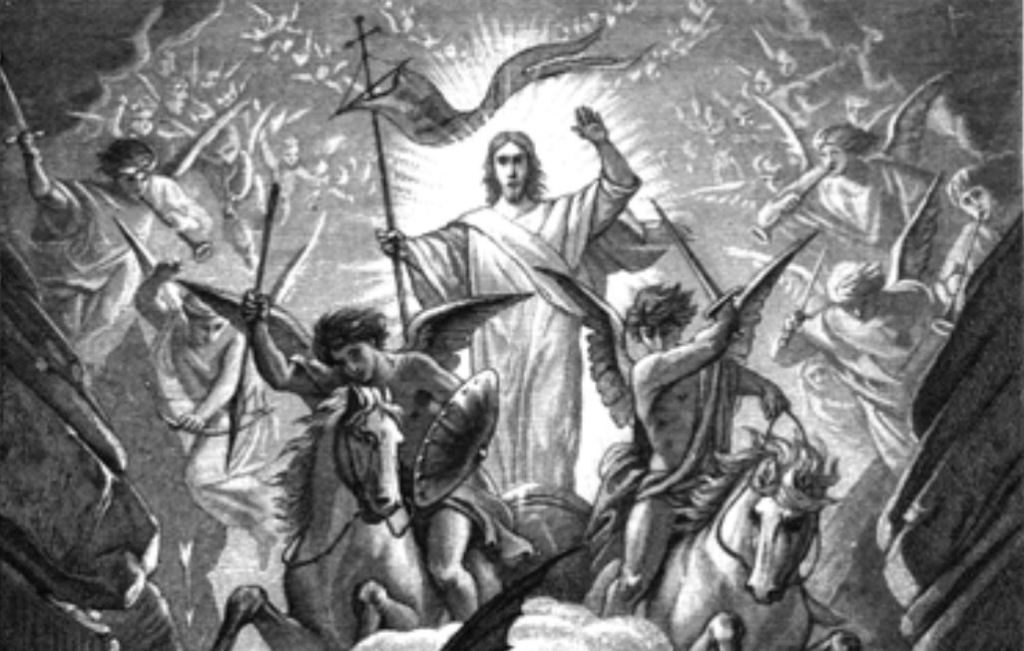
When Christ to Hell is seen to come.
She snarls with rage, but needs must cower
Before our mighty Hero’s power;
He signs—and Hell is straightway dumb.
Before His voice the thunders break,
On high His victor-banner blows;
E’en angels at His fury quake,
When Christ to the dread judgment goes.[12]


[1] The preacher was Kenneth Copeland.

[2] Wayne Grudem, Systematic Theology, Second Edition, 725-727.

[3] Some have also seen Romans 10:6-7 and Ephesians 4:8-9 as references to Christ descending into hell, but that’s a misreading of the text. In Romans 10:6-7, Paul makes the point that Christ is immediately available by faith, that you don’t need to descend into the abyss (probably a reference to the deepest ocean) to find Him. Ephesians 4:8-9 is simply saying that in the incarnation, Jesus descended to “lower regions” of the earth, as opposed to higher regions of Heaven, from which He came.

[4] Romans 1:4, 8:11; 1 Timothy 3:16.

[5] Some have taken the phrase “made alive in the spirit” to mean Jesus was spiritually enlivened while His body was in the grave. But does it really make sense to say the eternal Son of God needed to be “made alive” spiritually? The Greek doesn’t capitalize words for us, so we have to consider the context to determine whether or not the Holy Spirit is being referred to here. That phrase “in the Spirit,” is often used of the Holy Spirit in the New Testament. Also, the weakness of the flesh (sarx) is often contrasted with the power of the Holy Spirit (pneuma).

[6] In almost every case in the New Testament, “spirit” (pneuma) in the plural refers to angels/demons, not humans. However, you never have a case of “spirits” referring to humans without some qualifying description making it clear that humans are in view.

[7] This idea of suffering for Christ’s sake permeates the whole letter, from beginning to end. See 1 Peter 1:6-7; 2:19-25; 3:9-17; 4:1-2, 12-19; 5:10.

[8] See Job 1:6, 2:1, 38:7; Psalm 29:1, 89:6

[9] Other references to Jesus bearing the wrath of God include Romans 3:25, 1 John 2:2, 4:10, and Hebrews 2:17, where “propitiation” means “wrath-bearing substitute.”

[10] See Hebrews 9:26, 28, 10:10-14; 1 Peter 3:18

[11] The NIV even says, “After being made alive, he went and made proclamation to the imprisoned spirits…” (1 Peter 3:19).

[12] Johann Wolfgang von Goethe, “Thoughts on Jesus Christ’s Descent into Hell,” Goethe’s Works, illustrated by the best German artists, 5 vols. (Philadelphia: G. Barrie, 1885). Vol. 1.