It’s become popular for intellectual types to say things like “the resurrection of Jesus is a symbol of hope.” The problem for many is that it remains just that: a mere symbol, but not reality.
In the film The Shawshank Redemption, the main character Andy tells his fellow inmate, Red (played by Morgan Freeman), that hope is the only thing the prison guards can’t take from them. Red’s response is memorable: “Hope? Let me tell you something, my friend: Hope is a dangerous thing. Hope can drive a man insane.” Red does have a point. If you are in locked in prison for life and there is zero chance of escape, hope can eventually fade into severe disillusionment. In the end, a metaphorical or symbolic hope is no help at all.
The Apostle Peter discusses hope in his first epistle found in the New Testament:
“Blessed be the God and Father of our Lord Jesus Christ! According to his great mercy, he has caused us to be born again to a living hope through the resurrection of Jesus Christ from the dead…” (1 Peter 1:3, ESV)
He starts this sentence saying, “Blessed be” or “Praise be the God and Father of our Lord Jesus Christ!” This is the starting point. For Peter, everything begins and ends in worship, because everything begins and ends with God.
And he says this great God of all has shown unspeakable mercy to us, by causing us to be “born again.” In other words, God is the fountain and source of all spiritual life. We were spiritually lifeless and hopeless, but He stooped down to rescue us. In fact, He not only saved us but made us His own child.
Something we never want to take for granted is the fact that, as followers of Jesus, we are privileged to call God our own Father. For some people, this has taken some getting used to. Maybe you doubt you could ever be worthy of addressing God as “Father.” Or maybe you can’t get past the fact that your earthly father failed you growing up. And it’s hard to understand God as a father.
But let me tell you that there is incredible peace in knowing that, despite all the promises broken and failures of your earthly father, you have a heavenly Father who will never abandon you, never fail you, and will keep every promise perfectly.
God is a Majestic King, a Fearsome Warrior, and Just Judge. But before anything else–for the Christian–God is our loving Father. He loves as only a perfect Father could. He delights in His children and He lavishes us with His love in a way that sometimes seems unthinkable.
Peter says we have been “born again,” meaning we have been given new spiritual life and made a child of God the Father.
“… he has caused us to be born again to a living hope through the resurrection of Jesus Christ from the dead…” (1 Peter 1:3, ESV)
Our hope is alive. Why? Because our Savior is alive. So many people think that the Christian idea of Heaven is just pie-in-the-sky. They assume it’s just a fairytale for grown-ups, to help us cope with life’s hardships. Some even imagine Heaven to be boring.
That may be the case for other religions and philosophies out there, but from the very beginning the Christian church has always had its hope rooted in historical reality. And Heaven is about the reconciliation, redemption, and restoration of all that we hold dear in life. It’s about the satisfaction of all our earthly longings: our longing for justice to be satisfied, love without end, freedom from futility, and purpose for our existence.
Remember what Paul said? After listing all these evidences that Jesus really did rise from the dead (the tomb is empty, He appeared to people at many different times and in different contexts, the birth of the church itself), he added that Jesus even appeared to Paul himself, after His ascension!
And then Paul says something pretty radical:
“And if Christ has not been raised, your faith is futile and you are still in your sins.” (1 Corinthians 15:17, ESV)
He is willing to hang everything on the truth of the resurrection. That is something no other religion or belief system is willing to do. But here he says, “If this one event did not happen, it’s all for nothing… and we have no hope. If the stiff corpse that lay in that tomb for 36 hours didn’t miraculously and supernaturally come back to glorious resurrected life, then we have no hope whatsoever.”
Of course, he goes on to say, “But in fact Christ has been raised from the dead” (1 Corinthians 15:20).
Some of my favorite Christian testimonies are of those who, in God’s providence, set out to disprove Christianity and ended up realizing the evidence actually supported the resurrection.
That’s how it was for Josh McDowell. He was a hardened skeptic who thought Christianity was a bunch of old myths that had no bearing on life.
And some Christians challenged him on that, to do the research and really investigate everything historians know about the resurrection. And so he did just that. He went all over Europe desperate to prove everything about Jesus was a myth: His claims to deity, His resurrection, all of it. Until one night, he found himself in a library in London. Here’s what Josh writes:
“After several hours of research studying some out-of-print books, I leaned back in my chair, rubbed my eyes, and without remembering I was in a quiet library, I spoke out loud, ‘It’s true. It’s true! It’s really true!’”
He is just one example. Many other skeptics have done the same thing and found the evidence actually works against them. That is not to say that you have to go out and become a historian before you can be a Christian. The point is that even for the skeptic who demands compelling evidence for belief, the evidence is available if you’re willing to look.
Because Jesus is alive today, Christians have a living hope rooted in history.
My friend, you need to know that, if you’re not a Christian, the evidence for Jesus conquering death is compelling. Investigating the truth about it might just change your life. And if you are a Christian, you need to know that you have a living hope, because you have a living Savior. If Jesus can beat death itself, then what could possibly stop Him? Who else in history has conquered the grave? And just as He promised ahead of time to rise from the dead, He promised to raise us from the dead. The fact that He already did the first guarantees that He will do the second.
Have thoughts on this post? I’d love to hear from you!
It is remarkable to consider the numerous testimonies of skeptical scholars who set out to disprove the whole story of Jesus and His resurrection, and, like the hotheaded Saul of Tarsus, were knocked from their high horse only so they could gladly bow the knee to Christ.
“The Book that Refused to Be Written.”
One example is Frank Morrison. Morrison was a skeptical historian utterly convinced that the whole resurrection story was nothing but a hoax that had duped a great portion of the Western world and beyond. In his mind, the resurrection could not be true, simply because it proposed the impossible: that a lifeless corpse laying in a tomb had truly come to life. In Morrison’s mind, such an idea was preposterous from the start. It was ludicrous! Evangelical appeals to believe such a tale were an insult to his intellect.
And yet…
It did bother him that so many people had bought into this story—some of whom were no intellectual lightweights.
How is it, he wondered, that so many people could believe something that was so manifestly impossible? It would be one thing if a small crowd in Jerusalem back in the first century had been taken in by the resurrection tale, and that movement had fizzled and died long ago. But how is it that such a vast number of intellectual giants in the last 2,000 years (Augustine, Aquinas, Galileo, Kepler, Newton, and C. S. Lewis, to name a handful) have taken the claims of the New Testament seriously?
It was this question that drove Morrison to a detailed study of the resurrection accounts in the Gospels. He set out to disprove it all. But in a twist of providential irony, while he was meticulously seeking out holes in the Gospel accounts, he kept coming away from his study with the strange feeling that it all had the ring of truth. He had imagined himself writing a book detailing all the logical flaws and historical errors on the part of the Gospel writers. Instead, he found himself writing a very different book.
In fact, in his best-selling book, Who Moved the Stone?, which chronicles his investigative journey, the name of the first chapter is “The Book that Refused to Be Written.” In his own words, Morrison said that his historical investigation of Jesus’ resurrection kept taking him “in a new and unexpected direction.” He said, “It was as though a man set out to cross a forest by a familiar and well-beaten track and came out suddenly where he did not expect to come out. The point of entry was the same; it was the point of emergence that was different.”[1]
By the end of his research, it was not the whims of wishful thinking but the stubborn facts themselves that convinced him. Jesus Christ truly had risen from the grave!
The Greatest News on Earth
Can you remember the first time it really registered for you? Jesus is alive! He’s the Lord of the universe because He has defeated death! I remember experiencing something similar many years after I had become a Christian. I was reading a book called The Case for the Resurrection of Jesus, and I remember the truth washing over me in a new way. Jesus really is alive. He’s defeated death. That means I have nothing to fear in life or death!
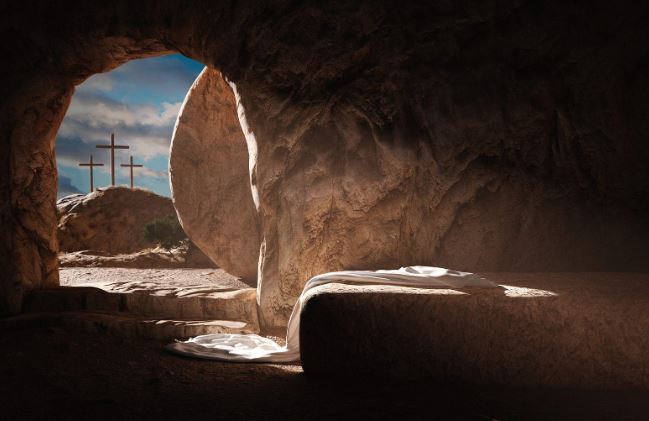
The following Sunday morning I remember tears of joy coming to eyes as we sang about Jesus as the living Lord, and I just kept thinking, Yes! Jesus is alive! The tomb is empty! I live for a resurrected King! Sheer happiness coursed through my veins. I wanted to sing His praises for the rest of the day.
What could possibly be better news than this? Learning your application was accepted at an Ivy League school? Landing the ideal job you’ve been working tirelessly to get? Getting married to the girl of your dreams? As amazing as each of these are, none can compare with knowing deep in your bones that Jesus really has defeated death for you.
I was experiencing Paul’s words in Romans:
“This hope will not disappoint us, because God’s love has been poured out in our hearts through the Holy Spirit who was given to us.” (Romans 5:5, CSB)
The resurrection really does change everything. All other religions and faith systems are built on the teachings of dead guys. No matter how fancy and pristine their tombs might be, their bodies rotted away long ago. Buddha is dead. Muhammad is dead. Krishna is dead. Confucius is dead. Moses is dead. They’re all dead! But Jesus? He’s alive.
“But the one God raised up did not decay.” (Acts 13:37, CSB)
And what’s more is that from the very beginning of the church, Christians have always claimed He is alive. This is the truth that propelled the early church forward with boldness, declaring that “Jesus is Lord! Above all earthly gods. Above Caesar. Above the most powerful people on the planet. Jesus is Lord!”
It’s no surprise that the book of Acts shows the earliest disciples making the resurrection the hub of their whole message. They claimed they had seen the risen Jesus in the flesh. “God has raised this Jesus to life, and we are all witnesses of it,” said Peter (Acts 2:32). Peter and Paul called the resurrection a clear fulfillment of what God had promised through the Hebrew prophets (Acts 2:29-31; 13:34-35). Philip said that when you’re reading Isaiah 53, you’re reading about Jesus (Acts 8:30-35). From the start, their message was all about Jesus’ sacrificial death for the forgiveness of sins, and how Jesus’ resurrection proves that His death was sufficient.
“Now when David…fell asleep, he was buried with his ancestors and his body decayed. But the one whom God raised from the dead did not see decay. Therefore, my friends, I want you to know that through Jesus the forgiveness of sins is proclaimed to you.” (Acts 13:36-38, NIV)
No sacrifice for sins is needed after Jesus, because He made the payment in full.
“But when Christ had offered for all time a single sacrifice for sins, he sat down at the right hand of God, waiting from that time until his enemies should be made a footstool for his feet. For by a single offering he has perfected for all time those who are being sanctified.” (Hebrews 10:12-14, ESV)
And the Father raised Him from the dead because He was satisfied in the Son’s payment.
“Because of our sins he was given over to die, and he was raised to life in order to put us right with God.” (Romans 4:25, GNT)
This was no esoteric message about a transcendent Heaven that had no bearing on our lives today. Everyone who encountered the risen Lord suddenly had a new direction in life. And sometimes, this got them into trouble with the local authorities. That’s why wherever the gospel goes in Acts, a mob quickly follows.
Responses to the Resurrection Message
But why would a message of life attract angry mobs? How did various groups respond?
The self-righteous and political elite were threatened and enraged.
“These men who have turned the world upside down have come here also, and Jason has received them, and they are all acting against the decrees of Caesar, saying that there is another king, Jesus.” (Acts 17:6-7, ESV)
The proud intellectuals debated and mocked the message.
Some of the Epicurean and Stoic philosophers also conversed with him. And some said, “What does this babbler wish to say?” (Acts 17:18, ESV)
But some, like the Bereans, were noble and humble seekers of the truth.
“The people there were more open-minded than the people in Thessalonica. They listened to the message with great eagerness, and every day they studied the Scriptures to see if what Paul said was really true.” (Acts 17:11, GNT)
But one thing was clear. You cannot hear the full truth about the risen Jesus and then shrug your shoulders and walk away. There is no neutrality when it comes to Jesus. How could you ever be neutral about One who has left behind an empty tomb? Whether you love it or hate it, this message will do something to you.
It’s the reason why Paul could say, “To live is Christ! And to die is gain!” He meant something like this: “As long as I’ve got breath in my lungs, I’m living for Christ and sharing the news that Jesus is the Savior. If I get killed, that’s okay with me, because then I get to be with my Lord face to face.” Paul could talk like that because he had met the risen Lord already.
That’s what happens when you are truly gripped by the greatest news on earth.
A. W. Tozer said, “The Christian owes it to the world to be supernaturally joyful.” I agree, and this can only happen as we experience “the power of the resurrection” (Philippians 3:10). The more the reality of Christ’s resurrection has gripped our hearts, the more we see we can no longer face life’s difficulties without reference to this world-changing event.
If you have not yet surrendered to the resurrected King, I urge you to do that today. Only through trusting in the living Jesus is your eternal salvation made secure.
“If you confess that Jesus is Lord and believe that God raised him from death, you will be saved. For it is by our faith that we are put right with God; it is by our confession that we are saved.” (Romans 10:9-10, GNT)
Have thoughts on this post? Feel free to comment below!
From its beginning, the Christian movement has been rooted in the resurrection of Jesus of Nazareth. No other religion or faith tradition so powerfully bases everything in the reality of one event. And yet, Paul can write to other Christians, “And if Christ has not been raised, then our preaching is in vain and your faith is in vain” (1 Corinthians 15:14, ESV). Everything hinges on the truth of this singular event in history. Apparently, evidence matters even to Jesus Himself. The Bible says, “After his suffering, he presented himself to them and gave many convincing proofs that he was alive. He appeared to them over a period of forty days and spoke about the kingdom of God” (Acts 1:3, NIV). That being the case, it’s worth considering the following twelve pieces of evidence from both Scripture and outside Scripture for this event.
1. Jesus died by crucifixion.
All the evidence both within the Bible and outside the Bible demonstrates that Jesus truly died on Good Friday (Matthew 27:50-56; Mark 15:37-41; Luke 23:46; John 19:33-35). Roman soldiers were professional executioners, and if a soldier failed to carry out his orders, his own life would be on the line. No one survived crucifixion. This rules out the swoon theory, which argues that perhaps Jesus didn’t die on the cross, and somehow survived being covered in myrrh, wrapped in burial cloths, and laid in a stone ossuary for 36 hours. If, by some miracle He survived all this, could Jesus really have convinced His followers that He had come back as the Lord who conquered death?
2. The location of the tomb was well known.
Every record we have uniformly teaches that Jesus’ body was buried in the tomb of Joseph of Arimathea (Matthew 27:57-61; Mark 15:42-47; Luke 23:50-55; John 19:38-42). Because there are no competing accounts for the tomb’s location and women followers witnessed his burial, that rules out someone going to the wrong tomb on Easter morning.
3. The tomb was empty.
The earliest record of Jesus’ tomb from both friends and enemies of Christianity is that the tomb was empty on the Sunday following the Friday that Jesus died on the cross. Christ’s enemies claimed the disciples stole the body, and this continued to be their claim even in the time of the second century apologist Justin Martyr.[1] One thing the “stolen body” story assumes is that the tomb really was empty. Interestingly, we don’t see any of Christ’s enemies claim that the disciples merely went to the wrong tomb, or that the tomb was still occupied. Enemy attestation is generally powerful evidence in court, so this proves that the tomb Jesus had been interred in was empty on Easter morning (Matthew 28:1-8, 11-15).
4. Women as the first eyewitnesses.
The first eyewitnesses of both the empty tomb and the risen Jesus were women (Matthew 28:1-10; Luke 24:9-12). This is significant because a woman’s testimony was not valid in a first century court.[2] The fact that women are recorded as the first eyewitnesses who courageously went to the tomb while the men were holed up in an upper room behind locked doors is an embarrassing detail that would only be included if it truly happened (John 20:19, 26). This demonstrates that the account has the ring of truth and is not an invention of Christians.
5. Individuals and groups saw the risen Jesus.
The accounts of Jesus being witnessed demonstrate that He was seen in a variety of circumstances by both individuals and groups of various sizes (1 Corinthians 15:1-8; Matthew 28:9-10, 16-20; Luke 24:15-32, 36-53; John 20:14-29; John 21; Acts 1:3-9, 9:3-9; 1 Corinthians 15:3-8). Some skeptics have argued that the disciples probably just had hallucinations of Jesus, as sometimes happens with the bereaved. However, the fact that Jesus appeared to groups as large as 500 people rules out the hallucination theory, since hallucinations are subjective experiences for individuals. If a group witnesses something, they must be seeing something that has an objective reality outside themselves.
6. The physical nature of Jesus’ body.
Jesus proved His resurrected body was real and physical by showing the nail scars in His hands and eating with the disciples (Luke 24:36-43; John 20:19-28). This shows the risen Jesus was not a ghost or a spiritual vision. N. T. Wright has also demonstrated that in the ancient world, the word resurrection universally referred to “new bodily life” after death.[3] It was not a general term for the afterlife or “going to heaven.” When Paul preached Christ’s resurrection to the Athenian Greeks, they scoffed – not because they didn’t believe in the soul’s afterlife, but because they denied any return to bodily life (Acts 17:32). Jesus’ resurrection is recorded as a real event with eyewitnesses, not a metaphor for “Jesus rising in our hearts” or some other such nonsense.
7. The resurrection was proclaimed from the beginning.
Our earliest records indicate that the most pivotal message proclaimed by the early church in Jerusalem from the beginning was that Jesus was bodily raised from death and that this was based on eyewitness testimony (See Acts 2:22-24, 32; 3:13-15, 26; 4:10-11; 5:30-32; 10:39-41; 13:26-31, 34-39; Romans 1:4; 4:24; 7:4; 10:9; 1 Corinthians 15:15-20; Ephesians 2:6; Colossians 2:12; 2 Timothy 1:10; 1 Peter 1:21; 2 Peter 1:16; 1 John 1:1-3). This rules out the legendary development theory.
8. Origin and sudden growth of Christianity.
It’s very difficult to explain the origin and sudden growth of the Christian movement apart from Jesus truly rising from death and appearing to eyewitnesses (Acts 2:41-47; 5:42). There were other self-proclaimed messiahs in the first century, who were later killed or crucified. In each case, these movements died with their founders. So what led the early Christians to begin worshiping Jesus, who was also crucified as a criminal by Rome? Historian N. T. Wright said, “Never before had there been a movement which began as a quasi-messianic group within Judaism and was transformed into the sort of movement which Christianity quickly became.”[4] One early Christian creed dates from within the first few years after the cross and includes a list of eyewitnesses to the resurrection (1 Corinthians 15:3-7). Such an early date rules out legendary development, too.
9. Liars make poor martyrs.
The Apostles went from hiding behind locked doors to being willing to suffer and die for their claim to witness the resurrected Jesus (John 20:19, 26; Acts 5:40-42; 6:59-60; 12:1-2). This is compelling because while martyrs can be deceived and may unknowingly die for a lie, it’s hard to imagine a group of men willingly dying for what they knew to be a lie. Can you imagine their rallying cry: “Okay, fellas, we’re about to go out and suffer horribly and possibly die for this whopper we’ve just cooked up. Who’s with me?!” When people try to cover up a fraud, there is usually some kind of motivation, like money or power. But these men only lost power because of their devotion to the risen Lord. They had nothing to gain in this world by proclaiming the resurrection. Their only motivation for enduring persecution and death must have been their firm conviction that Jesus truly did rise as Lord of life. Historian Michael Licona has said, “Liars make poor martyrs.”[5] And Blaise Pascal said, “I only believe histories whose witnesses are ready to be put to death.”[6]
10. Early belief that Jesus is God.
All the evidence shows that the earliest Christians were Jewish monotheists (believed in only one God). However, they also worshiped Jesus as God, something utterly unthinkable unless Jesus had truly proved Himself to be God by rising from the dead (John 20:28; Philippians 2:5-11; Colossians 1:15-19). Skeptics like Bart Ehrman have tried to argue that the view that Jesus was God evolved over time, but the evidence of the New Testament shows that Christians understood Jesus to be God from the first decades while eyewitnesses to His resurrection were still alive. They simply adopted the view that Jesus took of Himself, such as when He forgave sins as only God can, claimed to be the Giver of life, said He shared in the Father’s divine glory, and took the divine name “I Am” (Yahweh) to Himself on numerous occasions. We can especially note Jesus’ affirming response to Thomas, who after seeing the resurrected Lord proclaimed, “My Lord and my God!” (John 20:28).[7]
11. Unexpected conversions.
Even non-Christian historians generally acknowledge that both James, the Lord’s brother, and Saul of Tarsus were initially skeptics about Jesus being the divine Messiah. In fact, the book of Acts records Saul as a passionate opponent of Christianity who wanted to destroy the movement until he encountered the risen Lord and later became known as the Apostle Paul (read about this transformation in Acts 9:1-30). It’s very hard to explain James’ and Saul’s sudden conversion to Christianity after initially opposing it apart from the resurrection.
12. Immediate transformation of religious observance.
The first Christians immediately began meeting on Sunday, instead of Sabbath (Saturday), the day that Jews had gathered for worship for hundreds of years (Exodus 20:8-11; Acts 20:7; 1 Corinthians 16:2). This only makes sense if Jesus did in fact rise on Sunday (John 20:1-2). The first Christians also began celebrating the Lord’s Supper (a special meal that commemorates the Lord’s death; 1 Corinthians 11:17-34) and baptism (which is the initiatory rite of a disciple and pictures union with Christ in His death and resurrection; Matthew 28:18-20). Both ordinances only make sense in light of Christ’s substitutionary death and resurrection in history.
Conclusion
Certainly, it might be hard to accept that someone truly defeated death itself on the basis of one or two pieces of evidence. However, the cumulative case that can be made for Christ’s resurrection is staggering. Because of space constraints, I’m only giving a brief overview, but this is just the tip of the ice berg. Each one of these could be unpacked in far greater detail. The point is that the Christian claim that Jesus rose from the dead is well-founded in history. This gives the Christian great hope. Salvation is by grace alone, apart from any good works or religious obedience. All who put their trust in the risen Lord are assured of forgiveness of sins and eternal life with Him (Romans 10:9-10). Jesus said, “Because I live, you also will live” (John 14:19, NIV).
Have thoughts on this post? Feel free to comment below!
[1] This is mentioned in Justin’s Dialogue with Trypho.
[2] N. T. Wright, The Resurrection of the Son of God (Minneapolis, Fortress Press, 2003), 686-96.
[4] N. T. Wright, The Resurrection of the Son of God, 17.
[5] Quoted in Gary Habermas and Michael Licona, The Case for the Resurrection of Jesus.
[6] Quoted in Josh and Sean McDowell, Evidence that Demands a Verdict.
[7] There is also plenty of extrabiblical evidence that the earliest Christians worshiped Jesus as God, including the writings of the ante-Nicene fathers. In the year 112 AD, Pliny the Younger wrote to his Roman Emperor Trajan that Christians he saw “were in the habit of meeting on a certain fixed day before it was light, when they sang in alternate verses a hymn to Christ, as to a god, and bound them themselves by a solemn oath, not to any wicked deeds…”
“I am the LORD your God, who brought you out of the land of Egypt, out of the house of slavery.” (Exodus 20:2, ESV)
In my last post (Part 1), we considered the archaeological evidence for Hebrew slaves in Egypt before the time of the Exodus. That is significant, but what kind of evidence supports the Exodus event itself?
According to the biblical book of Exodus, when God commissioned Moses for the task of delivering His people out of bondage, Moses was told that Pharaoh would refuse to let the people go, but that there was a purpose to this.
The Lord instructed Moses, “When you go back to Egypt, make sure you do all the wonders before Pharaoh that I have put within your power. But I will harden his heart so that he won’t let the people go.” (Exodus 4:21, HCSB)
Sin always grieves God, and a hard heart stands in opposition to His holy ways. However, the God who works all things together for good (Romans 8:28) wisely used Pharaoh’s stubborn hardheartedness as an occasion to show His glory over the false gods of Egypt. And so God sent ten mighty plagues on the land of Egypt, beginning with Yahweh turning the Nile River into blood. From then on, each plague (frogs, gnats, hail wiping out grain, skin disease, etc.) escalates in magnitude of national devastation. And each time God spares His chosen people from these disasters.
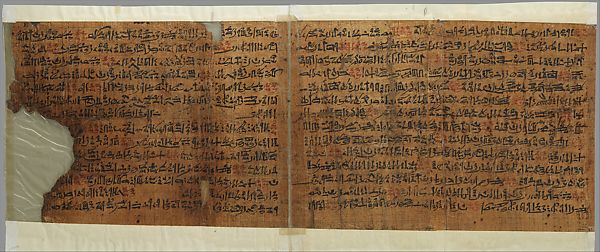
The Ipuwer Papyrus
The Ipuwer Papyrus
While many scholars have tried to come up with natural explanations for the plagues, the sequence and severity of these plagues demonstrate that these were directly from the hand of God. No natural cause would explain why the Egyptians were utterly devastated by these plagues while the Hebrews in neighboring Goshen remained safely untouched, both man and beast (Exodus 8:22; 9:26).
We also have a clue from the only surviving copy of an Egyptian text that has striking parallels to the Exodus account called The Admonitions of an Egyptian Sage, more often known as the Ipuwer Papyrus. Many scholars agree that this is a very early document, some placing it in the 18th Dynasty, the very time of the Exodus (ca. 15th century BC) because of certain linguistic features. The Ipuwer is basically a lengthy poem or prayer to the sun god Ra, written by an Egyptian sage lamenting a series of disasters in the land. I mentioned in my last post that the pharaoh would never let a defeat be recorded in the royal annals. But Ipuwer, the author, seems to be a sage reflecting on the state of the empire he once loved, not a court scribe, because he’s even critical of the pharaoh: “the king has been deposed by the rabble.”[1]
Ipuwer says “pestilence is throughout the land, blood is everywhere, death is not lacking, and the mummy-cloth speaks even before one comes near it.” He writes, “Indeed, the river is blood, yet men drink of it.”
Titus Kennedy neatly sums up the significance of the Ipuwer Papyrus:
“Passages in the poem, such as the river being blood, blood everywhere, plague and pestilence throughout the land, the grain being destroyed, disease causing physical disfigurement, the prevalence of death, mourning throughout the land, rebellion against Ra the sun god, the death of children, the authority of the pharaoh being lost, the gods of Egypt being ineffective and losing a battle, and jewelry now being in the possession of the slaves, are all occurrences in common with the Exodus story.”[2]
To read the Ipuwer Papyrus alongside the Book of Exodus is fascinating. The parallels are simply too clear to downplay. Many scholars have, of course, noted the similarities. However, most have asserted that this reflects a certain genre of “national disaster” folklore at the time rather than concluding that both could be referring to the same historical events. As Hoffmeier observed in the last post, your philosophical presuppositions determine what you will see. The problem with this easy dismissal is that if Ipuwer really was lamenting actual events in history, the above presupposition prevents someone from ever knowing it. One might dare to ask, What would Ipuwer need to say to demonstrate he really was referring to events he witnessed? After all, Ipuwer seems to be talking about a truly devastating time standing in contrast to Egypt’s glorious past.
The Date of the Exodus
There is considerable debate between biblical scholars as to when the Exodus actually took place. Most would place it in either the 15th, 13th, or 12th century BC. Because I take the Bible to be both the authoritative and understandable Word of God, I have no problem accepting the biblical timelines.
One of the clearest statements for dating the Exodus is 1 Kings 6:1: “In the four hundred and eightieth year after the people of Israel came out of the land of Egypt, in the fourth year of Solomon’s reign over Israel, in the month of Ziv, which is the second month, he began to build the house of the Lord.”
Scholars almost universally agree that Solomon began building the temple in 966 BC. We can then take the 480 years given here, do a little math, and come up with an approximate date of 1446 BC for the Exodus. Scholars who come up with a 12th or 13th century date have to say that the 480 years is a nice round number based on the number of idealized generations, allegedly 40 years each.[3] That strikes me as very strange since there is no indication from the text itself that this is what is going on.[4]
The Pharaoh of the Exodus
Once we have determined the date for the Exodus we can know the most probable pharaoh at this time based on Egyptian chronological records. And we can see if we have any supporting evidence for our dating of the Exodus, too.
According to Exodus, Moses was forced to flee from Egypt after killing an Egyptian guard. Moses spent the next 40 years in the Midianite desert, settling down with his wife Zipporah and becoming a nomadic shepherd.
The Bible says, “After a long time, the king of Egypt died” (Exodus 2:23, HCSB). Later, God tells Moses not to fear returning to Egypt “for all the men who were seeking your life are dead” (Exodus 4:19, ESV). Based on these verses, the pharaoh when Moses fled from Egypt must have been king for a long time, possibly at least forty years.
This is a crucial piece of evidence because most pharaohs did not reign for a very long time. Many didn’t even last ten years. There is, however, one and only one pharaoh in either the 18th or 19th dynasties (the possible eras for the Exodus) who reigned more than forty years, and his name was Thutmose III. According to Egyptian chronologies, that would mean his son, Amenhotep II was the king of Egypt when Moses returned for the Exodus. This is another factor supporting the early date of 1446 BC. The long reign of Thutmose III followed by Amenhotep II reigning at the time of the Exodus in 1446 BC fits together nicely.[5] However, no king during the 13th or 12th centuries reigned 40 years.
Since there are clues pointing to Amenhotep II being pharaoh at this time, it’s worth considering what we know about him from archaeology. Here’s what’s really intriguing. Amenhotep II was known for unrestrained arrogance of biblical proportions. Archaeologists have found inscriptions and monuments built in his honor where he claimed to be the greatest pharaoh in history. His boasts included rowing a ship faster than 200 Egyptian sailors, shooting an arrow through a copper target as thick as a palm, slaying 7 of the greatest warriors of Kadesh, and capturing more slaves than any other pharaoh in Egyptian history.
This was the pharaoh’s way of saying, “I’m kind of a big deal.” Does this align with what we know about the pharaoh of the Exodus? Well, let’s see. When Moses announced that Yahweh demanded he let the Hebrews go, the pharaoh proudly scoffed, “Who is Yahweh that I should obey Him by letting Israel go? I do not know anything about Yahweh, and besides I will not let Israel go” (Exodus 5:1, HCSB).
Throughout the Exodus narrative (Exodus 5-14), the pharaoh strikes us as arrogant, stubborn, and foolish – almost like someone who was compensating for some major insecurities. Such a psychological profile directly matches everything we know about Amenhotep II.
Evidence for a Crippled Army and Missing Slaves
In addition to his megalomaniacal boasts, Amenhotep II also completed only two military campaigns during the span of his whole reign. This seems strange when you compare it to all his predecessors, who averaged far more military campaigns. Thutmose III, by comparison, led at least 17 campaigns. What would lead the hotheaded Amenhotep II to drastically reduce the number of Egypt’s armed invasions?
Could it be that his once unstoppable army was drastically crippled – even annihilated – in an event at the Red Sea? This circumstantial evidence certainly fits the narrative given in Exodus 14, which says that after the Hebrews left Egypt, Pharaoh changed his mind and sent his entire army in pursuit, including “all Pharaoh’s horses and chariots and horsemen and his army” (Exodus 14:9, ESV). We then read that after Israel had made it safely across the parted Red Sea,
“…the Lord threw them [the Egyptian army] into the sea. The waters came back and covered the chariots and horsemen, the entire army of Pharaoh, that had gone after them into the sea. None of them survived.” (Exodus 14:27-28, HCSB)
It’s worth noting that Scripture never says that Pharaoh himself drowned in the Red Sea, only that his entire army perished. No wonder Amenhotep II had only one campaign after the Exodus.
Elephantine Stele of Amenhotep II
According to the Elephantine Steleof Amenhotep II inscription, this last campaign was more of a massive slave raid than a conquest of land. Amenhotep II claimed to have captured 101,128 slaves on this raid. If accurate, this would be about 20 times larger than the next largest slave raid in Egyptian history. How interesting that this pharaoh known for ridiculous exaggeration now says he’s also better at bringing in slaves than anyone else! Kennedy observes, “Because this happened right after the Exodus, perhaps it is indicative of an urgent need to replace the lost slave population in Egypt.”[6]
One thing most Exodus scholars agree upon is that future excavations in Egypt will likely shed more light on the timing and details of this central event in Israel’s history. After all, satellite imagery suggests that less than 1 percent of ancient Egypt has actually been excavated to date.[7] The Bible-believing Christian should rejoice in this fact. Once again, archaeological excavations have only strengthened the case for Scripture’s accuracy. We have only examined a portion of the incredible circumstantial evidence that has already been discovered in support of the biblical Exodus.
Have thoughts on this post? Feel free to comment below!
[3] This number of 40 years comes from the 40 years of wandering in the desert when a whole generation perished, but that was a specific case not a hard rule that 40 years must always equal one generation in biblical timelines. It’s also worth noting that only those who refused to believe God’s promises perished in the wilderness (Hebrews 3:17), and that the 40 years corresponded with the 40 days they spied out the land (Numbers 14:34). Ironically, supporters of the late view have to take the 40 years mentioned in Numbers 14:34 and Deuteronomy 34:7 literally to make their case, even while they do not take the 480 years given in 1 Kings 6:1 literally.
[4] Other passages supporting the early date of 1446 BC include Judges 11:26.
[5] The problem with the later 13th century or 12th century dates for the Exodus is that in both cases, the pharaoh at those times (Ramesses II or Ramesses III respectively), does not succeed a pharaoh who reigned a long time, which seems to contradict Exodus 2:23.
Modern scholars often assume the massive migration of Hebrew slaves out of Egypt recorded in the biblical book of Exodus never happened. The Exodus is thought to be nothing more than religious folklore, and that there is no hard evidence for such an event in the ruins of Ancient Egypt.
For example, critical scholars Israel Finkelstein and Neil Silberman claim, “The saga of Israel’s Exodus from Egypt is neither historical truth nor literary fiction… to pin this biblical image down to a single date is to betray the story’s deepest meaning. Passover proves to be not a single event but a continuing experience of national resistance against the powers that be.”[1]
But is this really the case? What can we learn from the actual evidence?
Biblical scholar and archaeologist James K. Hoffmeier has found undue skepticism among many of his peers. He observes, “If it were not still Scripture to Jews and Christians, the Bible probably would not be treated in such a condescending and dismissive manner.”[2]
Egyptologists concede that ancient Egyptians almost never recorded embarrassing losses. The pharaohs always made sure they looked like stellar leaders in the history books. Are we at all surprised? We are, after all, talking about the same human nature that craves approval from peers and longs for affirmation wherever it can get it. Even today, politicians will trumpet their successes but rarely begin a speech discussing their failures. But in Ancient Egypt, the pharaoh controlled the press. That being the case, we really shouldn’t expect to find positive evidence for the biblical Exodus in Egypt’s royal annals.
The remarkable thing, however, is that there is a truckload of circumstantial evidence for the biblical Exodus. I say “circumstantial” because while there may not be much in the way of direct evidence outside of Scripture, the evidence we do have strongly supports the circumstances that would have to be true if such an event were indeed historical.
Another point worth mentioning is that the Bible itself must be properly viewed as crucial evidence for the Exodus event. This may sound obvious, but the scholarly consensus often presupposes the Bible is a book full of myths. This is unwarranted, because an unbiased reading of Exodus reveals a text written as history. Furthermore, outside the Exodus narrative itself (Exodus 1-15), this redemptive event is referenced more than 120 times in the Old Testament. And in every case, the author seems to believe the Exodus really happened and that Moses was the historical man at the helm. In fact, it is the event that explains why Israel is a nation in the first place, and why Israel must serve the Creator-God Yahweh.
Circumstantial Evidence: Hebrews Lived in Egypt
So what is the circumstantial evidence supporting the historicity of the Exodus? One argument used by field archaeologist Titus Kennedy is called “The Point A to Point B argument.” Simply put, if there is good evidence for Hebrews living in Egypt (Point A) before the Exodus on the biblical timeline, and there is also good evidence for Hebrews living in Canaan (Point B) after that time, this would suggest that some kind of mass migration occurred.
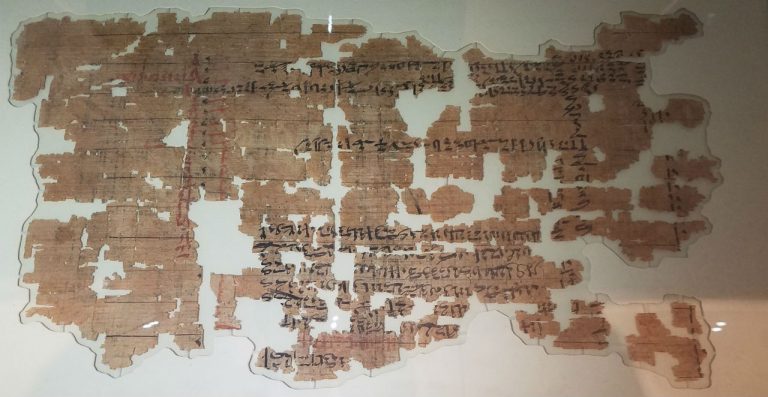
Papyrus Brooklyn
Egyptologists have discovered a list of Semitic servant or slave names on papyrus dated from about the 17th century BC.[3] This list, called Papyrus Brooklyn, gives both the Semitic name of the servant and the Egyptian name they were given. But here’s what’s fascinating. Nine of the servants listed have specifically Hebrew names that can be aligned very closely with other Hebrew names in the Bible. For example, one of the servants is named Shiphrah, the name of one of the Hebrew midwives mentioned in Exodus 1:15. Another servant is even named “Hebrew”!
This papyrus is powerful evidence not only that Semitic people (sometimes called Asiatics) lived in Egypt, but more specifically that Hebrews lived as servants or slaves in Egypt before the biblical Exodus. Interestingly, even critical scholars admit that the evidence points to Semitic people living in Egypt before the date of the Exodus (see Part 2 for a discussion of the Exodus date).[4]
Bricks without Straw
In the Book of Exodus, we read that when Moses first came to Pharaoh demanding he let God’s people go, Pharaoh was insulted. He said that such a demand to be released proved that the Hebrew slaves must be getting lazy. So he commanded his taskmasters to no longer give straw – a necessary ingredient for making bricks – to the slaves, adding that their brick quota would not be reduced. This led to the Hebrew foremen angrily blaming Moses and Aaron for coming to Egypt only to make their hard labor worse (Exodus 5:1-21).
Mural at Tomb of Thutmose III
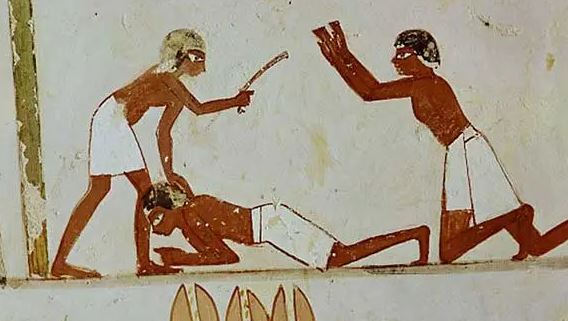
Interestingly, there is a mural on the tomb of Thutmose III, a pharaoh near the time of the Exodus, showing Semitic slaves making bricks. There is also a hieroglyphic text about an Egyptian taskmaster reminding slaves not to be idle or they’ll receive a beating. We also have a wall mural depicting this very thing, lending support to the biblical story of Moses killing a taskmaster who ruthlessly beat a slave (Exodus 2:11-12).
Mural at Tomb of Mennah, with Hebrew slave being beaten.
On top of all this, there is also an Egyptian text called the Louvre Leather Roll. Kennedy notes that this text “describes a situation similar to what is recorded in Exodus – that in this time period quotas of bricks were imposed on slaves, but when they did not have the necessary materials to complete all of the bricks, such as a lack of straw, the slaves were punished.”[5]
Did Hebrew Slaves Build the Pyramids?
Some have wondered if the Hebrews had any part in building the pyramids. First, it’s worth noting how much mystery surrounds the building of these massive ancient structures. The largest of the Great Pyramids, called Cheops, consists of 2.3 million stone blocks. These blocks weigh an average of 2.5 tons, with some of the blocks weighing as much as eighty tons! For comparison, the typical 18-wheeler truck can pull up to 24 tons. So, the question is: How in the world did they do it?
The Greek historian Herodotus (484-425 BC) said that when he visited Egypt, he learned that a work force of 100,000 slaves built the pyramids.[6] The Jewish historian Josephus (AD 37-100) said the Egyptian taskmasters “set them [the Hebrews] also to build pyramids.”[7] The consensus of modern scholars, however, is that slaves were not used because there is evidence of a workforce having their own settlement, with their own homes and provisions for all the food they could want.[8] So who is right?
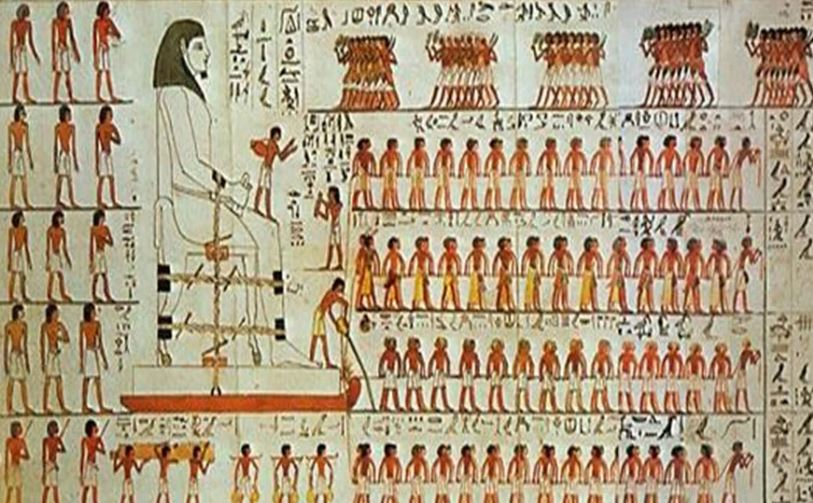
I think it’s impossible to say for sure that Hebrews built the pyramids. But here are some things we do know. Based on the Bible, the Hebrew slaves were used for many massive state projects involving mortar and brick (Exodus 1:10-14). We even have archaeological evidence of a Hebrew slave force in Egypt.[9] There is also a wall mural showing men using ropes to pull massive stones for building the pyramids. One mural seems to depict men using wet sand to help move massive structures.
Mural of slaves pulling large stone structure with ropes.
Again, none of this is conclusive evidence. Most Egyptologists would even date the construction of most of the pyramids to before the Hebrews were even in Egypt. Still, dating methods aren’t infallible; so we can’t rule it out. Scripture never actually claims that the Hebrews built the pyramids, so we shouldn’t be dogmatic on this point. What we can conclude is that a large Hebrew population did live in Egypt prior to the Exodus.
Have thoughts on this post? Feel free to comment below!
[1] Finkelstein and Silberman, The Bible Unearthed, 70-71.
[2] James K. Hoffmeier, “The Exodus and Wilderness Narratives,” in Ancient Israel’s History: An Introduction to Issues and Sources, edited by Bill Arnold and Richard Hess, Grand Rapids, MI: Baker, 2014, 48.
[3] Titus Kennedy, Unearthing the Bible: 101 Archaeological Discoveries that Bring the Bible to Life, 48-49.
[4] Mark Janzen writes, “Egyptologists agree that excavations in the delta reveal a strong Semitic presence during the Hyksos era (ca. 1650-1540 BC), continuing into the New Kingdom.” Janzen, “The Exodus: Sources, Methodology, and Scholarship,” Five Views on The Exodus, Grand Rapids, MI: Zondervan, 2021, 19.
[8] This shouldn’t be used as evidence against the pyramid builders being slaves. The Bible describes the Hebrew slaves as having their own settlement in Goshen (Genesis 47:27; Exodus 8:22; 9:26), having their own homes (Exodus 12:1-13) and eating plenty of delicious food (Numbers 11:5). Perhaps this is one of the ways the pharaohs compensated the Hebrews for their backbreaking work in hopes of preventing an uprising.
[9] James K. Hoffmeier, Israel in Egypt: The Evidence for the Authenticity of the Exodus Tradition.
Then Jesus said to Thomas, “Put your finger here and look at My hands. Reach out your hand and put it into My side. Stop doubting and believe.” (John 20:27, BSB)
The apostle Paul made the startling claim that “if Christ has not been raised, your faith is futile and you are still in your sins” (1 Corinthians 15:17). Such a statement is astonishing when you consider the implications. Everything in Christianity, Paul says, everything in the faith depends on the truth that Jesus bodily rose from the dead. If Christ didn’t truly rise from the dead, then He did not conquer death — death conquered Him!
The dark and terrifying shadow still hangs over all mankind (Isaiah 25:7-8), and we have no guarantee that we will ever escape the cords of death. That is, unless Jesus’ resurrection is true. Eternal life with God. Hope beyond the grave. Forgiveness of sins. The deity and identity of Christ. It’s all based on the resurrection of Jesus being true. No resurrection, no Christianity.
The good news is that God has left us compelling evidence that the Easter event is a solid fact of history. Here are five pieces of evidence I encourage you to consider before giving a verdict on the truth of Christ’s resurrection.
Evidence #1: Jesus’ death is an undeniable fact of history
Despite the fact that some may doubt Jesus’ death (such as many Muslims) and some radical scholars will doubt that He even existed (such as Richard Carrier),[1] Jesus’ life and death really are historically undeniable. Both Christian and non-Christian sources from the ancient world confirm that Jesus died as a victim of crucifixion.[2] Roman soldiers were highly trained in executing criminals, and they were motivated to not let a self-proclaimed king survive.
In his Gospel, the apostle John tells us He is an eyewitness of Jesus’ death on the cross.[3] In describing the event, John records something fascinating:
“But when they came to Jesus and saw that he was already dead, they did not break his legs. But one of the soldiers pierced his side with a spear, and at once there came out blood and water. He who saw it has borne witness—his testimony is true, and he knows that he is telling the truth—that you also may believe.” (John 19:33-35)
The fact that he reports seeing both blood and a watery fluid flowing out is powerful evidence that John really did watch Jesus die. Here’s why. Although John had no medical training to interpret what he saw, his eyewitness testimony is exactly what a medical doctor would have expected due to something called pericardial effusion, in which the membrane surrounding the heart fills with fluid as a result of heart failure.[4] John’s testimony stands as 2,000-year-old evidence that he really was an eyewitness of Christ’s death.
Even very liberal scholars, such as John Dominic Crossan, accept Jesus’ death as indisputable fact. He writes, “That [Jesus] was crucified is as sure as anything historical ever can be, since both Josephus and Tacitus … agree with the Christian accounts on at least that basic fact.”[5] Skeptical historian and biblical scholar James Tabor, who has studied the rise of early Christianity in depth, has written, “I think we need have no doubt that given Jesus’ execution by Roman crucifixion he was truly dead.”[6]
Evidence #2: On the Sunday following Jesus’ crucifixion, His tomb was empty.
All four Gospels record that Joseph of Arimathea, a secret disciple, was the one with the courage to bury Jesus. Since Joseph was a member of the Sanhedrin (Luke 23:50-51), the very council that condemned Jesus to death, it’s very unlikely that Christ’s earliest followers would make this up. We are also told that while the men were hiding from the Jewish authorities, the women followers of Jesus were the faithful ones who wanted to anoint His body in the tomb (Luke 23:55-56). Not only that, but the women are the ones who first discover the tomb is empty.
This, too, demonstrates the Gospels give an authentic record of what happened. In the first century, the testimony of women was not even admitted into court. The Jewish Talmud even says that a woman’s testimony was as valid as a criminal’s![7] To be sure, this low view of a woman’s testimony is not only politically incorrect today, it’s also not found in Scripture. Nevertheless, it was the prevailing view of the ancient world. Here’s the point: if you were making up this whole resurrection story in the first century, you wouldn’t pick women as the first eyewitnesses of the empty tomb. The apostles’ willingness to share this somewhat embarrassing fact demonstrates they were committed to faithfully sharing the truth, despite the awkward position it put them in at the time.
Additionally, history tells us that the counter claim from Christianity’s opponents was always that the disciples must have stolen the body.[8] This was an indirect admission that they knew the tomb was empty. It’s also very telling that we have no contradictory burial account whatsoever from either Christian or non-Christian sources. The fact that the tomb was well-known, as Josephs’ tomb, rules out the possibility that the women or other disciples went to the wrong tomb. If we are not told whose tomb or any details about where Jesus was buried, we might have reason to wonder if they went to the right tomb on that first Easter morning, but there are no competing accounts of another tomb being the real tomb.
Evidence #3: Jesus’ disciples believed they saw Him alive from the dead.
We have every reason to believe that the resurrection appearances that are recorded in the Gospels are based on eyewitness testimony, not legendary accretion over time. The gospel creed that Paul passes on in 1 Corinthians 15:3-7 can be dated to within a few years of the cross, which does not allow time for legendary development. From the earliest records of Christianity, we have people claiming that they truly saw the risen Jesus. The fact that Jesus is recorded as appearing to groups as large as 500 rules out the hallucination theory, because hallucinations are individual experiences that take place in the mind.
We also see the risen Jesus eating with His disciples, cooking them a meal, and telling them to touch the scars on His hands and His side to know He is real.[9] Jesus tells them, “Why are you troubled, and why do doubts arise in your hearts? See my hands and my feet, that it is I myself. Touch me, and see. For a spirit does not have flesh and bones as you see that I have” (Luke 24:38-39). This was an undeniably real and physical Jesus. It’s also very difficult for the historian to make sense of the conversion of Jesus’ brother James, the former skeptic (John 7:5), or Paul the one-time enemy of Christianity (Acts 26:10; 1 Corinthians 15:9). Biases are very powerful and both of them formerly thought of Jesus as a false messiah. Only an appearance of the risen Jesus could have turned their world upside down and convinced them that He really was their Lord and Messiah.
Evidence #4: The apostles were willing to suffer and die for their belief in the resurrection.
We can also safely rule out any conspiracy theory that claims the apostles stole Jesus’ body, because we have numerous historical records proving that these men were willing to suffer and die for the truth of the resurrection. While people of other faiths have been willing to die for their faith, the apostles were in the unique position of knowing for sure whether or not they’d seen the risen Jesus. As Michael Licona says, “Liars make poor martyrs.”[10] Origen (c. 185-c. 254), a church father, wrote that Jesus “so thoroughly persuaded” the apostles that He’d risen that they were willing to endure countless sufferings for His name, knowing that eternal life had been guaranteed them through Christ’s resurrection.[11]
In fact, we have numerous accounts of early Christians writing about Peter, Paul, and other apostles willingly going to their death and refusing to deny that they had seen the risen Jesus in the flesh. Under Nero’s rule, Paul was beheaded and Peter was crucified upside down – his final request was that he not be killed in the same manner as his Lord.[12]
I truly want to be sympathetic to the doubting skeptic. I acknowledge that many people feel they have good reason to doubt the resurrection accounts — at least initially. After all, haven’t we been lied to by numerous public figures? And haven’t we been trained to only accept claims that are rational and scientifically supported? Therefore, we have good reason to not blindly accept what we’re told simply because it’s been believed for a long time by many people.
At the same time, we should consider what it would mean if the disciples did lie and the resurrection was just a big hoax. Ask yourself, what would they gain from lying? People generally tell lies when it benefits them in some way. Either they get something out of it, or it makes them look better. Yet, as we’ve seen, the only things assured for the disciples were persecution and martyrdom.
The evidence is so powerful that the disciples were radically transformed by some kind of experience of seeing the risen Jesus that even agnostic historians will concede that something life-changing must have occurred. Atheist and historian Gerd Lüdemann provides this astonishing admission, “It may be taken as historically certain that Peter and the disciples had experiences after Jesus’ death in which Jesus appeared to them as the risen Christ.”[13]
Evidence #5: The resurrection led the disciples to radically alter their religion.
We need to remember that the first Christians were Jews, and as faithful Jews, they had been taught to never worship a mere man[14] as if he was the transcendent God or call anyone “Creator,” “Savior,” and “Redeemer” other than Yahweh, the one true God of Israel.[15] Thus, by worshiping Jesus as God, they were also risking eternal divine condemnation for promoting blatant idolatry — that is, if they were wrong about Jesus’ resurrection.
N. T. Wright has made the case that no faithful Jew anticipated a dying, let alone rising, Messiah. In fact, the resurrection was never viewed as something that would happen to one individual in the middle of history, but rather as something that happened to everyone at the end of history.[16] The fact that Jesus’ messianic claims got Him crucified should have been the divine signal that Jesus was certainly not the Messiah, because, according to the Jewish law, a man hanged on a tree is “cursed by God” (Deuteronomy 21:23).[17] But the interesting thing is that the disciples didn’t try to muffle this passage from their law. Instead, they shouted it from the rooftops! Peter said of Jesus, “They put him to death by hanging him on a tree” (Acts 10:39, italics added). Paul explains that after Jesus died to fulfill Jewish prophecy, “they took him down from the tree and laid him in a tomb” (Acts 13:29, italics added).
Jesus’ death, the apostles proclaimed, fulfilled God’s promise to put away man’s sin through His substitutionary death. Jesus died in our place, they explained. We must remember, however, that the disciples didn’t come to this conclusion until after they saw the resurrected Christ. In a very real sense, the resurrection gave the disciples permission to worship the man Jesus as God.
In addition to worshiping Jesus as God, the first Christians came to understand that the one true God existed as three distinct persons. They also moved their day of worship from Saturday to Sunday, the day the resurrection took place. They stopped sacrificing animals because they saw Jesus as the final and ultimate Lamb of God. In lieu of the Jewish Passover, they began observing the Lord’s Supper, which remembers not Jesus’ life but His death. For the faithful Jew to suddenly trade in all these long held and treasured religious practices in exchange for new ones has to be explained by the historian. My argument is that it can only be explained by the resurrection of Jesus.
I have been discussing the most important, unique, and defining event in all of history. In a remarkable display of grace and self-sacrifice, Jesus allowed Himself to be swallowed by death for us. But having done so, Jesus then broke the jaws of death from the inside and came forth. As a result, sin and Satan have no claim on the believer, and we no longer need to fear death. We have seen that there are indeed good reasons and evidence for taking the resurrection seriously. If true, we not only have hope for life after death, but for bodily life after death, because Jesus Himself rose bodily from the grave and promises to raise us in like manner.[18] Therefore, you can have a real and solid hope — something you can confidently stake your life on. Jesus’ tomb is empty, and He is alive! Now, what will your response be?
[1] Richard Carrier, On the Historicity of Jesus: Why We Might Have Reason for Doubt (Sheffield, UK: Sheffield Phoenix Press, 2014). Even the skeptical historian Bart Ehrman writes, “Jesus existed, and those vocal persons who deny it do so not because they have considered the evidence with the dispassionate eye of the historian, but because they have some other agenda that this denial serves.” Bart Ehrman, Did Jesus Exist?: The Historical Argument for Jesus of Nazareth (New York: HarperCollins Publishers, 2012).
[2] Josephus, Antiquities 18.64. Josephus in Ten Volumes, vol. 9, Jewish Antiquities, Loeb Classical Library, Louis H. Feldman, trans. (Cambridge, MA: Harvard University Press, 1981); Tacitus, Annals 15.44 (c. AD 115).
[3] John repeatedly emphasizes the importance of his personally witnessing the events of Jesus’ life in his writings: John 19:35; 20:30-31; 21:24-25; 1 John 1:1-5.
[5] John Dominic Crossan, Jesus: A Revolutionary Biography (San Francisco: HarperCollins, 1994), 163.
[6] James D. Tabor, The Jesus Dynasty: The Hidden History of Jesus, His Royal Family, and the Birth of Christianity (New York: Simon & Schuster, 2006), 230.
[7] “Any evidence which a woman [gives] is not valid (to offer), also they are not valid to offer. This is equivalent to saying that one who is Rabbinically accounted a robber is qualified to give the same evidence as a woman” (Talmud, Rosh Hashannah 1.8). The first century Jewish historian Josephus similarly writes, “But let not the testimony of women be admitted, on account of the levity and boldness of their sex, nor let servants be admitted to give testimony on account of the ignobility of their soul; since it is probable that they may not speak truth, either out of hope of gain, or fear of punishment.” (Josephus, Antiquities 4.8.15)
[8] Not only is this the story being spread by the guards and high priests according to Matthew 28:11-15, Justin Martyr writes in his Dialogue with Trypho, written in AD 150-155, that this was still the story being propagated by opponents of Christianity.
[10] Michael Licona, quoted in Lee Strobel, The Case for the Real Jesus (Grand Rapids: Zondervan, 2007) Location 2203 on Kindle edition.
[11] Origen, Contra Celsum, 2.56 in Roberts, Donaldson, and Coxe, eds. and trans., The Ante-Nicene Fathers.
[12] 1 Clement 5:2-7; 42:3; Polycarp, To the Philippians 9:2, Cited and translated in Gary Habermas and Michael Licona, The Case for the Resurrection of Jesus, 54. Also see Scorpiace, 15, in Roberts, Donaldson, and Coxe, eds. And trans., The Ante-Nicene Fathers.
[13] Gerd Lüdemann, What Really Happened to Jesus? Trans. John Bowden (Louisville: Westminster John Knox, 1995), 80.
[14] Numbers 23:19 says, “God is not man, that he should lie, or a son of man, that he should change his mind.” Also see 1 Samuel 15:29; 1 Kings 8:27; Psalm 139:7; Jeremiah 23:24.








 Lamp and Light