
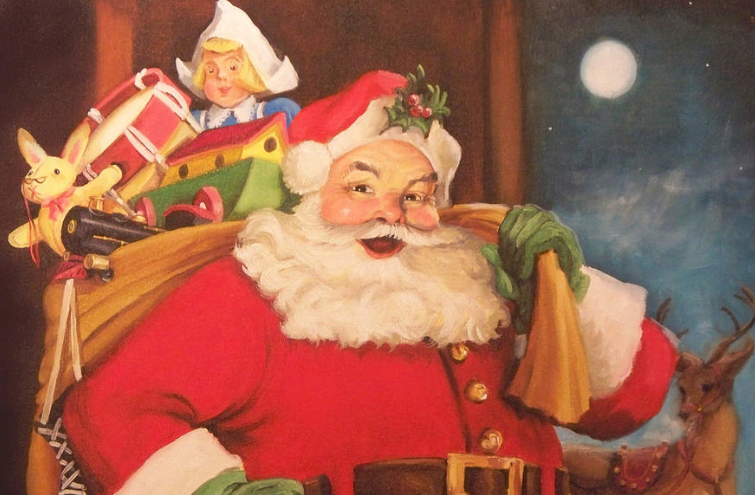
Santa Claus is coming to town. He’s back in the shopping malls and showing up at various holiday events. The jolly old, white-bearded guy in a red suit certainly is popular in our American culture. What’s not to love about a guy who lives at the North Pole, employs elves, magically soars through the sky with flying reindeer, and delivers Christmas gifts to children all around the world each Christmas Eve?
The question many thoughtful Christian parents have is: “Should we teach our kids about Santa?”
The Purpose of Advent
Let me begin by asking another question: “What is the purpose of the Advent season?” Most Christians would agree this season is about the birth of Jesus.
That first Christmas, the angel proclaimed to the shepherds, “Fear not, for behold, I bring you good news of great joy that will be for all the people. For unto you is born this day in the city of David a Savior, who is Christ the Lord” (Luke 2:10-11, ESV). What made it “good news of great joy” is that the message was about Jesus. If you want your Christmas season to be filled with “great joy,” you will want Jesus to be at the center of all your family’s traditions and festivities. Without Jesus, all the parties and presents are ultimately meaningless and empty.
“Christmas” literally means “Christ’s mass.” From the beginning, Christmas has been a time to especially contemplate the wonder of God’s love for a lost world, that the Son of God would come as a baby. Of course, the goal of Christ’s coming was primarily so that He would one day die as a substitute for sinners and rise again.
The angel told Jesus’ adoptive father Joseph, “She will bear a son, and you shall call his name Jesus, for he will save his people from their sins” (Matthew 1:21, ESV). Jesus came as the true Light of the world, and His primary mission was to save those who were lost in sin.
If Jesus and the salvation He brings is the reason we celebrate Christmas, then as parents, doesn’t it make sense to do all we can to put the focus on Him, not lesser distractions?
Harmless Myth?
As you look around our home during the Christmas season, you won’t find much of Santa Claus among our decorations. That’s not because we are anti-Christmas or even anti-Santa, but because we are very pro-Christmas and pro-Jesus. And my wife and I want our three boys to know that nothing compares with the gift God has given us in His Son, Jesus Christ.
Many parents might say, “But there’s nothing wrong with encouraging kids to believe in a magical myth while they are young.” But is that true? I think it’s a wonderful thing to read fiction to your kids. It fuels their imaginations, can teach deep lessons, and helps them grasp the real world in new and powerful ways. But that’s not the same thing as encouraging your kids to believe the fictional world is true.
Colossians 3:9 says, “Do not lie to one another, seeing that you have put off the old self with its practices.” Is it possible to encourage belief in a myth while not lying? I don’t think it is. And if you are teaching your kids about both Santa and Jesus, yet not distinguishing which is myth and which is true, can you see why this could lead to problems later? They may struggle to believe other things their parents have taught them, because they have a clear example of myth being presented as reality.
Old Man in the Skies?
Santa is often described in ways that remind many people of God. He’s seemingly all-knowing: “He sees you when you’re sleeping; he knows when you’re awake.” He fits the image some have of God as an old, white-bearded guy in the skies. And then he rewards good behavior: “He knows if you’ve been bad or good, so be good for goodness sake.”
But on closer examination, Santa is lightyears from the true God. God is infinite and all-knowing, and Santa is a chubby old man who needs elves and reindeer to help him do his job. The caricature of God as an old man in the sky is both false and dishonoring. God is eternal and all of creation depends on His sustaining power moment by moment. And unlike Santa, God is gracious and forgiving. Rather than merely rewarding the nice and leaving the naughty with a lump of coal, the one true God has given His beloved Son to die for His enemies.
While the mythical Santa can bring toys and trinkets that cannot last, the true and risen Jesus can give eternal life and the hope of an inheritance that is “imperishable, undefiled, and unfading” (1 Peter 1:4). Rather than giving Santa and Jesus equal attention this Christmas season, why not teach your kids about the true and living Jesus as the One who is always present for them (not just once a year!) and will meet their every need?
So why in the world would we focus on the myth of Santa, when we can teach our kids the glorious, joy-giving truth about Jesus? There’s simply no comparison!
The Real Saint Nicholas
Lastly, one thing we have done is teach our boys about the true Saint Nicholas from history, because he’s a great example of one who boldly stood for Jesus Christ and suffered for his faith.
Soon after ascending the throne in AD 284, the wicked Roman emperor, Diocletian, began a full-scale persecution dedicated to wiping Christianity from the face of the earth. Diocletian had copies of Scripture burned and imprisoned many bishops, including Nicholas of Myra. Many years later, Constantine became the Roman emperor, and he ordered the release of all bishops.
Around the time that Christianity was gaining more influence, a heretic named Arius began to deny Jesus was fully God. Arius gained quite the following and his teachings caused a lot of division in the church. So, in the year 325, Constantine called on 300 bishops across the Roman Empire to meet in Nicaea and come to unity on the question of Jesus. As Arius stood up before the assembly and began to pontificate, many of the bishops grew angry.
Many of these bishops at the council still had scars and maimed limbs from suffering brutal persecution for their faith in Jesus. Now they had to listen to this snobbish academic spout blasphemous ideas about their Lord. One man strode right up to Arius and smacked him across the face. Arius cried foul, and that bishop was restricted from the remainder of the Council. That bishop’s name? You guessed it: Saint Nicholas of Myra, better known today as “jolly old Saint Nick.”
The irony of all the attention going to Santa at Christmastime is that the real Saint Nicholas was passionate about people knowing the truth about Jesus. So, if someone asks you if you believe in Santa, you can say, “You bet I do, and he had a mean left hook!”
Let’s commit to worshiping Jesus and making Him known this season, beginning with our own homes.
Have thoughts on this post? Feel free to comment below!

 Lamp and Light