In the last couple months, I have been preaching from the Book of Joshua. Joshua is a book full of epic battles and miraculous events. Ultimately, it’s a book about the character and nature of God. It’s named after Israel’s military leader, Captain Joshua, but Yahweh is the true Hero who drives the story forward. And His majesty and power is what should captivate us.
In Joshua, we learn that Yahweh is a God who does not tolerate injustice and is unshakably committed to His word. His promises are rock solid and worthy of building your life upon. He is a God who demands our total allegiance, but He also is a God that is full of grace toward those who have failed Him countless times. He can destroy an entire army with a single blow, but He is also a God who notices and takes thought of individuals who are fearful, lost, and hurting. Yahweh, the God of Joshua, invites us to share in His victory over evil.
“Have I not commanded you?” God says to Joshua. “Be strong and courageous. Do not be afraid; do not be discouraged, for the Lord your God will be with you wherever you go” (Joshua 1:9, NIV).
One takeaway from studying Joshua is that you need to have a big view of God. A small god lacks the power to rescue you from your biggest fears. A small god has no ability to give you hope and meaning in life. But a big God–the God of Joshua–can save. He has the power to help you overcome all your fears, insecurities, and doubts. He is the God who walks with you in your pain. A small and shallow god abandons you when things get rough. But the awesome God of the Bible has a love for you that is deeper than the ocean, and He will not abandon you.
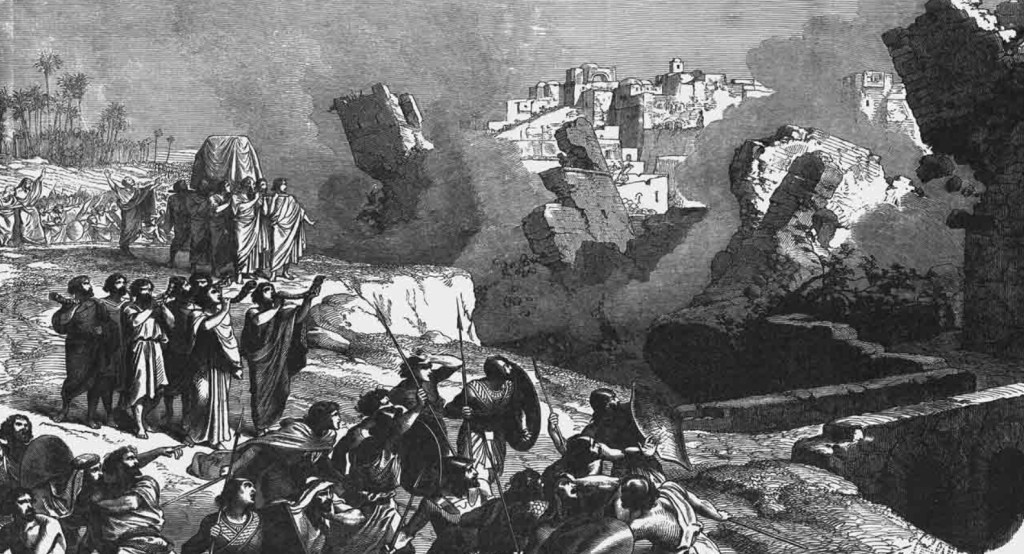
As you walk through Joshua, you get the most vivid and soul-stirring picture of God fighting for His people and granting them an inheritance in the Bible until we come to Jesus. Before the cross and resurrection, the walls of Jericho came down. Before Jesus promised us a kingdom, God promised Joshua the land of Canaan.
Can Modern People Believe in the Miraculous?
Critical scholars stumble in many places in the Book of Joshua. They say that it’s a myth, that it’s unhistorical, that the incredible events recorded could not happen. Why? Because there are some pretty astounding miracles in Joshua. When was the last time you saw the sun stand still in the sky all day? And if you know anything about our culture, you know there is an antisupernatural bias–especially in academia.
While a student in college, I had a conversation with a girl who had adopted this skeptical worldview. When I asked her why she didn’t accept that the miracles in the Bible were possible, she told me, “People in ancient times used to dream up these amazing stories of gods and miracles because they lacked any real understanding of the world. They attributed things like hurricanes and lightning to the gods, simply because they didn’t know anything of science.” That narrative is pretty firmly ingrained at a secular university.
I responded that the God of the Bible is not just one god among many. He’s not just responsible for the rain or the wind. He is the God over all of nature. He authored all of it. The whole universe lies in the palm of His hand. The mythical gods were all so humanlike. They warred against each other, lusted after women, and behaved like bigger, grumpier versions of us. But Yahweh–the God of the Bible–is in a category of His own. Perhaps her real issue wasn’t that she didn’t believe in miracles. Maybe she just had too small a god in mind.
What many often forget is how much evidence there is for one great and infinite Creator God. For example, we all enter this world preprogrammed to believe that there is an objective standard of justice to which we are all beholden. Even at the age of three, my boys were saying things like, “That’s not fair!” Why, if we’re just animals with instincts, do we all seem compelled to follow this higher moral order? It only makes sense if there is a moral Lawgiver to whom we’re all accountable. It’s easy to explain away the mythical pantheon of gods from ancient cultures, but what you can’t so easily explain away is the one eternal Creator God of the Bible–the reason nature exists in the first place.
If you struggle to believe in miracles, ask yourself, Is it possible that there is a God who created everything? Does the world look more like the product of design or unguided chaos? Does it seem like we are here without rhyme or reason, or does it seem like we were made for more than a mere 80 to 90 years, then nothing? If God is the reason for our existence, what would prevent Him from performing miracles in the world He created, especially if He had a special, redemptive purpose to overcome human evil?
How Big Is Your View of God?
If you are willing to accept the first statement of the Bible: “In the beginning, God created the heavens and the earth,” there’s no reason not to accept that miracles are possible. And suddenly the book of Joshua doesn’t seem so far-fetched. There are about 120 miracles recorded in the Bible, and I believe they really happened. But here’s what you need to know: the miracles of the Bible are always recorded in a sober, restrained way. They are given in the context of actual historical and factual accounts. They aren’t like Aesop’s Fables or Homer’s Odyssey. The Bible was written as history. And if you have a big view of God, you can accept the reality of miracles.
Furthermore, the best part is that you can actually know this God through committing your life to His uniquely divine Son, Jesus Christ. Despite what you may believe, God is not only real, He loves you and has made Himself available to you. But are you willing to open your heart and life to Him? When your life has been transformed by the God of the Bible, miracles aren’t so hard to believe.
After one alcoholic became a follower of Jesus, a skeptical friend asked him how he could possibly believe all the nonsense in the Bible about miracles. “You don’t believe that Jesus changed the water into wine do you?” The former alcoholic replied, “I sure do, because in our house Jesus changed the whiskey into furniture.”
The question is: Just how big is your view of God? You know you have a big view of God when reading sober and historical accounts of miracles doesn’t bother you. It encourages you!
If you have thoughts on this post, I would love to hear from you.
“For what can be known about God is plain to them, because God has shown it to them. For his invisible attributes, namely, his eternal power and divine nature, have been clearly perceived, ever since the creation of the world, in the things that have been made. So they are without excuse.” (Romans 1:19-20, ESV)
When the famous atheist Bertrand Russell was asked what he would say to God if, at death, He turned out to be real, Russell’s famous reply was, “Not enough evidence, God! Not enough evidence.”[1]
According to the Christian worldview, God’s existence can be known to all. Through creation and conscience, God has made Himself known. As the Apostle Paul would say, “So they are without excuse.” The problem, according to the Bible, is that because we love our autonomy and hate the thought of being accountable to God, we “suppress the truth in unrighteousness” (v. 18).
Like the speeding driver who hopes no police officer is watching, broken people don’t want there to be a God—at least, not the holy and righteous God of the Bible. A non-threatening god that winks at sin, so long as you offer token prayers and sufficient good deeds, is not problematic. The real threat is a God of blinding holiness, a God who knows everything about you, everything you’ve done, and why you did it.
As I have interacted with Generation Z on college campuses over the last ten years, I’ve noted that an increasing majority I meet identify as either atheist or agnostic. That means that it’s not uncommon for the typical American college student today to say they see no good reason to believe God is real.
However, I’ve observed that while many will initially say with confidence they see no reason to believe in God, if you’re willing to ask questions and patiently listen, you discover that there’s usually more to the story. In many cases, it’s not necessarily that they have carefully considered the God question. More often, it’s that people hunger for an identity, and I suspect that identifying as atheist or agnostic sounds to many like “liberated,” “free thinking,” and “self-determined.”
Why Do You Believe What You Believe?
My approach is to ask for reasons they doubt God’s existence and then to listen very carefully. I want them to know I genuinely do want to hear their objections and questions. The last thing they want is another religious guy dumping a truckload of truth on them without any gentleness or compassion.
The Bible calls us not only to respond with gentleness and respect, but also to “be quick to listen, slow to speak, and slow to anger” (James 1:19). If nothing else, I hope that they are left with the impression that at least one Christian in this world cares enough to listen to them. But after listening, I will gently push back, usually with some questions of my own, in the hope of getting them to think through what they are claiming to believe.
My goal, however, is to get the conversation to Jesus. And I’m not ashamed to say so. After all, it is the gospel—not clever theistic reasoning—that is the power of God for salvation to everyone who believes (Romans 1:16). So, let’s consider what would be a thoughtful response to some of the most common atheist objections.
“If everything needs a cause, what caused God?”
This objection usually shows up after I’ve asked someone, “How do you account for the beginning of the universe?” Many atheists seem to think this question of “What caused God?” is the knockout blow to the First Cause argument. The argument works like this.
Every effect is a result of some cause.
If the universe itself is an effect, there must be a self-existent First Cause outside our universe that caused the universe.
The universe is an effect, contingent on some prior Cause.
Therefore, a First Cause, whom we call God, exists.
Think about how you ended up where you are today. There were a series of events and decisions that led you to where you are now. You could trace this cause-and-effect series in your life back to the moment you were born. But what caused that? At some point, your parents had to meet. As did their parents. And their parents. You get the picture.
Like a series of Dominoes falling, you can trace back every event in the world to a cause. But you cannot simply do this forever. Eventually, you have to come to a First Cause that tipped that first domino—an uncaused Cause.
One quick note. Christians have never claimed that everything needs a cause—only that creation needs a cause. According to the Bible, God is eternal, existing outside of time, space, and matter.
“Before the mountains were brought forth, or ever you had formed the earth and the world, from everlasting to everlasting you are God.” (Psalm 90:2, ESV)
So, to ask what caused God is like asking how long a bachelor has been married. Properly stated, this objection would sound like this: “If God caused the universe, what caused the eternal and uncaused God?” Just like asking how long a bachelor has been married, the question becomes incoherent once we understand the nature of God. He is by definition “from everlasting to everlasting,” and thus uncaused.
In other words, the Bible claims that God is not one more feature of the created world but is instead the foundation for the created world. He is Being itself, and therefore the ground of all reality.
“Maybe the universe didn’t have a beginning. Or maybe there is a multiverse that gave birth to our universe.”
The Book of Genesis begins with a straightforward explanation of our universe: “In the beginning, God created the heavens and the earth” (Genesis 1:1, ESV). Because of Genesis, Christians believed the universe had a beginning even at a time in history when most of the Greco-Roman world believed in an eternal universe.
It makes sense that as belief in one eternal God spread, so did belief in the universe having a beginning. In order to avoid the need for God, one popular skeptic recently wrote, “There is no beginning and no end—no boundaries. The universe always was, always is, and always will be.”[2]
It’s worth noting that even most cosmologists today agree that the universe had a beginning. They would typically say it all began with the singularity. But any reasonable person might wonder how that singularity got there. Even if you believed—despite contrary evidence—the universe didn’t have a beginning, you still need an explanation for why the universe is sustained in existence even now.
To suggest that there is a multiverse to explain our universe is to appeal to something for which we have no evidence. While many Marvel movies today are based on this idea of a multiverse where there are an infinite number of Spider-mans out there, it’s good to remind people to distinguish between fact and fiction. And in reality, there is no evidence for the multiverse. So, if we care about following scientific evidence wherever it leads, we shouldn’t resort to something with no observable evidence whatsoever.
In fact, the theory of a multiverse first arose as something of a “metaphysical escape hatch” for those who didn’t like the theistic implications of our universe having a beginning and being finely-tuned for life.[3]
“We don’t need to ask why the universe is here. Asking ‘Why?’ is childish.”
In a debate several years ago, the atheist Richard Dawkins said that looking for purpose in nature is a childish endeavor. He added that asking the question “Why is something the way it is?” is to ask a “silly question” which most people grow out of after age six.[4]
But here, Dawkins is mocking what is a basic human intuition. We ask the question “Why?” because we seek understanding—a question that ironically should be encouraged in the sciences. If it’s a “childish” question, then perhaps we need to learn from children about the importance of curiosity and critical thinking and not grow smugly self-satisfied that we already know best how the world works.
Behind Dawkins’ mocking tone is a thinly veiled uneasiness about seeking an ultimate explanation for all the effects in nature. Everything in nature has a cause. Eggs come from birds. Seeds come from flowers. Milk comes from cows. I could keep going.
But while we have a basic intuition telling us that everything in nature has a cause, the question can reasonably be pushed back to the cause of the universe itself.
“Maybe the universe doesn’t need a cause. Maybe it just is, and there’s nothing more to say about it. Why posit a God we can’t see to explain it?”
But this response commits the logical fallacy of special pleading. Special pleading is when we exempt a certain circumstance or event from the same critical criteria as other circumstances or events without reasonable justification.
For example, if you were to come home and find a plate of freshly baked chocolate chip cookies on the counter, you might wonder who made them. Now imagine your roommate or spouse glibly replying, “No one did. They’re just there. Why posit a baker when you didn’t see someone baking them?” Of course, such a response sounds ridiculous.
But here’s where I want to make it clear why it sounds ridiculous. We all intuitively know that every effect (e.g., freshly baked cookies) has a cause (e.g., a baker). Even the 18th century skeptic, David Hume, freely admitted as much: “I have never asserted so absurd a principle as that anything might arise without a cause.”[5]
But if everything in nature has a cause for its existence, it only makes sense that the whole universe would need a cause for its existence, too. And to explain the universe, this Cause must stand outside the universe rather than being one more part within the universe. Hence, the conclusion that the universe is caused by an all-powerful, eternal, all-wise, immaterial, self-existent, and personal Being—also known as God.
Some atheists I’ve interacted with have brought up Ockham’s razor to say that the simplest explanation is always best, and that we don’t need to posit the existence of a God we cannot see.[6] But again, if we are seeking a cause for the physical world we can see, why would we expect God to be physically visible within the universe? Likewise, the Russian cosmonaut Yuri Gagarin, the first man to enter space, reportedly said that he didn’t see God up there.
But we don’t look for a book’s author within its pages. Rather, we recognize the necessary existence of an author because we have a book. Ironically, William of Ockham (1287-1347) never used his “razor” to rule out a need for God. In fact, he said the underlying order in nature is most simply explained by an intelligent Creator. He wrote, “For nothing ought to be posited without a reason given, unless it is self-evident or known by experience or provoked by the authority of Sacred Scripture.”[7]
As Scripture teaches:
“Now every house is built by someone, but the one who built everything is God.” (Hebrews 3:4, ESV)
“I prefer scientific explanations to theological speculations about God and what He may or may not have done.”
Science is a wonderful tool for exploring the natural world and for helping us develop technology. We are greatly indebted to scientific discoveries and pioneers of the past. However, science is a discipline for studying the physical world, nothing more.
For example, science may tell us what regularities (laws of nature) we can observe in the world, but it doesn’t tell us how those regularities got there in the first place. Moreover, while it has provided astounding observations about the universe, science cannot provide an ultimate explanation for the universe itself.
Underlying this objection is the presupposition that science is the source of all truth. But if someone was to say to me, “Truth is determined by what can be empirically verified by science,” I would ask them, “Can that statement be empirically verified by science?” This belief that science is the source of all truth is called scientism, and is a claim that, ironically, cannot be supported by science, and is therefore self-refuting.
However, science does provide evidence for a finely-tuned universe that had a beginning. Therefore, while science cannot prove the existence of God in a mathematical sense, it strongly points to the conclusion that God is the uncreated Creator exactly as the Bible describes Him. Moreover, through their studies, many believing scientists have sensed a greater awe by understanding how God so marvelously constructed this universe we call home. The famed astronomer Johannes Kepler (1571-1630) said, “The chief aim of all investigations of the external world should be to discover the rational order and harmony which has been imposed on it by God and which He revealed to us in the language of mathematics.”[8]
Nature can teach us that there is a God, but to know this God personally, we need Him to reveal Himself to us. And this is just what this God has done by giving us Scripture (2 Peter 1:16-21) and ultimately revealing Himself in the one true Redeemer, Jesus Christ, who claimed to be the eternal “I Am” of Genesis (John 8:58; 14:6).
Have thoughts on this post? Feel free to comment below!
[1] Michael J. Murray, An Introduction to the Philosophy of Religion.


 Lamp and Light