It’s become popular for intellectual types to say things like “the resurrection of Jesus is a symbol of hope.” The problem for many is that it remains just that: a mere symbol, but not reality.
In the film The Shawshank Redemption, the main character Andy tells his fellow inmate, Red (played by Morgan Freeman), that hope is the only thing the prison guards can’t take from them. Red’s response is memorable: “Hope? Let me tell you something, my friend: Hope is a dangerous thing. Hope can drive a man insane.” Red does have a point. If you are in locked in prison for life and there is zero chance of escape, hope can eventually fade into severe disillusionment. In the end, a metaphorical or symbolic hope is no help at all.
The Apostle Peter discusses hope in his first epistle found in the New Testament:
“Blessed be the God and Father of our Lord Jesus Christ! According to his great mercy, he has caused us to be born again to a living hope through the resurrection of Jesus Christ from the dead…” (1 Peter 1:3, ESV)
He starts this sentence saying, “Blessed be” or “Praise be the God and Father of our Lord Jesus Christ!” This is the starting point. For Peter, everything begins and ends in worship, because everything begins and ends with God.
And he says this great God of all has shown unspeakable mercy to us, by causing us to be “born again.” In other words, God is the fountain and source of all spiritual life. We were spiritually lifeless and hopeless, but He stooped down to rescue us. In fact, He not only saved us but made us His own child.
Something we never want to take for granted is the fact that, as followers of Jesus, we are privileged to call God our own Father. For some people, this has taken some getting used to. Maybe you doubt you could ever be worthy of addressing God as “Father.” Or maybe you can’t get past the fact that your earthly father failed you growing up. And it’s hard to understand God as a father.
But let me tell you that there is incredible peace in knowing that, despite all the promises broken and failures of your earthly father, you have a heavenly Father who will never abandon you, never fail you, and will keep every promise perfectly.
God is a Majestic King, a Fearsome Warrior, and Just Judge. But before anything else–for the Christian–God is our loving Father. He loves as only a perfect Father could. He delights in His children and He lavishes us with His love in a way that sometimes seems unthinkable.
Peter says we have been “born again,” meaning we have been given new spiritual life and made a child of God the Father.
“… he has caused us to be born again to a living hope through the resurrection of Jesus Christ from the dead…” (1 Peter 1:3, ESV)
Our hope is alive. Why? Because our Savior is alive. So many people think that the Christian idea of Heaven is just pie-in-the-sky. They assume it’s just a fairytale for grown-ups, to help us cope with life’s hardships. Some even imagine Heaven to be boring.
That may be the case for other religions and philosophies out there, but from the very beginning the Christian church has always had its hope rooted in historical reality. And Heaven is about the reconciliation, redemption, and restoration of all that we hold dear in life. It’s about the satisfaction of all our earthly longings: our longing for justice to be satisfied, love without end, freedom from futility, and purpose for our existence.
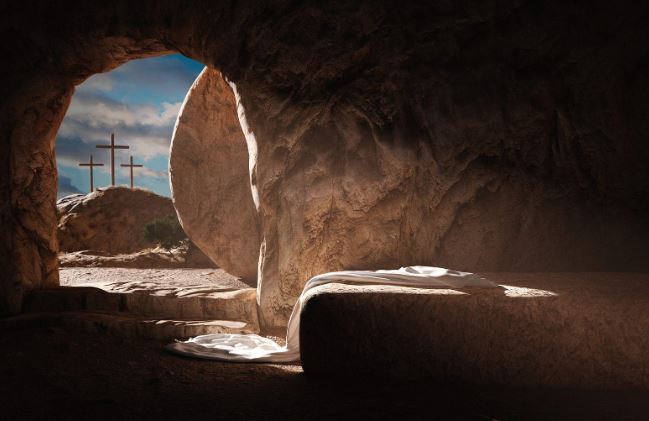
Remember what Paul said? After listing all these evidences that Jesus really did rise from the dead (the tomb is empty, He appeared to people at many different times and in different contexts, the birth of the church itself), he added that Jesus even appeared to Paul himself, after His ascension!
And then Paul says something pretty radical:
“And if Christ has not been raised, your faith is futile and you are still in your sins.” (1 Corinthians 15:17, ESV)
He is willing to hang everything on the truth of the resurrection. That is something no other religion or belief system is willing to do. But here he says, “If this one event did not happen, it’s all for nothing… and we have no hope. If the stiff corpse that lay in that tomb for 36 hours didn’t miraculously and supernaturally come back to glorious resurrected life, then we have no hope whatsoever.”
Of course, he goes on to say, “But in fact Christ has been raised from the dead” (1 Corinthians 15:20).
Some of my favorite Christian testimonies are of those who, in God’s providence, set out to disprove Christianity and ended up realizing the evidence actually supported the resurrection.
That’s how it was for Josh McDowell. He was a hardened skeptic who thought Christianity was a bunch of old myths that had no bearing on life.
And some Christians challenged him on that, to do the research and really investigate everything historians know about the resurrection. And so he did just that. He went all over Europe desperate to prove everything about Jesus was a myth: His claims to deity, His resurrection, all of it. Until one night, he found himself in a library in London. Here’s what Josh writes:
“After several hours of research studying some out-of-print books, I leaned back in my chair, rubbed my eyes, and without remembering I was in a quiet library, I spoke out loud, ‘It’s true. It’s true! It’s really true!’”
He is just one example. Many other skeptics have done the same thing and found the evidence actually works against them. That is not to say that you have to go out and become a historian before you can be a Christian. The point is that even for the skeptic who demands compelling evidence for belief, the evidence is available if you’re willing to look.
Because Jesus is alive today, Christians have a living hope rooted in history.
My friend, you need to know that, if you’re not a Christian, the evidence for Jesus conquering death is compelling. Investigating the truth about it might just change your life. And if you are a Christian, you need to know that you have a living hope, because you have a living Savior. If Jesus can beat death itself, then what could possibly stop Him? Who else in history has conquered the grave? And just as He promised ahead of time to rise from the dead, He promised to raise us from the dead. The fact that He already did the first guarantees that He will do the second.
Have thoughts on this post? I’d love to hear from you!
It is remarkable to consider the numerous testimonies of skeptical scholars who set out to disprove the whole story of Jesus and His resurrection, and, like the hotheaded Saul of Tarsus, were knocked from their high horse only so they could gladly bow the knee to Christ.
“The Book that Refused to Be Written.”
One example is Frank Morrison. Morrison was a skeptical historian utterly convinced that the whole resurrection story was nothing but a hoax that had duped a great portion of the Western world and beyond. In his mind, the resurrection could not be true, simply because it proposed the impossible: that a lifeless corpse laying in a tomb had truly come to life. In Morrison’s mind, such an idea was preposterous from the start. It was ludicrous! Evangelical appeals to believe such a tale were an insult to his intellect.
And yet…
It did bother him that so many people had bought into this story—some of whom were no intellectual lightweights.
How is it, he wondered, that so many people could believe something that was so manifestly impossible? It would be one thing if a small crowd in Jerusalem back in the first century had been taken in by the resurrection tale, and that movement had fizzled and died long ago. But how is it that such a vast number of intellectual giants in the last 2,000 years (Augustine, Aquinas, Galileo, Kepler, Newton, and C. S. Lewis, to name a handful) have taken the claims of the New Testament seriously?
It was this question that drove Morrison to a detailed study of the resurrection accounts in the Gospels. He set out to disprove it all. But in a twist of providential irony, while he was meticulously seeking out holes in the Gospel accounts, he kept coming away from his study with the strange feeling that it all had the ring of truth. He had imagined himself writing a book detailing all the logical flaws and historical errors on the part of the Gospel writers. Instead, he found himself writing a very different book.
In fact, in his best-selling book, Who Moved the Stone?, which chronicles his investigative journey, the name of the first chapter is “The Book that Refused to Be Written.” In his own words, Morrison said that his historical investigation of Jesus’ resurrection kept taking him “in a new and unexpected direction.” He said, “It was as though a man set out to cross a forest by a familiar and well-beaten track and came out suddenly where he did not expect to come out. The point of entry was the same; it was the point of emergence that was different.”[1]
By the end of his research, it was not the whims of wishful thinking but the stubborn facts themselves that convinced him. Jesus Christ truly had risen from the grave!
The Greatest News on Earth
Can you remember the first time it really registered for you? Jesus is alive! He’s the Lord of the universe because He has defeated death! I remember experiencing something similar many years after I had become a Christian. I was reading a book called The Case for the Resurrection of Jesus, and I remember the truth washing over me in a new way. Jesus really is alive. He’s defeated death. That means I have nothing to fear in life or death!
The following Sunday morning I remember tears of joy coming to eyes as we sang about Jesus as the living Lord, and I just kept thinking, Yes! Jesus is alive! The tomb is empty! I live for a resurrected King! Sheer happiness coursed through my veins. I wanted to sing His praises for the rest of the day.
What could possibly be better news than this? Learning your application was accepted at an Ivy League school? Landing the ideal job you’ve been working tirelessly to get? Getting married to the girl of your dreams? As amazing as each of these are, none can compare with knowing deep in your bones that Jesus really has defeated death for you.
I was experiencing Paul’s words in Romans:
“This hope will not disappoint us, because God’s love has been poured out in our hearts through the Holy Spirit who was given to us.” (Romans 5:5, CSB)
The resurrection really does change everything. All other religions and faith systems are built on the teachings of dead guys. No matter how fancy and pristine their tombs might be, their bodies rotted away long ago. Buddha is dead. Muhammad is dead. Krishna is dead. Confucius is dead. Moses is dead. They’re all dead! But Jesus? He’s alive.
“But the one God raised up did not decay.” (Acts 13:37, CSB)
And what’s more is that from the very beginning of the church, Christians have always claimed He is alive. This is the truth that propelled the early church forward with boldness, declaring that “Jesus is Lord! Above all earthly gods. Above Caesar. Above the most powerful people on the planet. Jesus is Lord!”
It’s no surprise that the book of Acts shows the earliest disciples making the resurrection the hub of their whole message. They claimed they had seen the risen Jesus in the flesh. “God has raised this Jesus to life, and we are all witnesses of it,” said Peter (Acts 2:32). Peter and Paul called the resurrection a clear fulfillment of what God had promised through the Hebrew prophets (Acts 2:29-31; 13:34-35). Philip said that when you’re reading Isaiah 53, you’re reading about Jesus (Acts 8:30-35). From the start, their message was all about Jesus’ sacrificial death for the forgiveness of sins, and how Jesus’ resurrection proves that His death was sufficient.
“Now when David…fell asleep, he was buried with his ancestors and his body decayed. But the one whom God raised from the dead did not see decay. Therefore, my friends, I want you to know that through Jesus the forgiveness of sins is proclaimed to you.” (Acts 13:36-38, NIV)
No sacrifice for sins is needed after Jesus, because He made the payment in full.
“But when Christ had offered for all time a single sacrifice for sins, he sat down at the right hand of God, waiting from that time until his enemies should be made a footstool for his feet. For by a single offering he has perfected for all time those who are being sanctified.” (Hebrews 10:12-14, ESV)
And the Father raised Him from the dead because He was satisfied in the Son’s payment.
“Because of our sins he was given over to die, and he was raised to life in order to put us right with God.” (Romans 4:25, GNT)
This was no esoteric message about a transcendent Heaven that had no bearing on our lives today. Everyone who encountered the risen Lord suddenly had a new direction in life. And sometimes, this got them into trouble with the local authorities. That’s why wherever the gospel goes in Acts, a mob quickly follows.
Responses to the Resurrection Message
But why would a message of life attract angry mobs? How did various groups respond?
The self-righteous and political elite were threatened and enraged.
“These men who have turned the world upside down have come here also, and Jason has received them, and they are all acting against the decrees of Caesar, saying that there is another king, Jesus.” (Acts 17:6-7, ESV)
The proud intellectuals debated and mocked the message.
Some of the Epicurean and Stoic philosophers also conversed with him. And some said, “What does this babbler wish to say?” (Acts 17:18, ESV)
But some, like the Bereans, were noble and humble seekers of the truth.
“The people there were more open-minded than the people in Thessalonica. They listened to the message with great eagerness, and every day they studied the Scriptures to see if what Paul said was really true.” (Acts 17:11, GNT)
But one thing was clear. You cannot hear the full truth about the risen Jesus and then shrug your shoulders and walk away. There is no neutrality when it comes to Jesus. How could you ever be neutral about One who has left behind an empty tomb? Whether you love it or hate it, this message will do something to you.
It’s the reason why Paul could say, “To live is Christ! And to die is gain!” He meant something like this: “As long as I’ve got breath in my lungs, I’m living for Christ and sharing the news that Jesus is the Savior. If I get killed, that’s okay with me, because then I get to be with my Lord face to face.” Paul could talk like that because he had met the risen Lord already.
That’s what happens when you are truly gripped by the greatest news on earth.
A. W. Tozer said, “The Christian owes it to the world to be supernaturally joyful.” I agree, and this can only happen as we experience “the power of the resurrection” (Philippians 3:10). The more the reality of Christ’s resurrection has gripped our hearts, the more we see we can no longer face life’s difficulties without reference to this world-changing event.
If you have not yet surrendered to the resurrected King, I urge you to do that today. Only through trusting in the living Jesus is your eternal salvation made secure.
“If you confess that Jesus is Lord and believe that God raised him from death, you will be saved. For it is by our faith that we are put right with God; it is by our confession that we are saved.” (Romans 10:9-10, GNT)
Have thoughts on this post? Feel free to comment below!
C. S. Lewis was born 121 years ago this Friday, November 29, 2019. I am one of many who can say that his writings have profoundly affected my life — even from childhood. I can still vividly recall my mom reading his classic series, The Chronicles of Narnia, to my brother and me as a child.Later in life, books like Mere Christianity and essays like The Weight of Glory left an indelible mark on my life. I have read and heard countless testimonies of men and women who note that his writings were instrumental in leading them to consider seriously the claims of Christ. In light of all that this Irish man has contributed to the cause of Christ and the world of literature in general, I thought it would be fitting to write a tribute in his honor.
The Making of an Imagination
First,
let me offer a brief biography of the man. Clive Staples Lewis was born in Belfast,
Northern Ireland, in 1898. Lewis’s mother died when he was only ten years old,
and the experience left a deep impression on him. As a result, the young Lewis
felt a deep sense of longing for what could have been. Lewis would later
describe this deep sense of longing for a better world simply as joy.
In
1917, Lewis enlisted in the British Army and was commissioned as an officer
during World War I. Although his war experiences dramatically shaped him as a
man, he deliberately strove to forget them. In fact, he devotes very little
space to his time in the Great War in his autobiography, Surprised by Joy. But with all the horrors and life-changing trauma
that war inevitably brings, why recount so little of the experience? Lewis
biographer Alister McGrath answers, “The simplest explanation is also the most
plausible: Lewis could not bear to remember the trauma of his wartime
experiences, whose irrationality called into question whether there was any
meaning in the universe at large or in Lewis’s personal existence in
particular.”[1]
This is all the more fascinating when one considers that Lewis was no pacifist.
Later in life, Lewis defended his own brand of just war theory, concluding that
in certain unfortunate circumstances, war is inevitable but always grievous.[2]
After the war, Lewis finished his schooling at Oxford, and eventually became an Oxford don. It is worth noting that while Lewis had a very tense relationship with his father, it was also likely his father’s death that spurred him out of his youthful atheism to reflect on spiritual realities.[3] While at Oxford, Lewis began his well-known friendship with J. R. R. Tolkien, the author of The Lord of the Rings.[4] In fact, the two mutually benefited from one another in incredible ways. When Tolkien grew discouraged about ever finishing his great fantasy epic, Lewis encouraged him to see it through, something for which I am immeasurably grateful. Furthermore, it was Tolkien who proved instrumental in Lewis’s conversion to Christ.[5]
Lewis
saw hints of the Christian story in nearly all the old pagan myths from various
cultures throughout history. This initially bothered him — was Christianity just
borrowing the grand themes of sacrifice and redemption from the pagans?
However, Tolkien helped him to see that these other myths merely accentuated
the innate longings we all have that Christ alone fulfills. Therefore,
Christianity is what Lewis called the “true myth” because it alone truly
happened in our space-time world and can satisfy the heart’s deepest longings.[6]
McGrath
calls Lewis an “eccentric genius”[7]
because he was an unusual blend of a clear-thinking, rational philosopher and
an imaginative lover of fables and ancient myths. Although he was a first-rank
Oxford scholar and professor, he took some flak from many of his peers for his
willingness to write popular works of fiction and Christian apologetics.[8]
Lewis
is perhaps best known for his classic The
Chronicles of Narnia, a fantasy series aimed at children and filled with
Christian themes. He wrote many other fictional works, such as The Screwtape Letters and The Great Divorce. However, the bulk of
Lewis’s published writings can be classified as works of theology, ethics, and
Christian apologetics. His best known apologetic work, Mere Christianity, is written with a skeptical British audience in
mind. In the first part of the short book, Lewis makes a case for Christianity,
and in the second part he explains what he believes are the chief issues
related to living a faithful Christian life.
Late
in life, Lewis met Joy Davidman, a woman who so enchanted him that he ended up
marrying her with the purpose of conferring her British citizenship in order
for her to avoid deportation.[9] To
Lewis’s great dismay, after only being married for about four years, their
blossoming romance came to an end. Joy died as a victim of cancer, the same
disease that had claimed Lewis’s mother so many years before. In November 1963,
Lewis himself was diagnosed with end-stage renal failure and ended up dying in
his own home, a week before his 65th birthday.[10]
A Man for All Ages
Part
of what makes Lewis still popular in evangelical circles today is his ability
to convincingly demonstrate how Christianity makes sense of our world. “I
believe in Christianity as I believe that the Sun has risen, not only because I
see it, but because by it I see everything else.”[11] His
arguments powerfully show how Christianity rings true when we are willing to
carefully examine the claims. Thus, his writings have proven instrumental in
bringing many skeptics to faith over the last half century.
Throughout
his writings, Lewis expresses his deep suspicion of the new and flashy brands
of theology. Ideas that try to be trendy often overshadow that which is tried
and true. “Novelty, simply as such, can have only an entertainment value.”[12] Just
because something entertains, suggests Lewis, does not mean it is either
helpful or true. That is a good word for us to heed in our entertainment-driven
culture.
For
Lewis, Christianity is not merely a matter of private devotion but a public
issue, because it encompasses our entire outlook on life. Lewis came to see
that atheism simply could not account for our world. Universal moral principles
that we all share make little sense if we are merely the product of our genes.
In Mere Christianity, Lewis argues
that we are all aware of a natural law of human behavior, a sense of justice
that we cannot ignore.[13] Since
we all recognize this inner law, there must be an authority higher than
humankind to whom we all are accountable. Only God could be the great Author of
the moral law we all find within ourselves.
The
“true myth” of Christianity is about the great Author entering into His world
in order to work out our redemption and restoration. Lewis likens the
incarnation of the Son of God to Shakespeare writing himself into one of his
plays. “Shakespeare could, in principle, make himself appear as Author within
the play, and write a dialogue between Hamlet and himself. The ‘Shakespeare’
within the play would of course be at once Shakespeare and one of Shakespeare’s
creatures. It would bear some analogy to Incarnation.”[14] In
fact, Lewis seemed to do just this when you consider to whom the professor (Digory
Kirke) bears a striking resemblance in The
Lion, the Witch, and the Wardrobe.
In his essay Is Theology Poetry?, Lewis explains his view that theology must by nature include metaphor since we are speaking about a God that we can’t see, taste, or smell.[15] What theologians are trying to do, he explains, is draw a map charting a vast land that has not been exhaustively explored. And theology — this is important — is always meant to lead us to God, never to replace God. “Doctrines are not God: they are only a kind of map.”[16] This is a powerful reminder for every student of theology. Ultimately, our studies should lead us to worship and love our Lord and Savior — and they certainly can help in that endeavor. However, we must also be content in what God has revealed to us and not go beyond what Scripture has told us about Him. Even if we were granted 1,000 years to study theology, we’d only be scratching the surface of God’s infinite depths. “Oh, the depths of the riches and wisdom and knowledge of God! How unsearchable are his judgments and how inscrutable his ways!” (Romans 11:33).
At
one point in his Letters to Malcolm,
Lewis scolds his fictional friend Malcolm for criticizing a woman named Rose
Macaulay for reciting prayers written by others rather than composing her own. Apparently,
such a practice lacked personal devotion to God in the eyes of Malcolm. Lewis
defends Miss Macaulay and playfully calls Malcolm “a bigot”. He then movingly
points out that we should not expect every Christian to worship in the same
way. “If grace perfects nature it must expand all our natures into the full
richness of the diversity which God intended when He made them, and heaven will
display more variety than hell.”[17]
Prayer, Lewis recognizes, is often very difficult for the believer. This is an
indication that we are not yet perfect. “If we were perfected, prayer would not
be a duty, it would be delight. Some day, please God, it will be. The same is
true of many other behaviours which now appear as duties. If I loved my
neighbor as myself, most of the actions which are now my moral duty would flow
out of me as spontaneously as song from a lark or fragrance from a flower.”[18]
According to Lewis, theology helps us recognize just how great and generous God
is, and prayer leads us to respond accordingly.
Lewis
recognizes that Christianity offers an understanding of life beyond the grave
that is shot through with infinitely more hope than all its competitors.
Believers are promised rewards — an “eternal weight of glory” (2 Corinthians
4:17) — far beyond compare with whatever small joys we may find in this life.[19]
In looking forward to our ultimate reconciliation with God, Lewis seems nearly incapable
of containing his joy. “To please God … to be a real ingredient in the divine
happiness … to be loved by God, not merely pitied, but delighted in as an
artist delights in his work or a son — it seems impossible, a weight or burden
of glory which our thoughts can hardly sustain. But so it is.”[20]
Scripture
speaks of a God of immeasurable grace who has chosen rebel sinners, sacrificed
His only Son for their redemption, secured them with the seal of His Holy
Spirit, and bestowed on them His fatherly love. As redeemed and adopted sons
and daughters, our Father sings over us in delight — despite the fact that we
have not earned this blessing (see Psalm 149:4; Zephaniah 3:17). It’s all by
grace! One day we will see this clearly when we see God as He truly is. “No
longer will there be anything accursed, but the throne of God and of the Lamb
will be in it, and his servants will worship him. They will see his face, and
his name will be on their foreheads” (Revelation 22:3-4). Lewis reminds us how
much the church needs this biblically induced, captivating vision of heaven
today. Are we still longing for heaven as Lewis did, or have we become ensnared
by the worthless pursuits attached to this lost world (see 2 Timothy 4:10;
James 4:4; 1 John 2:15)?
Lewis
despised liberal theologies that strive to downplay the miraculous core of
Christianity. He saw them as not only caving in to secular ideologies but also
offering no hope to a world filled with death and suffering. While giving
advice to prospective defenders of the faith, Lewis wrote, “Do not attempt to
water Christianity down. There must be no pretence that you can have it with
the Supernatural left out. So far as I can see Christianity is precisely the
one religion from which the miraculous cannot be separated. You must frankly
argue for supernaturalism from the very outset.”[21]
The Gospel that saves is the very power of God, and we should never be ashamed
of it (Romans 1:16).
Some Respectful Disagreements
I
have been profoundly blessed by Lewis. His ability to integrate reason,
Christian principles, and imaginative thinking is astonishing. For all his
incredible gifts, however, there are areas in his writings where I found myself
strongly disagreeing with Lewis. I should clarify that while I disagree with
Lewis in these areas, I nevertheless respect and admire him as a theologian and
apologist. We all have our blind spots, and Lewis has significantly helped
several generations of Christian thinkers who have attempted to communicate the
gospel to the secular world in a winsome and engaging way.
The three areas, in particular, where I disagree with Lewis include his views on the atonement, Purgatory, and total depravity. I do not believe in Purgatory. The reason is simple: I can’t find support for it in Scripture. I don’t believe the Bible teaches it explicitly or even allows for it implicitly. For example, in Jesus’s parable of the rich man and Lazarus, Abraham tells the rich man in Hades, “Child, remember that you in your lifetime received your good things, and Lazarus in like manner bad things; but now he is comforted here, and you are in anguish. And besides all this, between us and you a great chasm has been fixed, in order that those who would pass from here to you may not be able, and none may cross from there to us” (Luke 16:25-26).[22] According to Jesus, each person is headed for one of only two fixed and eternal destinies, not a third, temporary one (see Hebrews 9:27). When it comes to the doctrines of the atonement and total depravity, however, I suspect that my disagreement with Lewis has more to do with his description of these beliefs than his actual position.
Lewis says that prior to coming to faith, he viewed the idea that Christ needed to suffer on the cross in our place as “immoral and silly.”[23] While he doesn’t say that he still holds this view, he doesn’t seem to give penal substitution much weight. He simply suggests that we focus on the fact that Christ’s blood has somehow washed away our sins and not bicker about how He has done so. While I appreciate Lewis’s ecumenical spirit, I’m also troubled by his glib approach to the atonement when he says we can feel free to “drop” whatever doesn’t work for us.[24] Frankly, I would rather go with the scriptural understanding than a pragmatic understanding of the atonement. And, I believe it does matter that we understand Jesus’ death in a penal, sin-bearing sense, as Scripture clearly explains (see Romans 3:21-26; Hebrews 2:17; 9:11-14, 25-28; 1 John 2:2; 4:10). This understanding of what Jesus accomplished on the cross ties directly to Purgatory. If Jesus truly suffered once for all for all our sins — as I believe He did — what purpose would Purgatory serve? “And you, who were dead in your trespasses and the uncircumcision of your flesh, God made alive together with him [Jesus], having forgiven us all our trespasses, by canceling the record of debt that stood against us with its legal demands. This he set aside, nailing it to the cross” (Colossians 2:13-14).
However, I have to add that I do see Lewis conveying some kind of substitutionary view of the atonement in The Lion, the Witch, and the Wardrobe. Edmund is a traitor, and the “Deep Magic” of Narnia demands that a traitor be given the ultimate punishment. Aslan the lion, the Christ figure, wants to save Edmund, but he cannot deny the moral demands of the law his own father, the Emperor, wrote. So what does the great lion do? He dies in the place of Edmund, bearing the punishment that the young traitor deserves. This is an unmistakable allegory of what happened at the cross of Christ. Therefore, in the end, I think Lewis did hold to a substitutionary view, even if there were certain caricatures of the atonement that he clearly rejected.
Similarly,
I think that Lewis downplays the Bible’s teaching on man’s total depravity. At
times, however, he seems to misunderstand the doctrine by implying that man’s
ability to carry out good and generous acts rules it out. The doctrine,
however, is not that we are incapable
of anything good, like dying in someone else’s place for example (Romans 5:7).
Rather, it is that we are so thoroughly fallen that every aspect of our being has
been touched by sin (see Romans 3:23; Ephesians 2:1-3).
While some have questioned whether or not Lewis truly believed in Purgatory, despite the clear allusions we have of it in The Great Divorce, at least by the time he wrote Letters to Malcom his mind seems made up on this matter. When addressing the question of whether or not a Christian should pray for the dead, he states, “I believe in Purgatory.”[25] While dismissing various caricatures of the doctrine as a place of “retributive punishment” rather than “purification,” he seems to hold to a type of Purgatory that even believers like himself will experience. Some may argue that Lewis is only speaking of the believer’s translation to glory where he or she will be utterly free of sin. I doubt that, however, because Lewis addresses this subject in the context of what the dead now experience and why we ought to pray for them.
Lewis as a Spiritual Mentor
Despite
my few disagreements with Lewis, I cannot help but reiterate the way he has
molded much of the way I approach theology, ethics, and apologetics. His
winsome demeanor and beautiful prose make his writings a joy to read and
contemplate. There have been numerous occasions while reading him that I find
him articulating something I’d felt, but struggled to put into words.
For
instance, when explaining why he believes that the material world simply cannot
be all there is, Lewis points to the spiritual hunger common to all of us. Many
have called this Lewis’s argument from desire. “If I find in myself a desire
which no experience in this world can satisfy, the most probable explanation is
that I was made for another world.”[26]
As
we have seen, Lewis unabashedly believed in the supernatural realm. It is
encouraging to know that Lewis, an academic, refused to cave in to the
materialistic culture he indwelled. In fact, despite a growing vehemence to the
doctrine of hell in the Britain of his day, Lewis staunchly held his ground
declaring that Christ Himself clearly taught the reality of hell. In The Problem of Pain, he writes of hell,
“There is no doctrine which I would more willingly remove from Christianity
than this, if it lay in my power. But it has the full support of Scripture and,
specially, of our Lord’s own words; it has always been held by Christendom; and
it has the support of reason.”[27]
The underlying redemptive theme of Lewis’s theology could be expressed in this way: We are broken sinners who need to be remade by God. The way, however, in which this restoration of our true selves is accomplished is only through union with Christ by faith. As we come more into the presence of Christ, the more we are refashioned into what we were always intended to be.[28] Because Lewis views himself as just another pilgrim on the way to the glory we are destined for, he is very approachable as a spiritual mentor.[29] Time and time again, Lewis identifies himself as one who struggles in the very area he is proposing a solution.
In
Lewis’s understanding, humankind’s fundamental problem is not merely rejection
of God, but replacement of God with self. The only cure for our inherited
self-centeredness is self-surrender to God. “The principle runs through all
life from top to bottom. Give up yourself, and you will find your real self.
Lose your life and you will save it.”[30]
In this way, we open ourselves up to God, who alone can transform us by His
grace.
Lewis
draws our attention to why prayer is the only right response to a theistic
reality: God is never far from the believer. “We may ignore, but we can nowhere
evade, the presence of God. The world is crowded with Him. He walks everywhere incognito.”[31]
Therefore, regular prayer is a must for the Christ-follower, because it is in
prayer that we are acknowledging His ever-present nearness.
As our mentor, Lewis reminds us again and again that our enemy, Satan, seeks to obscure all thought of eternity and the supernatural. Throughout his writings, Lewis is continually trying to tear open the veil of modern secularism to reveal the supernatural world that has always been there. In works like The Screwtape Letters, Lewis reminds us that there are unseen forces continually at play in our lives.
The
modern mind attempts to do away with all things supernatural and reduce all
sense experience to what we can quantify in the laboratory. Yet Lewis repeatedly
reminds us that the spiritual world is no less real than the scientific. We
must never forget that we have an enemy seeking to muddle our view of the
world. Satan is both a deceiver and a strategist, desperately striving to bring
us down. “Be
sober-minded; be watchful. Your adversary the devil prowls around like a
roaring lion, seeking someone to devour” (1 Peter 5:8). In
fact, Satan would have us deny his reality if it meant we would also deny God’s
existence. He is perfectly content to be unknown rather than worshiped if that
means God receives no glory. Like the apostle Paul, Lewis argues that when we
know we have an enemy we want to take up the armor of God every day (see
Ephesians 6:10-18). For example, the modern believer might be tempted to assume
that his anxiety is the result of a chemical imbalance rather than consider
that Satan is assaulting him with troubling thoughts.
Forgiveness
is an essential component to Lewis’s view of the Christian life. However, he
does not adopt a “Pollyanna” kind of perspective here. He recognizes that for
those who have been deeply wounded by the sin of another, forgiveness is both
difficult and painful. In his Letters to
Malcolm, he gives his friend the “good news” that, after thirty years of
attempting to do so, he has finally managed to forgive someone who wronged him.
Lewis delights in the fact that — “even in dry old age” — he has managed to let
go of resentment. He gives us hope that we are all works in progress and that
even a deeply ingrained “evil habit” can be “whisked away” by our Lord, whom he
calls “the great Resolver.” [32]
It’s a beautiful picture to see that even the wise Lewis still had the humility
in his later years to discover anew the joy of forgiveness.
In
one essay, Lewis identifies a common misunderstanding that Christians have
concerning forgiveness — particularly, the forgiveness we receive from God. He
writes, “I find that when I am asking God to forgive me I am often in reality
(unless I watch myself very carefully) asking Him to do something quite
different. I am asking Him not to forgive me but to excuse me. But there is all
the difference in the world between forgiving and excusing.” Lewis goes on to
explain that when we try to excuse our sin, we are actually hindering ourselves
from receiving true forgiveness — the very thing we, as sinners, most need.
Like a patient who comes to the doctor presenting his true ailment in order
that he may be truly healed, Lewis says, we must come to God ready to confess
our sin openly rather than attempt to paper over it with excuses. I find his
perspective to be immensely helpful for myself personally and for the way I disciple
others. This is such a central issue for how one relates to God, and it delves
into the vital question of whether or not we truly believe that God forgives
even the worst of sins.
Conclusion
I
hope that this tribute to Lewis has merely whetted your appetite. I encourage
you to read his writings. Don’t believe those who tell you that he is too hard
to understand. In fact, he writes in a very understandable and friendly manner.
If nothing else, you ought to read TheChronicles of Narnia. I assure you —
they aren’t just for children!
[1] Alister
McGrath, C. S. Lewis — A Life: Eccentric
Genius, Reluctant Prophet (Colorado Springs, CO: Tyndale House Publishers,
2013), 50.
[2] C. S.
Lewis, The Weight of Glory And Other
Addresses (New York: HarperCollins, 1949, 1980), 64-90. I should note that
in his essay “Why I Am not a Pacifist”, he seems to be more concerned with
rebutting faulty arguments pitched by pacifists than with promoting a just war
theory, but the former easily leads him to the latter. Elsewhere, Lewis makes
it clear that war is an outrageous evil, directly resulting from our
estrangement from God. See C. S. Lewis, Mere
Christianity (New York: HarperCollins, 1952), 49.
[27] C. S.
Lewis, The Problem of Pain (New York:
Macmillan, 1962), 118.
[28] Joe
Rigney was helpful in coming to this understanding of Lewis’s theology in Joe
Rigney, Lewis on the Christian Life.
[29] For
example, Lewis writes, “The truth is, I haven’t any language weak enough to
depict the weakness of my spiritual life.” Lewis, Letters to Malcolm, 151.
“If God created the universe, then who created God?” I have lost count of the number of times I have been asked this question when interacting with university students about the Christian faith. I must admit that I believe it is usually asked as something of a smokescreen, a convenient question to avoid facing the evidence for God’s existence. However, I always try to to deal honestly with questions and not disparage the one asking a question, even when the answer may be simple. God by nature is eternal, without beginning or end, and therefore was not created. In fact, created gods are everywhere condemned in the Bible as idols, and thus false gods.
The creation myths of the ancient pagans give an
account of how the various deities came into being. These stories are called theogonies. The radically different fact
about Yahweh, the God of the Hebrew Scriptures, is that He never had a
beginning. “Before the mountains were brought forth, or ever you had formed the
earth and the world, from everlasting to everlasting you are God” (Psalm 90:2).
God always has existed. “In the beginning, God” was already there (Genesis
1:1). So, there’s no need to account for His existence, because God exists in a
category all on His own as the eternal and transcendent One.
There is a famous passage in the Torah, where God manifests
Himself to Moses in the form of a burning bush that never actually burns up. Imagine
Moses’s trepidation as he slowly approaches this strange sight. Then think of
how shocked he must have been when this burning bush began speaking to him! God tells Moses his assignment is to redeem his
people Israel out of slavery to the Egyptian empire. God promises to show His
power over the Egyptian gods with mighty signs and wonders. Moses initially
objects to God’s plan. “I think you’ve got the wrong guy, God. It’s me, Moses,”
he seems to say. “You can’t possibly think that I can stand up to Pharaoh and demand he let my people go. After
all, I have a speech impediment, and I’m already despised by the Egyptians.” God
assures Moses that He will be with Moses and accomplish His rescue plan through
him. But then Moses asks a crucial question.
“If I come to the people of Israel
and say to them, ‘The God of your fathers has sent me to you,’ and they ask me,
‘What is his name?’ what shall I say to them?’” (Exodus 3:13)
This is a legitimate question. Moses may be looking for excuses here, but it seems reasonable that after telling Israel that he is their God-appointed deliverer, they are going to wonder who exactly this God is. It is not enough to say that he was the God of their fathers. They want to know His name. The Lord’s response is fascinating.
“God said to Moses, ‘I AM WHO I AM.’
And He said, ‘Say this to the people of Israel: “I AM has sent me to you.”’
(Exodus 3:14)
Of all the names that God could have given, why did He
say His name is “I Am” (Hebrew, ‘ehyeh)?
God goes on to use a different form of the name when He tells Moses to say, “The LORD, the God of your fathers… has
sent me to you” (Exodus 3:15, emphasis added). The Hebrew name that English
Bibles typically translate as “the LORD” is actually Yahweh, meaning “He Who Is.” Significantly, Yahweh is the name most frequently used of God from this point on
in the Hebrew Scriptures. So what is the meaning behind this sacred name? The
point is actually quite simple. Every other so-called god had an origin — they
all beganto exist in time. But this God of Israel is utterly unique in that
He alone has always existed outside the
bounds of time. He’s not merely the God who was long ago. Instead, God is the eternal “I Am,” the changeless
One “who inhabits eternity” (Isaiah 57:15). God’s name is Yahweh —“He Who Is” — because
He forever lives as the one and only self-existent One. As Dennis Prager put
it,
“If God were created, God wouldn’t be God.
God’s creator — we’ll call him God’s Dad — would be God. But the same people
who ask, ‘Who created God?’ would then ask, ‘Who created God’s Dad?’ And after
that, they would ask ‘Who created God’s Dad’s dad?’ Ad infinitum.”[1]
To ask, “Who created God?” is to commit a category mistake. God, by definition, is uncreated. So it is really a meaningless question, no different than asking, “Who created the uncreated One?” This point seems completely lost on many atheists. In The God Delusion, arch-atheist Richard Dawkins argues that Thomas Aquinas’s “Unmoved Mover” does not work because one still has to account for the existence of God.[2] But Dawkins fails to account for the fact that in order for anything to exist, you have to begin with something that is self-existent. As I argue below, there is powerful evidence for the universe having a beginning. Thus, some entity that transcends the physical universe must have brought it into being.[3] But once you have come to an eternal and transcendent First Cause, you don’t need to account for its existence. R. C. Sproul writes:
“The force of the First Cause
argument is this: If something exists, something somehow, somewhere, at
some time has the power of being intrinsically. It is not an effect. The only
logical alternative to a First Cause is a No Cause.”[4]
However, as Sproul goes on to argue, to say that the
universe came into existence without a cause violates the law of causality.
The law of causality is one of the most basic laws of
logic. It states that every effect must have a sufficient cause. Whenever you
come across spilled coffee, hear a knock at the front door, or hear a crowd
burst into laughter, you intuitively know there must be a cause. Our rational
minds come equipped with this recognition that every effect must have a cause.
We simply cannot conceive of a scenario where footprints in the sand, for
example, have no cause whatsoever. Our minds rail against the idea that an
effect can exist without a cause. This also explains why even little
three-year-olds begin asking the question “But why, Mommy?” Our minds hunger
for explanations.
Inevitably, when explaining the existence of all
reality, you have to go back to the First Cause. Einstein demonstrated that the
space-time universe had a beginning, so we cannot say that the universe has
eternally existed and is the First Cause. You have to go back to something supernatural, something that transcends
the universe. And the more you investigate what this supernatural, transcendent
First Cause must have been like, the more you come away with something — or Someone — looking very much like the God
of the Bible.
In recent years, William Lane Craig has been the
biggest proponent among Christian apologists for what is known as the Kalam Cosmological Argument.[5]
The following syllogism captures this argument:
Whatever begins to exist has a cause of its existence.
The universe began to exist.
Therefore, the universe has a cause of its existence.
This simple argument is logically valid, but many have
challenged its first two premises. We should hope that most everyone would
accept the first premise, but, alas, even highly esteemed scientists, at times,
deny the straightforward notion that every event has a cause. The late
physicist Stephen Hawking argued in his book, The Grand Design, that the laws of physics have dispensed with any
need for a Creator. He writes, “Because there is a law such as gravity, the
universe can and will create itself from nothing.”[6] I
find it somewhat shocking that Hawking, who had such a brilliant mind, could
have said this. To say that something can “create itself” is logically
incoherent. In order to do anything —
let alone create — the universe would already have to exist. Therefore, to say
that the cosmos created itself is
simply absurd. Regarding Hawking’s statement, Oxford mathematician John Lennox
observed, “What this shows is that nonsense remains nonsense even when talked
by world-famous scientists.”[7]
Contrary to doing away with God, the laws of physics
actually point up the need for a Designer and Lawmaker. When Hawking speaks of the laws of physics having creative power, he makes a category
mistake. For example, the law of gravity is merely a description of the way the physical world behaves under normal conditions.
However, the laws of physics are not actual entities and therefore can actually
do nothing. Furthermore, the very
precision and mathematical elegance of these laws demonstrate the hand of God,
as even the famous atheist-turned-deist, Anthony Flew, recognized.[8]
Many atheists in the last hundred years have recoiled at the idea that the universe truly had a beginning because of its obvious theistic implications. Cambridge cosmologist Sir Arthur Eddington (1882-1944) said, “Philosophically, the notion of a beginning of the present order of Nature is repugnant… I should like to find a genuine loophole.”[9] Nevertheless, the evidence for a beginning of the universe is powerful. For example, the Second Law of Thermodynamics — or the law of entropy — states that usable energy in the cosmos is running out. Whenever your phone battery goes into the red, your once hot coffee becomes lukewarm, or you stop your car to refuel, you are experiencing the law of entropy. If usable energy is running out, then it is obvious that there has never been an infinite supply.
Consider this illustration. If you were to come across
an hourglass with half the amount of sand still in the upper portion, it is
clear that at some point someone turned the hourglass over. In other words, at
some definite point in time, the sand began
to trickle down to the bottom portion. If the amount of sand in the upper
portion is decreasing, you can know with certainty that it could not have been there
forever. In the same way, the fact that entropy is increasing (usable energy is
decreasing) proves that the universe had an absolute beginning — much to the
chagrin of many atheists.
So, who created God? No one, because no one ever could. God is the First Cause that gives explanation to everything else. As the American lawyer and Christian apologist, John Warwick Montgomery affirmed, “Nothing in this world is able to explain its own existence; thus, there must be a God in order to explain the world in which we find ourselves.”[10]
[1] Dennis Prager, The Rational
Bible: Genesis (Washington, DC: Regnery Faith, 2019), Kindle edition.
[2] Richard Dawkins, The God
Delusion (London: Bantam Press, 2006), 77-78. The quality of Dawkins’
arguments throughout this book are so poor that, in his review of The God
Delusion, Marxist philosopher Terry Eagleton remarked: “Imagine someone
holding forth on biology whose only knowledge of the subject is the Book of
British Birds, and you have a rough idea of what it feels like to read
Richard Dawkins on theology.” Terry Eagleton, “Lunging, flailing, mispunching,”
London Review of Books 28(20), 19 Oct. 2006, www.irb.co.uk/v28/n20/eagl01_html, 25 Jan. 2007.
[3] The word for “created” (Hebrew, bara)
in Genesis 1:1 (“In the beginning, God created the heavens and the earth”)
suggests an absolute beginning, with God creating the cosmos out of nothing. Bara
(create) is only ever used of God and suggests He alone preexisted
creation.
[4] R. C. Sproul, Not a Chance: The
Myth of Chance in Modern Science and Cosmology (Grand Rapids, MI: Baker
Books, 1999), 179.
[5] William Lane Craig and Paul Copan,
Creation out of Nothing (Grand
Rapids, MI: Baker and Apollos, 2004), chapter 6.
[6] Stephen Hawking and Leonard
Mlodinow, The Grand Design (London: Bantam Press, 2010), 180.
[7] John Lennox, Gunning for God: Why the New Atheists are Missing the Target
(Oxford: Lion Hudson, 2011), 32.
[8] Anthony Flew, There Is a God (New York: Harper Collins, 2007), 121.
[9] Sir Arthur Eddington, The End of the World: From the Standpoint of
Mathematical Physics (Nature, 127, 1931), 450.
[10] Quoted in Steve Kumar, Christianity for Skeptics (Atlanta:
Creation Book Publishers, 2012), 12.



 Lamp and Light