Why Thanksgiving Matters

One might expect that when a nation is deeply divided, few blessings can emerge. Strongly held conflicting views spill over on social media and in the news media. It seems that some Americans have contempt for one another. Many more feel overwhelmed by rising costs, unsure how they will pay all the bills as the year draws to an end. Those with health problems feel that burden most acutely. Still others feel burdened by all the ways they’ve been mistreated, overlooked, and undermined in the recent past. But this week our nation celebrates a holiday called “Thanksgiving.”

The First Thanksgiving

When we think of the historical roots of Thanksgiving, we most often think back to our forebears who came across the Atlantic to create a life in the “New World” in 1620. Many who stepped off the Mayflower were seeking a new start. Some, known as Separatists, wanted to freely worship God according to their understanding of Scripture. Others, with an adventurous spirit, had high hopes of making a fortune in this land of opportunity. The Pilgrims suffered from hunger, scurvy, and other diseases. Only 50 of the original 102 Pilgrims survived the first winter. It was a trying time, and things could have ended very badly.

In November 1621, Governor William Bradford organized a feast for these early settlers, and they invited the local Wampanoag tribe, along with their chief Massasoit. The Pilgrims had overcome the odds with a bountiful harvest of crops, largely thanks to Squanto, a Native American who taught them how to catch fish and plant corn. In 1609, the young Squanto had been captured by Europeans and sold into slavery – much like the Joseph of the Bible. Although Squanto’s enslavement was a clear violation of Scripture (Exodus 21:16; 1 Timothy 1:10), he ended up in the care of a kind Spanish monk in Europe, who taught him the Christian faith. Later, Squanto was allowed to return to North America, only to find his tribe had been wiped out by an epidemic. Squanto later saw his role was to help these struggling Europeans establish themselves in his homeland. Because of his invaluable assistance, Governor Bradford called Squanto “a special instrument of God for their good.”[1]

Bradford understood that ultimately “every good and perfect gift is from above” (James 1:17), so he wanted to celebrate God’s provision with a meal. A meal was a beautiful idea, because food has a way of bringing people together, even if such people are quite different. Historian Robert McKenzie observes that these Separatists would never have dreamed they were starting a holiday, or “holy day.” But on the other hand, since nothing is ultimately secular in the Christian worldview, Bradford did see the importance of honoring God on this festal occasion.[2] This iconic meal, with the Pilgrims and Native Americans gathering together to feast in peace, is what we usually imagine at the first Thanksgiving.

Obviously, the sentimentality tends to wear off when we recall that the European and Native American relationship was rarely so sweet and inspiring as this time. However rare it may be, historians have noted how the settlers’ harmonious relationship with the Wampanoag lasted a precious 50 years. Another important reminder is that the Pilgrims continued struggling to survive for the next two years after 1621. Indeed, during that time “it was typical for the colonists to go to bed at night not knowing where the next day’s nourishment would come from.”[3] But something about that first feast gives us a picture of what can happen in the sweet providence of God, even among those who hold conflicting worldviews.[4]

Something else often glossed over is that while the Pilgrims credited divine providence for that first Thanksgiving harvest, they said the famines of the next two years also came from God’s hand. “This was not the caprice of nature, but the handiwork of the Creator who worked ‘all things according to the counsel of His will’ (Ephesians 1:11).”[5] They recognized that sometimes God sends trials to stretch our faith and grow us. As Job asked, “Shall we accept good from God, and not trouble?” (Job 2:10). It might seem strange to us that these Pilgrims saw that first harvest as a time to honor God with thanks, given that they had buried around half of their family and friends in the last year. But they rested on God’s promise, that God “causes all things to work together for good to those who love God, to those who are called according to His purpose” (Romans 8:28).

Abraham Lincoln’s Thanksgiving Proclamation

Interestingly, Thanksgiving was not recognized as a national holiday until Abraham Lincoln’s proclamation in 1863, when he declared:

“I do therefore invite my fellow citizens in every part of the United States, and also those who are at sea and those who are sojourning in foreign lands, to set apart and observe the last Thursday of November next, as a day of Thanksgiving and Praise to our beneficent Father who dwelleth in the Heavens.”[6]

Once again, this was a time of great trial and conflict for the nation. America was so deeply divided that it was smack dab in the middle of the Civil War, “a civil war of unequalled magnitude and severity” in Lincoln’s words. Lincoln saw this as a time to also humbly repent of “national perverseness and disobedience” and to implore God “to heal the wounds of the nation.” [7]

In that address, Lincoln reminded Americans that even in the midst of great difficulty, we must remember the blessings of God.

“To these bounties, which are so constantly enjoyed that we are prone to forget the source from which they come… which are so extraordinary a nature, that they cannot fail to penetrate and soften even the heart which is habitually insensible to the ever watchful providence of God.”[8]

Lincoln’s point is that we must never take anything for granted. If nothing else, we can thank God for our most recent meal, for clean water, and for fresh air. All of these come from His generous and loving hand.

Gratitude for Divine Providence

Some people look around this world full of suffering and say there is no evidence for a good God. In some ways, I see their point. This world is riddled with wars, crime, disease, and death. But way back in the first century, when Paul proclaimed the gospel to a pagan crowd, he brought a different perspective.

“In past generations He allowed all the nations to walk in their own ways. Yet He did not leave Himself without witness, for He did good by giving you rains from heaven and fruitful seasons, satisfying your hearts with food and gladness.” (Acts 14:16-17)

Weather and crop success is not subject to the meaningless whims of Mother Nature, but rather is under the providential direction of Father God. As the Pilgrims recognized, God “sends rain on the just and on the unjust” (Mathew 5:45, ESV). When we’re not in survival mode, as those Pilgrims were, we can tend to forget how good and gracious God is to provide us with food and drink each day. Paul said the fact that we have these basic provisions in life is silent testimony that God is good.

Later, when writing to the Thessalonian church, Paul urged his fellow believers to seek to live in peace even when they are often afflicted by persecutors.

“See that no one repays anyone evil for evil, but always seek to do good to one another and to everyone. Rejoice always, pray without ceasing, give thanks in all circumstances; for this is the will of God in Christ Jesus for you. Do not quench the Spirit.” (1 Thessalonians 5:15-19, ESV)

Paul understood that for a community of Christ-followers to thrive, there must be an overwhelming sense of God’s goodness. No matter what your circumstances might be right now, Scripture says that there is cause for giving thanks. Why? Because this world is not run by the purposeless forces of blind nature, but by the providential hand of a good and wise God. Nothing happens apart from Him who does all things according to His good pleasure (Psalm 115:3; 135:6).

So because of that, Christians always have reason to delight in God’s goodness and should rejoice in His saving grace. After all, God did not have to send His Son into the world to save us from our sins, but in astounding mercy, He did. The fact that Jesus didn’t abandon us as the lost sheep that we were is reason enough for great thanksgiving and praise.

The Lord wants His people to have a calm confidence in His good sovereignty. This a supernatural peace that comes by the Spirit who indwells us. When Christians fail to “give thanks in all circumstances,” they are quenching the work of the Spirit, who wants to give us joy, love, and peace – even in the midst of heartbreak and affliction.

Both the Pilgrims of 1621 and the Americans of 1863 found reason to honor God with thanksgiving, even while facing the harsh realities of life in a broken world. Contemporary Christians need to recapture this strong confidence in the providence of God. What would it look like if Christians were known more for their gratitude and praise of God in all circumstances than for their finger-wagging and complaining?

“Do not be anxious about anything, but in everything by prayer and supplication with thanksgiving let your requests be made known to God.” (Philippians 4:6, ESV)

Have thoughts on this post? Feel free to comment below!


[1] Robert Tracy McKenzie, The First Thanksgiving: What the Real Story Tells Us about Loving God and Learning from History, Kindle edition.

[2] Ibid. McKenzie writes, “[H]istorians generally agree that what we now remember as the First Thanksgiving was not a Thanksgiving holiday at all in the Pilgrims’ estimation, but rather a kind of autumn harvest festival. That contemporary Americans are disposed to see this as a distinction without a difference says a lot about our values, not the Pilgrims’.”

[3] Ibid.

[4] While the Pilgrims worshiped the God of the Bible, the Wampanoag were an animistic tribe, attributing parts of nature with having a soul.

[5] McKenzie, The First Thanksgiving.

[6] Abraham Lincoln, The Gettysburg Address and Other Works, 383.

[7] Ibid, 382-3.

[8] Ibid, 382.

The Quest for Happiness

There are some pretty funny TV commercials out there. I’m sometimes amazed by the creativity of those marketing gurus. In one Kia car commercial from several years ago, a couple leaving a hotel is greeted by Morpheus from The Matrix at the valet desk. Morpheus tells them, “The world of luxury has been pulled over your eyes to blind you from the truth.” He then offers them a choice. Take the blue keys, and they can go back to their delusion of luxury. Or, take the red keys and experience greater luxury than they ever imagined. Of course, they choose the red keys. The commercial ends with them astonished by their Kia experience, complete with surrounding explosions and Morpheus singing opera. The final tagline reads: “Challenge the luxury you know.”

This memorable commercial captures the essence of nearly every commercial out there. The message is simple: “There is greater satisfaction out there, if only you try our product.” The message remains the same because it speaks to the longing of our hearts. We are all on a quest for happiness.

Here’s how the famous French philosopher Blaise Pascal explained it:

“All men seek happiness. This is without exception. Whatever different means they use, they all tend to this end. The cause of some going to war, and of others avoiding it, is the same desire in both – to be happy. This is the motive of every action of every man, even of those who hang themselves.”[1]

We all want to be happy. Pascal says this is the driving motive behind our every action. With a little reflection, you can see this desire behind every pursuit in life – earning a living, finding a spouse, raising good kids, having fun, keeping fit. All of it is because we want to be happy.

In the book of Ecclesiastes, Solomon says he chased after happiness, too. And he went about it every way he could. He says, “I applied my heart to seek and to search out by wisdom all that is done under heaven… to find out what is good” (Ecclesiastes 1:13, 2:1, ESV).

Like a lion going after his prey, he was on the hunt for true satisfaction in life. He then takes us through some of his endeavors to discover true happiness.

And he starts by giving us the summary of his findings: “I have seen everything that is done under the sun, and behold, all is vanity and a striving after wind” (Ecclesiastes 1:14, ESV). Solomon says, “Wherever you have searched for satisfaction in this life, I promise you I’ve already tried it. It’s all just a striving after wind.”

Happiness through Knowledge?

Solomon started at the university. He went there like a sponge ready to soak up every ounce of knowledge he could. He wanted to know everything about everything. He went to all the greatest minds of his time and learned what he could learn from them. Today, if you want to become an expert in a field, it’s truly amazing how much you can learn about science, history, math, the legal system, sports, crafts, cooking, and nature. God’s world is filled with fascinating bits of knowledge. Augustine said, “All truth is God’s truth.”

But the questions is, How far can such knowledge take us? Does it help us overcome death? Does it lead to everlasting life?

People can become brilliant scholars in any and all fields of knowledge, but Solomon concludes that this can’t give you true and lasting satisfaction. No matter how much you know, none of it ultimately matters apart from knowing Christ. We need God’s wisdom, found in His Book.

At the end of Ecclesiastes, he even warns us: “Of making many books there is no end, and much study wearies the body” (12:12). And to that, every college and high school student says, “Amen!” “For with much wisdom comes much sorrow; the more knowledge, the more grief” (v. 18).

All that hitting the books never brought the satisfaction that Solomon longed for. The more he knew, the more miserable life seemed. Knowledge alone could never satisfy. That reminds me of the teacher who wrote on the boy’s report card: “If ignorance is bliss, then this student is going to be the happiest person in the world.”

Leonard Woolf, a man known for his countless scholarly achievements, had this to say after a lifetime’s pursuit of academic study:

“I see clearly that I have achieved practically nothing. The world today and the history of the human anthill during the past five to seven years would be exactly the same as it is if I had played Ping-Pong instead of sitting on committees and writing books and memoranda. I have therefore to make a rather ignominious confession that I must have, in a long life, ground through between 150,000 and 200,000 hours of perfectly useless work.”[2]

This is a shocking admission. Woolf was known for his brilliant commentary on economics, education, and politics. He wrote stacks and stacks of books and articles on many different subjects. And yet his own assessment of his life’s achievement was that it amounted to “practically nothing” – a chasing after the wind.

Happiness through Pleasure and Success?

Next, Solomon tries pursuing pleasure. He leaves the university and heads out on the town for some entertainment. He buys tickets to the greatest comedians, buys drinks for himself and everyone around him, and does his best to have a good time. He indulges in every form of entertainment you can imagine, getting drunk night after night with the finest of wines.

He is like “The Wanderer” in the song based on Ecclesiastes that U2 wrote, featuring Johnny Cash as lead vocals:

“I went out there/ In search of experience/ To taste and to touch and to feel as much / As a man can before he repents.”

Solomon says:

“I made myself gardens and parks, and planted in them all kinds of fruit trees. I made myself pools from which to water the forest of growing trees… I hired wonderful singers, both men and women, and had many beautiful concubines. I had everything a man could desire!” (Ecclesiastes 2:5-6, 8, NLT)

He plants spectacular gardens and parks, then invites all the A-list celebrities over to his house for one pool party after another. He orders the most delicious foods imaginable. He hires Grammy-winning bands to come play music. And, of course, many beautiful women are there. Like Hugh Hefner, he lives the playboy lifestyle and denies himself nothing. He looks for pleasure wherever it may be found, leaving no stone unturned.

But once again, he sees where this pursuit of pleasure comes up short.

I said in my heart, “Come now, I will test you with pleasure; enjoy yourself.” But behold, this also was vanity. I said of laughter, “It is mad,” and of pleasure, “What use is it?” (Ecclesiastes 2:2-3, ESV)

Have you ever read the biography of a comedian? They often live the loneliest and saddest of lives. Solomon discovered that no matter what entertainment or pleasure he indulged in, it always left a gaping hole in his heart. He realized that it was really just a distraction from the pain and brevity of life.

In the end, even the most enjoyable earthly pleasures will leave us empty apart from God.

In our secular culture, it’s becoming more and more common to view human beings as merely material creatures. If Darwin was right and we’re just the product of unguided nature, then we are all just bags of molecules. And if you think we have no spiritual side to us – no immortal soul – but are instead just material creatures, then you’ll conclude that only material things could satisfy us.

But I think we all know deep down that there’s more to us than meets the eye. When you think about the choices you make every day — what to wear, what to eat, and what to do — that’s not just neural circuitry in your brain. That’s the freedom of choice coming from your inner self. When you think about a mother pouring out her blood, sweat, and tears to raise her children well, or a husband sacrificing career aspirations to care for his bedridden wife, that’s not just chemical reactions in the brain. That’s love.

The Big Tease

And since we are more than matter, material solutions will never fully satisfy. Happiness isn’t found where we so often look.

"The wise person has his eyes in his head, but the fool walks in darkness. And yet I perceived that the same event happens to all of them. Then I said in my heart, 'What happens to the fool will happen to me also. Why then have I been so very wise?' And I said in my heart that this also is vanity." (Ecclesiastes 2:14-15, ESV)

No matter how much fame, fortune, or fun he had, Solomon recognized that none of it lasts forever. It doesn’t matter how brilliant you are, the same event happens to us all. We all have an appointment with death.

"How the wise dies just like the fool! So I hated life, because what is done under the sun was grievous to me, for all is vanity and a striving after wind." (Ecclesiastes 2:17, ESV)

Solomon feels cheated. It’s like life is one big tease promising him the happiness he craves, but never fulfilling that desire. Why? Because life is still cut short by death. He says, “How pointless to work hard and have so much when eventually I’ll be gone and it will be left to someone else!”

It’s because of death that many have wondered, Can we really say that life has meaning?

Even atheists long for meaning in life. They too have been made in God’s image so they can’t escape this hunger for significance. They just talk about creating their own meaning. And in a sense, that’s what Solomon set out to do: create his own meaning under the sun.

But when we leave God out of the picture, we’re left with a pretty bleak picture of ourselves. The search for meaning and happiness becomes a chasing after the wind. Biology professor William Provine once bluntly stated: “Let me summarize my views… There are no gods… There is no ultimate foundation for ethics, no ultimate meaning in life.”[3]

That’s what Solomon is trying to show us: Life minus God is meaningless. That’s because apart from God, we cannot have lasting happiness (Ecclesiastes 2:24-25). When you receive all the joys of this life as gifts from our Maker, you can actually enjoy them more because you’re not seeking them as ends in themselves. They are meant to lead you to God Himself.

Joy Complete

Is it possible that we overlook the simple pleasures of life, like the beauty of a sunset or a delicious meal because we aren’t seeing them as gifts from our Father’s hand?

When Jesus came, He said, “I am the resurrection and the life. The one who believes in me will live, even though they die” and “If you keep my commands, you will remain in my love… I have told you this so that my joy may be in you and that your joy may be complete” (John 11:25; 15:10-11, NIV).

For those who belong to Jesus, death is not the end of all joy. When we surrender our lives to Him, death becomes the door to the greatest of all joys: the glory of God’s presence in Heaven for all eternity.

We search for happiness in this life, but Jesus tells us, “In Me, you will have joy everlasting.”

Where is your search for happiness taking you? Are you ready to find it in Jesus?

Have thoughts on this post? Feel free to comment below!


[1] Blaise Pascal, Pensees (Loc. 2049).

[2] Leonard Woolf, quoted in Wireless Age (September/November 1998).

[3] Phillip Johnson & William Provine, “Darwinism: Science or Naturalistic Philosophy? Philip Johnson vs William Provine,” IDquest, debate, 41:10, https://www.youtube.com/watch?v=m7dG9U1vQ_U , emphasis added.

Is There Evidence for the Exodus? (Part 2)

“I am the LORD your God, who brought you out of the land of Egypt, out of the house of slavery.” (Exodus 20:2, ESV)

In my last post (Part 1), we considered the archaeological evidence for Hebrew slaves in Egypt before the time of the Exodus. That is significant, but what kind of evidence supports the Exodus event itself?

According to the biblical book of Exodus, when God commissioned Moses for the task of delivering His people out of bondage, Moses was told that Pharaoh would refuse to let the people go, but that there was a purpose to this.

The Lord instructed Moses, “When you go back to Egypt, make sure you do all the wonders before Pharaoh that I have put within your power. But I will harden his heart so that he won’t let the people go.” (Exodus 4:21, HCSB)

Sin always grieves God, and a hard heart stands in opposition to His holy ways. However, the God who works all things together for good (Romans 8:28) wisely used Pharaoh’s stubborn hardheartedness as an occasion to show His glory over the false gods of Egypt. And so God sent ten mighty plagues on the land of Egypt, beginning with Yahweh turning the Nile River into blood. From then on, each plague (frogs, gnats, hail wiping out grain, skin disease, etc.) escalates in magnitude of national devastation. And each time God spares His chosen people from these disasters.

The Ipuwer Papyrus

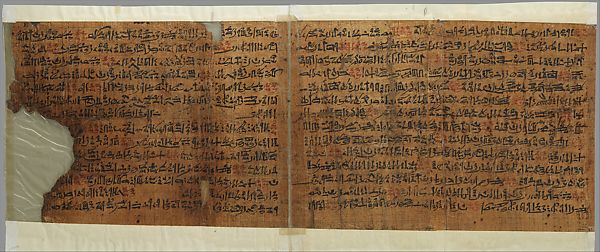
The Ipuwer Papyrus

While many scholars have tried to come up with natural explanations for the plagues, the sequence and severity of these plagues demonstrate that these were directly from the hand of God. No natural cause would explain why the Egyptians were utterly devastated by these plagues while the Hebrews in neighboring Goshen remained safely untouched, both man and beast (Exodus 8:22; 9:26).

We also have a clue from the only surviving copy of an Egyptian text that has striking parallels to the Exodus account called The Admonitions of an Egyptian Sage, more often known as the Ipuwer Papyrus. Many scholars agree that this is a very early document, some placing it in the 18th Dynasty, the very time of the Exodus (ca. 15th century BC) because of certain linguistic features. The Ipuwer is basically a lengthy poem or prayer to the sun god Ra, written by an Egyptian sage lamenting a series of disasters in the land. I mentioned in my last post that the pharaoh would never let a defeat be recorded in the royal annals. But Ipuwer, the author, seems to be a sage reflecting on the state of the empire he once loved, not a court scribe, because he’s even critical of the pharaoh: “the king has been deposed by the rabble.”[1]

Ipuwer says “pestilence is throughout the land, blood is everywhere, death is not lacking, and the mummy-cloth speaks even before one comes near it.” He writes, “Indeed, the river is blood, yet men drink of it.”

Titus Kennedy neatly sums up the significance of the Ipuwer Papyrus:

“Passages in the poem, such as the river being blood, blood everywhere, plague and pestilence throughout the land, the grain being destroyed, disease causing physical disfigurement, the prevalence of death, mourning throughout the land, rebellion against Ra the sun god, the death of children, the authority of the pharaoh being lost, the gods of Egypt being ineffective and losing a battle, and jewelry now being in the possession of the slaves, are all occurrences in common with the Exodus story.”[2]

To read the Ipuwer Papyrus alongside the Book of Exodus is fascinating. The parallels are simply too clear to downplay. Many scholars have, of course, noted the similarities. However, most have asserted that this reflects a certain genre of “national disaster” folklore at the time rather than concluding that both could be referring to the same historical events. As Hoffmeier observed in the last post, your philosophical presuppositions determine what you will see. The problem with this easy dismissal is that if Ipuwer really was lamenting actual events in history, the above presupposition prevents someone from ever knowing it. One might dare to ask, What would Ipuwer need to say to demonstrate he really was referring to events he witnessed? After all, Ipuwer seems to be talking about a truly devastating time standing in contrast to Egypt’s glorious past.

The Date of the Exodus

There is considerable debate between biblical scholars as to when the Exodus actually took place. Most would place it in either the 15th, 13th, or 12th century BC. Because I take the Bible to be both the authoritative and understandable Word of God, I have no problem accepting the biblical timelines.

One of the clearest statements for dating the Exodus is 1 Kings 6:1: “In the four hundred and eightieth year after the people of Israel came out of the land of Egypt, in the fourth year of Solomon’s reign over Israel, in the month of Ziv, which is the second month, he began to build the house of the Lord.”

Scholars almost universally agree that Solomon began building the temple in 966 BC. We can then take the 480 years given here, do a little math, and come up with an approximate date of 1446 BC for the Exodus. Scholars who come up with a 12th or 13th century date have to say that the 480 years is a nice round number based on the number of idealized generations, allegedly 40 years each.[3] That strikes me as very strange since there is no indication from the text itself that this is what is going on.[4]

The Pharaoh of the Exodus

Once we have determined the date for the Exodus we can know the most probable pharaoh at this time based on Egyptian chronological records. And we can see if we have any supporting evidence for our dating of the Exodus, too.

According to Exodus, Moses was forced to flee from Egypt after killing an Egyptian guard. Moses spent the next 40 years in the Midianite desert, settling down with his wife Zipporah and becoming a nomadic shepherd.

The Bible says, “After a long time, the king of Egypt died” (Exodus 2:23, HCSB). Later, God tells Moses not to fear returning to Egypt “for all the men who were seeking your life are dead” (Exodus 4:19, ESV). Based on these verses, the pharaoh when Moses fled from Egypt must have been king for a long time, possibly at least forty years.

This is a crucial piece of evidence because most pharaohs did not reign for a very long time. Many didn’t even last ten years. There is, however, one and only one pharaoh in either the 18th or 19th dynasties (the possible eras for the Exodus) who reigned more than forty years, and his name was Thutmose III. According to Egyptian chronologies, that would mean his son, Amenhotep II was the king of Egypt when Moses returned for the Exodus. This is another factor supporting the early date of 1446 BC. The long reign of Thutmose III followed by Amenhotep II reigning at the time of the Exodus in 1446 BC fits together nicely.[5] However, no king during the 13th or 12th centuries reigned 40 years.

Since there are clues pointing to Amenhotep II being pharaoh at this time, it’s worth considering what we know about him from archaeology. Here’s what’s really intriguing. Amenhotep II was known for unrestrained arrogance of biblical proportions. Archaeologists have found inscriptions and monuments built in his honor where he claimed to be the greatest pharaoh in history. His boasts included rowing a ship faster than 200 Egyptian sailors, shooting an arrow through a copper target as thick as a palm, slaying 7 of the greatest warriors of Kadesh, and capturing more slaves than any other pharaoh in Egyptian history.

This was the pharaoh’s way of saying, “I’m kind of a big deal.” Does this align with what we know about the pharaoh of the Exodus? Well, let’s see. When Moses announced that Yahweh demanded he let the Hebrews go, the pharaoh proudly scoffed, “Who is Yahweh that I should obey Him by letting Israel go? I do not know anything about Yahweh, and besides I will not let Israel go” (Exodus 5:1, HCSB).

Throughout the Exodus narrative (Exodus 5-14), the pharaoh strikes us as arrogant, stubborn, and foolish – almost like someone who was compensating for some major insecurities. Such a psychological profile directly matches everything we know about Amenhotep II.

Evidence for a Crippled Army and Missing Slaves

In addition to his megalomaniacal boasts, Amenhotep II also completed only two military campaigns during the span of his whole reign. This seems strange when you compare it to all his predecessors, who averaged far more military campaigns. Thutmose III, by comparison, led at least 17 campaigns. What would lead the hotheaded Amenhotep II to drastically reduce the number of Egypt’s armed invasions?

Could it be that his once unstoppable army was drastically crippled – even annihilated – in an event at the Red Sea? This circumstantial evidence certainly fits the narrative given in Exodus 14, which says that after the Hebrews left Egypt, Pharaoh changed his mind and sent his entire army in pursuit, including “all Pharaoh’s horses and chariots and horsemen and his army” (Exodus 14:9, ESV). We then read that after Israel had made it safely across the parted Red Sea,

“…the Lord threw them [the Egyptian army] into the sea. The waters came back and covered the chariots and horsemen, the entire army of Pharaoh, that had gone after them into the sea. None of them survived.” (Exodus 14:27-28, HCSB)

It’s worth noting that Scripture never says that Pharaoh himself drowned in the Red Sea, only that his entire army perished. No wonder Amenhotep II had only one campaign after the Exodus.

Elephantine Stele of Amenhotep II

According to the Elephantine Stele of Amenhotep II inscription, this last campaign was more of a massive slave raid than a conquest of land. Amenhotep II claimed to have captured 101,128 slaves on this raid. If accurate, this would be about 20 times larger than the next largest slave raid in Egyptian history. How interesting that this pharaoh known for ridiculous exaggeration now says he’s also better at bringing in slaves than anyone else! Kennedy observes, “Because this happened right after the Exodus, perhaps it is indicative of an urgent need to replace the lost slave population in Egypt.”[6]

One thing most Exodus scholars agree upon is that future excavations in Egypt will likely shed more light on the timing and details of this central event in Israel’s history. After all, satellite imagery suggests that less than 1 percent of ancient Egypt has actually been excavated to date.[7] The Bible-believing Christian should rejoice in this fact. Once again, archaeological excavations have only strengthened the case for Scripture’s accuracy. We have only examined a portion of the incredible circumstantial evidence that has already been discovered in support of the biblical Exodus.

Have thoughts on this post? Feel free to comment below!


[1] “The Admonitions of Ipuwer,” https://www.worldhistory.org/article/981/the-admonitions-of-ipuwer/

[2] Titus Kennedy, Unearthing the Bible, 55.

[3] This number of 40 years comes from the 40 years of wandering in the desert when a whole generation perished, but that was a specific case not a hard rule that 40 years must always equal one generation in biblical timelines. It’s also worth noting that only those who refused to believe God’s promises perished in the wilderness (Hebrews 3:17), and that the 40 years corresponded with the 40 days they spied out the land (Numbers 14:34). Ironically, supporters of the late view have to take the 40 years mentioned in Numbers 14:34 and Deuteronomy 34:7 literally to make their case, even while they do not take the 480 years given in 1 Kings 6:1 literally.

[4] Other passages supporting the early date of 1446 BC include Judges 11:26.

[5] The problem with the later 13th century or 12th century dates for the Exodus is that in both cases, the pharaoh at those times (Ramesses II or Ramesses III respectively), does not succeed a pharaoh who reigned a long time, which seems to contradict Exodus 2:23.

[6] Kennedy, 57.

[7] Mark Janzen, Five Views on The Exodus, Grand Rapids, MI: Zondervan, 2021, 16.

Is There Evidence for the Exodus? (Part 1)

Modern scholars often assume the massive migration of Hebrew slaves out of Egypt recorded in the biblical book of Exodus never happened. The Exodus is thought to be nothing more than religious folklore, and that there is no hard evidence for such an event in the ruins of Ancient Egypt.

For example, critical scholars Israel Finkelstein and Neil Silberman claim, “The saga of Israel’s Exodus from Egypt is neither historical truth nor literary fiction… to pin this biblical image down to a single date is to betray the story’s deepest meaning. Passover proves to be not a single event but a continuing experience of national resistance against the powers that be.”[1]

But is this really the case? What can we learn from the actual evidence?

Biblical scholar and archaeologist James K. Hoffmeier has found undue skepticism among many of his peers. He observes, “If it were not still Scripture to Jews and Christians, the Bible probably would not be treated in such a condescending and dismissive manner.”[2]

Egyptologists concede that ancient Egyptians almost never recorded embarrassing losses. The pharaohs always made sure they looked like stellar leaders in the history books. Are we at all surprised? We are, after all, talking about the same human nature that craves approval from peers and longs for affirmation wherever it can get it. Even today, politicians will trumpet their successes but rarely begin a speech discussing their failures. But in Ancient Egypt, the pharaoh controlled the press. That being the case, we really shouldn’t expect to find positive evidence for the biblical Exodus in Egypt’s royal annals.

The remarkable thing, however, is that there is a truckload of circumstantial evidence for the biblical Exodus. I say “circumstantial” because while there may not be much in the way of direct evidence outside of Scripture, the evidence we do have strongly supports the circumstances that would have to be true if such an event were indeed historical.

Another point worth mentioning is that the Bible itself must be properly viewed as crucial evidence for the Exodus event. This may sound obvious, but the scholarly consensus often presupposes the Bible is a book full of myths. This is unwarranted, because an unbiased reading of Exodus reveals a text written as history. Furthermore, outside the Exodus narrative itself (Exodus 1-15), this redemptive event is referenced more than 120 times in the Old Testament. And in every case, the author seems to believe the Exodus really happened and that Moses was the historical man at the helm. In fact, it is the event that explains why Israel is a nation in the first place, and why Israel must serve the Creator-God Yahweh.

Circumstantial Evidence: Hebrews Lived in Egypt

So what is the circumstantial evidence supporting the historicity of the Exodus? One argument used by field archaeologist Titus Kennedy is called “The Point A to Point B argument.” Simply put, if there is good evidence for Hebrews living in Egypt (Point A) before the Exodus on the biblical timeline, and there is also good evidence for Hebrews living in Canaan (Point B) after that time, this would suggest that some kind of mass migration occurred.

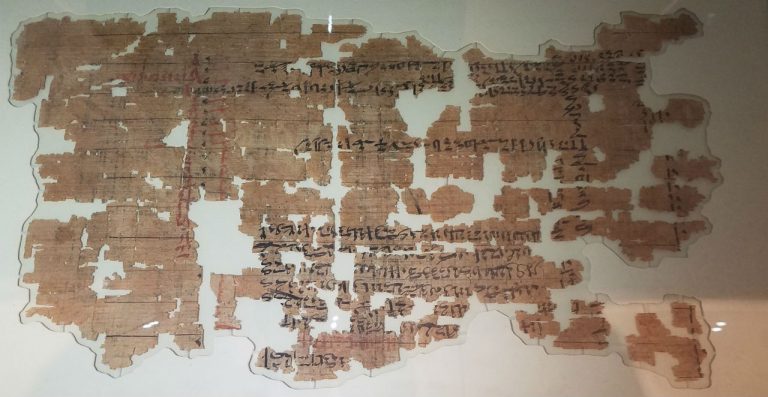
Papyrus Brooklyn

Egyptologists have discovered a list of Semitic servant or slave names on papyrus dated from about the 17th century BC.[3] This list, called Papyrus Brooklyn, gives both the Semitic name of the servant and the Egyptian name they were given. But here’s what’s fascinating. Nine of the servants listed have specifically Hebrew names that can be aligned very closely with other Hebrew names in the Bible. For example, one of the servants is named Shiphrah, the name of one of the Hebrew midwives mentioned in Exodus 1:15. Another servant is even named “Hebrew”!

This papyrus is powerful evidence not only that Semitic people (sometimes called Asiatics) lived in Egypt, but more specifically that Hebrews lived as servants or slaves in Egypt before the biblical Exodus. Interestingly, even critical scholars admit that the evidence points to Semitic people living in Egypt before the date of the Exodus (see Part 2 for a discussion of the Exodus date).[4]

Bricks without Straw

In the Book of Exodus, we read that when Moses first came to Pharaoh demanding he let God’s people go, Pharaoh was insulted. He said that such a demand to be released proved that the Hebrew slaves must be getting lazy. So he commanded his taskmasters to no longer give straw – a necessary ingredient for making bricks – to the slaves, adding that their brick quota would not be reduced. This led to the Hebrew foremen angrily blaming Moses and Aaron for coming to Egypt only to make their hard labor worse (Exodus 5:1-21).  

Mural at Tomb of Thutmose III

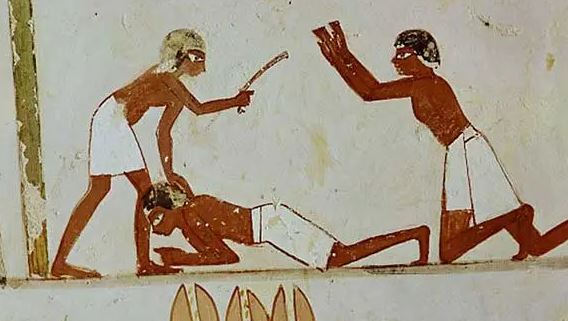
Interestingly, there is a mural on the tomb of Thutmose III, a pharaoh near the time of the Exodus, showing Semitic slaves making bricks. There is also a hieroglyphic text about an Egyptian taskmaster reminding slaves not to be idle or they’ll receive a beating. We also have a wall mural depicting this very thing, lending support to the biblical story of Moses killing a taskmaster who ruthlessly beat a slave (Exodus 2:11-12).

Mural at Tomb of Mennah, with Hebrew slave being beaten.

On top of all this, there is also an Egyptian text called the Louvre Leather Roll. Kennedy notes that this text “describes a situation similar to what is recorded in Exodus – that in this time period quotas of bricks were imposed on slaves, but when they did not have the necessary materials to complete all of the bricks, such as a lack of straw, the slaves were punished.”[5]

Did Hebrew Slaves Build the Pyramids?

Some have wondered if the Hebrews had any part in building the pyramids. First, it’s worth noting how much mystery surrounds the building of these massive ancient structures. The largest of the Great Pyramids, called Cheops, consists of 2.3 million stone blocks. These blocks weigh an average of 2.5 tons, with some of the blocks weighing as much as eighty tons! For comparison, the typical 18-wheeler truck can pull up to 24 tons. So, the question is: How in the world did they do it?

The Greek historian Herodotus (484-425 BC) said that when he visited Egypt, he learned that a work force of 100,000 slaves built the pyramids.[6] The Jewish historian Josephus (AD 37-100) said the Egyptian taskmasters “set them [the Hebrews] also to build pyramids.”[7] The consensus of modern scholars, however, is that slaves were not used because there is evidence of a workforce having their own settlement, with their own homes and provisions for all the food they could want.[8] So who is right?

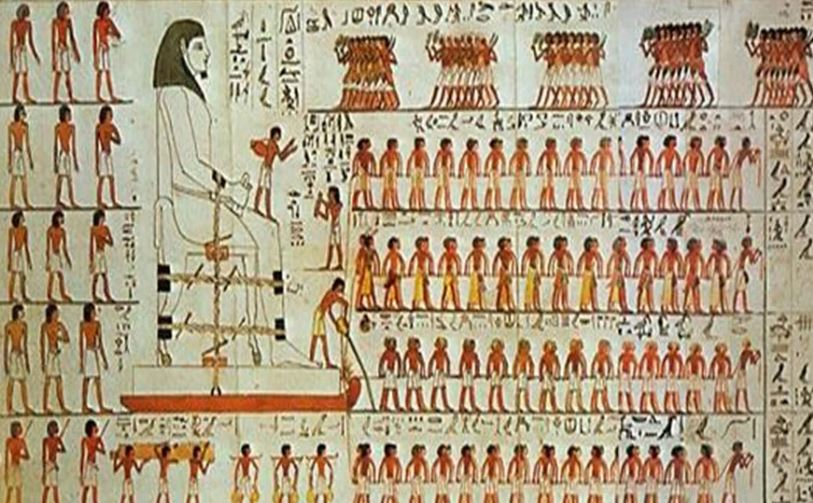
I think it’s impossible to say for sure that Hebrews built the pyramids. But here are some things we do know. Based on the Bible, the Hebrew slaves were used for many massive state projects involving mortar and brick (Exodus 1:10-14). We even have archaeological evidence of a Hebrew slave force in Egypt.[9] There is also a wall mural showing men using ropes to pull massive stones for building the pyramids. One mural seems to depict men using wet sand to help move massive structures.

Mural of slaves pulling large stone structure with ropes.

Again, none of this is conclusive evidence. Most Egyptologists would even date the construction of most of the pyramids to before the Hebrews were even in Egypt. Still, dating methods aren’t infallible; so we can’t rule it out. Scripture never actually claims that the Hebrews built the pyramids, so we shouldn’t be dogmatic on this point. What we can conclude is that a large Hebrew population did live in Egypt prior to the Exodus.

Continue reading in the next post “Is There Evidence for the Exodus? (Part 2)

Have thoughts on this post? Feel free to comment below!


[1] Finkelstein and Silberman, The Bible Unearthed, 70-71.

[2] James K. Hoffmeier, “The Exodus and Wilderness Narratives,” in Ancient Israel’s History: An Introduction to Issues and Sources, edited by Bill Arnold and Richard Hess, Grand Rapids, MI: Baker, 2014, 48.

[3] Titus Kennedy, Unearthing the Bible: 101 Archaeological Discoveries that Bring the Bible to Life, 48-49.

[4] Mark Janzen writes, “Egyptologists agree that excavations in the delta reveal a strong Semitic presence during the Hyksos era (ca. 1650-1540 BC), continuing into the New Kingdom.” Janzen, “The Exodus: Sources, Methodology, and Scholarship,” Five Views on The Exodus, Grand Rapids, MI: Zondervan, 2021, 19.

[5] Kennedy, Unearthing the Bible, 51.

[6] Miroslav Verner. The Pyramids: The Mystery, Culture, and Science of Egypt’s Great Monuments. New York: Grove Press, 2001.

[7] Josephus, Antiquities, 11:9.1.

[8] This shouldn’t be used as evidence against the pyramid builders being slaves. The Bible describes the Hebrew slaves as having their own settlement in Goshen (Genesis 47:27; Exodus 8:22; 9:26), having their own homes (Exodus 12:1-13) and eating plenty of delicious food (Numbers 11:5). Perhaps this is one of the ways the pharaohs compensated the Hebrews for their backbreaking work in hopes of preventing an uprising.

[9] James K. Hoffmeier, Israel in Egypt: The Evidence for the Authenticity of the Exodus Tradition.

Are Science and Christianity Friends or Foes?

“Great are the works of the LORD; they are pondered by all who delight in them.” (Psalm 111:2)

Many today take it for granted that biblical faith is incompatible with scientific findings. The assumption is that science has provided all the knowledge we need about our origins and the origin of our universe. This idea that science and Christianity are at odds has been so widely promoted in our culture by popular science communicators – including Bill Nye and Neil deGrasse Tyson – that many have taken for granted that this is true.

Christianity and Cosmic Order

Before one can undertake any scientific endeavor, such as calculating the growth rate of fertilized plants versus that of unfertilized plants, one must hold some basic working assumptions. One such assumption is the regularity of nature.  In other words, you must assume that certain physical laws will remain in place each time you observe and measure the plants. Such an assumption might seem incredibly obvious. We think, Of course, there is regularity in nature!

But on an atheistic worldview, why assume any kind of law-like structure to the universe? Laws don’t form by chance; they come from a Lawgiver. If the universe is the result of an undirected chaotic explosion rather than the ordered creation of an infinite Mind, why would we expect consistency in nature?

No one would believe that the Eiffel Tower formed as a result of an iron mine explosion. In the same way, we shouldn’t expect any kind of orderliness in a universe that formed by an unguided explosion.

Paul Davies is a physicist who is certainly not religious. And yet he comments:

“Just because the sun has risen every day of your life, there is no guarantee that it will rise tomorrow. The belief that it will, that there are indeed dependable regularities of nature, is an act of faith, but one which is indispensable to the progress of science.”[1]

The Bible not only says that “all things were created through [Christ] and for [Christ],” but also that “in Him all things hold together” (Colossians 1:16-17). It is because the Son of God “upholds the universe by the word of His power” that we can have confidence in the regularity of nature (Hebrews 1:3).

Physicist Michael Guillen says, “The Christian worldview best squares with the scientific worldview. It’s easy for me to be both a scientist and a Christian. Do science and Christianity have disagreements? Oh, you bet! And a few of them get the bulk of the publicity. But when it comes to the fundamentals, the two worldviews are very much in line. They are like my wife and me. We have our disagreements. And some of them are real doozies. But when it comes to core principles, we see eye to eye.”[2]

This is why modern science first began in the West, where the backdrop of the culture was the Christian worldview. This also explains why the vast majority of the founders of modern science were theists – and many were Christian theists.[3]

For instance, Galileo – often falsely portrayed as an opponent of biblical faith – was a Bible-believing Christian who argued that “the laws of nature are written by the hand of God in the language of mathematics” and that the “human mind is a work of God and one of the most excellent.”[4]

While many want to argue that faith and science are at odds, the scientific method itself is based on certain faith assumptions. Without these assumptions – which most scientists simply take for granted – science could never get off the ground. These include the orderly character of nature, the regularity of physical laws, the rational intelligibility of the universe, and the fact that our minds are equipped to understand certain truths about the universe.

Philosopher Richard Swinburne writes:

“The very success of science in showing us how deeply ordered the natural world is provides strong grounds for believing that there is an even deeper cause for that order.”[5]

The Limits of Science

Many have bought into the ideology of scientism, which says that science alone is the key to answering all our questions about the universe. But this ignores the many areas where science is limited. For example, science can teach us how to build an atomic bomb, but it cannot tell us whether it is right to use it.

Science cannot even tell us why there is a universe to study in the first place. Science is a wonderful tool, but it cannot give us a grand explanation of everything. Instead, science points us to a greater explanation beyond its analytical reach.

Scientific observations showing that our universe is expanding indicate that our universe had a beginning. But if the universe had a beginning, there must have been a cause. Things don’t just burst into existence without a prior cause. A timeless and all-powerful God who transcends nature would be a reasonable explanation for the origin of our universe.

“For what can be known about God is plain to them, because God has shown it to them. For his invisible attributes, namely, his eternal power and divine nature, have been clearly perceived, ever since the creation of the world, in the things that have been made. So they are without excuse.” (Romans 1:19-20, ESV)

Atheism and Its Illogical View of the Beginning

In his book The Grand Design, the late Stephen Hawking argued that we don’t need God to explain the origin of the universe. Instead, the universe’s physical laws can explain why there is a universe.

Hawking wrote: “Because there is a law such as gravity, the universe can and will create itself from nothing.”[6]

Interestingly, when I shared this idea with my 7-year-old son, Logan, he laughed and said, “That’s impossible for something to make itself.” He recognized that Hawking’s statement is logically flawed. For something to create itself, it would have to be in existence already. His statement is incoherent.

Why would a scientist as accomplished as Stephen Hawking make such an obvious logical blunder and claim that the universe brought itself into existence?

Scripture provides insight here. The Book of Romans says that when you reject the one true God who created nature, you will end up worshiping various aspects of nature itself (Romans 1:21-23). Interestingly, there is a parallel to this ancient form of nature worship among many scientists today. They attribute creative power, eternality, and even design to the cosmos instead of the Creator of the cosmos.

Oxford scientist John Lennox observes:

“Perhaps there is a subtle danger today that, in their desire to eliminate the concept of a Creator completely, some scientists and philosophers have been led, albeit unwittingly, to re-deify the universe by endowing matter and energy with creative powers that they cannot be convincingly shown to possess.”[7]

Can Irrationality Produce Rationality?

If nature is all there is, that would mean there is no divine mind outside the universe responsible for our existence. But that would mean that our brains are the result of blind and irrational natural processes. Now, if that is where atheistic science takes us, then why in the world would we trust our brains can grasp the truth? In fact, why think we could ever do science in the first place?

Consider a scenario where I told you about a computer that was not designed by a human mind but came about purely by the blind forces of nature. Would you expect such a machine to function well, let alone assemble naturally in the first place? Such an idea sounds preposterous. In the same way, we could only trust our brains to grasp scientific truth if they have been designed by an intelligent Creator who transcends the blind processes of nature. The great irony is that, in their eagerness to eliminate God from the scientific enterprise, atheists have actually removed any reason whatsoever for trusting our rational faculties.

Some atheists have recognized this and are haunted by the logical outcome of their godless worldview.

The chemist J. B. S. Haldane said, “It seems to me immensely unlikely that mind is a mere by-product of matter. For if my mental processes are determined wholly by the motions of atoms in my brain I have no reason to suppose that my beliefs are true.”[8]

Atheist John Gray has put this problem more bluntly: “Modern humanism is the faith that through science humankind can know the truth and so be free. But if Darwin’s theory of natural selection is true this is impossible. The human mind serves evolutionary success, not truth.”[9]

Gray’s point is that on Darwinism, there’s no real basis for thinking we have adapted the ability to know the truth. After all, the Darwinian worldview says that there is no ultimate design and purpose to organic life and that humans are the result of unguided chance.

Christian apologist C. S. Lewis similarly asked, “If thought is the undesigned and irrelevant product of cerebral motions, what reason have we to trust it?”[10]

If atheists want to go on believing that their brain is the product of blind chance, they are welcome to do so, but I’m going to stick with the hypothesis that the only wise God designed my brain. Praise God, we are not mere accidents. Instead, we are “fearfully and wonderfully made” by God with loving design and intention (Psalm 139:14).

According to the Bible, we have every reason to believe our brains can grasp certain truths about the natural world. In fact, the Bible says that God created us in His own image – meaning our rational minds are a reflection of His rational mind (Genesis 1:27-28). Thus, on the Christian worldview, we have good reasons to think we can learn about the world through the scientific endeavor.

Science and biblical faith are not at war. They complement and reinforce one another.

Feel free to comment below!


[1] Paul Davies, The Mind of God, 81.

[2] Michael Guillen, Seeing Is Believing.

[3] Such theistic scientists include Roger Bacon, Gregor Mendel, Blaise Pascal, Johannes Kepler, Nicolaus Copernicus, Galileo Galilei, Isaac Newton, and Michael Faraday.

[4] Galileo quoted in John C. Lennox, Cosmic Chemistry, 43.

[5] Richard Swinburne, Is There a God? (Oxford: Oxford University Press, 1996), 68.

[6] Hawking and Mlodinow, The Grand Design, 180.

[7] John C. Lennox, Cosmic Chemistry, 113.

[8] J. B. S. Haldane, Possible Worlds and Other Essays (reprint ed.) London, UK: Chatto and Windus, 1932.

[9] John Gray, Straw Dogs, London, Granta Books, 2002, 26.

[10] C. S. Lewis, Miracles.

Photo Courtesy of NASA, M. Livio, and the Hubble Heritage Team.

Is the Jesus Story Really Borrowed from Pagan Myths?

By Jason Smith

From the very birth of Christianity, the church has always believed in the virgin conception of Jesus Christ. It is part and parcel of the gospel message. It is an essential, not merely incidental, component for understanding who Jesus is.

While some skeptics would have us believe that Jesus’ virgin conception and divine nature were late inventions by the church, nothing could be farther from the truth. From the earliest sources on the life of Jesus, the four Gospels (Matthew, Mark, Luke, and John), we have the testimony of credible and early eyewitnesses who said Jesus Himself claimed to be the great “I Am” or Yahweh God.

One famous historian, Dr. William Ramsay, conducted a thorough investigation of every name and location mentioned in the Gospel of Luke and in Luke’s second volume, the book of Acts. Ramsay was an atheist convinced that Christianity was just one more myth of the ancient world. He planned to catalog all of Luke’s errors in order to make the story of the virgin-born Messiah look as ridiculous as the myths of Zoroaster and Zeus.

To Ramsay’s dismay, however, Luke proved to be a top-notch historian. He triple-checked every name and place Luke mentions against every historical record he could find pertaining to the first century. In the end, Ramsay could not deny Luke’s incredible accuracy. Eventually, Ramsay surrendered his life to the Jesus he had set out to debunk.

As mentioned, the Gospels of the New Testament claim to be based on eyewitness testimony, and the authors express a concern for what really happened in the life of Jesus.  Names and places are often mentioned that could only be known by people who were actually there when the events took place. These were people who knew Jesus personally. Most historians agree that Jesus’ mother, Mary, was the primary source for the nativity story found in Luke. The virgin conception was not only based in history, but also a necessary component of the gospel.

Writing at the beginning of the second century, the church father Ignatius wrote:

“For our God, Jesus the Christ, was conceived in the womb by Mary, according to a dispensation, of the seed of David but also of the Holy Ghost.”[1]

The Bible teaches that ever since Adam’s sin, children inherit the sinful condition of their parents.[2] Had Jesus come into this world like you and me, with a mother and father, He could not have been the sinless Savior and spotless sacrifice for sins that we all need. This could only happen if Jesus entered this world through a supernatural conception.

The Myth of the “Jesus Myth”

There are many out there, like comedian Bill Maher, who have tried to say that the virgin birth is just part of the “Jesus myth.” He argues that the Christians plagiarized this idea of the virgin birth from pagan mythologies that had already been around for centuries. But on closer examination, this skeptical claim falls apart. Not only are the pagan stories not really virgin births because they involve a god sleeping with a goddess or woman, but they don’t make any attempt to be rooted in history, as the Gospels do.

In his mockumentary film Religulous, Maher tries to argue that long before the Jesus story, the Egyptians believed that their god Horus, the son of Osiris, was born of a virgin, walked on water, performed healing miracles, died by crucifixion, and was resurrected as savior after three days. Oh yeah, and the film claims this is all recorded in the Egyptian book of the dead written in 1280 BC. This is meant to catch viewers off guard. Wait a minute. The Jesus story sounds just like that!

No doubt, it sounds pretty compelling. The only problem? Almost none of this is based in actual history; this is a deliberate misrepresentation of the facts. As Egyptian pastor Shaddy Soliman said, “If you made this kind of claim in Egypt, people would think you’re crazy.”[3]

The only thing truly accurate about the above description of Horus was that he was indeed supposed to be the son of the Egyptian god Osiris. But before considering the other claims, something needs to be clarified.

With nearly every one of the examples that skeptics like Maher cite, it is painfully obvious that they are mythological. They were not written as historical accounts. In fact, there is really no effort by the authors to root these polytheistic tales in a real historical context. By contrast, consider how Luke begins his Gospel:

“Inasmuch as many have undertaken to compile a narrative of the things that have been accomplished among us, just as those who from the beginning were eyewitnesses and ministers of the word have delivered them to us, it seemed good to me also, having followed all things closely for some time past, to write an orderly account for you, most excellent Theophilus, that you may have certainty concerning the things you have been taught.” (Luke 1:1-4, ESV)

Luke talks about his account being based on the testimony of eyewitnesses. He says he did his research, following “all things closely for some time past.” He set out “to write an orderly account” so that his reader would have “certainty” about the Jesus story. This is how you begin a work of history, not mythology. He doesn’t start with “Once upon a time,” but instead gives specific names and times when kings and emperors were reigning, so that there would be no question, this is a carefully researched historical account. As it turns out, the real myth is that there even was a “Jesus myth,” since the Jesus story is based on credible eyewitness accounts of history.

Is Jesus Based on Horus?

So what about Horus?

Was he too said to be born of a virgin?

According to author Rice Broocks, here’s what really happened in the Horus myth (brace yourself, it’s pretty gross):

“Osiris was killed and dismembered, and his body parts cast into a river. Isis retrieved his genitals and then inseminated herself in order to get pregnant and have the son, Horus.”[4]

Oookay then. To call that a virgin birth is a bit of a stretch, to say the least. Well, what about Horus performing healing miracles? Nope, there’s no record of him ever healing anyone. What about Horus being crucified? Again, no, nothing like that is recorded other than his hands being spread apart at death. But no cross. No nails. In fact, crucifixion wasn’t even practiced by the Egyptians. So again, the claim doesn’t fit the facts of history. What about rising from the dead? As Broocks explains, in one account Horus is said to be resuscitated, but that is nothing like the Jewish understanding of resurrection where you are raised to new bodily life in glory.

I would encourage those who have been told that the Jesus story is just a copycat of other ancient religions to actually delve into the accounts themselves. Do the research to see if this claim stands up to historical analysis. Ask critical questions. Does the copycat claim make sense of the facts? Where do certain beliefs or ideas show up in historical records? Don’t just blindly accept the claims of those who are bent on making Christianity look foolish.

In most cases, my guess is that these skeptics don’t want the Jesus story to be true, because if Jesus really did die and rise again, then they are undoubtedly accountable to Him; He’s Lord. But if the Jesus story is just a reshuffled version of what was already out there, and it has no grounding in historical truth, they can shunt it aside as another fable and Jesus could be safely ignored along with Zeus and Thor. But what if this retelling is pure fiction?

In his book, Reinventing Jesus, J. Ed Komoszewski writes:

“Only after the rise of Christianity did mystery religions begin to look suspiciously like the Christian faith. Once Christianity became known, many of the mystery cults consciously adopted Christian ideas so that their deities would be perceived to be on par with Jesus. The shape of the mystery religions prior to the rise of Christianity is vague, ambiguous, and localized. Only by a huge stretch of the imagination, and by playing fast and loose with the historical data, can one see them as having genuine conceptual parallels to the Christian faith of the first century.”[5]

The simple fact is that the vast majority of historians today accept that the basic facts about Jesus’ life are rooted in history, not mythology. Not only that, but no historian or scholar ever tried to argue against the Jesus of history for the first 1,700 years following His life. While some disputed His resurrection appearances, nobody tried to argue that Jesus was not a figure of history or that His story was just cobbled together from ancient mythologies. Even today, no historian worth his or her salt will try to deny that Jesus ever existed.

It wasn’t until the Enlightenment that a handful of historians began to argue that since miracles cannot happen (a premise they assumed a priori based on naturalistic convictions), then the story of the miraculous Jesus cannot be real either.

Komoszewski writes:

“As far back as the 1840s, Bruno Bauer began to publish views that the story of Jesus was rooted in myth. Bauer’s greatest influence was on one of his students, Karl Marx, who promoted the view that Jesus never existed. This view eventually became part of communist dogma.”[6]

The Jewish Context of Christian Origins

A glaring problem with this “copycat theory” is that it ignores the Jewish theological and historical context into which Christianity was born. While many forget this, the first Christians were all Jewish. One thing is clear about the Jews of the first century: they utterly repudiated all forms of polytheistic and pagan worship. That being the case, the early Christians would abhor the idea of borrowing ideas about God or worship from the pagan myths of the Gentiles.

It’s clear from the New Testament that the early Christian leaders saw myths as a dangerous threat, not something from which to learn. The Apostle Paul warned his fellow Christians about those who “devote themselves to myths” (1 Timothy 1:4, NIV). He predicted that many, even in churches, “will turn their ears away from the truth and turn aside to myths” (2 Timothy 4:4, NIV). The Apostle Peter said, “For we did not follow cleverly devised myths when we made known to you the power and coming of our Lord Jesus Christ, but we were eyewitnesses of his majesty” (2 Peter 1:16, ESV). The argument that Christians just adopted pagan mythical ideas makes no sense, given their leaders continual warnings to run away as far as they could from myths.

Again, Komoszewski writes:

“The first-century Jewish mindset loathed syncretism. Unlike the Gentiles of this era, Jews refused to blend their religion with other religions. Gentile religions were not exclusive; one could be a follower of several different gods at one time. But Judaism was strictly monotheistic, as was Christianity. As the gospel spread beyond the borders of Israel, the apostles not only found themselves introducing people to the strange idea of a man risen from the dead; they also came face-to-face with a polytheistic culture. But they made no accommodation on this front.”[7]

Is Christmas a Pagan Holiday?

I’ve come across numerous internet bloggers, YouTubers, and conversation partners who try to argue that Christianity so closely parallels the ancient mystery religions that Christians must have just copied them to sound legitimate. This erroneous idea is found on the lips of one of Dan Brown’s characters in The Da Vinci Code: “Nothing in Christianity is original.” The novel claims that everything from Jesus’ virgin birth to His birthday on December 25th to the idea of Him receiving “gold, frankincense, and myrrh” has its origin in pagan mythologies, like that of Mithras.

But this is so inaccurate, it’s almost laughable. None of Brown’s claims stand up to scrutiny. To be as charitable as possible, we’d have to say that he didn’t do his homework when writing the book. More likely, he knew that the sensational sells while the truth is often ignored. It’s simply not true that Mithras was born of a virgin – he was born of a rock![8] Let’s not pretend rocks can be called virgins now. In fact, what you don’t find in any of the mystery religions is anything remotely like the virgin conception in the New Testament – which was also prophesied 700 years in advance in Isaiah 7:14. You have gods like Zeus sleeping with human women and producing beings that are half-man and half-god. But obviously if a god had sex with a woman, then she’s not a virgin.

What about December 25th? It’s true that this was the date chosen by the Emperor Aurelius to dedicate his pagan temple to Sol Invictus, the god of the “Unconquerable Sun,” because it was close to the winter solstice. Since Mithraism was closely associated with the worship of Sol, there is a connection between Mithras and that particular date. But let me explain why that does not mean Christmas itself has pagan origins.

No one knows the actual date of Christ’s birth. The earliest known date for celebrating it was actually January 6th and many Eastern churches still celebrate Christmas on that day. But here’s the important point to be made: The celebration of Christmas preceded the choice of December 25th as the day on which to celebrate. So why do we celebrate it on December 25th? According to historians, we have Constantine, the first Roman emperor to convert to Christianity, to thank for that. Prior to becoming a Christian, Constantine worshiped Sol Invictus. It seems that in AD 336, the year before Constantine died, he chose December 25th to now be a day for celebrating Christ, not Sol Invictus. In the decades that followed, many popes and emperors argued for appropriating the pagan holidays to demonstrate the redemptive power of Christ.

What about this idea in The Da Vinci Code that gold, frankincense, and myrrh were presented to Krishna at his birth long before the Jesus story? This one is just false. There’s nothing like this found in the story of Krishna’s birth,[9] and I would guess that Brown got this idea from Dorothy Murdock, who has no academic training. While she is a popular writer, many of her claims – such as this one—are roundly rejected by the scholarly community.

The most we could say is that certain cultural practices appear to have overlap between Christianity and ancient pagan religions, but that only makes sense when you consider that by the end of the first century, the vast majority of Christians were former pagans. Nevertheless, there’s good reason to conclude that Christian theology and the Jesus story were not influenced by Mithraism or other pagan mythologies. In the most profound sense, the Christian gospel is both original and unique. The so-called parallels are either gross exaggerations or complete fabrications. All claims to the contrary are evidence of shoddy scholarship and a hunger for the sensational.

Eddy and Boyd make the point well:

“While there are certainly parallel terms used in early Christianity and the mystery religions, there is little evidence for parallel concepts. For example, as we have noted, both Christianity and the mystery religions spoke of salvation—as do many religions throughout history. But what early Christians meant by this term had little in common with what devotees of mystery religions meant by it. To site just one difference, there was in the mystery religions nothing similar to Paul’s idea that disciples participate in the death and resurrection of their Savior and are adopted as God’s children by placing their trust in him.”[10]

So, yes, you’ll find similarities in the general, but you won’t find specific parallels. Christianity is utterly unique in the kind of story it tells. It’s a story of grace – of the one true God coming to the rescue of humanity by being born of a virgin, living a sinless life, dying as a substitute sin-bearer in the place of lost sinners, and rising again bodily. The testimony we find in the New Testament belongs to those who actually saw the risen Christ, felt His nail-pierced hands, and saw Him ascend into the clouds.[11] History records not only His first followers doggedly sticking with the same story from the beginning but also their willingness to die for what they witnessed firsthand. What about the pagan adherents of those other supposed “dying and rising god” myths out there? We don’t have any record of them claiming to see their god in the flesh or being willing to die for this claim. Only Christianity can say this. That’s the power and uniqueness of the Jesus story.


[1] Quoted in Josh McDowell and Don Stewart, Answers to Tough Questions Skeptics Ask about the Christian Faith (San Bernardino: Here’s Life Publishers, 1980), 56.

[2] See my previous article “Does the Bible Teach Original Sin?”

[3] Quoted in Rice Broocks, Man, Myth, Messiah, 119.

[4] Rice Broocks, Man Myth Messiah, Kindle edition.

[5] J. Ed Komoszewski, Reinventing Jesus, 234.

[6] Ibid, 318.

[7] Ibid, 233.

[8] Edwin Yamauchi quoted in Lee Strobel, The Case for the Real Jesus, Kindle edition.

[9] https://www.learnreligions.com/the-story-of-the-birth-of-lord-krishna-1770453

[10] Boyd and Eddy, The Jesus Legend, 142.

[11] See John 19:35; 20:26-31; 21:24; 1 John 1:1-4

Is Original Sin a Biblical Idea?

By Jason Smith

One of the hardest Christian doctrines to swallow is that of original sin. To many, it sounds old-fashioned, pessimistic, and puritanical. But what exactly is it?

According to theologians, the term original sin does not describe the first sin of Adam in the garden, although that is a common assumption. Instead, original sin teaches that we have all inherited a corrupt and self-centered nature from Adam. Original sin is the condition of being sinful by nature.

A Little Savage

Throughout church history, various people have disputed this teaching. One somewhat infamous theologian named Pelagius taught that we don’t come into this world corrupted, but rather, morally neutral. He said every human being is free to follow Adam’s bad example or live a morally unmarred life. Much like the philosopher Jean-Jacques Rousseau who came along centuries later, Pelagius believed that man was conditioned to sin by a corrupt society, but goodness naturally flowed from the human heart.

I’m fairly certain that parents everywhere would disagree with Pelagius. No child needs to be taught how to lie their way out of a jam or how to steal that forbidden cookie. Even secular publications recognize this.

The Minnesota Crime Commission issued the following statement in response to the rising crime rate:

“Every baby starts life as a little savage. He is completely selfish and self-centered. He wants what he wants when he wants it – his bottle, his mother’s attention, his playmate’s toy, his uncle’s watch. Deny these and he seethes with rage and aggressiveness, which would be murderous were he not so helpless… If permitted to continue in the self-centered world of his infancy, given free reign to his impulsive actions, to satisfy his wants, every child would grow up a criminal, a thief, a killer, a rapist.”[1]

What this commission observed is merely what Christians have long taught about original sin. King David put this in stark terms:

"Surely I was sinful at birth,
    sinful from the time my mother conceived me." (Psalm 51:5, NIV)

John Calvin explained it this way:

“Original sin, therefore, seems to be a hereditary depravity and corruption of our nature, diffused into all parts of the soul, which first makes us liable to God’s wrath, then also brings forth in us those works which Scripture calls ‘works of the flesh’ [Gal. 5:19].”[2]

Not Just “Mostly” Dead

It is because of original sin that evil runs amuck in this world, and it is the reason we all need the redemption found in Jesus Christ alone.

If I was to guess, I would say the two biggest reasons people don’t see their need for Jesus are:

1) People downplay the majesty of God’s holiness; and

2) People downplay the seriousness of their own sin.

You could think of it like this. The less high and holy God is and the less morally corrupt we are, the less obvious it is that we need a divine Savior. If we human beings are basically good by nature but not everything we could be, then a human solution is all we need. Many would argue this way. What we need is self-improvement skills, a more developed society, or better education.

You ready to hear what the Bible says about us? Brace yourself; it’s not pretty. The Bible claims that we are by nature “dead” in our “trespasses and sins.”[3] We’re not talking “mostly dead” as Miracle Max might put it (The Princess Bride); this is dead dead. It says that we are “sons of disobedience” who follow the devil’s leading, obey the fleshly “desires of the body,” and are “by nature children of wrath, like the rest of mankind.”[4] Did I mention that it says the devil has blinded us to keep us from seeing the truth about God’s glory?[5] The Bible traces the problem not merely to bad fruit in our lives, but to the fact that we are spiritually dead at the root.

Ouch! Not exactly a boost to your self-esteem, perhaps. But doesn’t this teaching explain a lot about why we are the way we are? When you look around this world, doesn’t it seem like something has gone drastically wrong with the human race? Why so many wars? Why so much bloodshed? Why is it that you lock your doors at night and need a password to log in to your computer? Why do people have to earn your trust rather than already having it from the time you meet them?

G. K. Chesterton once wisely observed that “Certain new theologians dispute original sin, which is the only part of Christian theology which can really be proved.”

He had a point, didn’t he? When you scour the annals of human history over the last few millennia or when you flip on the evening news, isn’t it painfully obvious that human beings are naturally depraved, just as the Bible teaches.

Interestingly, only Christianity holds this view about our natural condition. No other faith system is willing to say that we inherit guilt and corruption from our first parents. But the Bible gives it to us straightaway as the problem that needs to be solved.

Not the Way It’s Supposed to Be

In his letter to the Romans, Paul says that while we inherit our moral corruption from Adam, there is also a way to inherit a righteousness that is not our own from Jesus.

“Therefore, as one trespass led to condemnation for all men, so one act of righteousness leads to justification and life for all men. For as by the one man's disobedience the many were made sinners, so by the one man's obedience the many will be made righteous.” (Romans 5:18-19, ESV)

Notice that Paul says it was not a host of atrocities, but only “one trespass” that “led to condemnation for all men.” Sin is always heinous; it is always an affront to God’s glory and a rebellion against His right authority. We should never again downplay the seriousness of sin after reading this. All it took was a single sin to drag the world down into condemnation. Only one!

If that seems over the top, could it be that we too don’t think sin is all that bad? Isn’t it our nature to relabel our own sins so that they don’t sound so bad?

Cornelius Plantinga Jr. writes:

“Vices have to masquerade as virtues – lust as love, thinly veiled sadism as military discipline, envy as righteous indignation, domestic tyranny as parental concern.”[6]

While we tend to see sin primarily as harming ourselves or others, the Bible makes it clear that sin is first and foremost against God Himself. We can try to pretty it up and make sin sound not so bad, but the reality is that you and I were born with a deep-seated hostility to our Maker. That is original sin. And original sin is the foremost reason the world is “not the way it’s supposed to be.”[7]

God created us to be good, but we’re not. So, what hope do we have?

An Alien Righteousness

Thankfully, the Romans 5 passage above explains that while Adam’s disobedience brought condemnation, another man’s obedience can make many righteous. God the Father sent Jesus into a world mired in sin and already condemned not to destroy us but to save us (John 3:16-18). On the cross, the sinless Jesus took the condemnation owed to us so that through faith in His loving sacrifice, we could be acquitted of all guilt and justified.

“Therefore, there is now no condemnation for those who are in Christ Jesus.” (Romans 8:1, NIV)

Spiritually speaking, the Bible says that we will belong to one of two men. In Adam, we inherited his corruption at conception and were marked by the associated guilt. In Christ, we inherit His righteousness by faith and are now marked by His redemption through the cross.

R. Albert Mohler said, “Most Americans believe that what their problem is, is something that has happened to them, and their solution is going to be found within. In other words, they believe that they have an alien problem that is to be resolved with an inner solution. The gospel says that we have an inner problem, and the only solution is an alien righteousness.”[8]

Do you believe that?

The Bible says that as long as we identify our chief problem as something external to us (our environment, society, family), we will never see our need for Christ. But the moment we agree with God that it is our sin that has separated us from Him,[9] then we are ready for the alien (external) righteousness of Christ that He lovingly gives us through faith.

Have thoughts on this post? Share in the comments below!


[1] This report is quoted in Charles Swindoll, You and Your Child (Nashville: Word Publishing, 1998), 21.

[2] John Calvin, Institutes of the Christian Religion, ed. John T. McNeill, trans. Ford Lewis Battles (Philadelphia: Westminster, 1975), 2.1.8.

[3] Ephesians 2:1.

[4] Ephesians 2:2-3.

[5] 2 Corinthians 4:4

[6] Cornelius Plantinga Jr., Not the Way It’s Supposed to Be: A Breviary of Sin (Grand Rapids: Eerdsmans, 1995).

[7] Ibid.

[8] Mohler said this in his talk “Preaching with the Culture in View” at the 2006 Together for the Gospel Conference.

[9] “It’s your sins that have cut you off from God. Because of your sins, he has turned away and will not listen anymore.” (Isaiah 59:2, NLT)

Photo by Johnny Greig

Should I Live My Truth?

By Jason Smith

We live in an age of “anything goes” when it comes to religion or spirituality. If it warms your heart or excites you or if it works for you, then go for it.

Into this cultural context comes the big question of truth. What is it? How do we know truth?

Historically, truth has been defined as that which corresponds to reality. To tell the truth is to say how things really are – objectively and independently of how I feel about it.

Truth and Authority Redefined

Today, people have redefined truth to mean “whatever I strongly feel to be true in my heart.” That’s why you hear people say things like “You’ve got to live your truth” and “Everyone has their own version of the truth.” The truth is no longer understood to be something “out there” that I must go and discover. Instead, it is something that rises up within my own heart. And there’s a reason for that. Truth is a binding word. That is why many will argue that if something is true for someone else, then we should never question it. Otherwise we’re asking others to not be true to themselves. To be inauthentic. To live a lie. Or so the argument goes.

J.P. Moreland explains this line of thinking:

“Today, people are more inclined to think that sincerity and fervency of one’s beliefs are more important than the content. As long as we believe something honestly and strongly, we are told, then that is all that really matters.”[1]

But no matter how much I may passionately believe that something is good for me, that fact alone does not make it true.

Intuitively, we recognize that truth is closely linked to authority. If I get to define what is true for me, then I am my highest authority, and I don’t have to answer to a truth that stands outside of me or to a God who determines what is true.

Despite how common this claim is in our culture, the reality is that you and I don’t get to decide what is true. Trying to elevate our feelings and opinions to the level of moral truth doesn’t change the fact that when God declares something to be so, it is true for everyone.

Truth and Love

This doesn’t mean that personal experiences don’t matter. One well-known political commentator has a famous line: “Facts don’t care about your feelings.”[2] It’s a witty slogan perfect for bumper stickers. But the problem I have with most bumper stickers is that they often leave something wanting, something left unexplained. While I agree that facts don’t care about your feelings, followers of Jesus should care. We belong to One who showed incredible compassion for the lost, the hurting, and the misled.

In the Gospel of Matthew, we read this of Jesus:

“When He saw the crowds, He was moved with compassion for them, because they were harassed and helpless, like sheep without a shepherd.” (Matthew 9:36, BSB)

Elsewhere in the Bible, we read this of God:

“As a father has compassion on his children, so the LORD has compassion on those who fear Him. For He knows our frame; He is mindful that we are dust.” (Psalm 103:13-14, BSB)

While truth should never be sacrificed in the name of love, truth is best delivered in the context of a loving relationship. Try as we might, we cannot have one without the other. Truth and love act as preservatives for one another. When you try and separate them, they both spoil.

Why We Need a Transcendent Authority

Many in American culture fail to understand that in order to determine whether something is objectively right or wrong, we must have a transcendent authority. Only a God who has created us and therefore holds authority over us can decide whether something is right or wrong. Whenever a higher authority is rejected, people get to pick and choose whatever is right for themselves. The biblical book of Judges is centered on how dark things become when everyone lives by their own version of morality.[3] Which is why all this talk about “living your truth” is really just a declaration of autonomy and liberty from all moral restraints. As Fyodor Dostoevsky said, “Without God… everything is permissible.” Families suffer, societies are ruined, and even whole nations are destroyed by such a poisonous philosophy.

Despite all those claiming the right to decide what is morally right for themselves, I still believe that everyone knows there is a transcendent moral standard that stands outside of them; it’s unavoidable. Our consciences bear witness to the fact that God’s law is written on our hearts (Romans 2:14-16). Deep down, none of us can deny that we are all beholden to this standard.

All you need to do is watch what happens when someone is mistreated by someone else. Sure, you can claim all day long that “everyone should just live their own truth.” But the moment your car stereo is stolen or a store overcharges you or you get penalized for something you didn’t do, suddenly your blood begins boiling and you feel the need to cry out, “You can’t do that! That’s not fair!” The moment we are harmed personally, our moral indignation betrays what we really believe: There is a transcendent moral standard to which we are all accountable, despite our frequent claims to the contrary.

After all, how could anyone ever say the Holocaust was evil or the Jim Crow laws were unjust or what the terrorists did on 9/11 was wicked unless there really is a transcendent moral standard embedded in the nature of God Himself? We all know it’s not enough to say, “I don’t personally like those things, but I’m not going to foist my version of truth on someone else.”

The Oldest Lie in the Book

In the book of Genesis, the serpent came to tempt Eve to eat from the one fruit that God had forbidden. We’re told that “the serpent was more crafty than any other beast of the field that the LORD God had made” (Genesis 3:1). In other words, he was an expert strategist. He had really thought this through. In order to entice Eve into rebellion against the One who had formed her and loved her, he had to point out something that she didn’t yet have. Despite all the delights of living in a beautiful garden with a husband who adored her and a God who met her every need, the serpent touched on the one thing she did not have: the ability to determine good and evil for herself.

After she initially objects to violating God’s single prohibition, the serpent assures her:

“You will not surely die. For God knows that when you eat of it your eyes will be opened, and you will be like God, knowing good and evil.” (Genesis 3:5, ESV)

That was the bait that convinced her to eat the fruit. Being like God. Standing in His place. Knowing good and evil as He does.

Well, how does God know good and evil? Not by experiencing both good and evil – the Bible everywhere denies God can sin – but by determining what is good and evil as only a moral authority can. So to be like God is to decide for oneself what is good, beautiful, and true. Eve believed the satanic lie that she could live her own truth and not face any consequences. “You will not surely die,” the serpent had said.

The Truth Will Set You Free

When Jesus of Nazareth walked this planet, He talked a lot about truth. Because we’ve inherited the sin nature from Adam, we are by nature truth suppressors.[4] Jesus explained that we fall for the same old lie that duped Eve. And just as she and Adam ran and hid from God, we all run from the truth. To be more precise, Jesus said we don’t want to know the truth about ourselves. In the Gospel of John, Jesus says:

“For everyone who does wicked things hates the light and does not come to the light, lest his works should be exposed. But whoever does what is true comes to the light, so that it may be clearly seen that his works have been carried out in God.” (John 3:20-21, ESV)

Jesus came into an already condemned world to bear our condemnation.[5] He said that apart from Him we are trapped in the darkness of deception. On the other hand, “If you abide in my word, you are truly my disciples, and you will know the truth, and the truth will set you free” (John 8:32).

The gospel of Jesus Christ is a call to repentance and surrender. To repent is to admit we have gone wrong – that our version of the truth is not, in fact, the truth. When we surrender our lives to Jesus, our sins are forgiven (including the sin of distorting the truth) and our minds are renewed. From that point forward, we’re called to live in line with the truth of the gospel.

To sum up – yes, we should speak the truth in gentleness and love, not abrasively.[6] Yes, we need to be sensitive to the feelings, personal convictions, and experiences of others. Yes, we need to respect those who are different from us. After all, in the biblical worldview they are made in the image of God and thus imbued with unfathomable dignity as His precious creations.

But let’s stop claiming things that can only mislead: “People should be able to determine what is right and wrong for themselves” or “Everyone needs to live their own truth.” As followers of the One who claimed to be “the Way, the Truth, and the life,” we need to surrender to the truth as He defines it in His Word.

"I the LORD speak the truth; I declare what is right." (Isaiah 45:19, ESV)

Living my truth might be the worst thing I could ever do. Instead, I am called to live God’s truth.


[1] J.P. Moreland, Love Your God with All Your Mind (NavPress: Colorado Springs, 2012). Kindle edition.

[2] This is conservative commentator Ben Shapiro’s line. For the record, I agree with much of Shapiro’s moral reasoning. Of course, because Shapiro does not believe the gospel, he and I just don’t see eye to eye on the solution to moral problems.

[3] This was the repeated message in the very dark book of Judges: “In those days there was no king in Israel. Everyone did what was right in his own eyes.” (Judges 21:24)

[4] See Romans 1:18-20; 5:12. According to the Bible, the universal sin is that human beings have “exchanged the truth about God for a lie.” We worship things of this world, rather than the Creator of this world.

[5] Romans 8:1-3; 2 Corinthians 5:21; Hebrews 10:11-14; 1 Peter 2:24.

[6] Ephesians 4:15; 2 Timothy 2:24-26.

Did Jesus Claim to Be God?

Cristo de la Concordia on San Pedro Hill, Bolivia

“But what about you?” Jesus asked. “Who do you say I am?” (Matthew 16:15, BSB)

When Jesus was on earth, He warned His followers that there would be many false pictures of Him in the future.[1] People would try to mold and shape the person of Jesus of Nazareth to fit their personal biases and assumptions. It is rare in our Western world to simply let Jesus speak for Himself and tell us who He really is.

The Gospels of Matthew, Mark, Luke, and John are not merely theological treatises on Jesus; they are the earliest and most reliable records we have of the life of Jesus. All four of them were written during the first century, only a matter of decades after Jesus walked the planet. Think about the level of accuracy we have today for events that occurred only a few decades ago. Not only that, but these Gospels were all based on eyewitness testimonies of what actually happened.[2]

The Gospels tell us that in the middle of the night before Good Friday, Jesus was arrested and brought before the Sanhedrin, the ruling Jewish council, for a kind of phony trial. They had one agenda: Gather enough evidence to condemn Jesus to death. Jesus’ talk about the Kingdom of God arriving through Him was a threat to their authority. So they needed to kill Him.

Now the chief priests and the whole council were seeking false testimony against Jesus that they might put him to death, but they found none, though many false witnesses came forward. (Matthew 26:59-60, ESV)

This is really incredible. They’ve had three years to find some kind of dirt on Jesus. They’ve even had time to try and concoct some kind of false allegations against Jesus. But even when they try to cook something up, all their accusations fall short.[3]

“I Am”

Of course, when you know who Jesus really is, it only makes sense that you cannot find dirt on Him. For the first and only time in human history, you have a perfect Man walking around. Imagine that. As a toddler, He never flung food across the table or threw tantrums. In school, He was the perfect student. As a teenager, He never went through a rebellious stage. When things were difficult, He never resorted to lying or stealing or badmouthing. Jesus was morally perfect.

So how do you convict someone without a single blot on His moral record? You can’t. Your only two options are to make something up or get Him to say something that scandalizes everyone.

All through this kangaroo trial, Jesus has stood there in total silence while the religious leaders slander Him, smear His name, and lie about Him. And this silence aggravates the high priest. So he asks Jesus the question he knows will get them the evidence they need to condemn Him.

Again the high priest asked him, “Are you the Christ, the Son of the Blessed?” And Jesus said, “I am, and you will see the Son of Man seated at the right hand of Power, and coming with the clouds of heaven.” And the high priest tore his garments and said, “What further witnesses do we need? You have heard his blasphemy. What is your decision?” And they all condemned him as deserving death. (Mark 16:61-64, ESV)

The irony is that while they couldn’t convict Jesus based on a mountain of lies, when they finally got Jesus to clearly tell the truth about Himself, they had everything they needed to convict Him. All He had to do was acknowledge that He really was the Christ and Son of God.

Even as He hung from the cross, the religious leaders mocked Jesus by saying: “Let God rescue him now if he wants him, for he said, ‘I am the Son of God.’” (Matthew 27:43, NIV)

Who Do You Say He Is?

I wonder how you respond to His claim. Do you believe Him when He gives this response? What is your verdict on Jesus?

Bart Ehrman is a skeptic and historian who has written many books attempting to debunk the historical claims of Christianity. In an interview several years ago, he said: “During his lifetime, Jesus himself didn’t call himself God and didn’t consider himself God, and … none of his disciples had any inkling at all that he was God.”[4] But is this accurate?

The Bible doesn’t tell us that Jesus went around with a bullhorn saying, “I’m God! I’m God!” to everyone He met. That would be confusing and communicate essentially that He was what Christians now call God the Father. Instead, He spoke of Himself in a way that even faithful Jews who only believed in one God could recognize that He really was both divine and human. He forgave sin. He healed the sick, the blind, the mute. He calmed the storms. He called Himself the “I Am,” which was the divine name of Yahweh, the one true God.[5] He received worship as only God should.[6]

Jesus: A Good Teacher?

People today want to say Jesus was merely a good teacher. They want to say He was a great moral example. And some Eastern religions are even willing to say, “Sure, Jesus was god. And I’m god. You’re god. Hey, we all have a spark of the divine!” But to say Jesus was the unique Son of God and that this world has never known anyone else like Him goes beyond what our world can accept.

Here’s what Gandhi famously said about Jesus in his autobiography:

“My difficulties lay deeper. It was more than I could believe that Jesus was the only incarnate son of God, and that only he who believed in him would have everlasting life. If God could have sons, all of us were His sons. If Jesus was like God, or God Himself, then all men were like God and could be God Himself. My reason was not ready to believe literally that Jesus by his death and by his blood redeemed the sins of the world… I could accept Jesus as a martyr, an embodiment of sacrifice, and a divine teacher, but not as the most perfect man ever born. His death on the Cross was a great example to the world, but that there was anything like a mysterious or miraculous virtue in it my heart could not accept.”[7]

There are many people in our world today that share Gandhi’s sentiment. They’re happy to hold Jesus up as this great moral example, but they refuse to go beyond that.

But here’s the problem: Jesus Himself taught that He was the unique Son of God. Just listen to a handful of Jesus’ statements about Himself:

Jesus said to [the Jews], “Truly, truly, I say to you, before Abraham was, I Am.” (John 8:58, ESV)
“I and the Father are one.” (John 10:30, ESV)
“Whoever has seen me has seen the Father. How can you say, ‘Show us the Father’? Do you not believe that I am in the Father and the Father is in me? The words that I say to you I do not speak on my own authority, but the Father who dwells in me does his works.” (John 14:9-10, ESV)

See, the problem with Gandhi and so many others, is they want to accept Jesus as a great teacher, but they ignore what the Teacher actually taught. You cannot have it both ways.

When Jesus was asked directly if He was the Son of God, He said, “I Am.” Gandhi says Jesus’s death on the cross was a great example, but the reason the crowds demanded Jesus’s crucifixion is that He claimed to be the unique Son of God – the eternal God who took on human flesh to rescue us.

Liar, Lunatic, or Lord?

J. R. R. Tolkien, author of Lord of the Rings, once spoke to C. S. Lewis about the uniqueness of Jesus. Lewis was at one point an atheist, but he came to see that once you understand what Jesus really said about Himself, you can’t just call Him a great moral teacher. Lewis later wrote:

“I am trying to prevent anyone saying the really foolish thing that people often say about Him: “I’m ready to accept Jesus as a great moral teacher, but I don’t accept His claim to be God.” That is the one thing we must not say. A man who was merely a man and said the sort of things Jesus said would not be a great moral teacher. He would either be a lunatic – on a level with the man who says he is a poached egg – or he would be the Devil of Hell. You must make your choice. Either this man was, and is, the Son of God: or else a madman or something worse. You can shut Him up for a fool, you can spit at Him and kill Him as a demon; or you can fall at His feet and call Him Lord and God. But let us not come with any patronizing nonsense about His being a great human teacher. He has not left that open to us. He did not intend to.”[8]

Jesus’ teachings have been revered across the entire planet. Think about how wild that is for a moment. Here we have a poor itinerant rabbi from an obscure town in northern Israel in the first century who ends up crucified like a common criminal by the mighty ruling empire. How can this tragic tale be about God incarnate – “very God of very God” as the Nicaean Creed of AD 325 has it?

The only thing that could possibly convince someone that this man was in fact God is if three things are true:

1) He claimed it. We’ve seen He did.[9] When His disciple Thomas saw Him risen from the dead, he said, “My Lord and my God!” (John 20:28). Rather than correcting Thomas, Jesus said, “Have you believed because you have seen me?” (v. 29).

2) He lived it. No one could find Him guilty of a single sin, including His closest followers who lived with Him for three whole years. Just try convincing someone you live with that you’re perfect. One of His closest followers, Peter, said this of Jesus, quoting the prophet Isaiah:

“He committed no sin, and no deceit was found in his mouth.” (1 Peter 2:22, NIV)

3) He proved it. Jesus proved in every way imaginable that He was just who He claimed to be. Not only did He forgive sins, but He also performed many miraculous feats throughout His life – including raising the dead to life. The evidence for Jesus’s miraculous wonders was incontrovertible. In fact, it was so substantial that we find opponents of Christianity explaining away His miracles by calling Him a villainous sorcerer in league with Satan.

But beyond all these miracles during His life, the greatest miracle that Jesus performed was in defeating death itself. Scripture says He tasted death for all of us. He really and truly died on the cross. But unlike all the other founders of the world religions, Jesus did something utterly unique – He came back to life. His tomb is empty to this day![10]

Because Jesus is the merciful God He says He is, we can turn to Him for forgiveness and eternal life. We don’t have to run from God, because we can know that, in Jesus, God is merciful and forgiving.

Christians have a living Savior who is also the God-man, and that’s why we have every reason to celebrate this great hope and walk with confidence in an uncertain world.


[1] Jesus said that even “the elect” (believers) can be deceived by some of these false representations. See Matthew 24:23-24.

[2] Luke 1:1-4; John 19:35; 1 Corinthians 15:1-18; 2 Peter 1:16.

[3] The best they can do is to twist His words about raising the temple if it was destroyed (John tells us He speaking about His body, see John 2:19; Matthew 26:61), but even that is flimsy at best.

[4] Bart Ehrman, NPR. Interview found here: https://www.npr.org/2014/04/07/300246095/if-jesus-never-called-himself-god-how-did-he-become-one

[5] See Exodus 3:13-14.

[6] There are numerous occasions in the Gospels where Jesus received worship (see Matthew 2:11; 14:33; 15:25; 28:9, 17; Luke 24:52; John 20:21). This is astounding when you consider that Jews viewed worship of anyone other than God as idolatrous blasphemy. In other instances, we see men and angels refuse worship and divert attention to God (Acts 3:12-13; 10:25-26; 14:11-15; Revelation 19:10; 22:8-9).

[7] Mahatma Gandhi, Gandhi: An Autobiography.

[8] C. S. Lewis, Mere Christianity (1952)

[9] Jesus claimed both implicitly (through doing things that only God can do, like forgiving sins) and explicitly (through His bold assertions identifying Himself as Yahweh God). See my post “What Is God Like?”

[10] For the evidence for Jesus’s historical resurrection, see my posts “Why I Believe in the Resurrection of Jesus” and “12 Reasons to Believe that Jesus Rose from the Dead.”

Hope for Racial Reconciliation Today

By Derek L. Jackson and Jason Smith

Our hope in this article is to set the stage for how to think about racism in our nation through a biblical and gospel lens. Racism is so deeply enmeshed in our nation that we cannot afford to ignore it for the problem that it is. We also need to look for peaceful and sustainable solutions. Each of us needs to ask, “How can I do my part in seeing racial reconciliation happen?”

It’s so easy for people of different skin color to talk past one another rather than listen carefully with the goal of understanding. That’s why we made a point of writing this article as a collaborative effort between a black man (Derek) and a white man (Jason). Both of us love Jesus dearly and pray that those in the throes of racial violence may find the hope and peace that only our Lord can give. Although we want to confront some tragic realities in our world, we are also filled with hope because the gospel of God’s grace is greater than all our sin.

Only One Race

We both believe that the Bible is emphatically opposed to any and all forms of racism, bigotry, and hatred. Some have ignorantly claimed that the Bible supports racism by misreading and distorting certain passages, but the reality is that the biblical message offers the only genuine remedy to the plague of racism.

The very first chapter in Genesis, the Bible’s first book, tells us that God created the first man and woman in His image (Genesis 1:26-27). Of all the descriptions of humanity’s origin available, in both ancient and modern literature, you will not find a more magisterial description of our nature. In the Bible alone, we see the fascinating combination of humanity’s extraordinary greatness and tragic depravity.  Because we bear God’s image, every person has unfathomable dignity. Because we are fallen, we are all prone to treat our fellow humans in horrendous ways.

The Bible’s teaching on the image of God condemns every form of racism.  God did not create a white Adam, a black Adam, and a brown Adam, and so on, so that we might wonder if one is superior to another. Instead, the biblical argument goes like this: If we are all images of God, how can you hate another image of God (James 3:9)?  How can you say you love God, whom you have never seen, but hate your brother, your neighbor, God’s image, whom you see every day (1 John 4:20-21)?

According to the Apostle Paul, we all have descended from one man (Acts 17:26). Therefore, we are all blood relatives. The black man and the white man truly are brothers by blood. This doesn’t squelch the beauty of cultural diversity; rather, it affirms the dignity of every person because of our common bond as image bearers of God – a truth that transcends every culture.

The Ultimate Source and Cure for Racism

Many have spoken about the need to end “systemic racism,” and we agree that racial injustice has infected nearly every corner of our nation. However, we also believe that every sin – including racism – begins with the human heart. Our Lord Jesus put it this way, “For out of the heart come evil thoughts, murder, adultery, sexual immorality, theft, false witness, slander” (Matthew 15:19). Therefore, it requires a solution that addresses the heart.

In other words, while new laws and policies certainly must be worked for, they ultimately lack the power to uproot all forms of racism. Each of us personally needs nothing less than a total renovation of the heart. That’s where the gospel of Christ comes in. In Christ, people of every ethnicity, background, and gender are united. The ground is level at the foot of the cross. Jesus died for those of every nation and skin color, and through Him, believers are all brought into the one family of the church together.

Paul writes that Christ Himself “is our peace, who has made the two groups one and has destroyed the barrier, the dividing wall of hostility… His purpose was to create in himself one new humanity out of the two, thus making peace, and in one body to reconcile both of them to God through the cross, by which he put to death their hostility” (Ephesians 2:14-16, ESV).

We all have equal access to God through the one cross. All the racial injustice and prejudice that is all too prevalent in this world is rendered powerless by Christ’s bloody cross, where He absorbed all our sin and reconciled us to our Maker.

The Need to Listen Well

When we hear about racial injustice in the news, we’re often guilty of jumping too quickly to conclusions. I (Jason) know, as a white person, how easy it is to minimize the prevalence of racism in our nation. In many ways, I would like to think that we’ve moved past the racism that has plagued our nation’s history. But in reality the stain of racism has not gone away, and we need to do our part in confronting prejudice wherever we find it, beginning with our own hearts.

We need to listen to those of a different skin tone and background to try and understand and help contribute to the solution. The point of Derek sharing the stories below isn’t to undermine the necessary and noble service of good and faithful police officers, but to give a better understanding of the experience of countless black men and women in America.

There are so many things I (Derek) can say about the death of innocent and/or unarmed black people at the hands of white police officers.  I could say that this a new phenomenon, but that would be a lie.  It’s being recorded on camera more often, but this has been happening for years.  There are television shows and movies that try to shine a light on “The Talk” black parents have with their children, but I don’t know if it is understood by non-blacks that these types of conversations are real. 

As a teenager, I was sat down by my father who taught me how to react to police officers who pull you over or seek to question you.  “Always make your hands visible, always be polite, always follow directions, and always repeat vocally the directions as you’re doing them.” But the lesson that has always stuck with me is when my father told me that the police will always see me as black first. Not as human, not as a man, not as a person, just black. What’s really sad is that I have now had to have the same conversation with my son, and he’s only 11.

The color of my skin comes with certain stereotypical misconceptions.  To some I’m seen as a criminal, dirty, less than, worthless, unintelligent or uneducated, a thief, a murderer, and a gang member.  This has been the plight of the black man and woman for centuries.

I will give one example of my run in with law enforcement. As an Oakland, California, native, I know most areas of the city. While in my early twenties, I was in the Rockridge area of Oakland near College Boulevard.  It is a more astute area of Oakland.  I was coming from a friend’s dance studio in the area one evening, just after dark. The crosswalk light was so fast you would not be able to walk across before it changed. So, as the light turned green, I ran across the street just as a police officer was coming down the street and stopping at the red light. I got into my Honda Accord and waited to see if the police officer would drive past, because in my experience he was going to follow me. He didn’t move after the light turned green. I knew if I could make it to the freeway about a mile away, I’d be fine. So, I started my car and began to drive. Of course, the police officer began to follow behind me.

As I drove towards the freeway, I was extra cautious to follow all traffic laws. The police officer followed me the entire mile. Just before I got to the freeway, he turned his lights on and pulled me over. I remember what my father taught me. Before the officer made it to my door, I already had my wallet out with my license and registration on my dash and my hands on the steering wheel, with window down and engine off.  So, when the officer made it to my car’s driver’s side window, he didn’t ask the usual, “License or registration?”  He stated, “This car has been reported stolen.” 

Now, my little light blue Honda Accord wasn’t much to look at, but it was the first car I bought with my own money and it was in my name. So, how did my car get reported as stolen?  The officer then asked for my license. As I gave him my driver’s license, an operator came over his radio stating the car belongs to Derek Jackson. The officer looked at my license, then at me, and reluctantly handed my driver’s license back to me and told me I was free to go as he walked back to his car.

It may not be a big thing to some, but the fear I had at that moment is something that I should not have had.  This officer didn’t ask if my car had been stolen, he stated that it had been reported as stolen.  I believe if I had not heard what the operator said, it would have been a different story.  That, I believe, was God’s protection.

I have other stories, such as being cursed out by a cop for being young and black or another incident of being handcuffed and put in the back of a police car after being pulled over driving to school. I can’t even get into the times I’ve been followed by police or followed in a store. God has protected me because those situations could have ended with someone posting an RIP on their Instagram or Facebook page. 

We (Derek and Jason) both thank God for those police officers of every skin color who have faithfully served and protected the citizens under their care with diligence, sacrifice, and justice. We need more like them now more than ever.

What Can We Do About It?

But what about those who have suffered death, beatings, false accusations, and harassment from the police or Caucasians who hate blacks because of their skin color? Neither of us had a say in our skin color, but we exult in the fact that we are “fearfully and wonderfully made” (Psalm 139:14). You were made the way you were on purpose, and we affirm God’s joyful creativity seen in the mosaic of all our varying skin tones. With grieved hearts, we both acknowledge the hatred and racism that can be traced through every era of our nation’s history.  From the unjust killings of American Indians to the unspeakable atrocities of the enslavement of African men and women.

Together, we affirm God’s denunciation of hate and racism. He tells us to love our neighbors as ourselves (Matthew 22:39). He doesn’t say, “Love the neighbor who shares your skin color.” He just says, “Love your neighbor.”  Your neighbor is anyone you come in contact with.  We’re to love as God loves, and He loved us so much He sacrificed His Son on a cross to save us from our sin. The blood of Jesus can wash away the stain of hate, the stain of racism, and the stain of bigotry and discrimination.

Scripture tells us to speak up for the rights of the hurting and the oppressed (Proverbs 31:8-9). To be silent is to be complicit in the evil happening before our eyes. At the same time, we must not take personal vengeance into our own hands. Violence only begets more violence. Martin Luther King, Jr. said, “Nonviolence is a powerful and just weapon, which cuts without wounding and ennobles the man who wields it. It is a sword that heals.” We must demand justice for those who are oppressed, but we must always do so in love. “Do not be overcome by evil, but overcome evil with good” (Romans 12:21, NIV). Will you join us in working for racial reconciliation today?