Is the Jesus Story Really Borrowed from Pagan Myths?

By Jason Smith

From the very birth of Christianity, the church has always believed in the virgin conception of Jesus Christ. It is part and parcel of the gospel message. It is an essential, not merely incidental, component for understanding who Jesus is.

While some skeptics would have us believe that Jesus’ virgin conception and divine nature were late inventions by the church, nothing could be farther from the truth. From the earliest sources on the life of Jesus, the four Gospels (Matthew, Mark, Luke, and John), we have the testimony of credible and early eyewitnesses who said Jesus Himself claimed to be the great “I Am” or Yahweh God.

One famous historian, Dr. William Ramsay, conducted a thorough investigation of every name and location mentioned in the Gospel of Luke and in Luke’s second volume, the book of Acts. Ramsay was an atheist convinced that Christianity was just one more myth of the ancient world. He planned to catalog all of Luke’s errors in order to make the story of the virgin-born Messiah look as ridiculous as the myths of Zoroaster and Zeus.

To Ramsay’s dismay, however, Luke proved to be a top-notch historian. He triple-checked every name and place Luke mentions against every historical record he could find pertaining to the first century. In the end, Ramsay could not deny Luke’s incredible accuracy. Eventually, Ramsay surrendered his life to the Jesus he had set out to debunk.

As mentioned, the Gospels of the New Testament claim to be based on eyewitness testimony, and the authors express a concern for what really happened in the life of Jesus.  Names and places are often mentioned that could only be known by people who were actually there when the events took place. These were people who knew Jesus personally. Most historians agree that Jesus’ mother, Mary, was the primary source for the nativity story found in Luke. The virgin conception was not only based in history, but also a necessary component of the gospel.

Writing at the beginning of the second century, the church father Ignatius wrote:

“For our God, Jesus the Christ, was conceived in the womb by Mary, according to a dispensation, of the seed of David but also of the Holy Ghost.”[1]

The Bible teaches that ever since Adam’s sin, children inherit the sinful condition of their parents.[2] Had Jesus come into this world like you and me, with a mother and father, He could not have been the sinless Savior and spotless sacrifice for sins that we all need. This could only happen if Jesus entered this world through a supernatural conception.

The Myth of the “Jesus Myth”

There are many out there, like comedian Bill Maher, who have tried to say that the virgin birth is just part of the “Jesus myth.” He argues that the Christians plagiarized this idea of the virgin birth from pagan mythologies that had already been around for centuries. But on closer examination, this skeptical claim falls apart. Not only are the pagan stories not really virgin births because they involve a god sleeping with a goddess or woman, but they don’t make any attempt to be rooted in history, as the Gospels do.

In his mockumentary film Religulous, Maher tries to argue that long before the Jesus story, the Egyptians believed that their god Horus, the son of Osiris, was born of a virgin, walked on water, performed healing miracles, died by crucifixion, and was resurrected as savior after three days. Oh yeah, and the film claims this is all recorded in the Egyptian book of the dead written in 1280 BC. This is meant to catch viewers off guard. Wait a minute. The Jesus story sounds just like that!

No doubt, it sounds pretty compelling. The only problem? Almost none of this is based in actual history; this is a deliberate misrepresentation of the facts. As Egyptian pastor Shaddy Soliman said, “If you made this kind of claim in Egypt, people would think you’re crazy.”[3]

The only thing truly accurate about the above description of Horus was that he was indeed supposed to be the son of the Egyptian god Osiris. But before considering the other claims, something needs to be clarified.

With nearly every one of the examples that skeptics like Maher cite, it is painfully obvious that they are mythological. They were not written as historical accounts. In fact, there is really no effort by the authors to root these polytheistic tales in a real historical context. By contrast, consider how Luke begins his Gospel:

“Inasmuch as many have undertaken to compile a narrative of the things that have been accomplished among us, just as those who from the beginning were eyewitnesses and ministers of the word have delivered them to us, it seemed good to me also, having followed all things closely for some time past, to write an orderly account for you, most excellent Theophilus, that you may have certainty concerning the things you have been taught.” (Luke 1:1-4, ESV)

Luke talks about his account being based on the testimony of eyewitnesses. He says he did his research, following “all things closely for some time past.” He set out “to write an orderly account” so that his reader would have “certainty” about the Jesus story. This is how you begin a work of history, not mythology. He doesn’t start with “Once upon a time,” but instead gives specific names and times when kings and emperors were reigning, so that there would be no question, this is a carefully researched historical account. As it turns out, the real myth is that there even was a “Jesus myth,” since the Jesus story is based on credible eyewitness accounts of history.

Is Jesus Based on Horus?

So what about Horus?

Was he too said to be born of a virgin?

According to author Rice Broocks, here’s what really happened in the Horus myth (brace yourself, it’s pretty gross):

“Osiris was killed and dismembered, and his body parts cast into a river. Isis retrieved his genitals and then inseminated herself in order to get pregnant and have the son, Horus.”[4]

Oookay then. To call that a virgin birth is a bit of a stretch, to say the least. Well, what about Horus performing healing miracles? Nope, there’s no record of him ever healing anyone. What about Horus being crucified? Again, no, nothing like that is recorded other than his hands being spread apart at death. But no cross. No nails. In fact, crucifixion wasn’t even practiced by the Egyptians. So again, the claim doesn’t fit the facts of history. What about rising from the dead? As Broocks explains, in one account Horus is said to be resuscitated, but that is nothing like the Jewish understanding of resurrection where you are raised to new bodily life in glory.

I would encourage those who have been told that the Jesus story is just a copycat of other ancient religions to actually delve into the accounts themselves. Do the research to see if this claim stands up to historical analysis. Ask critical questions. Does the copycat claim make sense of the facts? Where do certain beliefs or ideas show up in historical records? Don’t just blindly accept the claims of those who are bent on making Christianity look foolish.

In most cases, my guess is that these skeptics don’t want the Jesus story to be true, because if Jesus really did die and rise again, then they are undoubtedly accountable to Him; He’s Lord. But if the Jesus story is just a reshuffled version of what was already out there, and it has no grounding in historical truth, they can shunt it aside as another fable and Jesus could be safely ignored along with Zeus and Thor. But what if this retelling is pure fiction?

In his book, Reinventing Jesus, J. Ed Komoszewski writes:

“Only after the rise of Christianity did mystery religions begin to look suspiciously like the Christian faith. Once Christianity became known, many of the mystery cults consciously adopted Christian ideas so that their deities would be perceived to be on par with Jesus. The shape of the mystery religions prior to the rise of Christianity is vague, ambiguous, and localized. Only by a huge stretch of the imagination, and by playing fast and loose with the historical data, can one see them as having genuine conceptual parallels to the Christian faith of the first century.”[5]

The simple fact is that the vast majority of historians today accept that the basic facts about Jesus’ life are rooted in history, not mythology. Not only that, but no historian or scholar ever tried to argue against the Jesus of history for the first 1,700 years following His life. While some disputed His resurrection appearances, nobody tried to argue that Jesus was not a figure of history or that His story was just cobbled together from ancient mythologies. Even today, no historian worth his or her salt will try to deny that Jesus ever existed.

It wasn’t until the Enlightenment that a handful of historians began to argue that since miracles cannot happen (a premise they assumed a priori based on naturalistic convictions), then the story of the miraculous Jesus cannot be real either.

Komoszewski writes:

“As far back as the 1840s, Bruno Bauer began to publish views that the story of Jesus was rooted in myth. Bauer’s greatest influence was on one of his students, Karl Marx, who promoted the view that Jesus never existed. This view eventually became part of communist dogma.”[6]

The Jewish Context of Christian Origins

A glaring problem with this “copycat theory” is that it ignores the Jewish theological and historical context into which Christianity was born. While many forget this, the first Christians were all Jewish. One thing is clear about the Jews of the first century: they utterly repudiated all forms of polytheistic and pagan worship. That being the case, the early Christians would abhor the idea of borrowing ideas about God or worship from the pagan myths of the Gentiles.

It’s clear from the New Testament that the early Christian leaders saw myths as a dangerous threat, not something from which to learn. The Apostle Paul warned his fellow Christians about those who “devote themselves to myths” (1 Timothy 1:4, NIV). He predicted that many, even in churches, “will turn their ears away from the truth and turn aside to myths” (2 Timothy 4:4, NIV). The Apostle Peter said, “For we did not follow cleverly devised myths when we made known to you the power and coming of our Lord Jesus Christ, but we were eyewitnesses of his majesty” (2 Peter 1:16, ESV). The argument that Christians just adopted pagan mythical ideas makes no sense, given their leaders continual warnings to run away as far as they could from myths.

Again, Komoszewski writes:

“The first-century Jewish mindset loathed syncretism. Unlike the Gentiles of this era, Jews refused to blend their religion with other religions. Gentile religions were not exclusive; one could be a follower of several different gods at one time. But Judaism was strictly monotheistic, as was Christianity. As the gospel spread beyond the borders of Israel, the apostles not only found themselves introducing people to the strange idea of a man risen from the dead; they also came face-to-face with a polytheistic culture. But they made no accommodation on this front.”[7]

Is Christmas a Pagan Holiday?

I’ve come across numerous internet bloggers, YouTubers, and conversation partners who try to argue that Christianity so closely parallels the ancient mystery religions that Christians must have just copied them to sound legitimate. This erroneous idea is found on the lips of one of Dan Brown’s characters in The Da Vinci Code: “Nothing in Christianity is original.” The novel claims that everything from Jesus’ virgin birth to His birthday on December 25th to the idea of Him receiving “gold, frankincense, and myrrh” has its origin in pagan mythologies, like that of Mithras.

But this is so inaccurate, it’s almost laughable. None of Brown’s claims stand up to scrutiny. To be as charitable as possible, we’d have to say that he didn’t do his homework when writing the book. More likely, he knew that the sensational sells while the truth is often ignored. It’s simply not true that Mithras was born of a virgin – he was born of a rock![8] Let’s not pretend rocks can be called virgins now. In fact, what you don’t find in any of the mystery religions is anything remotely like the virgin conception in the New Testament – which was also prophesied 700 years in advance in Isaiah 7:14. You have gods like Zeus sleeping with human women and producing beings that are half-man and half-god. But obviously if a god had sex with a woman, then she’s not a virgin.

What about December 25th? It’s true that this was the date chosen by the Emperor Aurelius to dedicate his pagan temple to Sol Invictus, the god of the “Unconquerable Sun,” because it was close to the winter solstice. Since Mithraism was closely associated with the worship of Sol, there is a connection between Mithras and that particular date. But let me explain why that does not mean Christmas itself has pagan origins.

No one knows the actual date of Christ’s birth. The earliest known date for celebrating it was actually January 6th and many Eastern churches still celebrate Christmas on that day. But here’s the important point to be made: The celebration of Christmas preceded the choice of December 25th as the day on which to celebrate. So why do we celebrate it on December 25th? According to historians, we have Constantine, the first Roman emperor to convert to Christianity, to thank for that. Prior to becoming a Christian, Constantine worshiped Sol Invictus. It seems that in AD 336, the year before Constantine died, he chose December 25th to now be a day for celebrating Christ, not Sol Invictus. In the decades that followed, many popes and emperors argued for appropriating the pagan holidays to demonstrate the redemptive power of Christ.

What about this idea in The Da Vinci Code that gold, frankincense, and myrrh were presented to Krishna at his birth long before the Jesus story? This one is just false. There’s nothing like this found in the story of Krishna’s birth,[9] and I would guess that Brown got this idea from Dorothy Murdock, who has no academic training. While she is a popular writer, many of her claims – such as this one—are roundly rejected by the scholarly community.

The most we could say is that certain cultural practices appear to have overlap between Christianity and ancient pagan religions, but that only makes sense when you consider that by the end of the first century, the vast majority of Christians were former pagans. Nevertheless, there’s good reason to conclude that Christian theology and the Jesus story were not influenced by Mithraism or other pagan mythologies. In the most profound sense, the Christian gospel is both original and unique. The so-called parallels are either gross exaggerations or complete fabrications. All claims to the contrary are evidence of shoddy scholarship and a hunger for the sensational.

Eddy and Boyd make the point well:

“While there are certainly parallel terms used in early Christianity and the mystery religions, there is little evidence for parallel concepts. For example, as we have noted, both Christianity and the mystery religions spoke of salvation—as do many religions throughout history. But what early Christians meant by this term had little in common with what devotees of mystery religions meant by it. To site just one difference, there was in the mystery religions nothing similar to Paul’s idea that disciples participate in the death and resurrection of their Savior and are adopted as God’s children by placing their trust in him.”[10]

So, yes, you’ll find similarities in the general, but you won’t find specific parallels. Christianity is utterly unique in the kind of story it tells. It’s a story of grace – of the one true God coming to the rescue of humanity by being born of a virgin, living a sinless life, dying as a substitute sin-bearer in the place of lost sinners, and rising again bodily. The testimony we find in the New Testament belongs to those who actually saw the risen Christ, felt His nail-pierced hands, and saw Him ascend into the clouds.[11] History records not only His first followers doggedly sticking with the same story from the beginning but also their willingness to die for what they witnessed firsthand. What about the pagan adherents of those other supposed “dying and rising god” myths out there? We don’t have any record of them claiming to see their god in the flesh or being willing to die for this claim. Only Christianity can say this. That’s the power and uniqueness of the Jesus story.


[1] Quoted in Josh McDowell and Don Stewart, Answers to Tough Questions Skeptics Ask about the Christian Faith (San Bernardino: Here’s Life Publishers, 1980), 56.

[2] See my previous article “Does the Bible Teach Original Sin?”

[3] Quoted in Rice Broocks, Man, Myth, Messiah, 119.

[4] Rice Broocks, Man Myth Messiah, Kindle edition.

[5] J. Ed Komoszewski, Reinventing Jesus, 234.

[6] Ibid, 318.

[7] Ibid, 233.

[8] Edwin Yamauchi quoted in Lee Strobel, The Case for the Real Jesus, Kindle edition.

[9] https://www.learnreligions.com/the-story-of-the-birth-of-lord-krishna-1770453

[10] Boyd and Eddy, The Jesus Legend, 142.

[11] See John 19:35; 20:26-31; 21:24; 1 John 1:1-4

The Cradle in the Shadow of the Cross

By Jason Smith

During the Christmas season, our schedule is often crammed with all the festivities to attend, gifts to deliver, and shopping to complete. The race against the clock and the stress of getting things “just right” can be a bit overwhelming. That is why we all could use a reminder to pause, step back, and take it all in. Consider with me what Christmas is really all about.

Selah

The Bible has a wonderful word for this: selah. Selah means stop. Consider. Absorb. Don’t hurry on to the next task to accomplish. Instead, take a deep breath and reflect on the wonder of what God has done out of His unspeakable love for you.

One reason we need to pause is that we often think we have already “figured out” Christmas. We imagine that since we have heard the Christmas story so many times before that we already have a good grasp on it. But, in truth, Christmas is about an event we could never fully wrap our minds around.

“The Word became flesh.” (John 1:14)

We are talking about the infinite becoming finite; the omnipotent One becoming small and weak; the eternal Son of God who created time entering into time itself as the Son of Mary. The Creator entered His creation. The Author wrote Himself into His play.

There is great mystery here. In the words of the Lutheran theologian, Dietrich Bonhoeffer, the incarnation is a holy mystery. It’s a mind-bending mystery to consider how divinity and humanity could be so closely intertwined in a single person. And yet, that is precisely what we have with Jesus. He is not merely the greatest man who ever lived. He is the one and only God-man.

His hands were the hands that placed the stars in the sky. His voice was the one that spoke light into existence at the very beginning. His were the eyes that have peered into the soul of every man, woman, and child. Yet, here He was on Mary’s lap, the glory of Heaven was there as a little baby, nursing from His mother’s breast.

And we are meant to pause and wonder, to allow ourselves the time to ponder the incredible truth of it all. As we do that, the Spirit of God opens His glorious truth to us.

We are like the person with impaired vision who went into surgery to have his vision corrected, and when he comes out, he can see color for the first time. “I never dreamed that the sky could be so blue!” he says. “I never imagined grass to be so green.” Although he could see things before, he’s now seeing everything in a brand new way, as it was always meant to be seen.

That’s what we must do as we consider the coming and incarnation of the Son of God. As we stare into the face of the infant in the manger, we begin to see everything and everyone else in the light of God’s glory.

“He Was in the Form of God”

Writing about the incarnation, the Apostle Paul said:

“Have this mind among yourselves, which is yours in Christ Jesus, who, though he was in the form of God, did not count equality with God a thing to be grasped, but emptied himself, by taking the form of a servant, being born in the likeness of men.” (Philippians 2:5-7, ESV)

To say that Jesus existed “in the form of God,” is to say that the Son has always had the nature of God. We typically think of “form” as the outward design, but in first-century Greek, the word morphe (“form”) meant something more like “inner substance” and “nature.” Paul is saying that at no point in time did Jesus ever become a god or graduate to godhood. He always has been and always will be the eternal God of all. The fact that He is the Son of God doesn’t make Him any less divine, because a son always shares the nature of his father.

Paul goes on to say that this Son who has always existed as God “did not count equality with God a thing to be grasped” (v. 6) or clutched. The idea is that the Son didn’t cling to His divine rights so as to avoid coming to our rescue. In fact, He did the opposite. Rather than seeing His divine nature as a reason to overlook us, He saw it as the thing that qualified Him to save us.

“He Emptied Himself”

Now, when some scholars early in the 20th century looked at the text that says Christ “emptied Himself” (v. 7), they assumed this meant He emptied Himself of His divine nature. As if, in order to become a man, Jesus had to shed His deity. But there’s a fundamental misunderstanding here. It doesn’t say He emptied something out of Himself, but that He “emptied Himself, by taking the form of a servant” (v. 7). This self-emptying is talking about Christ’s incredible humility – that He who was exalted above all would stoop to such a low and degrading level out of love.

It’s not that being human is degrading; it’s not. We alone are the prized creation made in God’s own image (Genesis 1:26-27). But the Son of God was willing to subject Himself to being servant of all.

Christ didn’t have His Godhood taken away. This might sound like a mathematical paradox, but what we have here is subtraction by addition. Christ emptied Himself – not by losing His deity, but by adding a human nature.

Remember Christ’s words to the disciples when they were bickering about who was the greatest?

“Whoever would be great among you must be your servant, and whoever would be first among you must be slave of all. For even the Son of Man [speaking of Himself] came not to be served but to serve, and to give His life as a ransom for many.” (Mark 10:43-45, ESV)

How much egg do you think was on their face after that? They had just been arguing back and forth. Peter says, “I’m taller, so I should lead.” James says, “No, I’m smarter, so I should be in charge.” Jesus says, “Guys, stop looking to be served. Even I came here to serve you all and even die for you.” You can bet their mouths were snapped shut after that!

“And being found in human form, He humbled Himself by becoming obedient to the point of death, even death on a cross.” (Philippians 2:8, ESV)

Once again, “form” here means nature. So Jesus really did become fully human in every way. He wasn’t just wearing a human disguise. And He came as an obedient servant of His Father – all the way to the point of dying a criminal’s death on a cross.

“Even Death on a Cross”

This statement would have been shocking. To say that the cross was God’s idea would have sounded absurd to people at the time. They didn’t think of the cross as something you find on top of churches or worn around a neck. A cross — or stauros in the Greek — would have been viewed as the epitome of shame and agony. The word “cross” is something that even Romans wouldn’t say in polite company, because it conjured up the image of gore and shame.

Crucifixion – which originally was invented by the Persians – and then “perfected” by the Romans was designed to maximize both the pain and shame of the victim. In fact, the very word “excruciating” literally means “out of the cross.” This horrendous experience needed a whole category of its own to describe this level of torture.

Now consider that at Calvary, that was God on the cross. According to this verse, the cross was always the goal of Christ’s coming. This was not Plan B; God had always intended it to happen in this way. The reason for the manger of Christmas is the cross of Good Friday. The Son of God came to this earth as a man ultimately to pay for our sin and die the death we deserved.

Now ask yourself, “How much love is required to willingly undergo that kind of torture for those who are spitting in your face?” Jesus lived out the very humility Paul is calling us to embody. That’s why Paul brings up Christ’s incarnation and death. Earlier, he said, “Do nothing from selfish ambition or conceit, but in humility count others more significant than yourselves” (Philippians 2:3, ESV). Who but Christ embodied this perfectly?

It was Christ who looked not merely “to His own interests, but… to the interests of others” (v. 4). At the cross, we see the ultimate act of selflessness – God Himself pouring out His love, enduring the penalty for our sins, so that we could be forgiven in full.

“God Has Highly Exalted Him

Charles Wesley, who is known for his many hymns, including “Hark! The Herald Angels Sing” also wrote the famous hymn, “And Can It be that I Should Gain.”

The first stanza goes like this:

“And can it be that I should gain
An int’rest in the Savior’s blood?
Died He for me, who caused His pain?
For me, who Him to death pursued?
Amazing love! How can it be
That Thou, my God, shouldst die for me?”

When we consider Christmas, we should see a Savior God who was willing to lay aside every privilege and right in order to secure the freedom of those who deserved death. Jesus looked at you and considered your need, and because of His great love, He willingly made that vast journey from heaven to earth. And because He did that, words like “Bethlehem,” “manger,” and “wise men” mean something to us today.

Let’s join Paul in letting the truths of Christmas and Calvary turn out hearts to worship.

“Therefore God has highly exalted him and bestowed on him the name that is above every name, so that at the name of Jesus every knee should bow, in heaven and on earth and under the earth, and every tongue confess that Jesus Christ is Lord, to the glory of God the Father.” (Philippians 2:9-11, ESV)

Have thoughts on this post? Share in the comments below!

“O Holy Night,” Celtic Worship

Is Original Sin a Biblical Idea?

By Jason Smith

One of the hardest Christian doctrines to swallow is that of original sin. To many, it sounds old-fashioned, pessimistic, and puritanical. But what exactly is it?

According to theologians, the term original sin does not describe the first sin of Adam in the garden, although that is a common assumption. Instead, original sin teaches that we have all inherited a corrupt and self-centered nature from Adam. Original sin is the condition of being sinful by nature.

A Little Savage

Throughout church history, various people have disputed this teaching. One somewhat infamous theologian named Pelagius taught that we don’t come into this world corrupted, but rather, morally neutral. He said every human being is free to follow Adam’s bad example or live a morally unmarred life. Much like the philosopher Jean-Jacques Rousseau who came along centuries later, Pelagius believed that man was conditioned to sin by a corrupt society, but goodness naturally flowed from the human heart.

I’m fairly certain that parents everywhere would disagree with Pelagius. No child needs to be taught how to lie their way out of a jam or how to steal that forbidden cookie. Even secular publications recognize this.

The Minnesota Crime Commission issued the following statement in response to the rising crime rate:

“Every baby starts life as a little savage. He is completely selfish and self-centered. He wants what he wants when he wants it – his bottle, his mother’s attention, his playmate’s toy, his uncle’s watch. Deny these and he seethes with rage and aggressiveness, which would be murderous were he not so helpless… If permitted to continue in the self-centered world of his infancy, given free reign to his impulsive actions, to satisfy his wants, every child would grow up a criminal, a thief, a killer, a rapist.”[1]

What this commission observed is merely what Christians have long taught about original sin. King David put this in stark terms:

"Surely I was sinful at birth,
    sinful from the time my mother conceived me." (Psalm 51:5, NIV)

John Calvin explained it this way:

“Original sin, therefore, seems to be a hereditary depravity and corruption of our nature, diffused into all parts of the soul, which first makes us liable to God’s wrath, then also brings forth in us those works which Scripture calls ‘works of the flesh’ [Gal. 5:19].”[2]

Not Just “Mostly” Dead

It is because of original sin that evil runs amuck in this world, and it is the reason we all need the redemption found in Jesus Christ alone.

If I was to guess, I would say the two biggest reasons people don’t see their need for Jesus are:

1) People downplay the majesty of God’s holiness; and

2) People downplay the seriousness of their own sin.

You could think of it like this. The less high and holy God is and the less morally corrupt we are, the less obvious it is that we need a divine Savior. If we human beings are basically good by nature but not everything we could be, then a human solution is all we need. Many would argue this way. What we need is self-improvement skills, a more developed society, or better education.

You ready to hear what the Bible says about us? Brace yourself; it’s not pretty. The Bible claims that we are by nature “dead” in our “trespasses and sins.”[3] We’re not talking “mostly dead” as Miracle Max might put it (The Princess Bride); this is dead dead. It says that we are “sons of disobedience” who follow the devil’s leading, obey the fleshly “desires of the body,” and are “by nature children of wrath, like the rest of mankind.”[4] Did I mention that it says the devil has blinded us to keep us from seeing the truth about God’s glory?[5] The Bible traces the problem not merely to bad fruit in our lives, but to the fact that we are spiritually dead at the root.

Ouch! Not exactly a boost to your self-esteem, perhaps. But doesn’t this teaching explain a lot about why we are the way we are? When you look around this world, doesn’t it seem like something has gone drastically wrong with the human race? Why so many wars? Why so much bloodshed? Why is it that you lock your doors at night and need a password to log in to your computer? Why do people have to earn your trust rather than already having it from the time you meet them?

G. K. Chesterton once wisely observed that “Certain new theologians dispute original sin, which is the only part of Christian theology which can really be proved.”

He had a point, didn’t he? When you scour the annals of human history over the last few millennia or when you flip on the evening news, isn’t it painfully obvious that human beings are naturally depraved, just as the Bible teaches.

Interestingly, only Christianity holds this view about our natural condition. No other faith system is willing to say that we inherit guilt and corruption from our first parents. But the Bible gives it to us straightaway as the problem that needs to be solved.

Not the Way It’s Supposed to Be

In his letter to the Romans, Paul says that while we inherit our moral corruption from Adam, there is also a way to inherit a righteousness that is not our own from Jesus.

“Therefore, as one trespass led to condemnation for all men, so one act of righteousness leads to justification and life for all men. For as by the one man's disobedience the many were made sinners, so by the one man's obedience the many will be made righteous.” (Romans 5:18-19, ESV)

Notice that Paul says it was not a host of atrocities, but only “one trespass” that “led to condemnation for all men.” Sin is always heinous; it is always an affront to God’s glory and a rebellion against His right authority. We should never again downplay the seriousness of sin after reading this. All it took was a single sin to drag the world down into condemnation. Only one!

If that seems over the top, could it be that we too don’t think sin is all that bad? Isn’t it our nature to relabel our own sins so that they don’t sound so bad?

Cornelius Plantinga Jr. writes:

“Vices have to masquerade as virtues – lust as love, thinly veiled sadism as military discipline, envy as righteous indignation, domestic tyranny as parental concern.”[6]

While we tend to see sin primarily as harming ourselves or others, the Bible makes it clear that sin is first and foremost against God Himself. We can try to pretty it up and make sin sound not so bad, but the reality is that you and I were born with a deep-seated hostility to our Maker. That is original sin. And original sin is the foremost reason the world is “not the way it’s supposed to be.”[7]

God created us to be good, but we’re not. So, what hope do we have?

An Alien Righteousness

Thankfully, the Romans 5 passage above explains that while Adam’s disobedience brought condemnation, another man’s obedience can make many righteous. God the Father sent Jesus into a world mired in sin and already condemned not to destroy us but to save us (John 3:16-18). On the cross, the sinless Jesus took the condemnation owed to us so that through faith in His loving sacrifice, we could be acquitted of all guilt and justified.

“Therefore, there is now no condemnation for those who are in Christ Jesus.” (Romans 8:1, NIV)

Spiritually speaking, the Bible says that we will belong to one of two men. In Adam, we inherited his corruption at conception and were marked by the associated guilt. In Christ, we inherit His righteousness by faith and are now marked by His redemption through the cross.

R. Albert Mohler said, “Most Americans believe that what their problem is, is something that has happened to them, and their solution is going to be found within. In other words, they believe that they have an alien problem that is to be resolved with an inner solution. The gospel says that we have an inner problem, and the only solution is an alien righteousness.”[8]

Do you believe that?

The Bible says that as long as we identify our chief problem as something external to us (our environment, society, family), we will never see our need for Christ. But the moment we agree with God that it is our sin that has separated us from Him,[9] then we are ready for the alien (external) righteousness of Christ that He lovingly gives us through faith.

Have thoughts on this post? Share in the comments below!


[1] This report is quoted in Charles Swindoll, You and Your Child (Nashville: Word Publishing, 1998), 21.

[2] John Calvin, Institutes of the Christian Religion, ed. John T. McNeill, trans. Ford Lewis Battles (Philadelphia: Westminster, 1975), 2.1.8.

[3] Ephesians 2:1.

[4] Ephesians 2:2-3.

[5] 2 Corinthians 4:4

[6] Cornelius Plantinga Jr., Not the Way It’s Supposed to Be: A Breviary of Sin (Grand Rapids: Eerdsmans, 1995).

[7] Ibid.

[8] Mohler said this in his talk “Preaching with the Culture in View” at the 2006 Together for the Gospel Conference.

[9] “It’s your sins that have cut you off from God. Because of your sins, he has turned away and will not listen anymore.” (Isaiah 59:2, NLT)

Photo by Johnny Greig

Should I Live My Truth?

By Jason Smith

We live in an age of “anything goes” when it comes to religion or spirituality. If it warms your heart or excites you or if it works for you, then go for it.

Into this cultural context comes the big question of truth. What is it? How do we know truth?

Historically, truth has been defined as that which corresponds to reality. To tell the truth is to say how things really are – objectively and independently of how I feel about it.

Truth and Authority Redefined

Today, people have redefined truth to mean “whatever I strongly feel to be true in my heart.” That’s why you hear people say things like “You’ve got to live your truth” and “Everyone has their own version of the truth.” The truth is no longer understood to be something “out there” that I must go and discover. Instead, it is something that rises up within my own heart. And there’s a reason for that. Truth is a binding word. That is why many will argue that if something is true for someone else, then we should never question it. Otherwise we’re asking others to not be true to themselves. To be inauthentic. To live a lie. Or so the argument goes.

J.P. Moreland explains this line of thinking:

“Today, people are more inclined to think that sincerity and fervency of one’s beliefs are more important than the content. As long as we believe something honestly and strongly, we are told, then that is all that really matters.”[1]

But no matter how much I may passionately believe that something is good for me, that fact alone does not make it true.

Intuitively, we recognize that truth is closely linked to authority. If I get to define what is true for me, then I am my highest authority, and I don’t have to answer to a truth that stands outside of me or to a God who determines what is true.

Despite how common this claim is in our culture, the reality is that you and I don’t get to decide what is true. Trying to elevate our feelings and opinions to the level of moral truth doesn’t change the fact that when God declares something to be so, it is true for everyone.

Truth and Love

This doesn’t mean that personal experiences don’t matter. One well-known political commentator has a famous line: “Facts don’t care about your feelings.”[2] It’s a witty slogan perfect for bumper stickers. But the problem I have with most bumper stickers is that they often leave something wanting, something left unexplained. While I agree that facts don’t care about your feelings, followers of Jesus should care. We belong to One who showed incredible compassion for the lost, the hurting, and the misled.

In the Gospel of Matthew, we read this of Jesus:

“When He saw the crowds, He was moved with compassion for them, because they were harassed and helpless, like sheep without a shepherd.” (Matthew 9:36, BSB)

Elsewhere in the Bible, we read this of God:

“As a father has compassion on his children, so the LORD has compassion on those who fear Him. For He knows our frame; He is mindful that we are dust.” (Psalm 103:13-14, BSB)

While truth should never be sacrificed in the name of love, truth is best delivered in the context of a loving relationship. Try as we might, we cannot have one without the other. Truth and love act as preservatives for one another. When you try and separate them, they both spoil.

Why We Need a Transcendent Authority

Many in American culture fail to understand that in order to determine whether something is objectively right or wrong, we must have a transcendent authority. Only a God who has created us and therefore holds authority over us can decide whether something is right or wrong. Whenever a higher authority is rejected, people get to pick and choose whatever is right for themselves. The biblical book of Judges is centered on how dark things become when everyone lives by their own version of morality.[3] Which is why all this talk about “living your truth” is really just a declaration of autonomy and liberty from all moral restraints. As Fyodor Dostoevsky said, “Without God… everything is permissible.” Families suffer, societies are ruined, and even whole nations are destroyed by such a poisonous philosophy.

Despite all those claiming the right to decide what is morally right for themselves, I still believe that everyone knows there is a transcendent moral standard that stands outside of them; it’s unavoidable. Our consciences bear witness to the fact that God’s law is written on our hearts (Romans 2:14-16). Deep down, none of us can deny that we are all beholden to this standard.

All you need to do is watch what happens when someone is mistreated by someone else. Sure, you can claim all day long that “everyone should just live their own truth.” But the moment your car stereo is stolen or a store overcharges you or you get penalized for something you didn’t do, suddenly your blood begins boiling and you feel the need to cry out, “You can’t do that! That’s not fair!” The moment we are harmed personally, our moral indignation betrays what we really believe: There is a transcendent moral standard to which we are all accountable, despite our frequent claims to the contrary.

After all, how could anyone ever say the Holocaust was evil or the Jim Crow laws were unjust or what the terrorists did on 9/11 was wicked unless there really is a transcendent moral standard embedded in the nature of God Himself? We all know it’s not enough to say, “I don’t personally like those things, but I’m not going to foist my version of truth on someone else.”

The Oldest Lie in the Book

In the book of Genesis, the serpent came to tempt Eve to eat from the one fruit that God had forbidden. We’re told that “the serpent was more crafty than any other beast of the field that the LORD God had made” (Genesis 3:1). In other words, he was an expert strategist. He had really thought this through. In order to entice Eve into rebellion against the One who had formed her and loved her, he had to point out something that she didn’t yet have. Despite all the delights of living in a beautiful garden with a husband who adored her and a God who met her every need, the serpent touched on the one thing she did not have: the ability to determine good and evil for herself.

After she initially objects to violating God’s single prohibition, the serpent assures her:

“You will not surely die. For God knows that when you eat of it your eyes will be opened, and you will be like God, knowing good and evil.” (Genesis 3:5, ESV)

That was the bait that convinced her to eat the fruit. Being like God. Standing in His place. Knowing good and evil as He does.

Well, how does God know good and evil? Not by experiencing both good and evil – the Bible everywhere denies God can sin – but by determining what is good and evil as only a moral authority can. So to be like God is to decide for oneself what is good, beautiful, and true. Eve believed the satanic lie that she could live her own truth and not face any consequences. “You will not surely die,” the serpent had said.

The Truth Will Set You Free

When Jesus of Nazareth walked this planet, He talked a lot about truth. Because we’ve inherited the sin nature from Adam, we are by nature truth suppressors.[4] Jesus explained that we fall for the same old lie that duped Eve. And just as she and Adam ran and hid from God, we all run from the truth. To be more precise, Jesus said we don’t want to know the truth about ourselves. In the Gospel of John, Jesus says:

“For everyone who does wicked things hates the light and does not come to the light, lest his works should be exposed. But whoever does what is true comes to the light, so that it may be clearly seen that his works have been carried out in God.” (John 3:20-21, ESV)

Jesus came into an already condemned world to bear our condemnation.[5] He said that apart from Him we are trapped in the darkness of deception. On the other hand, “If you abide in my word, you are truly my disciples, and you will know the truth, and the truth will set you free” (John 8:32).

The gospel of Jesus Christ is a call to repentance and surrender. To repent is to admit we have gone wrong – that our version of the truth is not, in fact, the truth. When we surrender our lives to Jesus, our sins are forgiven (including the sin of distorting the truth) and our minds are renewed. From that point forward, we’re called to live in line with the truth of the gospel.

To sum up – yes, we should speak the truth in gentleness and love, not abrasively.[6] Yes, we need to be sensitive to the feelings, personal convictions, and experiences of others. Yes, we need to respect those who are different from us. After all, in the biblical worldview they are made in the image of God and thus imbued with unfathomable dignity as His precious creations.

But let’s stop claiming things that can only mislead: “People should be able to determine what is right and wrong for themselves” or “Everyone needs to live their own truth.” As followers of the One who claimed to be “the Way, the Truth, and the life,” we need to surrender to the truth as He defines it in His Word.

"I the LORD speak the truth; I declare what is right." (Isaiah 45:19, ESV)

Living my truth might be the worst thing I could ever do. Instead, I am called to live God’s truth.


[1] J.P. Moreland, Love Your God with All Your Mind (NavPress: Colorado Springs, 2012). Kindle edition.

[2] This is conservative commentator Ben Shapiro’s line. For the record, I agree with much of Shapiro’s moral reasoning. Of course, because Shapiro does not believe the gospel, he and I just don’t see eye to eye on the solution to moral problems.

[3] This was the repeated message in the very dark book of Judges: “In those days there was no king in Israel. Everyone did what was right in his own eyes.” (Judges 21:24)

[4] See Romans 1:18-20; 5:12. According to the Bible, the universal sin is that human beings have “exchanged the truth about God for a lie.” We worship things of this world, rather than the Creator of this world.

[5] Romans 8:1-3; 2 Corinthians 5:21; Hebrews 10:11-14; 1 Peter 2:24.

[6] Ephesians 4:15; 2 Timothy 2:24-26.

Did Jesus Descend into Hell?

By Jason Smith

With great emotion, intensity in his eyes, and a distinct southern drawl, the preacher on television vividly described the scene. “Now he’s in the pit of hell… he’s down there suffering like no man has ever suffered. Death and all hell’s emissaries have piled in there on him to annihilate this one called the Son of God!”[1] 

Did Jesus really go to hell to be tortured by demons between His death and resurrection? While you may not be aware of this teaching, this idea is not all that rare. In fact, there’s a line in the famous Apostles’ Creed (not to be confused with Apollo Creed, Rocky’s nemesis) that seems to support what the preacher said: “He [Jesus] descended into hell.”

So what do we make of this? The first thing to determine is whether or not this idea is taught in Scripture. As an evangelical Christian, I love church history and value much of the tradition that has been handed down to believers today. But I also equally confess the Reformation principle of sola scriptura—“Scripture alone.” This principle states that Scripture alone is my final authority on matters of faith and practice. Church tradition, while valuable and important, must submit to the authority of God’s Word.

Even so, it’s worth noting that the phrase “Descendit ad Inferna (He descended into hell)” was not included in the earliest versions of the Apostles’ Creed.[2] And it’s also worth noting that the Apostles’ Creed does not date back to the twelve Apostles themselves, despite what the name may imply.

But, as already mentioned, what really matters is whether or not the concept of Jesus descending into hell is found in the Bible.

Some have wondered if Peter’s sermon on the Day of Pentecost, recorded in the book of Acts, alludes to this event. In the King James Version, Peter quotes Psalm 16:10 as saying, “Because thou wilt not leave my soul in hell, neither wilt thou suffer thine Holy One to see corruption” (Acts 2:27, KJV).

Such a reading does seem to suggest that Jesus’s soul descended into hell prior to His resurrection. The problem here is that the KJV translates the Greek hades as “hell,” when it should be translated as “death” or “the grave.” Most biblical scholars agree that hades largely corresponds with the Hebrew sheol in the Old Testament, and sheol simply means “the grave” in Psalm 16:10. If the author had really wanted to say Jesus descended into hell before rising from the dead, he would have used the word gehenna.

The other passage[3] people often see as a reference to Jesus descending into hell is 1 Peter 3:18-20.

I find it ironic that Peter elsewhere says that his fellow Apostle Paul’s writings “contain some things that are hard to understand” (2 Peter 3:16). That’s one Christ-appointed Apostle saying of another Christ-appointed Apostle, “Sometimes what he says is a bit… confusing.” Of course, I wouldn’t argue with Peter on this point, but I could see Paul replying, “Peter, my friend, the same could be said of you at times.”

Peter writes,

For Christ also suffered once for sins, the righteous for the unrighteous, that he might bring us to God, being put to death in the flesh but made alive in the spirit, in which he went and proclaimed to the spirits in prison, because they formerly did not obey, when God's patience waited in the days of Noah, while the ark was being prepared, in which a few, that is, eight persons, were brought safely through water. (1 Peter 3:18-20, ESV)

What’s going on here? When Peter talks about Jesus “being put to death in the flesh but made alive in the spirit,” I take that to be a reference to Christ’s death and resurrection. Peter seems to be saying that Jesus rose from the dead in the power of the Holy Spirit, a common way for Scripture to refer to the resurrection.[4] [5]

But then comes the tricky phrase: “… in the spirit, in which he went and proclaimed to the spirits in prison, because they formerly did not obey, when God’s patience waited in the days of Noah…” Let’s be real. On first reading, this is a confusing statement. The idea seems to be that just as Jesus was raised in the power of the Holy Spirit, He also went in the power of the Spirit to proclaim His victory to disobedient spirits who have been imprisoned since the days of Noah. Some have interpreted the “spirits” here to be human, but I believe there’s good reason to see these as demonic spirits.[6] But this certainly raises some questions. Like, for instance, why did Jesus feel the need to do this? And why did this event involve these specific demons, which were somehow linked to the flood of Noah?

Here’s what I think is happening. Peter is speaking to a beleaguered group of Christians who have been facing suffering and being maligned for their faith in Christ.[7] He wants to encourage them. And what better way to do it than to remind them of Christ’s total victory over the spiritual forces of darkness. When Jesus declares victory, it’s meant to embolden us to share this gospel of Christ’s victory with others (see 1 Peter 3:15).

But why did Jesus proclaim His victory to these specific demons? This leads us to yet another strange account found in Genesis 6:1-4, which speaks of “the sons of God” having sexual relations with “the daughters of man” and producing offspring known as the Nephilim. That last sentence opens a massive can of worms, but I actually think there’s good biblical precedent for this view.

In almost every instance, “sons of God” means angels in the Old Testament.[8] So these were likely rebellious angels (or demons) that somehow took possession of human male bodies to procreate with human women. Yes, this sounds bizarre, but I think this same event is alluded to elsewhere in the New Testament.

In Peter’s second letter, he writes:

“For if God did not spare angels when they sinned, but cast them into hell (tartarus) and committed them to chains of gloomy darkness to be kept until the judgment; if he did not spare the ancient world, but preserved Noah, a herald of righteousness, with seven others, when he brought a flood upon the world of the ungodly...” (2 Peter 2:4-5, ESV)

Similarly, Jude 6 says:

“And the angels who did not keep their positions of authority but abandoned their proper dwelling—these he has kept in darkness, bound with everlasting chains for judgment on the great Day.” (Jude 6, ESV)

So what does all this mean? These imprisoned demons seem to be the archetype of how God will judge those who side with Satan. Therefore, Peter is saying something like this: “Although satanic forces in the world may persecute you now, God calls you to endure this suffering for Christ, because He has already won the war against them through the cross and resurrection.”

This fits with what Peter says next in verse 22, which says that Jesus “has gone into heaven and is at the right hand of God, with angels, authorities, and powers having been subjected to him” (1 Peter 3:22).

It does appear that Jesus descended to hell (or what Peter calls “Tartarus”) after His resurrection, but not to suffer. He went to declare His total victory over the demons already imprisoned there. However, I’m not a fan of including the phrase “He descended into hell” in the Creed, because it is not treated as a central gospel theme in Scripture. The Bible must always trump tradition.

We know that Christ did not suffer in hell after His death, because Jesus already endured hell when He suffered the punishment for sin on the cross. And it wasn’t demons torturing Jesus (a common misunderstanding of what hell is all about), but the wrath of a holy God that was being poured out on Him. That is why Jesus cried out, “My God, My God, why have You forsaken Me?” (Matthew 27:46)[9]

The Bible says that Jesus’s sacrifice for sins was made “once for all.”[10] And when His atoning work on the cross was complete, Jesus cried out, “It is finished!” The Greek term is tetelestai, which can be translated “paid in full.” Thus, there was no more suffering needed after Jesus bled and died on the cross. The mission was complete and the debt for sin was fully paid.

Some have suggested that Jesus declared His victory in hell while His body was in the tomb. That could be, but Jesus’s own words seem to suggest otherwise. He told the repentant thief on the cross, “Truly I tell you, today you will be with me in paradise” (Luke 23:43, NIV). He also cried out, “Father, into your hands I commit my spirit” (v. 46). This seems to clearly teach that in between the cross and resurrection, Jesus went into the Father’s presence.

Could he have then spoken to the imprisoned spirits immediately after that, prior to the resurrection? It’s possible, but Peter seems to be saying that Jesus was first made alive in the power of the Spirit (see 1 Peter 3:18-19).[11] And wouldn’t it make sense to declare His total victory after overcoming the grave?

All that to say, 1 Peter 3:18-20, though at first confusing, is meant to encourage followers of Christ today. Why? Because though we may be wearied by the world, we can remember that we follow a King who has already won the victory over sin, death, and the devil.

When Christ to Hell is seen to come.
She snarls with rage, but needs must cower
Before our mighty Hero’s power;
He signs—and Hell is straightway dumb.
Before His voice the thunders break,
On high His victor-banner blows;
E’en angels at His fury quake,
When Christ to the dread judgment goes.[12]


[1] The preacher was Kenneth Copeland.

[2] Wayne Grudem, Systematic Theology, Second Edition, 725-727.

[3] Some have also seen Romans 10:6-7 and Ephesians 4:8-9 as references to Christ descending into hell, but that’s a misreading of the text. In Romans 10:6-7, Paul makes the point that Christ is immediately available by faith, that you don’t need to descend into the abyss (probably a reference to the deepest ocean) to find Him. Ephesians 4:8-9 is simply saying that in the incarnation, Jesus descended to “lower regions” of the earth, as opposed to higher regions of Heaven, from which He came.

[4] Romans 1:4, 8:11; 1 Timothy 3:16.

[5] Some have taken the phrase “made alive in the spirit” to mean Jesus was spiritually enlivened while His body was in the grave. But does it really make sense to say the eternal Son of God needed to be “made alive” spiritually? The Greek doesn’t capitalize words for us, so we have to consider the context to determine whether or not the Holy Spirit is being referred to here. That phrase “in the Spirit,” is often used of the Holy Spirit in the New Testament. Also, the weakness of the flesh (sarx) is often contrasted with the power of the Holy Spirit (pneuma).

[6] In almost every case in the New Testament, “spirit” (pneuma) in the plural refers to angels/demons, not humans. However, you never have a case of “spirits” referring to humans without some qualifying description making it clear that humans are in view.

[7] This idea of suffering for Christ’s sake permeates the whole letter, from beginning to end. See 1 Peter 1:6-7; 2:19-25; 3:9-17; 4:1-2, 12-19; 5:10.

[8] See Job 1:6, 2:1, 38:7; Psalm 29:1, 89:6

[9] Other references to Jesus bearing the wrath of God include Romans 3:25, 1 John 2:2, 4:10, and Hebrews 2:17, where “propitiation” means “wrath-bearing substitute.”

[10] See Hebrews 9:26, 28, 10:10-14; 1 Peter 3:18

[11] The NIV even says, “After being made alive, he went and made proclamation to the imprisoned spirits…” (1 Peter 3:19).

[12] Johann Wolfgang von Goethe, “Thoughts on Jesus Christ’s Descent into Hell,” Goethe’s Works, illustrated by the best German artists, 5 vols. (Philadelphia: G. Barrie, 1885). Vol. 1.

What Does It Mean to Turn the Other Cheek?

By Jason Smith

Photo Credit: Allan Swart

I have had several conversations recently with other Christians who have considered the question: “Is it ever right for a Christian to practice self-defense against an attacker?”

Perhaps you read that and think it’s a no-brainer. Of course, you can. You have every right to defend yourself. However, I’ve talked with many Bible-believing Christians who would disagree. And the text they almost always turn to when arguing against self-defense is found in the Sermon on the Mount:

“You have heard that it was said, ‘Eye for eye, and tooth for tooth.’ But I tell you, do not resist an evil person. If anyone slaps you on the right cheek, turn to them the other cheek also.” (Matthew 5:38-39, ESV)

So, what exactly did Jesus mean when He commanded us to “turn the other cheek”? When He says, “Do not resist an evil person,” does that mean we should never defend ourselves against a violent aggressor? Or what about if our family or loved ones are in danger? Can we still not resist the evil person who is about to harm them?

Before answering, I want to let this whole idea of non-resistance percolate for a moment. Too often, I’ve heard knee-jerk responses to the questions above that seem to ignore altogether what Jesus said. People often use terms like “crazy,” “moronic,” and “weak” when talking about non-resistance to violence. Ironically, these are the very words the world uses when they hear about a crucified king.[1] We cannot allow our own impulses, desires, and assumptions to muffle our Lord’s words. If Jesus really is our King, then we should be willing to submit our hearts to whatever He commands – even if such obedience initially seems unthinkable.

I’ll be very candid here. The idea of letting someone who has just slapped me take another whack at me goes against everything in me. Think of the times that a car pulls out in front of you or when someone rudely interrupts you or when someone intentionally slights you. What is your natural response? You’re hot, bothered, and ready to put people in their place… or is this just a struggle for me? What Jesus is confronting here is our natural response to want to hit back.

Most biblical scholars agree that a slap on the cheek was more often viewed as an insult, rather than a violent attack. So what Jesus is probably forbidding is returning insult for insult. That said, how should we think about self-defense against physical attacks in light of this text?

We live in a culture that is inundated with violence. We love watching movies where our favorite action heroes take sweet vengeance on those bad guys. We often talk about “payback” and “my rights.” As Khan tells Captain Kirk in one of the Star Trek films, “Kirk, old friend, do you know the Klingon proverb, ‘Revenge is a dish best served cold’?.”[2] Or, as Jesus explained this principle: “An eye for an eye, and a tooth for a tooth.” That was the lex talionis, the principle of just retribution in Jewish law: the punishment must fit the crime.

On the one hand, this desire to get even isn’t purely sinful. Woven into this impulse is our natural thirst for justice, an evidence of God’s moral law written on our hearts. We long to see wrongs put right and to have the evildoer punished. However, within our fallen hearts there is a slippery slope from a genuine yearning for justice to a sinful desire for personal vengeance.

Interestingly, the whole purpose of the lex talionis in Jewish law was to avoid needless cycles of vengeance. Think of all the gang violence, vendettas, and family feuds throughout history, the latter of which is the context for Shakespeare’s fictional Romeo and Juliet. So the lex talionis was intended to curtail the hostility between two parties that naturally tends to escalate. The local justice system would punish the guilty and right the wrongs.[3] However, the Jewish scribes began to extend this principle from the Jewish law courts to personal relationships. Ironically, this undermined the whole point of that law. By the time of Jesus, it meant: “You punched my eye. Now I get to punch your eye!”

This explains why all of Jesus’s examples involve individuals laying aside their rights out of love for those who wrong them.

“But I tell you, do not resist an evil person. If anyone slaps you on the right cheek, turn to them the other cheek also. And if anyone wants to sue you and take your shirt, hand over your coat as well. If anyone forces you to go one mile, go with them two miles. Give to the one who asks you, and do not turn away from the one who wants to borrow from you.” (Matthew 5:39-42, NIV)

In each example, Jesus calls the wronged party to demonstrate extraordinary love where anger and retaliation would naturally follow. Jesus is saying that Christians must surrender this deep-seated impulse to get even – and more than that, to replace this impulse with tangible love for those who wrong us (see Matthew 5:44). Wanting justice is not wrong, but Jesus forbids taking justice into our own hands.

First and foremost, followers of Jesus are called to be radical peacemakers. We are to deny our thirst to get even, crucify all fleshly desires for personal vengeance, and stamp out the wildfire of violent retaliation. We are to aim for reconciliation and forgiveness where the natural impulse is to hit back, whether metaphorically or literally.

I can hear the objection: But this sounds crazy! I’m not going to let criminals go free, causing chaos in the world! With this very objection in mind, Paul writes:

“Repay no one evil for evil, but give thought to do what is honorable in the sight of all. If possible, so far as it depends on you, live peaceably with all. Beloved, never avenge yourselves, but leave it to the wrath of God, for it is written, ‘Vengeance is mine, I will repay, says the Lord.’” (Romans 12:17-19, ESV)

How can you lay aside this desire for vengeance while keeping a clear conscience? Leave room for the wrath of God. It is God’s role, not yours, says Paul, to carry out vengeance. You say, But I want justice! So does God. Which is why, in the very next chapter of Romans, Paul explains that the governing authorities are God’s appointed means of administering justice in a fallen world. Perfect and final justice in eternity is coming, certainly, but even today God appoints police officers, law courts, and judges to administer justice. Scripture even calls such authorities “the servant of God, an avenger who carries out God’s wrath on the wrongdoer” (Romans 13:5, ESV). True, these institutions are not perfect, but they are there for our good.

This is one area I cannot agree with Preston Sprinkle, author of Fight: A Christian Case for Non-Violence. While I loved so much of what Preston said, he argues that Christians can never use lethal weapons – even when serving in the police or military – because Christians are never to kill.[4] But I believe Scripture differentiates between murder (lawless killing) and wartime or judicial killing.[5] It is because these God-ordained authorities carry the sword of justice that I, as a citizen, should not.

When a band of temple soldiers came to arrest Jesus, Peter drew his sword and sliced off the servant’s ear. Jesus sharply rebuked Peter, “Put your sword back into its place. For all who take the sword will perish by the sword” (Matthew 26:52, ESV). Then, with stunning love, Jesus knelt down and healed this man who had come to arrest Him. Jesus was vividly demonstrating for all His followers that His kingdom would not spread through violence and warfare.

When Pilate questioned Jesus about what kind of a king He was, Jesus said, “My kingdom is not of this world. If my kingdom were of this world, my servants would have been fighting, that I might not be delivered to the Jews. But my kingdom is not from the world” (John 19:36, ESV).

Suffering wrong without vengeful retaliation doesn’t make you a wimp or a coward. In fact, God calls it a “gracious thing.” “For this is a gracious thing, when, mindful of God, one endures sorrows while suffering unjustly” (1 Peter 2:19, ESV).

When Jesus calls us to turn the other cheek, we need to remember that this is precisely what He did when He was slapped. “Then they began to spit in Jesus’ face and beat him with their fists. And some slapped him” (Matthew 26:67, NLT). He endured the very thing to which He calls His followers.

And Peter tells us that in enduring such ruthless violence, Jesus was modeling the kind of attitude we should have when others mistreat us.

“To this you were called, because Christ suffered for you, leaving you an example, that you should follow in his steps… When they hurled their insults at him, he did not retaliate; when he suffered, he made no threats. Instead, he entrusted himself to him who judges justly.” (1 Peter 2:21, 23, NIV)

So we come to the big question: Does this mean we are never to defend ourselves? I’ve considered this question a great deal in light of Scripture, and I really don’t think that Jesus is making an absolute statement ruling out all forms of self-defense. However, in light of everything we’ve seen in Scripture, our self-defense should always be measured and should only be about bare protection, not retaliation. Christians should never view themselves as self-appointed vigilantes executing justice on wrongdoers in the name of God.

Jesus calls us to love even our enemies. That means in our self-defense, we should try to bring the least amount of harm to our attacker while still stopping the attack. Lethal force should be avoided at all costs.

I’ve come to this conclusion because there are numerous cases in Scripture where God seems to permit self-defense. For example, when Nehemiah and his men were rebuilding the wall around Jerusalem, they carried a sword to defend themselves.

“Those who carried burdens were loaded in such a way that each labored on the work with one hand and held his weapon with the other. And each of the builders had his sword strapped at his side while he built.” (Nehemiah 4:17-18, ESV)

They completed the wall and God clearly blessed their efforts, implying that this is a good example to follow. In the New Testament, Paul escaped danger by being let down in a basket from a window in Damascus (2 Corinthians 11:32-33). When he was mistreated in Philippi, he appealed to his rights as a Roman citizen. He also welcomed protection from Roman soldiers more than once (Acts 21:32-22:1, 23:12-22). Even Jesus escaped violent attacks by slipping away from the crowds, prior to the cross (Luke 4:29-30; John 8:59, 10:39). While we don’t see occasions where Christians fight back in the New Testament, it seems that these examples demonstrate that reasonable self-defense is endorsed rather than forbidden.

When Jesus says, “Turn the other cheek,” we have to take this command in light of other passages that allow for self-defense. We have to see there is a difference between fighting back to defend oneself and taking vengeance on someone who has hurt you.

For example, if a man is assaulting a woman, do we really think Jesus meant she can’t use a weapon to fend him off? There are numerous passages in Scripture that call for rescuing the oppressed and vulnerable, so it only makes sense that one is encouraged to defend oneself (Psalm 82:3-4; Proverbs 31:8-9).

At the same time, Christ tells us that following Him includes radical self-denial and cross-carrying. So, if God calls us to suffer for His sake in persecution – simply by taking a beating or even being killed – we can accept it. We are in good company when we do this. And Scripture says that when we suffer in the same manner as Jesus suffered, we experience a sweet communion with Him (Philippians 3:10).

But what about the attacker at the door? Shouldn’t Christians do everything they can to defend their own families?

There are actually numerous texts that speak to this issue. For example, Exodus 22:2-3 speaks to God’s approval of defending one’s own home. Elsewhere, we see that the head of the home is called to care for those in his household, which would clearly include defending against violent aggressors (1 Timothy 5:8).

There is a lot more that could be discussed here, and we have to see that this is a matter of Christian conscience, where believers must learn to disagree charitably. When in doubt, we should follow the love principle. We should make it our aim in life to show love to even the most wicked and vile offenders. Yet, we cannot allow this love for enemies to abrogate our love for our neighbors, our love for human life, and our love for justice.


[1] See 1 Corinthians 1:18-25.

[2] From the film The Wrath of Khan.

[3] It’s interesting to note that the Hebrew Scriptures even take into account accidental killings (manslaughter)

[4] As I read Preston’s book, there was so much to love about it. His overarching principle of commitment to non-violence was, for the most part, measured and biblical. I loved the tenacious commitment to love even the worst of enemies and seek their good, despite what harm they may cause you. But I simply cannot agree with his view of Christians never carrying lethal weapons in the military or police.

[5] The Hebrew word ratsach found in commandment “You shall not kill” (Exodus 20:13) is never used in a military context. Ratsach should really be translated “murder” or occasionally “manslaughter” (accidental killing).

Is the Sermon on the Mount for Christians Today?

By Jason Smith

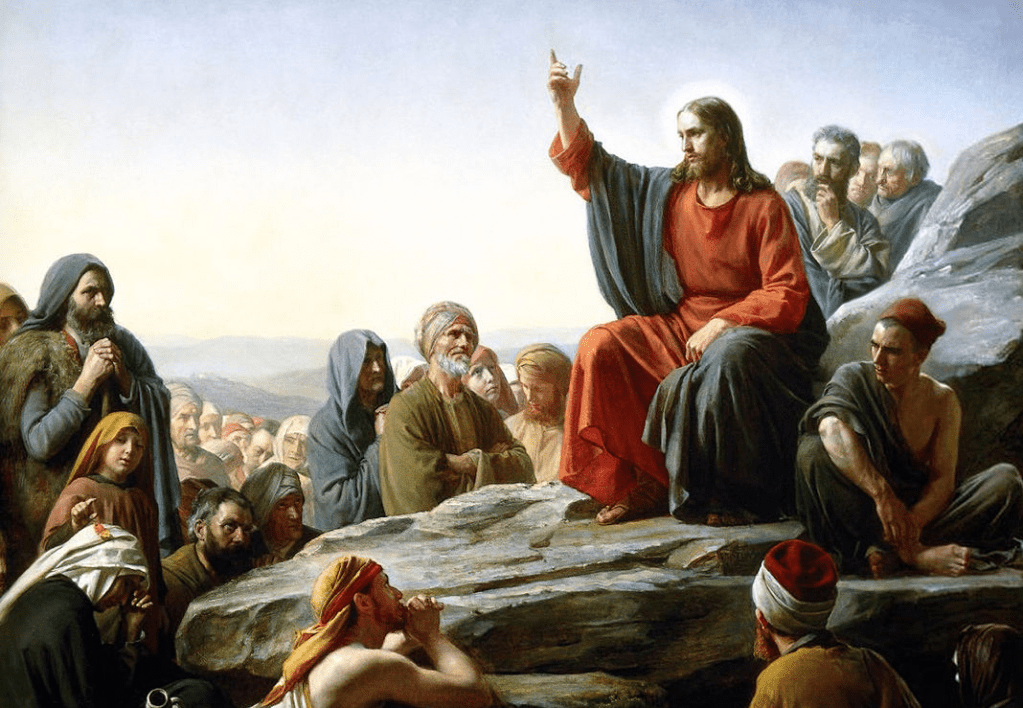
Sermon on the Mount by Carl Bloch, 1877 (Wikimedia Commons)
Everyone then who hears these words of mine and does them will be like a wise man who built his house on the rock.” (Matthew 7:24, ESV)

With these words, Jesus concluded His world famous discourse found in the Gospel of Matthew, now called the Sermon on the Mount.[1]

It’s hard to overstate the impact this sermon has had on the church throughout history. Augustine called it “a perfect standard of the Christian life.”[2] Others have devoted their whole lives to searching out its meaning and understanding its application for today. Regarding the Sermon on the Mount, biblical scholar R. Kent Hughes has said, “Every phrase can bear exhaustive exposition and yet never be completely plumbed.”[3]

Dietrich Bonhoeffer, the German Lutheran pastor who resisted Hitler’s tyrannical rule, based his famous work The Cost of Discipleship on this power-packed sermon. The Sermon is all about what it means to enter the Kingdom of God. It’s an explication of what it means to live your life under God’s rule.

It has even influenced non-Christians, such as Gandhi who came to revere (but not worship) Jesus because of His words spoken here in Matthew 5-7. Nietzsche hated it. He said that the Sermon captures the “slave morality” of Christianity. Apparently, he wasn’t a big fan of loving your enemies. But to be fair to Nietzsche, Jesus’s words here are pretty shocking to all of us, and so we all naturally resist them. Here are some statements found in the Sermon:

“If your right eye causes you to stumble, gouge it out and throw it away. It is better for you to lose one part of your body than for your whole body to be thrown into hell.” (Matthew 5:29, NIV)
“Enter through the narrow gate. For wide is the gate and broad is the road that leads to destruction, and many enter through it. But small is the gate and narrow the road that leads to life, and only a few find it.” (Matthew 7:13-14, NIV)
“You have heard that it was said, ‘Eye for eye, and tooth for tooth.’ But I tell you, do not resist an evil person. If anyone slaps you on the right cheek, turn to them the other cheek also. And if anyone wants to sue you and take your shirt, hand over your coat as well. If anyone forces you to go one mile, go with them two miles. Give to the one who asks you, and do not turn away from the one who wants to borrow from you. You have heard that it was said, ‘Love your neighbor and hate your enemy.’ But I tell you, love your enemies and pray for those who persecute you, that you may be children of your Father in heaven.” (Matthew 5:38-45, NIV)

Again, these words come from the lips of the Lord Jesus Himself. The fact that He, the incarnate Son of God, lived out this ethic is incredible, but that doesn’t make them easy to obey. If we really take them seriously, they are indeed jarring.

There are some Christians who have softened the blow by arguing that Jesus preached the Sermon on the Mount as a lofty ideal, a virtually impossible ethic that was only for the spiritual elite.[4] Others have proposed that the Sermon on the Mount was only for the old covenant Jew or for the age to come when Christ’s kingdom is fully consummated.[5] For many reasons, I cannot accept that interpretation.

For instance, in this very sermon, Jesus taught His followers to pray for the kingdom’s arrival: “Your kingdom come, your will be done, on earth as it is in heaven” (Matthew 6:10, ESV). So how could this sermon be addressing a future era and not today?

Those who claim this ethic is too lofty for the Christian today are forgetting that we now have the supernatural power of the Holy Spirit at work in our hearts and lives. In fact, it’s worth comparing all that Jesus calls His followers to in the Sermon on the Mount with the fruit of the Spirit listed in Galatians 5:22-23: “Love, joy, peace, patience, kindness, goodness, faithfulness, gentleness, and self-control.” I would also add humility, a trait implied in all of these and one which Paul commonly lists elsewhere (see Ephesians 4:2; Philippians 2:3; Colossians 3:12).

I’m not arguing for Christian perfectionism. But like Paul I believe we are to strive for holiness through God’s empowering grace. “Not that I have already obtained all this, or have already arrived at my goal, but I press on to take hold of that for which Christ Jesus took hold of me” (Philippians 3:12, NIV).

Those who claim that the Sermon on the Mount doesn’t apply to today’s world remind me of something G. K. Chesterton said: “The Christian ideal has not been tried and found wanting. It has been found difficult; and left untried.”[6] Followers of Jesus should never avoid the difficult passages in Scripture. They are there for a reason.

Without a doubt, Jesus has set a high goal for us to aim at. To claim that the Sermon on the Mount’s ethic is too lofty to attain may sound humble. But ultimately such a response ignores what Jesus later told His disciples: “If you love Me, you will keep My commandments” (John 14:15, NASB). He also ended His sermon by saying, “Everyone then who hears these words of mine and does them will be like a wise man who built his house on the rock” (Matthew 7:24, ESV).

Jesus is our King today, not merely in the future. And this is His kingly address to us. If we consider ourselves followers of King Jesus, the Sermon on the Mount isn’t an optional add-on. It is something we need to read, cherish, and obey now more than ever. Why don’t you read through Matthew 5-7 right now? It might just change your life.


[1] Matthew 5-7. Portions of the sermon are restated in Luke 6:20-49.

[2] Quoted in Philip Schaff, NPNF1-06. St. Augustine: Sermon on the Mount; Harmony of the Gospels; Homilies on the Gospels, Chapter 1.

[3] The Sermon on the Mount, R. Kent Hughes, 14.

[4] This was Thomas Aquinas’s view. See Charles Quarles, The Sermon on the Mount: Restoring Christ’s Message to the Modern Church, Kindle edition.

[5] For instance, Lewis Sperry Chafer said, “As a rule of life, it is addressed to the Jew before the cross and to the Jew in the coming kingdom, and is therefore not now in effect.” L. S. Chafer, Systematic Theology (Dallas: Dallas Theological Seminary, 1948), 5:97.

[6] G. K. Chesterton, What’s Wrong with the World.

Did Jesus Claim to Be God?

Cristo de la Concordia on San Pedro Hill, Bolivia

“But what about you?” Jesus asked. “Who do you say I am?” (Matthew 16:15, BSB)

When Jesus was on earth, He warned His followers that there would be many false pictures of Him in the future.[1] People would try to mold and shape the person of Jesus of Nazareth to fit their personal biases and assumptions. It is rare in our Western world to simply let Jesus speak for Himself and tell us who He really is.

The Gospels of Matthew, Mark, Luke, and John are not merely theological treatises on Jesus; they are the earliest and most reliable records we have of the life of Jesus. All four of them were written during the first century, only a matter of decades after Jesus walked the planet. Think about the level of accuracy we have today for events that occurred only a few decades ago. Not only that, but these Gospels were all based on eyewitness testimonies of what actually happened.[2]

The Gospels tell us that in the middle of the night before Good Friday, Jesus was arrested and brought before the Sanhedrin, the ruling Jewish council, for a kind of phony trial. They had one agenda: Gather enough evidence to condemn Jesus to death. Jesus’ talk about the Kingdom of God arriving through Him was a threat to their authority. So they needed to kill Him.

Now the chief priests and the whole council were seeking false testimony against Jesus that they might put him to death, but they found none, though many false witnesses came forward. (Matthew 26:59-60, ESV)

This is really incredible. They’ve had three years to find some kind of dirt on Jesus. They’ve even had time to try and concoct some kind of false allegations against Jesus. But even when they try to cook something up, all their accusations fall short.[3]

“I Am”

Of course, when you know who Jesus really is, it only makes sense that you cannot find dirt on Him. For the first and only time in human history, you have a perfect Man walking around. Imagine that. As a toddler, He never flung food across the table or threw tantrums. In school, He was the perfect student. As a teenager, He never went through a rebellious stage. When things were difficult, He never resorted to lying or stealing or badmouthing. Jesus was morally perfect.

So how do you convict someone without a single blot on His moral record? You can’t. Your only two options are to make something up or get Him to say something that scandalizes everyone.

All through this kangaroo trial, Jesus has stood there in total silence while the religious leaders slander Him, smear His name, and lie about Him. And this silence aggravates the high priest. So he asks Jesus the question he knows will get them the evidence they need to condemn Him.

Again the high priest asked him, “Are you the Christ, the Son of the Blessed?” And Jesus said, “I am, and you will see the Son of Man seated at the right hand of Power, and coming with the clouds of heaven.” And the high priest tore his garments and said, “What further witnesses do we need? You have heard his blasphemy. What is your decision?” And they all condemned him as deserving death. (Mark 16:61-64, ESV)

The irony is that while they couldn’t convict Jesus based on a mountain of lies, when they finally got Jesus to clearly tell the truth about Himself, they had everything they needed to convict Him. All He had to do was acknowledge that He really was the Christ and Son of God.

Even as He hung from the cross, the religious leaders mocked Jesus by saying: “Let God rescue him now if he wants him, for he said, ‘I am the Son of God.’” (Matthew 27:43, NIV)

Who Do You Say He Is?

I wonder how you respond to His claim. Do you believe Him when He gives this response? What is your verdict on Jesus?

Bart Ehrman is a skeptic and historian who has written many books attempting to debunk the historical claims of Christianity. In an interview several years ago, he said: “During his lifetime, Jesus himself didn’t call himself God and didn’t consider himself God, and … none of his disciples had any inkling at all that he was God.”[4] But is this accurate?

The Bible doesn’t tell us that Jesus went around with a bullhorn saying, “I’m God! I’m God!” to everyone He met. That would be confusing and communicate essentially that He was what Christians now call God the Father. Instead, He spoke of Himself in a way that even faithful Jews who only believed in one God could recognize that He really was both divine and human. He forgave sin. He healed the sick, the blind, the mute. He calmed the storms. He called Himself the “I Am,” which was the divine name of Yahweh, the one true God.[5] He received worship as only God should.[6]

Jesus: A Good Teacher?

People today want to say Jesus was merely a good teacher. They want to say He was a great moral example. And some Eastern religions are even willing to say, “Sure, Jesus was god. And I’m god. You’re god. Hey, we all have a spark of the divine!” But to say Jesus was the unique Son of God and that this world has never known anyone else like Him goes beyond what our world can accept.

Here’s what Gandhi famously said about Jesus in his autobiography:

“My difficulties lay deeper. It was more than I could believe that Jesus was the only incarnate son of God, and that only he who believed in him would have everlasting life. If God could have sons, all of us were His sons. If Jesus was like God, or God Himself, then all men were like God and could be God Himself. My reason was not ready to believe literally that Jesus by his death and by his blood redeemed the sins of the world… I could accept Jesus as a martyr, an embodiment of sacrifice, and a divine teacher, but not as the most perfect man ever born. His death on the Cross was a great example to the world, but that there was anything like a mysterious or miraculous virtue in it my heart could not accept.”[7]

There are many people in our world today that share Gandhi’s sentiment. They’re happy to hold Jesus up as this great moral example, but they refuse to go beyond that.

But here’s the problem: Jesus Himself taught that He was the unique Son of God. Just listen to a handful of Jesus’ statements about Himself:

Jesus said to [the Jews], “Truly, truly, I say to you, before Abraham was, I Am.” (John 8:58, ESV)
“I and the Father are one.” (John 10:30, ESV)
“Whoever has seen me has seen the Father. How can you say, ‘Show us the Father’? Do you not believe that I am in the Father and the Father is in me? The words that I say to you I do not speak on my own authority, but the Father who dwells in me does his works.” (John 14:9-10, ESV)

See, the problem with Gandhi and so many others, is they want to accept Jesus as a great teacher, but they ignore what the Teacher actually taught. You cannot have it both ways.

When Jesus was asked directly if He was the Son of God, He said, “I Am.” Gandhi says Jesus’s death on the cross was a great example, but the reason the crowds demanded Jesus’s crucifixion is that He claimed to be the unique Son of God – the eternal God who took on human flesh to rescue us.

Liar, Lunatic, or Lord?

J. R. R. Tolkien, author of Lord of the Rings, once spoke to C. S. Lewis about the uniqueness of Jesus. Lewis was at one point an atheist, but he came to see that once you understand what Jesus really said about Himself, you can’t just call Him a great moral teacher. Lewis later wrote:

“I am trying to prevent anyone saying the really foolish thing that people often say about Him: “I’m ready to accept Jesus as a great moral teacher, but I don’t accept His claim to be God.” That is the one thing we must not say. A man who was merely a man and said the sort of things Jesus said would not be a great moral teacher. He would either be a lunatic – on a level with the man who says he is a poached egg – or he would be the Devil of Hell. You must make your choice. Either this man was, and is, the Son of God: or else a madman or something worse. You can shut Him up for a fool, you can spit at Him and kill Him as a demon; or you can fall at His feet and call Him Lord and God. But let us not come with any patronizing nonsense about His being a great human teacher. He has not left that open to us. He did not intend to.”[8]

Jesus’ teachings have been revered across the entire planet. Think about how wild that is for a moment. Here we have a poor itinerant rabbi from an obscure town in northern Israel in the first century who ends up crucified like a common criminal by the mighty ruling empire. How can this tragic tale be about God incarnate – “very God of very God” as the Nicaean Creed of AD 325 has it?

The only thing that could possibly convince someone that this man was in fact God is if three things are true:

1) He claimed it. We’ve seen He did.[9] When His disciple Thomas saw Him risen from the dead, he said, “My Lord and my God!” (John 20:28). Rather than correcting Thomas, Jesus said, “Have you believed because you have seen me?” (v. 29).

2) He lived it. No one could find Him guilty of a single sin, including His closest followers who lived with Him for three whole years. Just try convincing someone you live with that you’re perfect. One of His closest followers, Peter, said this of Jesus, quoting the prophet Isaiah:

“He committed no sin, and no deceit was found in his mouth.” (1 Peter 2:22, NIV)

3) He proved it. Jesus proved in every way imaginable that He was just who He claimed to be. Not only did He forgive sins, but He also performed many miraculous feats throughout His life – including raising the dead to life. The evidence for Jesus’s miraculous wonders was incontrovertible. In fact, it was so substantial that we find opponents of Christianity explaining away His miracles by calling Him a villainous sorcerer in league with Satan.

But beyond all these miracles during His life, the greatest miracle that Jesus performed was in defeating death itself. Scripture says He tasted death for all of us. He really and truly died on the cross. But unlike all the other founders of the world religions, Jesus did something utterly unique – He came back to life. His tomb is empty to this day![10]

Because Jesus is the merciful God He says He is, we can turn to Him for forgiveness and eternal life. We don’t have to run from God, because we can know that, in Jesus, God is merciful and forgiving.

Christians have a living Savior who is also the God-man, and that’s why we have every reason to celebrate this great hope and walk with confidence in an uncertain world.


[1] Jesus said that even “the elect” (believers) can be deceived by some of these false representations. See Matthew 24:23-24.

[2] Luke 1:1-4; John 19:35; 1 Corinthians 15:1-18; 2 Peter 1:16.

[3] The best they can do is to twist His words about raising the temple if it was destroyed (John tells us He speaking about His body, see John 2:19; Matthew 26:61), but even that is flimsy at best.

[4] Bart Ehrman, NPR. Interview found here: https://www.npr.org/2014/04/07/300246095/if-jesus-never-called-himself-god-how-did-he-become-one

[5] See Exodus 3:13-14.

[6] There are numerous occasions in the Gospels where Jesus received worship (see Matthew 2:11; 14:33; 15:25; 28:9, 17; Luke 24:52; John 20:21). This is astounding when you consider that Jews viewed worship of anyone other than God as idolatrous blasphemy. In other instances, we see men and angels refuse worship and divert attention to God (Acts 3:12-13; 10:25-26; 14:11-15; Revelation 19:10; 22:8-9).

[7] Mahatma Gandhi, Gandhi: An Autobiography.

[8] C. S. Lewis, Mere Christianity (1952)

[9] Jesus claimed both implicitly (through doing things that only God can do, like forgiving sins) and explicitly (through His bold assertions identifying Himself as Yahweh God). See my post “What Is God Like?”

[10] For the evidence for Jesus’s historical resurrection, see my posts “Why I Believe in the Resurrection of Jesus” and “12 Reasons to Believe that Jesus Rose from the Dead.”

Wired for Community

Photo by FreePik

From the moment we emerge from our mother’s womb, we crave closeness and connection. New mothers are encouraged to practice skin-to-skin contact to bond with their babies. Have you ever wondered why a baby’s head smells so good? It’s because God designed their scent glands to secrete pheromones which actually make their perspiration smell sweet.[1] Everything about our physiology seems to point to this need for community. Through eye contact, we connect. Through a hug, we comfort. Through body language, we convey emotions.

Humans naturally long to be with other humans. When we are left in isolation, we quite literally start to go insane. Just watch the film Castaway, where Tom Hanks’ character is stranded on a desert island and forced to befriend a volleyball named “Wilson.” Sure, there are days where we tell ourselves, “Life would be great, if it weren’t for other people.” But like it or not, at the end of the day, we crave human contact.

This has everything to do with how God originally wired us. We were created in the image of a personal God of community. He has eternally existed as Father, Son, and Holy Spirit. In other words, God is by nature a God of relationships. That’s why God said “it is not good that the man should be alone” when He made us to reflect His nature (Genesis 2:18). From the very beginning, we were wired for community!

Many today will ask the question, “Why should I bother with the church anyway?” Perhaps, you can relate to this question. Maybe you were hurt by others in a church, and you feel church is not worth the effort or the risk of being hurt again. After all, they reason, I can have a relationship with God without being part of a church.

It’s this sentiment that has led to the mantra we often hear: “I’m spiritual, but not religious.” Although I have an idea of where this statement comes from, that response has always somewhat bothered me. There seems to be a whole bundle of worldview assumptions buried in that simple declaration. The worst part about this is that it seems to draw a solid black line between that which is spiritual and that which is religious (or even church-related). Such a dichotomy seems to fly in the face of so much of what I know personally and what I see in Scripture.

Is it true that we can have a relationship with God without being involved in a church? The answer, according to Scripture, is that at the moment we come to Jesus Christ in repentant faith, we are indeed reconciled to our Creator. We don’t need the church or a leader in the church to establish our conversion; that’s something God alone can accomplish. So the answer to the question above is “yes,” but it is a qualified “yes.”

Here’s what I mean. To be in a relationship with someone implies that you are living with that person — not merely speaking to that person, but also listening to that person. And God, in His Word, has a lot to say about the great importance of regularly gathering with a local church.

For example: “And let us consider how we may spur one another on toward love and good deeds, not giving up meeting together, as some are in the habit of doing, but encouraging one another—and all the more as you see the Day approaching” (Hebrews 10:24-25, NIV). So, for the Christian, “meeting together” should be a regular, consistent part of our life. In fact, the emphasis on “encouraging one another,” implies that we will benefit spiritually as we meet together in the context of the local church.

In the past year, with the spread of COVID-19, this has taken a different shape for many who cannot meet for various reasons. Either way, meeting together should be the norm for the church – barring exceptional circumstances. In this past year, many have found ways to “meet” or interact online. Would Paul have this in mind as a form of gathering? Since he lived in the first century, not the twenty-first, the answer is clearly “No.”

Technology has its limitations, and I don’t think it’s an ideal permanent substitution for the vast majority of Christians who can meet together. But even if it’s not the ideal, at least it allows believers to study God’s Word together, pray for each other’s needs, and talk with one another. Several people have told me how grateful they are that our church has online options available; otherwise, they wouldn’t be able to participate in church life at all. I know what it’s like to be encouraged when talking with Christian brothers and sisters on Skype who are halfway around the world. Sure, the fellowship is not as sweet as when we meet in person, but I can still say I’m thankful for the connections that technology gives us. Overall, the in-person gathering is certainly the ideal the church should strive for because there’s a certain level of fellowship or community that technology can’t achieve.

And since definitions are important, by “church” I do not mean that brick building with stained glass windows. The Greek word we translate as “church,” ekklesia, simply means “a gathering or assembly of people.”[2] However, in the Christian sense, it refers to a “gathering of believers in Jesus Christ.”

Too often, men today can think of true manhood as being this solitary, John Wayne-like individual who has no need for friendships. It’s as if being alone and independent of others is the epitome of manliness. But that’s not true! Our Creator says, “It’s not good for the man to be alone.”

In the words of the theologian-poet, John Donne: “No man is an island entire of itself; every man is a piece of the continent, a part of the main.”

Not only is perpetual isolation unfulfilling, it is also unwise. It can often reveal a stubborn unwillingness to listen to the counsel of others. Proverbs 18:1 says, “Whoever isolates himself seeks his own desire; he breaks out against all sound judgment.”

Here’s how this can work out. In our pride, we can think, “Of course I know what’s best for me. I don’t need to listen to anyone else.” What about when others are counseling you not to go down a road in life they consider unwise or dangerous? They can easily be ignored, because you don’t consider yourself in community with them. Proverbs says that when you isolate yourself from others who can speak wisdom into your life, you are raging against sound judgment. You are actively choosing the way of destruction.

God calls believers to live in community with other believers, so that they are in a context where others can know them well and speak biblical wisdom, love, and encouragement into their lives. God says, “Don’t isolate yourself. Christian men, unite with other Christian men and seek accountability as a band of brothers, walking together in the journey of life. Christian women, form close bonds with other Christian women as your sisters in the Lord who can share life with you.”

In the dark days of Israel recounted in the sobering book of Judges, we are told: “In those days there was no king in Israel. Everyone did what was right in his own eyes” (Judges 17:6; 21:25). It’s a tragic thing to see men and women refuse counsel and accountability to others. Although they imagine they are building up a fortress of protection around themselves, in reality they are cutting themselves off from growth, hope, and the joy of Christian fellowship.

If you are a Christian, God calls you to not neglect the gathering of a local body of believers when you are able. From the moment the church was first launched, the Holy Spirit came upon the gathered group of believers on the Day of Pentecost. Note the way Luke explains this: “All the believers devoted themselves to the apostles’ teaching, and to fellowship, and to sharing in meals (including the Lord’s Supper), and to prayer” (Acts 2:42, NLT). Whether we are willing to admit it or not, we need one another. We were designed for community.


[1] Rachel Nuwer, Smithsonian Magazine, (https://www.smithsonianmag.com/smart-news/the-smell-of-newborn-babies-triggers-the-same-reward-centers-as-drugs-58482/  September 24, 2013)

[2] See Wayne Grudem, Systematic Theology, 2nd Edition. (Grand Rapids, MI: Zondervan, 2020),), 1048. Grudem points out in footnote 2 that even in the Septuagint (the Greek translation of the Old Testament) the word ekklesia “refers frequently to the assemblies of God’s people.”

When a Christian Leader Falls

In the past several months, there has been an outside investigation into sexual misconduct allegations of Ravi Zacharias, who was a well-known and sought after Christian apologist and speaker. The law firm conducting the investigation, Miller & Martin, released some devastating news in recent weeks: the allegations were all true. The firm found “convincing and credible evidence” that Zacharias had indeed engaged in sexual misconduct with multiple women over the course of many years.[1]

This news stunned many Christians. Zacharias was known for his rhetorical eloquence and powerful presentations in defense of the Christian faith. Perhaps even more troubling is that Zacharias, who died in the spring of 2020, never repented of his secret sin.

I for one looked up to Zacharias as an incredible man of faith, who spoke the truth boldly yet with genuine love for others – a truly rare quality. I have been helped by many of his books and talks, and I was equally shocked to read the report.

As I considered this news, two thoughts entered my head. What will be the long-term impact of Zacharias’s sin? Will this devastate the faith of thousands of young men and women that he greatly influenced? Secondly, I considered the pain this must cause his family. I can’t even imagine their grief. I’m praying for their hearts, as they desperately need the comfort and peace only God can give.

Although very saddened, I do have some takeaways from all this.

Sin always has consequences

Although we know this intuitively, it’s so easy for Christians to forget this: sin always has consequences. It always harms both ourselves and those around us. Especially grievous sins – and sexual sin definitely makes the list. It shatters trust. It boggles the mind. It cuts through bonds meant to last a lifetime. It divides couples who promised to love each other no matter what. It tears families apart. And sexual sin is always shrouded in deception. Unless it is quickly confessed and repented of, lies inevitably abound. It also has a distorting effect, twisting the way we view our relationships.

I’ve spoken to a man who cheated on his wife about this. While still feeling numb in the aftermath of his sin coming to light, he shook his head and said, “I never meant to hurt her. I never meant to hurt anyone.” That’s how it always goes. Our tendency as fallen people is to put all our focus on the pleasure of the moment, rather than the long-term consequences of one sinful choice. Only the Holy Spirit can break the power of sin and lead us to walk in faithfulness and self-control.

Christian leaders must hold themselves to a higher standard

It is both sad and reprehensible how some Christian pastors, authors, and thought leaders have not taken the influence they carry seriously. They abuse the power they have been entrusted with by manipulating others or hurting those who oppose them.

Others ignore biblical standards and mock those who still cherish historic Christian teachings. Perhaps they forget all the warnings the Bible gives about those who abuse spiritual influence. “Not many of you should become teachers, my fellow believers, because you know that we who teach will be judged more strictly” (James 3:1, NIV). Whether you are a pastor or teacher or blogger, this verse should be engraved on your heart.

Christian leaders carry a lot of influence among the Lord’s people, and they should not downplay the seriousness of their role. If you lead others, please remember that you will be held accountable for how faithfully you stood against the tide of worldly influences.

After surveying the grandeur of His creation, God says in Isaiah: “But this is the one to whom I will look: he who is humble and contrite in spirit and trembles at my word” (Isaiah 66:2, ESV). Do you still tremble at the thought of teaching God’s sacred Word? Don’t be so concerned with being admired among the cultural elites. Make your aim the faithful teaching of God’s Word. You have been entrusted with the life-changing message of the gospel, and that is no small thing.

It is the better part of wisdom to gather around you wise and godly believers who will have access to you, to correct you when you’re wrong, to ask you the hard questions, and to encourage you to stay the course. You have been put in a position with so much potential to advance God’s kingdom for good. God takes your role seriously; so should you. This is a loving warning all Christian leaders – including myself – need to hear.

Never put yourself in a compromising situation

One stand out example from the Bible is Joseph. Betrayed by his brothers, Joseph ended up as a slave in the house of Potiphar, an officer in Pharaoh’s army. Because Joseph trusted in God and worked hard in his master’s service, Potiphar put him in charge of his whole household. When Potiphar’s wife summoned Joseph to her quarters and tried to seduce him, he responded, “My master trusts me with everything in his entire household. No one here has more authority than I do. He has held back nothing from me except you, because you are his wife. How could I do such a wicked thing? It would be a great sin against God” (Genesis 39:8-9, NLT).

But apparently she didn’t give up easy. “She kept putting pressure on Joseph day after day, but he refused to sleep with her, and he kept out of her way as much as possible” (v. 10). Joseph knew that temptation is something to avoid at all costs – not something to go exploring out of curiosity.

Finally, the time came when Potiphar’s wife catches him alone in the empty house. Once again, she tried to lure him into the bedroom. So how did Joseph respond? Did he stand his ground to see how much temptation he could resist? No! He bolted out of there as if the whole house was about to burst into flames. Joseph understood the importance of avoiding compromising situations. He cared more about God’s honor than his self-serving pleasure. He did exactly what the Bible commands us to do: “Run from sexual immorality!” (1 Corinthians 6:18, HCSB).

Jesus Is the Real Hero of the Story

Never forget that the gospel makes everything about Christ and what He has done – not you or what you have or haven’t done. That doesn’t take away our sense of responsibility, but it does offer us incredible hope. Jesus, through His cross, can overcome all your shame, sin, and failure. His grace allows us to live out of our identity in Christ, not some self-made identity.

Since Jesus is the real hero of the story, we should never put all our hope in a Christian leader. God has put them in our lives to help guide us, but they are not our Lord. They did not die for our sins.

This should make us treasure the perfect life of Jesus. Whereas Christian leaders will always be fallible and inevitably make mistakes in this life, Jesus is the King who will never fail us. If a Christian leader has failed you, keep in mind that this doesn’t change the truth about Jesus. He was, is, and always will be the sinless Savior you and I desperately need. “Jesus Christ is the same yesterday and today and forever” (Hebrews 13:8). Make Jesus your ultimate hero, because He will never let you down.


[1] Daniel Silliman, “RZIM Confirms Ravi Zacharias’s Sexual Misconduct,” Christianity Today: https://www.christianitytoday.com/news/2020/december/rzim-evidence-confirms-ravi-zacharias-sexual-misconduct.html