The Quest for Happiness

There are some pretty funny TV commercials out there. I’m sometimes amazed by the creativity of those marketing gurus. In one Kia car commercial from several years ago, a couple leaving a hotel is greeted by Morpheus from The Matrix at the valet desk. Morpheus tells them, “The world of luxury has been pulled over your eyes to blind you from the truth.” He then offers them a choice. Take the blue keys, and they can go back to their delusion of luxury. Or, take the red keys and experience greater luxury than they ever imagined. Of course, they choose the red keys. The commercial ends with them astonished by their Kia experience, complete with surrounding explosions and Morpheus singing opera. The final tagline reads: “Challenge the luxury you know.”

This memorable commercial captures the essence of nearly every commercial out there. The message is simple: “There is greater satisfaction out there, if only you try our product.” The message remains the same because it speaks to the longing of our hearts. We are all on a quest for happiness.

Here’s how the famous French philosopher Blaise Pascal explained it:

“All men seek happiness. This is without exception. Whatever different means they use, they all tend to this end. The cause of some going to war, and of others avoiding it, is the same desire in both – to be happy. This is the motive of every action of every man, even of those who hang themselves.”[1]

We all want to be happy. Pascal says this is the driving motive behind our every action. With a little reflection, you can see this desire behind every pursuit in life – earning a living, finding a spouse, raising good kids, having fun, keeping fit. All of it is because we want to be happy.

In the book of Ecclesiastes, Solomon says he chased after happiness, too. And he went about it every way he could. He says, “I applied my heart to seek and to search out by wisdom all that is done under heaven… to find out what is good” (Ecclesiastes 1:13, 2:1, ESV).

Like a lion going after his prey, he was on the hunt for true satisfaction in life. He then takes us through some of his endeavors to discover true happiness.

And he starts by giving us the summary of his findings: “I have seen everything that is done under the sun, and behold, all is vanity and a striving after wind” (Ecclesiastes 1:14, ESV). Solomon says, “Wherever you have searched for satisfaction in this life, I promise you I’ve already tried it. It’s all just a striving after wind.”

Happiness through Knowledge?

Solomon started at the university. He went there like a sponge ready to soak up every ounce of knowledge he could. He wanted to know everything about everything. He went to all the greatest minds of his time and learned what he could learn from them. Today, if you want to become an expert in a field, it’s truly amazing how much you can learn about science, history, math, the legal system, sports, crafts, cooking, and nature. God’s world is filled with fascinating bits of knowledge. Augustine said, “All truth is God’s truth.”

But the questions is, How far can such knowledge take us? Does it help us overcome death? Does it lead to everlasting life?

People can become brilliant scholars in any and all fields of knowledge, but Solomon concludes that this can’t give you true and lasting satisfaction. No matter how much you know, none of it ultimately matters apart from knowing Christ. We need God’s wisdom, found in His Book.

At the end of Ecclesiastes, he even warns us: “Of making many books there is no end, and much study wearies the body” (12:12). And to that, every college and high school student says, “Amen!” “For with much wisdom comes much sorrow; the more knowledge, the more grief” (v. 18).

All that hitting the books never brought the satisfaction that Solomon longed for. The more he knew, the more miserable life seemed. Knowledge alone could never satisfy. That reminds me of the teacher who wrote on the boy’s report card: “If ignorance is bliss, then this student is going to be the happiest person in the world.”

Leonard Woolf, a man known for his countless scholarly achievements, had this to say after a lifetime’s pursuit of academic study:

“I see clearly that I have achieved practically nothing. The world today and the history of the human anthill during the past five to seven years would be exactly the same as it is if I had played Ping-Pong instead of sitting on committees and writing books and memoranda. I have therefore to make a rather ignominious confession that I must have, in a long life, ground through between 150,000 and 200,000 hours of perfectly useless work.”[2]

This is a shocking admission. Woolf was known for his brilliant commentary on economics, education, and politics. He wrote stacks and stacks of books and articles on many different subjects. And yet his own assessment of his life’s achievement was that it amounted to “practically nothing” – a chasing after the wind.

Happiness through Pleasure and Success?

Next, Solomon tries pursuing pleasure. He leaves the university and heads out on the town for some entertainment. He buys tickets to the greatest comedians, buys drinks for himself and everyone around him, and does his best to have a good time. He indulges in every form of entertainment you can imagine, getting drunk night after night with the finest of wines.

He is like “The Wanderer” in the song based on Ecclesiastes that U2 wrote, featuring Johnny Cash as lead vocals:

“I went out there/ In search of experience/ To taste and to touch and to feel as much / As a man can before he repents.”

Solomon says:

“I made myself gardens and parks, and planted in them all kinds of fruit trees. I made myself pools from which to water the forest of growing trees… I hired wonderful singers, both men and women, and had many beautiful concubines. I had everything a man could desire!” (Ecclesiastes 2:5-6, 8, NLT)

He plants spectacular gardens and parks, then invites all the A-list celebrities over to his house for one pool party after another. He orders the most delicious foods imaginable. He hires Grammy-winning bands to come play music. And, of course, many beautiful women are there. Like Hugh Hefner, he lives the playboy lifestyle and denies himself nothing. He looks for pleasure wherever it may be found, leaving no stone unturned.

But once again, he sees where this pursuit of pleasure comes up short.

I said in my heart, “Come now, I will test you with pleasure; enjoy yourself.” But behold, this also was vanity. I said of laughter, “It is mad,” and of pleasure, “What use is it?” (Ecclesiastes 2:2-3, ESV)

Have you ever read the biography of a comedian? They often live the loneliest and saddest of lives. Solomon discovered that no matter what entertainment or pleasure he indulged in, it always left a gaping hole in his heart. He realized that it was really just a distraction from the pain and brevity of life.

In the end, even the most enjoyable earthly pleasures will leave us empty apart from God.

In our secular culture, it’s becoming more and more common to view human beings as merely material creatures. If Darwin was right and we’re just the product of unguided nature, then we are all just bags of molecules. And if you think we have no spiritual side to us – no immortal soul – but are instead just material creatures, then you’ll conclude that only material things could satisfy us.

But I think we all know deep down that there’s more to us than meets the eye. When you think about the choices you make every day — what to wear, what to eat, and what to do — that’s not just neural circuitry in your brain. That’s the freedom of choice coming from your inner self. When you think about a mother pouring out her blood, sweat, and tears to raise her children well, or a husband sacrificing career aspirations to care for his bedridden wife, that’s not just chemical reactions in the brain. That’s love.

The Big Tease

And since we are more than matter, material solutions will never fully satisfy. Happiness isn’t found where we so often look.

"The wise person has his eyes in his head, but the fool walks in darkness. And yet I perceived that the same event happens to all of them. Then I said in my heart, 'What happens to the fool will happen to me also. Why then have I been so very wise?' And I said in my heart that this also is vanity." (Ecclesiastes 2:14-15, ESV)

No matter how much fame, fortune, or fun he had, Solomon recognized that none of it lasts forever. It doesn’t matter how brilliant you are, the same event happens to us all. We all have an appointment with death.

"How the wise dies just like the fool! So I hated life, because what is done under the sun was grievous to me, for all is vanity and a striving after wind." (Ecclesiastes 2:17, ESV)

Solomon feels cheated. It’s like life is one big tease promising him the happiness he craves, but never fulfilling that desire. Why? Because life is still cut short by death. He says, “How pointless to work hard and have so much when eventually I’ll be gone and it will be left to someone else!”

It’s because of death that many have wondered, Can we really say that life has meaning?

Even atheists long for meaning in life. They too have been made in God’s image so they can’t escape this hunger for significance. They just talk about creating their own meaning. And in a sense, that’s what Solomon set out to do: create his own meaning under the sun.

But when we leave God out of the picture, we’re left with a pretty bleak picture of ourselves. The search for meaning and happiness becomes a chasing after the wind. Biology professor William Provine once bluntly stated: “Let me summarize my views… There are no gods… There is no ultimate foundation for ethics, no ultimate meaning in life.”[3]

That’s what Solomon is trying to show us: Life minus God is meaningless. That’s because apart from God, we cannot have lasting happiness (Ecclesiastes 2:24-25). When you receive all the joys of this life as gifts from our Maker, you can actually enjoy them more because you’re not seeking them as ends in themselves. They are meant to lead you to God Himself.

Joy Complete

Is it possible that we overlook the simple pleasures of life, like the beauty of a sunset or a delicious meal because we aren’t seeing them as gifts from our Father’s hand?

When Jesus came, He said, “I am the resurrection and the life. The one who believes in me will live, even though they die” and “If you keep my commands, you will remain in my love… I have told you this so that my joy may be in you and that your joy may be complete” (John 11:25; 15:10-11, NIV).

For those who belong to Jesus, death is not the end of all joy. When we surrender our lives to Him, death becomes the door to the greatest of all joys: the glory of God’s presence in Heaven for all eternity.

We search for happiness in this life, but Jesus tells us, “In Me, you will have joy everlasting.”

Where is your search for happiness taking you? Are you ready to find it in Jesus?

Have thoughts on this post? Feel free to comment below!


[1] Blaise Pascal, Pensees (Loc. 2049).

[2] Leonard Woolf, quoted in Wireless Age (September/November 1998).

[3] Phillip Johnson & William Provine, “Darwinism: Science or Naturalistic Philosophy? Philip Johnson vs William Provine,” IDquest, debate, 41:10, https://www.youtube.com/watch?v=m7dG9U1vQ_U , emphasis added.

The Hardening of Pharaoh’s Heart

God clearly cares about our hearts. Throughout the Bible, we read about the significance of the heart. The heart is the seat of all human thought, emotion, and activity (Proverbs 4:23). God knows us so well, because His gaze pierces all the way through to our hearts (1 Samuel 16:7). The heart is often portrayed as the secret inner storehouse or the deep well of a person’s soul (Proverbs 20:5; Matthew 12:35; 1 Corinthians 14:26; Hebrews 4:12).

The words on our lips are usually good indicators of what’s brewing within. Jesus wisely said, “For out of the abundance of the heart the mouth speaks” (Matthew 12:34).

King Solomon urges us, “Trust in the Lord with all your heart, and do not lean on your own understanding” (Proverbs 3:5, ESV).

A heart that is right with God is a heart that gladly leans on Him as a child leans on her father’s chest. It is not too proud to trust in His grace.

Pharaoh’s Hard Heart

The Bible records God telling Moses, “When you go back to Egypt, see that you do before Pharaoh all the miracles that I have put in your power. But I will harden his heart, so that he will not let the people go” (Exodus 4:22, ESV).

This is the first time Pharaoh’s hard heart is mentioned. The Hebrew word chazaq literally means “to strengthen,” as in God strengthened Pharaoh’s heart in his rebellion. In 11 cases, chazaq is used to speak of God hardening Pharaoh’s heart (4:21; 9:2; 10:20, 27; 11:10; 14:4, 8) or more generally that Pharaoh’s heart “was hardened” (7:13, 22; 8:19; 9:35).

However, another word is also used to speak of Pharaoh’s hard heart – the Hebrew word kabad’, which literally means “to make heavy.” Three times, this word is used to speak of Pharaoh hardening his own heart (8:15, 32; 9:34), once with the general phrase “was hardened” (9:7), and twice to speak of God hardening Pharaoh’s heart (10:1; 14:4). It is a similar word to chazaq, but it has a special nuance worth noting.

Ancient Egyptians believed that in the afterlife a special ceremony took place called The Weighing of the Heart (pictured above). In this ceremony, overseen by the god Anubis, the heart of the deceased was placed on one side of a great scale and was weighed against the feather of truth. If someone had committed many sins, their heart would be weighed down, and they would be condemned to eternal restlessness. However, if they’d lived a virtuous life, one’s heart would be lighter than the feather. In this case, they would be granted safe passage to the Egyptian paradise, the fields of Aaru.

Because of this belief about one’s heart determining one’s eternal destiny, Egyptians would remove all the organs except the heart when burying their dead. Moses may be alluding to this ancient belief when he writes that Pharaoh’s heart was “made heavy” (Exodus 8:15, 32; 9:7, 34; 10:1; 14:4).

This is a reminder that in nearly every age and culture, people have been religious. God has given humanity a universal sense of right and wrong, and because of this, we all know we are supposed to be good. And we all sense the scales of justice by which our lives will be weighed.

Our Hard Hearts

It is interesting how often Scripture connects salvation to the state of one’s heart. The Bible says that we need to be saved from sin, and Jesus said that all sin ultimately springs from a defiled heart (Matthew 15:18-20). When He saw the prideful religiosity of the Pharisees, Jesus asked them, “Why do you think evil in your hearts?” (9:4). Mark tells us He was “grieved at their hardness of heart” (Mark 5:3). Sometimes, even His disciples didn’t understand because “their hearts were hardened” (6:52). But Jesus also said the greatest commandment was, “You shall love the Lord your God with all your heart and with all your soul and with all your mind” (Matthew 22:37).

It’s popular today for people to say, “Just follow your heart.” It’s cliché and catchy. But in the Bible, that sounds like generally bad advice, like something the devil would urge you to do. Instead, we are warned about the inherent dangers of following one’s heart, which is so prone to self-deception. A heart that is not directed toward God is foolish and darkened (Genesis 3:1-6; Ephesians 4:22; Romans 1:21). The prophet Jeremiah quoted God on the matter:

“The heart is deceitful above all things
    and beyond cure.
    Who can understand it?
I the Lord search the heart
    and examine the mind,
to reward each person according to their conduct,
    according to what their deeds deserve.” (Jeremiah 17:9-10, NIV)

It’s good to know that God is just and will reward people according to what they deserve, but what hope of reward do we have? The Bible also says, “There is no one righteous, not even one; there is no one who understands; there is no one who seeks God” (Romans 3:10-11, NIV). This sounds pretty bleak. Thankfully, this isn’t Scripture’s last word on the matter.

The New Heart We All Need

The prophet Ezekiel records a divine promise about those who would receive a new heart:

“I will give you a new heart and put a new spirit in you; I will remove from you your heart of stone and give you a heart of flesh. And I will put my Spirit in you and move you to follow my decrees and be careful to keep my laws. Then you will live in the land I gave your ancestors; you will be my people, and I will be your God. I will save you from all your uncleanness.” (Ezekiel 36:26-29, NIV)

This means there is hope for those who have hard hearts like Pharaoh. But it’s not a matter of having a new commitment to live a good life; it’s a matter of becoming a new creation in Christ. This can only happen through faith in His finished work on the cross and subsequent resurrection. Speaking of that time when Jesus was on the cross, the prophet Isaiah says, “he was pierced for our transgressions, he was crushed for our iniquities; the punishment that brought us peace was on him, and by his wounds we are healed” (Isaiah 53:5, NIV).

Jesus took all that defiles our hearts onto Himself so that we could be redeemed from the sin that had enslaved us. Salvation is about God cleansing our hearts by grace through faith (see Acts 15:9; Hebrews 10:22; 13:9). A new heart is a forgiven heart, a liberated heart.

Through faith in Christ, the burden of guilt is lifted, and our hearts become lighter than a feather. Jesus comforted His disciples when He was about to die for them, saying, “Let not your hearts be troubled. Believe in God; believe also in Me” (John 14:1). A heart cleansed by the shed blood of Jesus is a heart reconciled to God. “For with the heart one believes and is justified” (Romans 10:10, ESV).

A new heart is soft and fleshy (Ezekiel 36:26). It wants more of God, not less. It desires His name to be famous, not our own. It craves to be filled with His love and His Spirit, not the fleeting pleasures of sin. It seeks His leading and direction, rather than wanting its own way. Though the battle of opposing desires still rages today (Romans 7:15-25), only the fruit produced in the new heart will last into eternity (1 Corinthians 3:12-15)).

And finally, Paul’s prayers for the church were continually about the state of their hearts, showing that the heart is a subject we should not neglect.

“May the Lord direct your hearts to God’s love and Christ’s endurance.” (2 Thessalonians 3:5, HCSB)

That is my prayer for you as well.

Father of mercies, my heart is so prone to wander after worthless pursuits that seem so urgent or attractive today. Give me fresh desires from Your heart of love, that I might live the life You’ve called me to. In Jesus’ name. Amen.

Have thoughts on this post? Feel free to comment below!

First Love Forsaken

Library of Celsus, Ephesus, Turkey

Perhaps one of the saddest things to witness is when one spouse says to another, “I just don’t love you anymore.” It’s especially heartbreaking because we know that at one time – perhaps many years ago – the couple shared an intimacy too deep and mysterious for words. Just being near one another would quicken the pulse. And merely hearing the other’s voice would cause the heart to flutter.

Upon hearing that such a love is now dormant, the question we all want to ask is: What happened? We know that such affection is not quickly extinguished. And in fact, when asked why they no longer love their spouse, they will usually say they have gradually, over time, simply drifted apart.

The Love You Had at First

In the last book of the Bible, Revelation, Jesus addresses the church in Ephesus, a church known for enduring persecution for Christ. Jesus had a lot of good things to say about this church. But after commending them for their faithfulness, Jesus delivers these piercing words:

“Yet I hold this against you: You have forsaken the love you had at first. Consider how far you have fallen! Repent and do the things you did at first.” (Revelation 2:4-5, ESV)

How hard it must have been for the Ephesian Christians to hear the Lord say this. “You have forsaken the love you had at first.” It wasn’t as though they’d merely “lost that loving feeling,” as The Righteous Brothers crooned in 1965. Literally, the original Greek says “You have left your first love.” In one sense, they had “drifted” out of love. But Jesus puts it even more starkly. They had actually abandoned their love for Him.

So, what exactly did that first love look like for the Ephesian Christians? From what kind of love had they fallen so far? We read about this in the book of Acts.

A Church on Fire for Jesus

When the Apostle Paul first arrived in the commercial port of Ephesus around AD 53, he went straight to the synagogue to show his fellow Jews and God-fearers from the Hebrew Scriptures that Jesus is their long-awaited Messiah. After preaching boldly there for three months, Paul’s message was roundly denounced by his own kinsmen.[1]

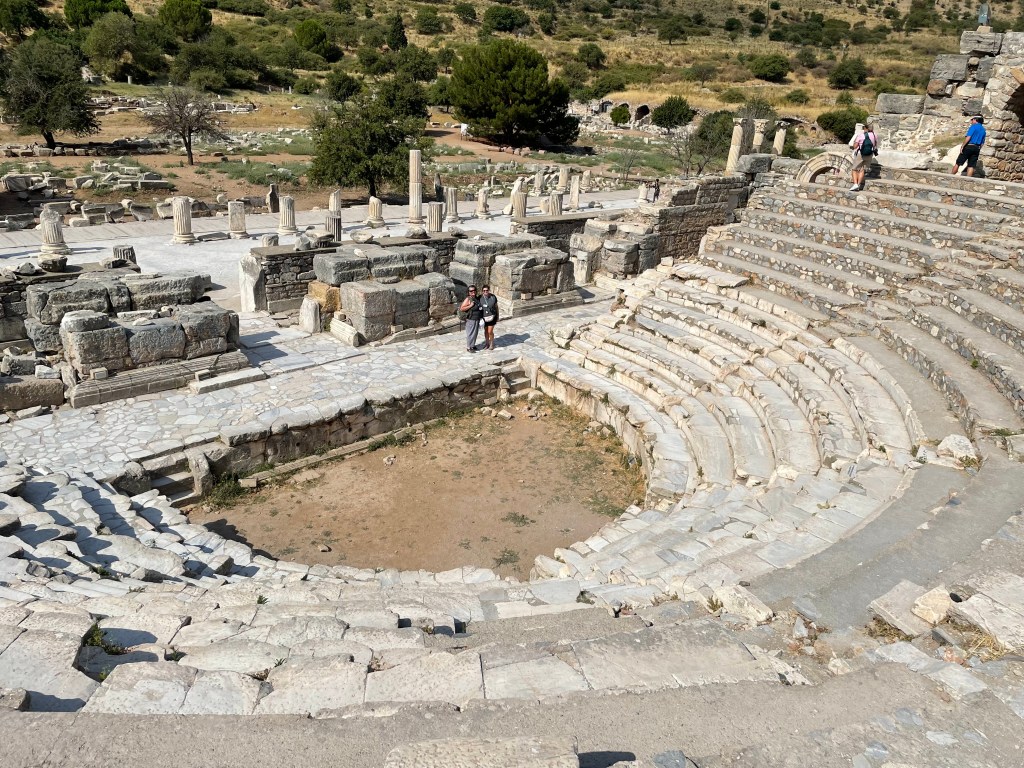
Was it the message where Paul emphasized the Messiah’s sacrificial death for sinners that led to his dismissal? Or maybe it was Paul’s clear teaching on Jesus being not merely a man but the divine Savior from Heaven that led to the Jews’ collective response of “Thanks, but no thanks.” It’s often been said that when God closes one door, He is opening another. And in that very sense, the Jewish Paul found a new opportunity to preach the gospel in a secular setting known as “the lecture hall of Tyrannus” (Acts 19:9). When I visited Turkey (called “Asia” in the Bible) recently, our guide led us to a small theater in Ephesus that is thought to perhaps be this very hall of Tyrannus.

Odeion Theater, possibly the Hall of Tyrannus (Acts 19:9).

It was here that, for two solid years, the apostle’s ministry was so fruitful that the historian Luke could say that “all the Jews and Greeks who lived in the province of Asia heard the word of the Lord” and that “the name of the Lord Jesus was held in high honor” (Acts 19:10, 17).[2] In fact, many of the Ephesians who formerly practiced sorcery decided to hold an open bonfire where they burned all their incantation scrolls out of their newfound devotion to Christ. These former magicians had found something in Jesus that magic could never deliver. Eternal hope. Total forgiveness. Unconditional love. Peace with God.

These Ephesian Christians were passionately in love with Jesus.

With such a soul harvest, it’s no wonder Paul stayed there for over two years. Luke goes on to tell us something truly remarkable. So many Ephesians had turned from mute idols to the living Lord that a local silversmith named Demetrius complained to his fellow tradesmen that his idol business was tanking. Most notably, these craftsmen’s livelihood was based on selling silver shrines to the Greek goddess Artemis.

The Temple of Artemis stood proudly just outside the city center of Ephesus. Today, it is little more than a heap of rubble, but in the first century, it was one impressive spectacle – one of the Seven Wonders of the Ancient World, no less.[3] For nearly 400 years, Artemis and her temple were the Ephesians’ pride and joy, and they viewed themselves as the guardians protecting her honor.

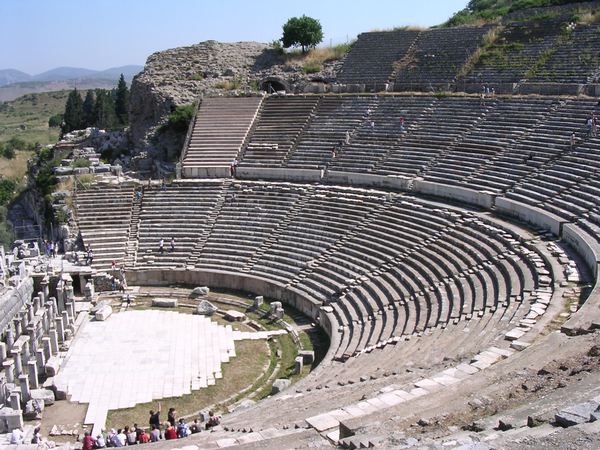
So volatile was the opposition to the gospel Paul preached that a riot broke out in the city’s massive arena (still standing today). The crowd mindlessly chanted for two hours: “Great is Artemis of the Ephesians!” Luke humorously records: “The assembly was in confusion: Some were shouting one thing, some another. Most of the people did not even know why they were there” (v. 32). So much for the wisdom of crowds.

That the message of a crucified and risen Messiah could provoke such a startling reaction in a major city like Ephesus is astounding. It signals the transforming power of the gospel. Hearts once enslaved to idolatry now burned hot for Jesus.

Reigniting Your Love for Jesus

When Jesus addressed this same Ephesian church some 40 years later, that love had grown cold. It’s worth noting that they had sound theology, were quick to spot false teachers, and lived moral lives (Revelation 2:2-3). Outwardly, this church seemed to have it all together, even in the midst of the cultural pushback they’d known since the church’s inception.

Despite all this, their love for Jesus had cooled from a glowing blaze to dying embers. This is a reminder to us that Jesus cares about more than outward performance. “For the Lord sees not as man sees: man looks on the outward appearance, but the Lord looks on the heart” (1 Samuel 16:7). While Jesus commends faithfulness, our Lord is far more concerned with our relationship with Him.

Perhaps you can relate to the Ephesian church. You’ve stayed the course in so many areas of your life. You haven’t indulged in gross immorality. You could stand up to any test of biblical orthodoxy and right beliefs. But there’s something vital missing.

The passion for Christ you once felt so keenly has slowly ebbed away. You serve faithfully in your church, but you often wonder why more aren’t like you. The joy you once had at knowing your sins were forgiven has been replaced by an undercurrent of bitterness and jealousy toward others.

I want to suggest that the way to rekindle the love you once felt so deeply for Jesus is to come back to the simple message of the cross. Jesus tells the Ephesians, “Repent and do the things you did at first. If you do not repent, I will come to you and remove your lampstand from its place” (Revelation 2:5). Repentance is not just for unbelievers. Christians need to repent, too. 

Repentance is about acknowledging how you have offended the Lord and then turning to His shed blood on the cross as your only hope. Remember how just the thought of Jesus choosing to love you in spite of your great sinfulness used to ignite your love for Him? In the same way, contemplating His deep love for you will reignite your love for Him.

“This is love: not that we loved God, but that he loved us and sent his Son as an atoning sacrifice for our sins… We love because he first loved us.” (1 John 4:10, 19, NIV)

Have thoughts on this post? Feel free to comment below!


[1] See Acts 19:8-9

[2] Though not explicitly named as the author in Acts, “the beloved physician Luke” (Colossians 4:14) is widely regarded by scholars as the author of both the Gospel of Luke and the Book of Acts.

[3] When listing the Seven Wonders of the Ancient World, Antipater of Sidon had this to say about the Temple of Artemis: “I have set eyes on the wall of lofty Babylon on which is a road for chariots, and the statue of Zeus by the Alpheus, and the hanging gardens, and the colossus of the Sun, and the huge labour of the high pyramids, and the vast tomb of Mausolus; but when I saw the house of Artemis that mounted to the clouds, those other marvels lost their brilliancy, and I said, ‘Lo, apart from Olympus, the Sun never looked on aught so grand.’” Antipater, Greek Anthology IX.58.

Called to Be Distinct

The Bible describes Christians as citizens of Heaven who are called to live as exiles in the world. To belong to Jesus is to belong to another world. This world – in its fallen state – is not our home. To live as an exile means you’re living between two worlds – the world you are currently enmeshed in and the world to come, where you truly belong. At its heart, this world is hostile to God.

One of the ways the world expresses its hostility is trying to squeeze us into its mold. That is why believers continually face the pressure to adopt the values, beliefs, and lifestyles of this world. Jesus said He wanted His followers to be set apart in the truth of His Word (John 17:17), but a full-orbed biblical worldview is increasingly scorned in our culture.

Do not be conformed to this world, but be transformed by the renewal of your mind, that by testing you may discern what is the will of God, what is good and acceptable and perfect. (Romans 12:2, ESV)

Christians must choose daily to either live for this world, adopting its values and belief structure, or live for the glory of God, which will one day be fully known on this planet.

“For the earth will be filled with the knowledge of the glory of the LORD as the waters cover the sea.” (Habakkuk 2:14, ESV)

So we ask the question: How do you follow God in a world that is at odds with Him?

Know the Truth

Daniel knew what it means to be an exile. Imagine being dragged from your home while your city is under assault, and then taken to a faraway land where you are far from your family, your place of worship, and everything you have ever known. That is what happened to the young man named Daniel, and his three friends, Hananiah, Mishael, and Azariah, when they were rounded up in Jerusalem and taken to the great city of Babylon.[1] These teenagers were handpicked because they were handsome and intelligent, fit to serve in the king’s court.

King Nebuchadnezzar commanded Ashpenaz, his chief eunuch, “to teach them the language and literature of the Babylonians” (Daniel 1:4, NIV). Although their given names reflected Yahweh, the God of Israel and Creator of the world, Ashpenaz gave them new names that reflected the gods of Babylon. All of this was done to indoctrinate these young men in the worldview of Babylon. If they were going to serve in the palace, they needed to think like Babylonians.

But throughout this book, the author continues to refer to himself as Daniel, which means “God is my judge.” That is significant. It tells us that, despite being educated and enmeshed in the Babylonian culture, Daniel recognized from the beginning that he is accountable to only one God: Yahweh. The Babylonian gods didn’t own him, so he refused to identify with them. While he would be a loyal subject of the king, he ultimately served the God of Israel – even as an exile hundreds of miles from Israel.

Daniel knew the truth about who was really in charge of this world, and he based his entire life on that. After all, what could matter more than serving the very One who gave you life, breath, and everything else (Acts 17:25)?

Resolve to Be Different

Along with being educated in the Babylonian culture, Daniel and his friends were given plates filled with the sumptuous food and fine wine of the king. However, they refused to eat it. I can imagine the four teenagers sitting at the table with the delicious aroma wafting into their nostrils. But then they gave each other a knowing look and set their forks back on the table.

“But Daniel resolved that he would not defile himself with the king’s food, or with the wine that he drank.” (Daniel 1:8, ESV)

These young men knew the truth of their Scriptures, which under the old covenant at that time included certain dietary restrictions. While we don’t know for sure what made the food defiling, it’s reasonable to conclude that eating it would violate their scriptural convictions.

I’m sure many objections arose in their minds. Why should we refuse the food they give us here? After all, it’s just food. What’s the big deal anyway? We’re not in Israel anymore. And do we really want to insult the king who generously offered this delicious food?

Perhaps they had an Eve moment when they looked at the forbidden food and weighed all the advantages of taking one bite of the delicious morsels (see Genesis 3:6). We should appreciate how difficult this decision must have been for them; they were prone to temptation like the rest of us. And taking a stand here could be costly.

But these were young men of conviction – a trait all too rare in the church today. They had already decided they were not going to cut corners or compromise their beliefs. They were firmly rooted in the Bible, and they knew in their hearts they were called to be distinct from the world around them.

What about you? What are some convictions you hold that no amount of cultural pressure can squeeze out of you? Have you already resolved to be different from the world?

Peacefully Resist Conformity

When Daniel politely refuses to eat the king’s food, the chief eunuch Ashpenaz is agitated. He knows that if those under his tutelage reject their assigned portions, he could lose his head (Daniel 1:10)!

But I love Daniel’s response. Rather than belittle Ashpenaz or the king, he seeks a peaceful and reasonable solution.

Daniel says, “Test your servants for ten days; let us be given vegetables to eat and water to drink. Then let our appearance and the appearance of the youths who eat the king’s food be observed by you, and deal with your servants according to what you see” (v. 12).

In essence, Daniel is saying, “Let’s see if we can find a solution that works in both our favors. You need us to be strong and healthy, and we need to live by our convictions. Let’s put our convictions to the test and see if they hold up.”

Instead of acting in self-righteous anger or defiance, Daniel humbly asks Ashpenaz to weigh the evidence. Daniel’s working assumption is that it’s always better to obey God than disobey, despite how foolish it may appear to others. Ashpenaz agrees to his terms, and God honors their obedience by giving them greater health than the other youths (v. 15).

In reading this passage, I have wondered why it only mentions Daniel and his three friends taking a stand. What about all the other young Jews enlisted to serve in the palace? Did they all fold under pressure? It seems likely they did.

This is supported by Daniel’s statement: “As for these four youths, God gave them learning and skill in all literature and wisdom, and Daniel had understanding in all visions and dreams” (v. 17, my emphasis).

How interesting that God honored the faithful obedience of these four young men in ways they hadn’t imagined. They were faithful over something seemingly small here, but God took notice. It is no accident that Daniel and his friends are given opportunities to stand for Yahweh in far more prominent ways later. As it turns out, faithfulness in the small things matters because it’s a reflection of your faithfulness in the big things.

Let’s ask God to give us the courage of conviction to refuse to compromise in either the small or big things in life. Christians are called to be distinct.

Have thoughts on this post? Feel free to comment below


[1] This true story is recounted in the biblical Book of Daniel, chapter 1.

Photo courtesy of kadingirra.com

How Do I Know if I’m Struggling with Pride?

“To fear the LORD is to hate evil; I hate pride and arrogance, evil behavior and perverse speech.” (Proverbs 8:13, NIV)

Pride. It never looks good on anyone. If you trace every sin back to its root, you almost certainly will find pride lurking in the shadows. In the biblical sense, pride is an inflated view of oneself, especially with respect to God or others. Scripture urges us, “Do not think of yourself more highly than you ought, but rather think of yourself with sober judgment, in accordance with the faith God has distributed to each of you” (Romans 12:3, NIV).

The biblical Book of Daniel has much to teach us on the problem of pride: why it is an affront to God, and how we can both identify it and avoid it in our lives. Daniel provides three indications that you are struggling with pride:

  1. When you don’t have time to pray.
  2. When you have a low view of divine providence.
  3. When you think lightly of sin.

The Deception of Pride

Pride is subtle, because it is so hard to notice in ourselves. We have no problem noticing it in others. Sometimes, it can even seem glaringly obvious in someone else. By its very nature, pride convinces us that we don’t struggle with it.

C. S. Lewis calls pride “the great sin” and “the utmost evil.” Lewis stresses how deceptive pride can be:

“There is no fault which makes a man more unpopular, and no fault which we are more unconscious of in ourselves. And the more we have it ourselves, the more we dislike it in others.”[1]

In the book of Daniel, we learn about the proud King Nebuchadnezzar, who was repeatedly warned about the limitations of his kingdom. Throughout this fascinating book, the looming question is “Who’s really in charge here – Nebuchadnezzar or the God of Israel?”

At the beginning of the book, Nebuchadnezzar has just begun his conquest of Jerusalem, the capital of Israel, God’s chosen nation. To the Babylonian king, his victory over Israel might have been all the proof needed that Yahweh, the God of Israel, was defeated. But Daniel provides a theological understanding to what really happened when Jerusalem fell to Nebuchadnezzar: “And the Lord gave Jehoiakim king of Judah into his hand, with some of the vessels of the house of God” (Daniel 1:2, ESV).

While Nebuchadnezzar might have supposed that Jerusalem fell simply because of his great might and military strategy, Daniel is cluing us in to what’s really going on. God gave Jerusalem into Nebuchadnezzar’s hand, because He was judging the nation for their unrepentant sin and idolatry (Jeremiah 20:3-18; 21:1-11; 22:11-30).

One of the lessons of Daniel is that pride blinds us to our own insecurities. We see this when Nebuchadnezzar compels his officials to bow down to a golden image soon after being told in a dream that his great empire will not last forever (Daniel 3).

Toward the end of his reign, Nebuchadnezzar looks across his mighty empire and boasts, “Is not this great Babylon, which I have built by my might power as a royal residence and for the glory of my majesty?” (Daniel 4:30). In that very moment, God humbles this proud man by making him insane and driving him away from his palace to live among beasts for seven years.

Nebuchadnezzar experienced the hard truth of Proverbs 16:18: “Pride goes before destruction, and a haughty spirit before a fall.”

When You Don’t Have Time to Pray

Daniel is the polar opposite of King Nebuchadnezzar in almost every way. Rather than having an inflated view of himself, Daniel consistently exhibits an exalted view of the one true God and a sober view of himself. Rather than claiming he possesses wisdom and power, Daniel says, “Praise be to the name of God for ever and ever; wisdom and power are his” (Daniel 2:20, NIV).

With such a high view of God, Daniel cannot afford not to pray. In fact, Daniel is repeatedly found on his knees throughout this book. In one famous passage, King Darius is inveigled into signing a decree forbidding anyone to pray to anyone but him; those who violate this injunction will have to spend the night with some hungry lions. Of course, this decree is part of a ploy by some jealous officials bent on annihilating Daniel, who now outranks them.

Ironically, the only so-called “flaw” they can find in Daniel is that he consistently and without fail was found on his knees in prayer (Daniel 6:5).

When God grants Daniel the ability to interpret Nebuchadnezzar’s dreams, he doesn’t take credit for this gift. “But as for me, this mystery has been revealed to me, not because of any wisdom that I have more than all the living, but in order that the interpretation may be made known to the king” (2:30).

In one of his prayers, Daniel recognizes that God “removes kings and sets up kings; he gives wisdom to the wise and knowledge to those who have understanding” (2:21).

It’s no accident that a humble man like Daniel had a well-honed prayer life. It’s hard to be proud when you’re on your knees before God. One sure sign that you are struggling with pride is that you rarely express dependence on God through prayer.

Like Daniel, we live in a culture that is hostile to faith in God. Since we are surrounded by secularism, it’s very easy for us to forget the power of prayer or wonder if it’s worth our time. After all, life is busy. But we can learn something from this man who lived some 26 centuries ago. Even when Daniel was a busy executive, he made sure to carve out three times each day for prayer (6:10).

When You Have a Low View of Divine Providence

The Book of Daniel especially highlights the way pride flies in the face of divine providence. Coupled with the need for communion with God through prayer is a high view of God’s sovereign direction of history.

What is tragically lacking among many moderns is a radically God-centered view of all reality. By “God-centered view” I mean a recognition that all reality is in the palm of God’s hand. His purpose in the world is what will ultimately hold sway.

“Many are the plans in the mind of a man, but it is the purpose of the LORD that will stand.” (Proverbs 19:21, ESV)

Christians need to reclaim the truth that all things exist by God’s creative power and are sustained in existence for His glory alone (Romans 11:36).

After being forced to live like a beast for seven years, Nebuchadnezzar finally lifts his eyes to heaven and only then does his reason return to him (Daniel 4:34). Nebuchadnezzar had previously grown proud, looking down on everyone else. To humble him, God gave him the mind of a beast (4:16), as if to demonstrate that a failure to acknowledge God makes you like a beast. It’s only when he lifts his face from the grass he’s been eating to gaze at the heavens above that a sound mind returns.

Nebuchadnezzar had to learn the hard way that God is the one in charge of history. He sets up kings and kingdoms. He determines where and when you live (Acts 17:26). We only have breath in our lungs as long as God supplies it, and He foreordained the date of our death (Acts 17:25; Psalm 139:16).

“A person’s days are determined; you have decreed the number of his months and have set limits he cannot exceed.” (Job 14:5, NIV)

When King Nebuchadnezzar recognized the folly of his former boasting, he now chose to praise the one true God who is sovereign over all:

His dominion is an eternal dominion;
    his kingdom endures from generation to generation.
All the peoples of the earth
    are regarded as nothing.
He does as he pleases
    with the powers of heaven
    and the peoples of the earth.
No one can hold back his hand
    or say to him: “What have you done?” (Daniel 4:34-35, NIV)

Having learned this lesson well, the king declared to all his kingdom: “Now I, Nebuchadnezzar, praise and exalt and glorify the King of heaven, because everything he does is right and all his ways are just. And those who walk in pride he is able to humble” (v. 37).

When You Think Lightly of Sin

In addition to not having time for prayer or having a small view of God’s providence, the Book of Daniel teaches us that pride manifests itself when we think lightly of sin. The Bible teaches that sin is rebellion against the King of heaven that Nebuchadnezzar spoke about. It’s choosing our own way and opposing God’s way.

Sin is so grievous because we were made for fellowship with our Creator, but sin separates us from His holy presence. When we tell ourselves that sin is not a big deal, we are sowing lies that will reap destruction. Small thoughts of God and His holiness are the devil’s playground. When we think lightly of sin, we play right into his hands.

That’s what happened to Belshazzar, Nebuchadnezzar’s successor. Although he had learned about how his predecessor needed to be humbled, he chose to not heed the warning (Daniel 4:22-23). He too lifted himself “against the Lord of heaven” and threw a party where he, his friends, his wives, and his concubines all drank from the sacred vessels that Nebuchadnezzar took from the Jerusalem Temple. Not only did they defile the vessels intended for worship of God, but they began worshiping the Babylonian gods in their drunkenness.

It was some party, I’m sure. That is, until God showed up. The music stopped when a massive hand suddenly appeared, writing a message on the wall of the palace: “Mene, Mene, Tekel, and Parsin” (Daniel 5:25). Daniel gives us a humorous picture of Belshazzar’s reaction.

“His face turned pale and he was so frightened that his legs became weak and his knees were knocking.” (Daniel 5:6, NIV)

When Daniel is summoned, he interprets the message to mean that the king’s days had been numbered, he had been weighed and found wanting, and his kingdom would soon be taken away and given to the Medes and Persians. Sure enough, this is precisely what happened, and Belshazzar was killed that very night (v. 30).

This passage is a good reminder for us today. Sin is still a big deal, and God still judges sin. God weighs the heart and we can be sure that no sin escapes His notice (Hebrews 4:13).

While Belshazzar thought lightly of the sin he committed, we again see the godly contrast in Daniel. When Daniel humbly prays to God in Daniel 9, he begins by acknowledging God’s greatness and love. He then confesses his sin.

“…we have sinned and done wrong. We have been wicked and have rebelled; we have turned away from your commands and laws.” (Daniel 9:5, NIV)

Although Daniel lived a faithful life, he doesn’t pretend he doesn’t have his own sin to confess. Rather than merely talking about Israel’s sin, he includes himself among those who have more obviously turned from God.

That’s the attitude we need to have before our holy God. Not merely, “Lord, this nation has sinned,” but, “Lord, we have sinned.”

When we confess the sin of pride, we are sure to find grace and forgiveness through the saving sacrifice of Jesus Christ.

“If we confess our sins, he is faithful and just to forgive us our sins and to cleanse us from all unrighteousness.” (1 John 1:9, ESV)

That gives great hope for those of us who struggle with the sin of pride.

Have thoughts on this post? Feel free to comment below.


[1] C. S. Lewis, Mere Christianity, 121.

Why Honoring Parents Still Matters

The family is the basic unit of society. Our family background and experiences inevitably shape the way we view the world, for good or ill. Most of us love our parents dearly and owe them more than we know for helping us become the people we are today. Others at times have wished their parents had done many things differently. Still others have wished they had different parents.

If you have a hard-working, courteous and honest employee, there’s a good chance his parents had something to do with that. In God’s design, parents are intended to be the greatest human influences in a person’s life. By and large, worldviews, values, and beliefs are forged in the home.

It’s no wonder that when a winning athlete has a microphone shoved in her face she nearly always seizes the opportunity to thank her parents for helping her become the person she is today. Like it or not, God set up His world in such a way that parents have a major impact. In countless ways, you are unavoidably a product of your upbringing. Even the absentee parent greatly affects the child in ways they could not have dreamed.

Divinely Appointed Representatives

The way that one relates to other people, particularly those in authority, is shaped by the relationship they had with their parents at home. This extends to how one tends to perceive God. Of course, many parents may think this level of influence amounts to an impossible responsibility. But if considering all this gives parenting greater weightiness, that’s actually a good thing. Whether you are a dad or a mom, your children (no matter their age) need you desperately, and your God-given role is indispensable. Many parents only wish they had stopped to consider the significance of their role before their children moved out.

Nevertheless, God has granted parents the awesome privilege of representing Him to their children. Parents are a tangible and visible representation of the authority that is ultimately His. It’s no wonder that God often compares Himself to a devoted parent in Scripture.

“Can a mother forget the baby at her breast and have no compassion on the child she has borne? Though she may forget, I will not forget you!” (Isaiah 49:15, NIV)
“As a father has compassion on his children, so the Lord has compassion on those who fear him.” (Psalm 103:13, NIV)

When God gave the Big Ten for His people to live by, He included this one as the fifth commandment:

“Honor your father and your mother, so that you may live long in the land the Lord your God is giving you.” (Exodus 20:12, NIV)

To honor one’s father and mother is to express respect, obedience, and gratitude to them. Since parents represent divine authority in the home, the way a child relates to their parents is a reliable indicator of how they will relate to God. A father, in particular, tends to have a powerful influence on how children view God the Father. A mother’s influence is equally important, but is usually impactful in different ways.

Many adults can testify how their father dramatically shaped the way they imagined God. Some even struggle with the very concept that God is called “Father.” I would argue this extends beyond individual families. Societies that have a low view of fathers will also have a low view of God.

Paul Vitz has argued that there is a direct correlation between atheism and growing up with an absentee or abusive father. In his book, Faith of the Fatherless, Vitz turns Freud’s “projection theory” of religion on its head, showing that it is actually having a “defective father” that often predisposes one to atheism.[1]

The Child’s Calling to Obey Parents

So what does it mean to honor one’s parents? First and foremost, it means children are to obey their parents. “Children, obey your parents in the Lord, for this is right” (Ephesians 6:1, NIV). Children must be taught to recognize their parents are their God-given authority.

Some think of “authority” as a bad word, but when it describes the authoritative structures that fill out God’s design for the human race, it is most certainly a good authority. If we never respect our parents’ authority, there is little chance we will respect any authority.

It is significant that God has vested parents, not government, with the responsibility of raising children. Kevin DeYoung remarks, “It is no wonder that when totalitarian regimes throughout history have tried to exert control over people, one of the chief mechanisms by which they’ve done so is severing that attachment to the family – making allegiance to the state the building block of society rather than the honoring of parents.”[2] It’s not an overstatement to say that if you want to destroy a nation, step one is to destroy the family by subverting the authority of parents.

But it is to parents that God says, “Train up a child in the way he should go, and when he is old he will not depart from it” (Proverbs 22:6, NKJV). You can’t very well learn character traits like honesty and self-control without someone modeling that in flesh and blood in the home.

Unfortunately, it’s become all too common for this basic authority of parents in the home to be scoffed and sneered at. Many parents casually talk about teenagers going through the “rebellious years.” The cover of one magazine for teenage girls asked, “Do you really hate your parents? Like, who doesn’t?” The magazine then offered advice on how to deal with the “detestables.” All you have to do is consult what the Law of God said about what to do with “rebellious teens,” and you’ll have an idea of how much God despises such an attitude (Deuteronomy 21:18-21; Leviticus 20:9).

When Edward, Duke of Windsor, was asked what caught his attention about the United States, he curtly replied, “The way parents obey their children.”  

The Book of Proverbs has the format of a father teaching his son the basic wisdom for living a righteous life in God’s world. There is a wealth of wisdom to be gleaned from this book. The son is taught to be hard-working, honest in all his dealings, and mindful of how he uses his tongue. Undergirding all this wisdom is a fundamental fear or reverence for God and respect for parents as the two greatest authorities in one’s life (Proverbs 1:7-8; 6:20; 9:10).

“A wise son hears his father’s instruction, but a scoffer does not listen to rebuke.” (Proverbs 13:1, ESV)

The same basic principle of the fifth commandment is borne out in a hundred different contexts in Proverbs. The basic teaching is that when you live by wisdom, you honor your parents, and “your days may be long in the land that the LORD your God is giving you” (Exodus 20:12, ESV).

While we should honor our parents simply because God commands us to do so, I love that God is willing to unfold for us all the ways that life will be blessed through honoring parents. In other words, when you honor your father and mother, life will generally go well for you! You can expect to live a full life and have the kind of character people want to be around (Proverbs 2:21-22; 3:1-2; 9:11; 10:27; 11:12; 13:3, 15; 15:18).

God Wants Me to Honor Them?

In some instances, honoring one’s parents may seem like a terrible idea. Many have only dark memories of their father or mother, and the pain has left an emotional hole in their heart. The last thing their parents deserve is honor, they think. And there is an important sense in which they are absolutely right.

I recently heard about a young woman whose father was an alcoholic throughout her life. There was very little commendable about his character. At her wedding ceremony, her father arrived drunk. Seeing him behave so thoughtlessly on this day of days pained the young woman, but she consciously chose to forgive him in the moment.

Yes, sometimes the best way we can honor our parents is to forgive them for the ways they have wronged us. In no way do I want to minimize the pain a parent may have caused you. I think of the daughter who clings tightly to the grudge against her abusive father, or of the son who can only recall the way his mother ran him down with relentless criticism. But true healing can happen when you forgive those who have hurt you the most. Nothing can change what happened, but you can decide to follow in the footsteps of Jesus, who forgave even those who were mocking Him while He hung from the cross (Luke 23:34). If you don’t have a relationship with your mom or dad, I would urge you to do all you can to reconnect with them.

We are called to honor our parents, not because of how well they did or did not raise us, but because the God-ordained roles of father and mother are intrinsically honorable. If children never honored their parents and only rebelled, our world would be much darker than it already is. Your parents may not deserve honor, but honor is still due them. That’s why the fifth commandment plainly says, “Honor your father and mother.” Period. There is no exception clause like “but only if they live honorably.”

What about those who want a relationship with their father or mother, but the parent has closed off all communication? God wants us to know that He will be the Father we need if our earthly parents abandoned us. “For my father and my mother have forsaken me, but the LORD will take me in” (Psalm 27:10, ESV).

Ultimately, God is the Father and the church is the family we all most need. But God promises us greater fulfillment in life when we learn to honor our parents.

Have thoughts on this post? Share in the comments below!


[1] Paul Vitz, Faith of the Fatherless. To be clear, Vitz does not argue that someone is psychologically determined to reject God. Each one of us is responsible for the decisions we make, to follow or reject God, but his argument is that there are psychological factors that frequently contribute to atheism.

[2] Kevin DeYoung, The Ten Commandments, 81.

Photo from Getty Images

Can We Have Assurance of Salvation?

By Jason Smith

One of the most common questions Christians have is: “How can I be sure that I’m really saved? How can I know?”

And often this question is not even verbalized, but it’s a doubt that can weigh on a believer’s heart for a long time, sometimes for years. Or it can come and go.

One of the devil’s chief goals is to steal the Christian’s assurance. He wants us to be living in constant doubt. He wants us to be constantly plagued by the thought, Maybe I’m not really saved. But God wants genuine believers to have assurance of salvation.

A good father would never want his children to always be plagued by doubt on whether they really belong to him. And that is God’s heart, too.

What Does Assurance Look Like?

A merchant ship once came across a fierce storm while crossing the Atlantic Ocean. One sailor clutched his seat with white knuckles while massive waves rocked the massive vessel. He cried out to his shipmate, “We’re going to sink!” The other man shook his head. “I’ve been aboard this ship through many storms.” With calm confidence, he added, “She’ll take us safely to harbor.”

What was the difference between the two men? Both were facing a massive storm at sea, but only one had assurance they would make it home safely. The difference was not in their self-confidence, but in how much confidence they had in the ship.

This illustration helps us see that our assurance of salvation will depend on what we know about the object of our faith. We will be assured of a great salvation only if we know we have a great Savior.

Run to the Blood

In the book of Revelation, John records an apocalyptic scene where the dragon – who is the devil – is thrown down to earth in the midst of a cosmic war.

And I heard a loud voice in heaven, saying, “Now the salvation and the power and the kingdom of our God and the authority of his Christ have come, for the accuser of our brothers has been thrown down, who accuses them day and night before our God.” (Revelation 12:10, ESV)

Satan is an accuser. He is constantly trying to shake our faith. He’s constantly trying to steal our assurance of salvation. So what does he do? He accuses us over and over, day and night. Satan says, “Look, how you’ve failed God. Do you really think you could belong to a holy God?” Satan keeps a constant ledger to accuse us and steal our confidence.

So what do the Christians do when these accusations come? It says:

“And they have conquered him by the blood of the Lamb and by the word of their testimony, for they loved not their lives even unto death.” (Revelation 12:11, ESV)

When in the midst of life’s trials, your faith is shaken and you begin to doubt your own salvation, the most important thing is not to first look at your own life. It is to run to the blood of the Lamb. It is to claim the promises of the gospel.

Martin Luther discussed times when the devil seemed to fixate on a single sin from his past in order to torment his conscience and steal his assurance. Luther urged his readers not to disagree with the devil that they had broken the Law, but to instead point the devil to the crucified Savior who already bore the Law’s condemnation in their place.[1]

So many Christians have come to believe that they can lose their salvation if they go one step too far. If they fail God one time too many, then all is lost. Or many people have been taught that if they die with unconfessed sins, they’ll be lost forever.

One church with this confusing theology had a weekly ritual where the town drunk got saved every Sunday morning and then was drunk every Sunday evening. One day the pastor said to him, “Next Sunday we ought to shoot you right after you get saved!” He was joking, of course, but you can see where this whole theology leads. Salvation is seen as something you’re constantly dipping into and out of, like a kid that can’t decide if he wants to be in the swimming pool. On this view, everything depends on your daily moral performance. But, friend, salvation is not like that.

Let me just tell you clearly: Salvation is about being born again. Do you think you can undo the new birth?

“Therefore, if anyone is in Christ, the new creation has come: The old has gone, the new is here!” (2 Corinthians 5:17, NIV)

The Bible says, that when the Holy Spirit comes into our hearts at salvation, from that point forward we are “sealed for the day of redemption” (Ephesians 4:30). Picture an envelope sent from earth that is guaranteed to arrive in heaven. When God seals something, it cannot be undone!

If your good works didn’t have anything to do with getting you saved, then they don’t have anything to do with keeping you saved.

What about spiritual fruit?

Someone might think, Now, wait a minute. Shouldn’t we look for spiritual fruit for confirmation that we’re saved? That’s true, and we don’t want people who have not given their lives to Jesus to have a false assurance that they are saved while living like the rest of the world.

Here is something that I think will be helpful: There is a massive difference between a driving source of assurance and a confirming source of assurance.

Consider what Jesus said:

“Very truly I tell you, whoever hears my word and believes him who sent me has eternal life and will not be judged but has crossed over from death to life.” (John 5:24, NIV)

Notice that eternal life is a present possession for the believer. They “will not be judged,” because they have crossed over from spiritual death to life in Christ.

When you’re looking for assurance of salvation, the first and foremost thing you must turn to is the gospel itself, which is the driving source of assurance.

Driving source of assurance (the Gospel): The promise of forgiveness and eternal life for all who trust in Jesus Christ.

Confirming source of assurance (spiritual fruit): Evidence of Christ’s moral transformation in your life.[2]

You don’t turn to evidence of moral change as the primary source of assurance. It’s an important fruit of spiritual life, but not the root of assurance.

Think of it this way. The gospel is like the accelerator in your car. When you press on that pedal, that’s what drives the car forward. Good works are like the speedometer. They are indicators that you’re saved, but they are not to be the driving source of assurance.

Kept by Jesus, for Jesus

Consider what Jude says to those who might be struggling with doubts about salvation:

“Now to him who is able to keep you from stumbling and to present you blameless before the presence of his glory with great joy, to the only God, our Savior, through Jesus Christ our Lord, be glory, majesty, dominion, and authority, before all time and now and forever. Amen.” (Jude 24-25, ESV)

Who keeps you from ultimately stumbling? God. Who presents you blameless before the presence of His glory? God. Your salvation is in His hands, not yours. It always was and always will be.

Instead of me trying to convince you that no one who is genuinely saved can lose their salvation, let’s look at promises from Scripture.

You are not lacking in any gift, as you wait for the revealing of our Lord Jesus Christ, who will sustain you to the end, guiltless in the day of our Lord Jesus Christ. (1 Corinthians 1:7b-8, ESV)
And I am sure of this, that he who began a good work in you will bring it to completion at the day of Jesus Christ. (Philippians 1:6, ESV)

And this next one is the words of Jesus, recorded in John 6. Listen to how all-encompassing this promise is.

“All those the Father gives me will come to me, and whoever comes to me I will never drive away. For I have come down from heaven not to do my will but to do the will of him who sent me. And this is the will of him who sent me, that I shall lose none of all those he has given me, but raise them up at the last day. For my Father’s will is that everyone who looks to the Son and believes in him shall have eternal life, and I will raise them up at the last day.” (John 6:37-40, NIV)

Not only does Jesus say He will never drive away any who come to Him, but He says He won’t lose a single one of those the Father gave Him. So, the logic works like this. All the Father gives to Jesus come to Jesus. All who come to Jesus will be kept by Jesus. All who are kept by Jesus have eternal life.

The Golden Chain of Redemption

If all those promises from our Lord were not enough, we could still turn to Romans 8:29-30, a passage often called “the Golden Chain of Redemption.”

“For those whom he foreknew he also predestined to be conformed to the image of his Son, in order that he might be the firstborn among many brothers. And those whom he predestined he also called, and those whom he called he also justified, and those whom he justified he also glorified.” (Romans 8:29-30, ESV)

Some Christians balk at the whole idea of predestination. But frankly, this and many other passages would have to be ignored to dismiss the idea of predestination. It is a word meant to give Christians a humble assurance of their final salvation.

Notice, especially in verse 30 that there doesn’t seem to be room for any to fall away from salvation. It’s not as though you can be predestined, called, and justified, but somehow miss out on being glorified. Each link in the chain is connected to the next, creating an indestructible chain of security that stretches all the way back to eternity.

It is fascinating that Paul uses the past tense when he says “those whom he justified he also glorified,” as though our future glory has already taken place (v. 30). We would expect him to use the future tense (“will be glorified”), because this will happen at Christ’s return. So how can Paul say this? Because in God’s eyes it is as certain as something that already happened.

Super Bowl XLVIII was expected to be a tough battle between the Seahawks and the Broncos. Going into the game, no one imagined Russell Wilson would lead his team to a blowout victory over the superstar Peyton Manning and his Broncos. When the Seahawks led 43-8 with two minutes remaining in the game, Seahawks fans confidently declared, “We won! We won!” Although the game was not yet over, victory was certain. In the same way, because our victory in Christ is so certain, Paul can speak of it in the past tense.

These promises are meant to give the believer confidence. Assurance of salvation is the birthright of those who are born again.

But even if you were to say to me after all these promises, “Jason, I still don’t know. It seems like people can lose their salvation. I know people who have left the faith.” Here’s what I would say: The Bible does talk about those who fall away, but it never says those who have saving faith in Jesus ever fall away.

Are there any examples of someone who lived among the community of the faithful and later fell away? Judas Iscariot was one of the twelve disciples Jesus chose to travel with Him. But Jesus called Judas “one doomed to destruction” and said it would be better for Judas “if he had not been born” (John 17:12; Matthew 26:24). So, yes, there are examples of those who appear to love and follow Jesus and then fall away. But that’s not the same as those who are truly saved by trusting in Jesus. This is a sober reminder that you can trust in a pastor, priest, church, or even set of doctrines, but not actually be trusting in Jesus.

Over and over, the Scriptures proclaim this promise: If you are saved by Jesus, you are kept by Jesus and for Jesus.

To those who are called, beloved in God the Father and kept for Jesus Christ. (Jude 1, ESV)

Notice, it doesn’t say we keep ourselves saved. It’s a passive term. We are kept for Jesus.

Mustard Seed Faith

Our tendency is to look primarily at ourselves and consider whether we have done enough for God, to see whether we really belong to Jesus. But while self-examination has its place, the Bible doesn’t encourage us to look inwardly for assurance. We are called to trust in Christ alone for salvation, resting everything on His work through the cross and resurrection.

Even passages that don’t mention faith, like Romans 8:29-30, don’t negate the necessity of faith in Christ for salvation. The Bible is crystal clear that salvation comes through faith in the risen Lord.

“If you confess with your mouth that Jesus is Lord and believe in your heart that God raised him from the dead, you will be saved.” (Romans 10:9, ESV)

One thing people often do is they think: Yes, I have faith in Jesus, but is my faith strong enough to save? But this kind of thinking can end up turning faith into a work. You can think, I just need to muster up enough faith for God to accept me. But if you’re doing that, you’re missing the whole point of faith.

Remember the two sailors? Salvation from the storm did not rest on the strength of either individual. The sailor assured of survival was resting in the strength of the ship itself, not the strength of his faith.

Faith is about looking outside of yourself to someone else. The size of the faith isn’t what ultimately counts. Jesus said a mustard-seed size will do (Matthew 17:20). What matters is that we persevere in faith, knowing that our keeping the faith ultimately depends on God keeping us (Hebrews 3:14; 2 Peter 1:10).

Take some time to meditate on God’s promises of eternal life and ask God for the faith and assurance that He will keep you in His hands forever.

Feel free to comment or share your thoughts below!


[1] Luther’s Works, 54:34, 275-76.

[2] Thanks to Greg Gilbert for helping me clarify this distinction. See Gilbert, Assurance.

Painting “Ship in a Storm” by Sarah Dowson

Seeking God with All Your Heart

By Jason Smith

Life is filled with distractions that pull us away from what matters most. We all know this. Most likely, there have been times where you have recognized this fact playing out in your life. You spend a whole evening watching TV; afterwards, you wonder if that was time well-spent. Or, you spend hours shopping for the perfect thing to meet your needs only to come up empty. Or perhaps you get stuck reading one news feed after another until you realize that an hour has zipped by and little was really accomplished.

So how do we avoid these time-wasting distractions and make time for God? I think it’s helpful to consider what a distraction really is: something that pulls your attention away from what you need to focus on. In a way, it’s like when I make a run to the grocery store to buy some milk. If I’m focused on getting to the milk, I will probably take the most direct pathway. Of course, milk is nearly always tucked away in the far corner of the store (it’s a big marketing conspiracy to entice your eyes with everything else the store has to offer when you’re really only there for the essentials), so I have to maneuver my way through a host of potential distractions.

Oh, look – cookies. That would go well with the milk. Oh, and there’s some salad options – better grab something healthy, too. And look! The cereal is on sale! It would be pretty silly to get milk and not get cereal…

You get the picture. But imagine that before you even step foot in the store, you make the commitment to not be distracted by any other potential purchases. You tell yourself, “All right. I’m coming out those doors with nothing but a jug of milk in my hand.” Imagine you even let a friend know about your plan so that they can help hold you accountable. That would probably firm up your resolve.

All In

When it comes to seeking God, it’s not all that different. When you truly commit to making time for fellowship with your Creator, it will happen. Just like the man in love with a woman will let no hindrance or distraction interfere with their time together, so it is with the one who truly seeks God. God never calls for half-hearted commitment from us. He wants us to be all in.

Consider how Moses counseled the people of Israel before they entered the land God promised them. He reminded them first of the miraculous deeds God did to bring them all the way out of slavery in Egypt to where they now stood. He then warned about the temptation to seek after “man-made gods” of the neighboring nations, which are counterfeits of the true and living God. After warning about their susceptibility to these dishonoring distractions, Moses said, “But if from there you seek the Lord your God, you will find him if you seek him with all your heart and with all your soul” (Deuteronomy 4:29, NIV). Essential to seeking God is obeying His Word:

“You shall be careful therefore to do as the LORD your God has commanded you. You shall not turn aside to the right hand or to the left.” (Deuteronomy 5:32, ESV)

In other words, don’t let anything sidetrack you from walking with the Lord and listening to His voice.

When asked what the greatest commandment was, Jesus similarly urged us to love God with our entire being: “Love the Lord your God with all your heart and with all your soul and with all your mind” (Matthew 22:37, NIV).

Jesus called for comprehensive, wholehearted devotion. He knew that anything less than wholesale commitment to God was a woeful neglect of the purpose for which we have been made.

The Problem

The problem, as the Bible describes it, is that our loves are disordered:

“For people will be lovers of self, lovers of money, proud, arrogant, abusive, disobedient to parents, ungrateful, unholy, heartless, unappeasable, slanderous, without self-control, brutal, not loving good, treacherous, reckless, swollen with conceit, lovers of pleasure rather than lovers of God.” (2 Timothy 3:2-4, ESV)

Created by God and for God, we all have chosen instead to live for ourselves. This is the basic definition of what the Bible calls “sin.” Martin Luther said that we are incurvatus in se. That is, our hearts are turned inward, so that we live for ourselves rather than for God. Though our hearts cannot be satisfied apart from God, our affections have been so warped that the self has become the center of gravity. This is the universal problem of sin.

The worst part is that we can’t break out of this cycle. Even our best deeds are marred by patterns of self-centered thinking. Our hearts are chained to the desires that displease God. Jesus said, “Truly, truly, I say to you, everyone who practices sin is a slave to sin” (John 8:34, ESV).

The Remedy

So, what’s the remedy?

Only Jesus can break the hold that sin has on our hearts so that we can seek Him. It’s as though the poison of sin was gathered up in a bottle, and Jesus willingly drank it for us. The anguish and punishment owing to us was borne by Him. “He himself bore our sins in his body on the tree, that we might die to sin and live to righteousness” (1 Peter 2:24, ESV).

Living to God and righteousness is our created purpose. But only through Jesus can this great purpose be realized. Jesus said if He sets us free, we will be free indeed (John 8:36).

When you come to Christ, not only is the power of sin broken, but you now have new Spirit-wrought desires to live fully for Him. The self can no longer reign. There is only room on the throne for one King.

Then Jesus told his disciples, “If anyone would come after me, let him deny himself and take up his cross and follow me.” (Matthew 16:25, ESV)

When Jesus spoke those words, taking up one’s cross could only mean one thing: it was a call to die to oneself, that you might fully live for Him. That’s why Peter said Jesus bore our sins “that we might die to sin and live to righteousness.” Jesus calls us to lay everything down – our pride, our ambitions, our self-centered thinking, our fear that we might miss out on something better – and follow Him with abandon. In Jesus’s words, anything less is to “forfeit your soul” (v. 26).

Wholehearted Devotion

What does all this mean? We can only seek God fully when we surrender ourselves to Him. We can only say “Yes” to God without reservation when we have first said “No” to our own selfish pursuits. We will know we are seeking God when we are spending time with Him in His Word, the Bible.

“Blessed are those who keep His testimonies and seek Him with all their heart.” (Psalm 119:2, BSB)
“With my whole heart I seek you; let me not wander from your commandments!” (Psalm 119:10, ESV)

Jesus calls for wholehearted devotion, because He knows that seeking God is the only path to true life. Those who follow Jesus now live in a new direction. This will mean laying aside all distractions that seek to steal our attention away. The Bible is clear that those who follow Jesus with a whole heart will look radically different from the rest of the world. Not only will this mean going against the grain of the world around us, it will also mean going against the grain of the selfish desires that still cling to our hearts in this life.

You might be thinking, I don’t know if this is for me. I’ve already chosen a different direction for my life. I’m not even sure God would want something to do with me anyway.

But the Bible says God is rich in mercy. In fact, He’s not a God looking for a reason to cast you aside. Consider how Scripture describes His character:

“Who is a God like you, who pardons sin and forgives the transgression of the remnant of his inheritance? You do not stay angry forever but delight to show mercy.” (Micah 7:18, NIV)

Did you catch that? God delights to show mercy. He takes great joy in pouring out grace and forgiveness on sinners who surrender to Him. As long as there is still breath in your lungs, this applies to you.

“Seek the LORD while He may be found; Call upon Him while He is near.” (Isaiah 55:6, NASB)

Feel free to comment or share your thoughts below!

The Cry from the Cross

By Jason Smith

From Christianity’s inception, critics have wondered why believers put so much focus on the cross. It’s easy to see why this might seem strange. When you read a biography of one of your favorite heroes, you expect it to focus on the life of that person, not their death.

The Gospels are ancient biographies about Jesus. But what makes the Gospels so unusual is that they spend between a quarter and half of their pages focusing on the events leading up to Jesus’s death and then the crucifixion itself. That’s strange. People don’t usually write with such a focus on the deaths of their heroes.

Why in the world would Christians celebrate the death of their leader? Sing songs about His blood? And regularly partake in a meal that highlights His death more than His life?

The Gospel story is written in such a way that none of us could have imagined on our own. It completely goes against our natural way of thinking. The Bible says that the message of the cross confounds even the wisest among us (1 Corinthians 1:18-25). Why? Because none of us could have imagined a crucified God, a God who saves by coming to die.

Don Carson offers this warning:

“I fear that the cross, without ever being disowned, is constantly in danger of being dismissed from the central place it must enjoy, by relatively peripheral insights that take on far too much weight. Whenever the periphery is in danger of displacing the center, we are not far removed from idolatry.”[1]

The Cry

While Jesus hung there on the cross 2,000 years ago, the Bible records Him crying out to God, His Father.

I remember once being asked by someone, “Did Jesus really make a sacrifice on the cross when He died? After all, He was only dead for three days and then He got raised from the dead. Now, His followers worship Him.” The statement took me aback, because I’d never heard someone raise this objection. But it’s impossible to read the Gospels’ account of Jesus’s death without concluding that He indeed made a tremendous sacrifice.

A strange thing happened when Jesus was on the cross. God actually gave meteorological evidence that He was pouring out His judgment on His beloved Son.

Matthew 27:45 says: “From noon until three in the afternoon darkness came over all the land.” Going all the way back to the Plagues of Egypt in the Book of Exodus, we see that darkness frequently accompanies God’s judgment of sin. It’s a sign of cursing, not blessing. A sign of wrath, not joy.

On Labor Day in 2020, many of us in Oregon remember how eerily dark the Willamette Valley was when the Oregon wildfires were raging. The fires killed at least 11 people and more than one million acres were burned. Whitney and I were driving home from a friend’s house, and in the early evening – when one would expect clear and sunny skies – the sky was a dark and hazy brown with a strange orange glow on the horizon. There was something apocalyptic about it all.

Jesus was crucified in the middle of the afternoon, the brightest time of day. Yet, the entire land as far as you could see was shrouded in thick darkness. How bizarre must that have looked to everyone present.

God is a very visual God. He uses pictures to show us what He is doing. And while Jesus hung on the cross, He was showing everyone two things: this was no ordinary Man and this was no ordinary death. He didn’t want anyone to miss this!

About three in the afternoon Jesus cried out in a loud voice, “Eli, Eli, lema sabachthani?” (which means “My God, my God, why have you forsaken me?”). (Matthew 27:46, ESV)

Jesus’s cry is pretty startling. And it is meant to be. Earlier that week, Jesus rode into Jerusalem on a donkey to the shouts of praise and acclamation. A handful of days later, this same Jesus is spread out on a cross, with the crowds now jeering and mocking Him. And He’s shouting to the heavens, “Why have You forsaken Me? Why have You abandoned Me?”

The Curse

We are meant to stare in wonder as Jesus cries out in despair. Throughout His life recorded in the Gospels, Jesus makes 21 prayers to God, and in every case but one He addresses God intimately as “Abba” (“Father” in Aramaic). Yet here, for the first time in His life, Jesus feels His Father withdraw His loving presence and calls Him simply “my God.”

Every Jew knew that, according to their Hebrew Scriptures, anyone hanging from a tree was cursed by God.[2]

Now, imagine what a Jew is thinking as this spectacle unfolds. The land is covered in darkness. You see a man pinned to a tree, and He is crying out, asking why God has forsaken Him. Everything would tell you that this Man hanging there is under the wrath of holy God. And the truth is that He was under the wrath of God.

Paul even says:

“Christ redeemed us from the curse of the law by becoming a curse for us—for it is written, “Cursed is everyone who is hanged on a tree.’” (Galatians 3:13, ESV)

Jesus became a curse for us. If you have ever wondered what the horror of hell must be like, here you have it in stark clarity. Although Jesus had never done anything wrong, He is bearing the weight of our sin and guilt. So He cries out in agony.

Psalm 22

Let me say something very paradoxical. And I’ll warn you, it may not sound right, but I absolutely believe it to be true. Jesus’s cry of agony from the cross was also a shout of victory.

Again, that may sound strange. But let me explain. This cry of dereliction actually comes from the first line of Psalm 22: “My God, My God, why have you forsaken me?” It was somewhat common for an ancient Jew to quote the first line of a psalm with the whole psalm actually in mind.

If you have ever wondered if Scripture really transforms our perspective on what we are going through, here is proof that it does. Scripture even gave the Son of God perspective on what He was facing as He hung there from the cross.

And when David wrote Psalm 22 roughly 1,000 years before the Cross, he was actually writing a prophecy about what the Messiah would face at the end of His life. And it is astounding when you see the precision in which Psalm 22 describes the suffering of the Messiah.

The psalm is written as if Jesus Himself was giving His first person perspective from the cross.

But I am a worm and not a man,
    scorned by everyone, despised by the people.
All who see me mock me;
    they hurl insults, shaking their heads.
“He trusts in the Lord,” they say,
    “let the Lord rescue him.
Let him deliver him,
    since he delights in him.” (Psalm 22:6-8, NIV)

v. 14 says:

“I am poured out like water,
    and all my bones are out of joint.
My heart has turned to wax;
    it has melted within me.”

v. 18:

They divide my clothes among them
    and cast lots for my garment.

v. 16:

“Dogs surround me,
    a pack of villains encircles me;
    they pierce my hands and my feet.”

This line is especially remarkable. Keep in mind this was written around 1,000 BC, which is 500 years before crucifixion was even invented by the Persians. And yet… who can deny that this sounds strangely like someone being pinned to a cross, with nails piercing both hands and feet? The Bible is God-breathed and when you have a God-breathed text, you have things that just don’t make sense apart from a God who perfectly knows the future.

And as Jesus is looking around and seeing His clothes being divided up, in one sense He’s facing enormous shame as He’s hoisted up for all the crowds to mock Him. But on the other hand, Jesus knew the Scriptures. And He knew that everything taking place perfectly fulfilled Scripture. Those very mocking words intended to tear Him down ended up being the source of His strength. Why? Because He saw that His Father’s plan was being perfectly carried out. And this same principle holds true for us.

Only the God-breathed Scriptures can give us the perspective we need when we’re facing a crisis or tremendous loss.

I was talking to someone who recently lost a family member, and he told me that nothing has given him the sense of peace and calm he needs like poring over the Bible and just letting God’s Word wash over him and settle his heart. When you have roots going deep into Scripture, death no longer terrifies you. You can face your trials with a view to eternity. And you can know that God is with you.

The Choir of Heaven

From all appearances, Jesus looked like a man totally stripped of power – stripped of everything! And yet in reality, no one there was more fully in control of that event. Jesus, as a man, drew strength from Scripture. It gave Him the perspective He needed to see His death as the grand event of redemption history.

But let’s be clear about something. Jesus really was experiencing Godforsakenness on the cross. Jesus wasn’t merely quoting Psalm 22 to draw attention to it. He really was being cut off from fellowship with the Father. So the cry of being abandoned is authentic; it’s not for show.

Hours before this, in the Garden of Gethsemane, Jesus had pleaded with the Father, “If it is possible, take this cup from Me” (Matthew 26:39).

What was the cup that Jesus referred to? Throughout the Old Testament, there are frequent mentions of the cup of God’s wrath being poured out on sin.[3] The cup was a cup of judgment. So Jesus was asking, “Is there any other way for sinners to be reconciled to You, Father?”

But the silence in the darkness was the response. There was no other way. God is holy. So sin must be punished. There’s no Exceptions Clause here. Sin must be punished. So the only way for you and me to be spared from the judgment of a holy God is if there is a Substitute who would step in and bear our sin and punishment for us. All who trust in this Substitute will never have to drink the cup of judgment.

Why do Christians love to sing about the cross? Why is it that in the Book of Revelation, the choir of Heaven is pictured singing over and over, “Worthy is the Lamb, who was slain” (Revelation 5:12, NIV). The song of redemption will never grow old, because the sacrifice of Jesus is our everything. The children of God will never forget that apart from the cross, they are lost and condemned. Through the cross, our every need is met, the love of God abounds, and our eternity secured. Because Jesus cried out in Godforsakenness in our place, we can cry out to God knowing we are never forsaken in Jesus.


[1] D. A. Carson, The Cross and Christian Ministry (2004)

[2] Deuteronomy 21:23 saysthat a man hanged on a tree is cursed by God.

[3] Isaiah 51:17-22; Jeremiah 25:15-29; Obadiah 16; Revelation 14:10.

How Can I Know God’s Will for My Life?

By Jason Smith

If you’re a Christian, it is in you to want to do what pleases God. You don’t want to oppose His will. You’ve had enough of that in your life, and you know how badly that can go. But sometimes you come across situations in life where you’re unsure what God would have you do. And these are just a small sampling of the thousands of decisions we make every day – what to wear, what to say, how to spend time, and what to do first. Life is full of decisions!

Many decisions in life are very much in the moment and either don’t require or don’t allow for a lot of careful thinking beforehand. Other times, you have more time to make a decision, and usually these are the decisions that weigh on you the most when you’re considering what is God’s will. Where should I look for work? Should I marry this person? When should I retire? I want to consider some of the basic principles for knowing God’s will for your life. Then I want to conclude with how this works out in practice, considering the example of how to know who to marry or even whether one should marry at all.

Begin with Biblical Principles

God’s will is that His children would be sanctified – or set apart – in the truth of His Word (John 17:17). As we regularly immerse ourselves in the Word and apply its truths to our lives, it will begin to shape our critical thinking and become the foundational worldview out of which we make all our decisions. In other words, as you submit your mind to God’s Word, God will work in your heart and mind so that you better understand His will.[1] While many assume that Scripture doesn’t speak directly to their situation, I have found that Scripture provides the counsel we need to follow God’s leading. Even though the Bible doesn’t spell out the answer to every specific question, it equips us with the truth and wisdom necessary to make that decision.

“All Scripture is breathed out by God and profitable for teaching, for reproof, for correction, and for training in righteousness, that the man of God may be complete, equipped for every good work.” (2 Timothy 3:16-17, ESV)[2]

The Bible teaches that we are first and foremost to focus on Christ and aspire to become more like Him in all we think, say, and do. Jesus is not only our Savior; He is our example (1 Peter 2:21). As you do this, both the momentary decisions and the prolonged decisions will be shaped by the character of Christ, as revealed in God’s Word.

Ask God for Wisdom

Seeking God’s guidance through prayer and communion with God is essential. Jesus spent the whole night in prayer before choosing His twelve disciples (Luke 6:12). It’s clear that He sought out communion with God before making this all-important decision. Likewise, we are to lay out every decision before the Lord, pleading for the wisdom that only He can give.

“If any of you lacks wisdom, let him ask God, who gives generously to all without reproach, and it will be given him. But let him ask in faith, with no doubting, for the one who doubts is like a wave of the sea that is driven and tossed by the wind.” (James 1:5-6, ESV)

One caution here. We shouldn’t try and demand that God give us a miraculous sign so that we know what to do. I remember wondering about this in the past. For example, if God wants me to try out for the basketball team, can I just ask Him to prove that by having the Portland Trailblazers win their next game?

Should I Put Out a Fleece?

In the book of Judges, we read about a man named Gideon who is told by God that he will have victory over the Midianites, a neighboring tribe (Judges 6:14-16). And so, as a test, Gideon puts out a fleece, asking God to prove this is His will by having the fleece filled with dew while having the surrounding dirt be completely dry in the morning. Sure enough, in the morning, only the fleece is soaked. But that’s not enough for Gideon. He asks God to do the very opposite the next morning – dry fleece and wet dirt (Judges 6:36-40). Once again, God is willing to comply with Gideon’s request. So you could say that Gideon asked God to prove something He had already revealed by giving Him a miraculous sign.

Many people have tried to use this as an example to follow, saying things like, “God wants us to put out a fleece” – i.e., ask God for a miraculous sign so that we’ll know His will. But Gideon’s story is not given as an example to follow. By Gideon’s own admission, God had already told him He would give Israel victory (v. 36). God chooses to comply with Gideon’s request, but not because Gideon is right to ask for this sign. Instead, this demonstrates God’s patience with a weak-willed man who was filled with doubts and lived in a difficult time.

So, before you lay a sponge on your back patio tonight, consider that Jesus said “a wicked and adulterous generation seeks after a sign” (Matthew 12:39). Also consider that Gideon did not have a Bible. And there’s really no example of someone “putting out a fleece” in the New Testament after the Holy Spirit comes at Pentecost.

The one time you could argue there’s an example of seeking God’s will through some kind of external sign is when, in choosing Judas’s replacement among the Apostles, the disciples cast lots, much like what was done for determining priestly duties in the Old Testament era (Acts 1:26). But I think we have to conclude that this was a very unique situation. The Apostles were the specially commissioned men who represented Christ’s authority in a unique way after Christ’s ascension. Their teaching was authoritative because they had spent considerable time with Christ on earth and witnessed His resurrection. So, it makes sense that they wanted to have a very public event like casting lots for determining the twelfth Apostle, who would be Matthias. No one could dispute Matthias’s authority, because this was done by the Apostles and in front of the church.

Invite the Leading of the Holy Spirit and the Counsel of Loved Ones

All true believers in Jesus Christ are indwelled by the Holy Spirit. The Holy Spirit is God, and He directly leads us according to Scripture. “For all who are being led by the Spirit of God, these are sons of God” (Romans 8:14). The Holy Spirit gives us God-honoring desires, grants us various gifts with which to build up the church, produces spiritual fruit in our lives, and prompts us to obey the Lord. It is incredible to think that God is with us wherever we go in life!

At the same time, there’s an important caution that I should make here. The Holy Spirit will never lead someone to disobey the revealed Word of the Bible. Therefore, you should first seek to understand the moral principles of God’s Word, and not simply “pray about” a moral question, hoping the Holy Spirit will give you a new moral insight on an issue that Scripture already addresses. While the Holy Spirit empowers us to obey and freshly applies biblical truths to our hearts, He will never contradict the Bible He gave us.[3]

I have come across people who have tried to justify a behavior that clearly violates Scripture, stating something along the lines of “The Holy Spirit okayed this one for me.” That is a dangerous position to be in, my friend. While subjective impressions can certainly be helpful in making a decision, they must be tested by the objective Word of God, our primary source for moral truth.[4]

Seeking the counsel of others is always wise, especially those who share the same biblical worldview and faith commitments that you do. Proverbs 15:22 says, “Without counsel plans fail, but with many advisers they succeed.”

Even if you can’t meet with someone personally about a decision, you can read books on the subject. One especially useful place to look for guidance on ethical decisions is in the various Christian teachers of church history. It’s amazing how so many issues we face today are described and considered by great minds from the past. Once again, counsel from others should always be tested against the authoritative Word of God.

Consider the Consequences

A good question to consider when weighing competing decisions is the potential consequences of a given action: What will result if I do this and not that? Paul encouraged the Corinthians to think through what will build their brothers and sisters up as they conduct the worship service:

“What then, brothers? When you come together, each one has a hymn, a lesson, a revelation, a tongue, or an interpretation. Let all things be done for building up.” (1 Cor. 14:26, ESV)

Elsewhere, Paul talks about the potential consequences of eating foods that were considered “unclean” in the Old Testament, like pork, in front of a “weaker brother” (Romans 14:13-16). We should consider the long-term consequences of our decisions. The vast majority of bad decisions come from a failure to consider the long-term cost, because our focus is only on the short-term benefit.

An Example of Seeking God’s Will in Action: Who Should I Marry?

So, for instance, if a believer in Christ is wanting to know who they should marry or whether they should even be pursuing marriage, there are some clear Scriptural guidelines to follow:

  1. The person you plan to marry must be a believer. 1 Corinthians 7:39 says that a single person is “free to be married to whom she wishes, only in the Lord.” And 2 Corinthians 6 warns against being “unequally yoked with unbelievers” (2 Corinthians 6:14). So, the point to be made here is that missionary dating is always a bad idea. Many Christians enter into romantic relationships with non-Christians, trying to convince themselves that they will convert that person before the wedding date arrives. Allow me to be somewhat blunt here. That’s a colossal mistake. God doesn’t want you to even start down the road toward marriage – which is what dating is – if you would be unequally yoked. It’s like trying to unite two people with radically different centers of gravity.[5] This isn’t a matter of “praying about it” to see if it is God’s will. God has already spoken to this issue. Christians must only pursue marriage with other Christians.
  2. You should consider the Scriptural commands related to the marriage relationship, like in 1 Peter 3 and Ephesians 5, and decide if you are willing to submit to what Scripture commands for what your role in that relationship must look like. God calls wives to “submit to your own husbands, as to the Lord” (Ephesians 5:22) and husbands to “love your wives, as Christ loved the church and gave himself up for her” (v. 25). If these God-ordained marital roles seem too burdensome to accept, then perhaps you’re not as ready to marry as you may have thought.
  3. If you desire marriage, that’s a very good thing. The Bible says, “He who finds a wife finds a good thing” (Proverbs 18:22). Marriage is part of God’s original created design for human flourishing and reproduction. But there’s also a word spoken for those who are called to singleness, particularly in 1 Corinthians 7. The Apostle Paul, a single man, explains that the single life has its benefits. It frees you up to serve the Lord without having to also consider the needs of your spouse (1 Corinthians 7:32-35).
  4. How do you know if you are called to singleness? Well, however long you may be called to the single life, the main point is that you will be able to serve the Lord in a special way if you are single. But if you have a strong desire for marriage, there’s no reason to assume you are called to singleness. After commending the single life as a worthy pursuit, Paul bluntly says “But if they cannot exercise self-control, they should marry. For it is better to marry than to burn with passion” (1 Corinthians 7:9). In other words, if you are struggling with sexual temptation and long to be married, then by all means, seek out a spouse. Some might argue that this doesn’t seem like a very romantic reason to marry someone, but Paul is simply being realistic about the power of sexual temptation and our need to live pure lives – whether we are single or married. It’s not that Paul doesn’t see other good reasons to pursue marriage, such as a strong attraction to another single person, a desire to have lifelong companionship with two souls knit together as one, and a hope of raising a family together.
  5. Invite the Holy Spirit’s leading and the input of others. The more you intentionally yield this decision to the Lord, the more you will be at peace with whatever direction God leads. Ask parents, family members, close friends, pastors, and confidantes to give their thoughts on the prospective marriage. If you’re afraid to ask someone, it might be that you already sense it is a bad idea.
  6. Who can you see yourself growing old with? Since marriage is a lifelong commitment, it’s worth considering this question carefully. It’s not merely a matter of finding someone who checks all the boxes, such as who will be the best financial provider or who seems to have the most friends. The big issue is: Who do you want to enter into covenant with? Again, the single person is “free to be married to whom she wishes, only in the Lord” (1 Corinthians 7:39). That means that you should marry the one you wish to spend the rest of your days with.

Check Your Motives

Lastly, Scripture encourages us to consider our motives when we weigh various decisions. As Paul says, “If I give away all I have, and if I deliver up my body to be burned, but have not love, I gain nothing” (1 Corinthians 13:3, ESV). This somewhat shocking statement should prompt us to consider the intentions of our heart. While we don’t want to fall prey to “analysis paralysis,” it’s also worth examining motives before plunging headlong into a weighty decision. Ask yourself questions like:

  • Is this an action done for the glory of God?
  • Is this an action done in love?
  • Will this build others up or tear them down?
  • Is this in line with what Scripture says?

Have thoughts on this post? Feel free to comment below!


[1] See Romans 12:2 and Philippians 2:13.

[2] See Philippians 2:13; Ephesians 5:10; Hebrews 13:20-21; 1 John 3:21-22.

[3] See 2 Peter 1:21 to see the Holy Spirit’s role in giving Scripture.

[4] See Ephesians 5:30; 1 Thessalonians 5:20-21; 1 John 4:1.

[5] For believers who are already married to an unbeliever, the Bible calls them to stay committed to the marriage vows, but because this will inevitably create friction in the relationship, it is not given as the ideal.