
By Jason Smith
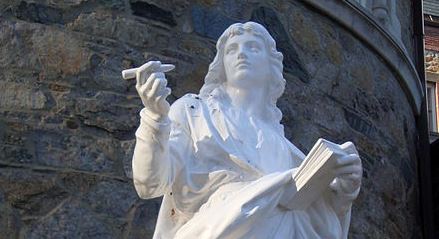
There are numerous cases in the New Testament of two or more individuals sharing the same name. That can be confusing, because we have to decipher who is being talked about. On the other hand, this is also a mark of authenticity. Fiction authors don’t typically give two different characters the same name, because they don’t want their readers to get lost. However, an authentic historical account is most concerned with sharing the truth, so we should expect to find popular names showing up multiple times.
So…how do we know John the Apostle (aka John the Evangelist) wrote the fourth Gospel bearing his name?
I’m glad you asked. There are several reasons we know that John the Apostle authored this Gospel. And since many have tried to argue otherwise, I think it’s worth taking a little time to explain why we know John and not somebody else is the author. Whatever your worldview or beliefs may be, it’s important for you to see that the Christian faith rests on good, reliable evidence. And John’s Gospel is central to Christianity.
The Internal Evidence
First of all, there is the internal evidence. The author describes certain events as an eyewitness and even tells us that he was there.
For example, in chapter 19, the author describes how the soldiers did not break the legs of Jesus at the crucifixion, as they often would, to hasten the victim’s death. Well, Jesus was already dead. So instead, they pierced His side to ensure He really was dead.
John 19:34-35 says:
"Instead, one of the soldiers pierced Jesus’ side with a spear, bringing a sudden flow of blood and water. The man who saw it has given testimony, and his testimony is true. He knows that he tells the truth, and he testifies so that you also may believe."
John’s saying, “Look, I was there. I’m giving a true testimony about what I personally saw.” There are other times when John refers to himself as the “disciple whom Jesus loved” (13:23). When John uses that term, he’s not saying Jesus only loved him. As in, “I’m the guy Jesus really cared about.” Instead, he’s talking about his own personal experience. At the core of his being, he knew Jesus loved him. And notice, when John uses that term, he focuses on who Jesus is rather than himself.
Since the author describes himself as being there at intimate times when only the Apostles were present, and since the other Gospels mention that John was there, it only makes sense that John is the author (see John 13:21-26; 20:1-8; 21:4-7, 18-24).
The Manuscript Evidence
Outside of the internal evidence that John wrote this Gospel, there’s also the fact that every manuscript for the fourth Gospel we have found always – without exception – is attributed to John. In other words, there is always a title given, like “The Gospel According to John,” or something very close to that. In fact, no extant manuscripts for any of the Gospels are anonymous. This is a truly remarkable thing that often goes overlooked.
Skeptics like the well-known author, Bart Ehrman, have tried to discredit the Gospels. And skeptics have especially attacked John’s Gospel, because John makes the most explicit claims about Christ’s deity. But one of the frequent charges that guys like Ehrman have made is that we have no clue who really wrote the four Gospels. In fact, according to Ehrman, not only were the Gospels “written anonymously,” but also the authors were most definitely not eyewitnesses of the events they record.[1]
I’m going to be blunt here. Those claims are just absurd. I know that sounds a bit harsh, but there’s really no nice way to say it. The idea that the Gospels are all anonymous is simply absurd. Here’s why: Every single manuscript we have is respectively attributed to the traditional authors of Matthew, Mark, Luke, and John.
Look at what historian Brant Pitre had to say about this: “The first and perhaps biggest problem for the theory of the anonymous Gospels is this: no anonymous copies of Matthew, Mark, Luke, or John have ever been found. They do not exist. As far as we know, they never have.”[2] This just proves your mom was right when she told you that you can’t trust everything you read!
So, how can Ehrman make such bold claims about the Gospels being written anonymously? How can he be so sure they weren’t written by the apostolic eyewitnesses? He responds that “the followers of Jesus, as we learn from the New Testament itself, were uneducated lower-class Aramaic-speaking Jews from Palestine. These books are not written by people like that.”[3]
But again, we have to ask how Ehrman can be so sure. True, John was a commercial fisherman by trade, but that doesn’t rule out his ability to read and write well. In fact, his father, Zebedee, was likely the business owner (Matthew 4:21-22) and would want his sons to have the necessary literary skills for commerce — including reading and writing Greek, the lingua franca of the Roman Empire.[4] Given that the fourth Gospel is always attributed to John the Apostle, Ehrman’s bald assumption that John was too ignorant to write it is unjustified, highly speculative, and, I must add, a bit unfair to dear old John .
According to tradition, John wrote this Gospel as an elderly man and would have had plenty of time to hone his skills as a literary genius. Besides, after seeing the risen Jesus in the flesh, he had all the motivation he needed to learn how to communicate the gospel well.
Consider that the author of the fourth Gospel also wrote these words:
"That which was from the beginning, which we have heard, which we have seen with our eyes, which we have looked at and our hands have touched—this we proclaim concerning the Word of life. The life appeared; we have seen it and testify to it, and we proclaim to you the eternal life, which was with the Father and has appeared to us. We proclaim to you what we have seen and heard, so that you also may have fellowship with us. And our fellowship is with the Father and with his Son, Jesus Christ." (1 John 1:1-3)
Ehrman has to claim that the author who wrote that is lying through his teeth. But if the manuscript records we do have confirm that John wrote this as the eyewitness he passionately claims to be, why assume he’s not telling the truth?
Reza Aslan’s book Zealot: The Life and Times of Jesus of Nazareth has become very popular. In it, Aslan tries to paint Jesus as a failed Jewish revolutionary who ended up getting crucified for trying to lead a violent rebellion against Rome. Much like Ehrman, Aslan asserts that “with the possible exception of the gospel of Luke, none of the gospels we have were written by the person after whom they were named.”[5] But on what basis does Aslan make this claim?
According to Aslan, the Jesus of the Gospels is too exalted to be historical. But his reasoning is circular. It’s as though his argument is: “Since we know Christians in the second century worshiped Jesus of Nazareth as God, the Gospels must be a reflection of their beliefs.” But why make that assumption, especially when the early Christians point to these very Gospels as the basis for their belief that Jesus is God?[6]
If every manuscript of John that we have is attributed to John, why would we ignore this? Aslan doesn’t bother to tell the reader that there are no anonymous Gospel manuscripts. None! Zippo. Zero. Zilch. Instead, he just makes a baseless claim that John didn’t write the fourth Gospel without bothering to prove it.
It is hard to avoid the unflattering conclusion that Aslan’s only reason for making this assumption is that he wants to reconstruct a Jesus after his own imagination. The careful reader ought to be immediately suspicious of any conclusions by an author who makes such a blatantly false statement in the introduction of a book allegedly about the real Jesus of Nazareth.
Again, New Testament scholar Michael Bird affirms: “There is an absolute uniformity in the authors attributed to the four Gospels. Matthew is always called ‘Matthew,’ and Luke is always called ‘Luke,’ and so forth.”[7]
The Testimony of the Early Church
“That’s nice for modern day scholars,” you might say, “But what about the early church? What did they believe about the authorship of the fourth Gospel?” Here’s the incredible thing: Despite being in various regions around the Mediterranean Sea, the early church fathers unanimously agreed that John the Apostle set down his eyewitness account alongside the other three Gospels.
Irenaeus of Lyons (c. 130-202 AD) wrote, “Then [after the publication of the Gospels of Matthew, Mark, and Luke] John, the disciple of the Lord, who had even rested on his breast, himself also gave forth the Gospel, while he was living at Ephesus in Asia.”[8]
Clement of Alexandria (c. 150-215 AD) likewise confirms that John authored the fourth Gospel: “Of all those who had been with the Lord only Matthew and John left us their recollections, and tradition says that they took to writing perforce…. John, it is said, used all the time a message which was not written down, and at last took to writing for the following cause. The three gospels which had been written down before were distributed to all including himself; it is said he welcomed them and testified to their truth but said that there was only lacking to the narrative the account of what was done by Christ at first and at the beginning of the preaching…. They say accordingly that John was asked to relate in his own gospel the period passed over in silence by the former evangelists.”[9]
In the Muratorian Canon (originally written in the second century), we read: “The fourth of the Gospels is that of John, [one] of the disciples.”[10]
In response to non-Christians who were claiming otherwise, Tertullian of Carthage (155-220 AD) took his stand with the rest of the early church: “We lay it down as our first position, that the evangelical Testament has apostles for its authors…. Of the apostles, therefore, John and Matthew first instill faith into us; whilst of apostolic men, Luke and Mark renew it afterwards.”[11]
I wanted you to see this evidence, because the reality is that many skeptics misrepresent what we know about the authorship of the Gospels. My assertion is that these skeptics have an agenda to discredit the Gospels, and if they can cast doubt on the original authorship, then they have already reached their goal. They reject the authenticity of the Gospels because they reject the authority of the Jesus found therein. Nevertheless, followers of Jesus and curious seekers have no reason to doubt the authenticity of the four Gospels, and the authorship traditionally ascribed to each. The uniform testimony of the early church is that John the son of Zebedee, the Apostle and close associate of Jesus, wrote the fourth Gospel. So, my friend, I encourage you to take up and read.
[1] Bart D. Ehrman, How Jesus Became God: The Exaltation of a Jewish Preacher from Galilee (San Francisco: HarperOne, 2014), 90.
[2] Brant Pitre, The Case for Jesus (New York: Random House, 2016), 26.
[3] Bart D. Ehrman, How Jesus Became God, 90.
[4] Matthew, as a tax collector, would have certainly known how to write and read Greek, something Ehrman seems to totally ignore.
[5] Reza Aslan, Zealot: The Life and Times of Jesus of Nazareth (New York: Random House, 2014), xxvi.
[6] For example, the second-century church father Irenaeus wrote, “Therefore neither would the Lord, nor the Holy Spirit, nor the apostles, have ever named as God, definitely and absolutely, him who was not God, unless he were truly God.” Irenaeus, Against Heresies, Book 3, Chapter 6, Section 1. For additional examples, see Polycarp, Letter to the Philippians, 12:3 and Justin Martyr, Dialogue with Trypho, chapters 56, 63 and 128.
[7] Michael F. Bird, The Gospel of the Lord: How the Early Church Wrote the Story of Jesus (Grand Rapids, MI: Eerdmans, 2014), 259.
[8] Cited in Eusebius, Church History, 5.8; compare Irenaeus, Against Heresies, 3.1.1.
[9] Cited in Eusebius, Church History, 3.24.1-13.
[10] Translated in Bruce Metzger, The Canon of the New Testament, 305–7.
[11] Tertullian, Against Marcion, 4.2., trans. ANF, 3.347.
Photo Credit: Wikimedia
 Lamp and Light
Amen.
It’s not that the evidence has been examined and found lacking.
LikeLike