
By Jason Smith
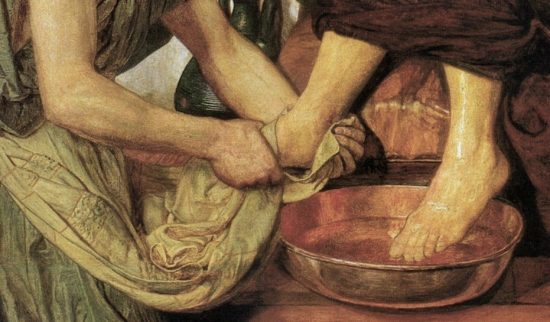
“Jesus, knowing that the Father had given all things into His hands, and that He had come from God and was going back to God, rose from supper. He laid aside His outer garments, and taking a towel, tied it around His waist. Then He poured water into a basin and began to wash the disciples’ feet and to wipe them with the towel that was wrapped around Him.” (John 13:3-5)
Jesus said some outrageous things. Like the time He looked at His closest friends with a piercing gaze and said, “Whoever wants to be my disciple must deny themselves and take up their cross and follow Me. For whoever wants to save their life will lose it, but whoever loses their life for Me will find it” (Matthew 16:24-25).
Wait a minute. Deny myself? Such an invitation sounds bizarre, not just to our twenty-first century ears, but to first century ears, as well. We live in a culture of self-promotion. Ours is the era of entitlement. We look into the mirror and repeat the motto that we’ve inherited: “You deserve the best.” Advertisements urge us to have it your way and indulge thyself. Feeling thirsty? Well then, “this Bud’s for you.” Want to look young again? No problem, this beauty product will remind you that you are a goddess. Want to do something for yourself for a change? It’s about time. Express yourself!
“I Love Me Some Me”
Did you know that between October 2011 and November 2017, there were 259 selfie-related deaths reported? I’m not kidding. These people died while attempting to capture an impressive or hilarious snapshot of themselves. Many were hit by a train. Some fell off a bridge. Even more slipped off a sheer cliff. According to the 2018 report, men outnumbered women three to one in selfie-related deaths.[1] To counter this growing problem, many sightseeing locations around the world have put up signs prohibiting selfies due to the mortal danger associated with this risky behavior. Think of it: men and women (mostly young men) are literally risking their lives in order to capture a one-second pose so they can post it on social media or share it with friends!
Now, obviously, there is nothing inherently wrong with taking a picture of oneself. However, we should reflect on how often we have acted foolishly in order to be in the spotlight. We can laugh at former wide receiver Terrell Owens’ statement, “I love me some me,” but I say he was just being more honest than most. Although we don’t care to admit it, we’re all prone to narcissism.
Into this self-intoxicated world, our Lord speaks, turning our entire outlook on life upside down. “If you try to hang on to your life, you will lose it. But if you give up your life for my sake, you will save it” (Matthew 16:25, NLT). To those of us who thought the movie of life is all about us, Jesus flips the script. It’s not about self-promotion, it’s about self-denial. It’s not about self-fulfillment, it’s about self-emptying. It’s not about making much of yourself, it’s about giving yourself to God. That, in fact, is precisely what Jesus did when He encoded Himself with human DNA to live, love, die, and rise in this beautiful yet broken world. He surrendered His rights and “emptied Himself, by taking the form of a servant, being born in the likeness of men” (Philippians 2:7).
What would it look like if we were to follow in the footsteps of Jesus, who chose self-denial over self-promotion or even self-preservation?
The Apostle Paul foresaw the coming days when “people will be lovers of self” (2 Timothy 3:2). Self-love is corrosive; it turns us in upon ourselves — something love was never intended to do. We need to let Jesus teach us that there is a beauty to self-denial. As we empty our hearts of self-love, we make room for receiving God’s love and, in turn, can extend that love to others.
The Servant King
Jesus is the King, but He’s a king who humbly washes the smelly feet of His followers (John 13:3-5).
When we humans rise to positions of power and influence, it tends to go to our heads. Satisfied with our new power status, we get a bloated sense of self-importance. Like Simba from The Lion King, we “can’t wait to be king” of our own little kingdoms so that, as the cub sings, we are “free to do it all my way.” But not Jesus. Note how counterintuitively this works out in His life. “Jesus, knowing that the Father had given all things into His hands, and that He had come from God and was going back to God, rose from supper… laid aside His outer garments… poured water into a basin and began to wash the disciples’ feet” (John 13:3-5).
Whereas we often look around for servants from our position of power, Jesus took on the role of a servant from His position of power. It’s as if the elderly John is shaking his head in amazement as he recalls what took place in that upper room so many years before. He carefully observes that Jesus did the unpopular job of scrubbing calloused and dusty feet while fully aware that He was the King of the universe — “the Father had given all things into His hands” (v. 3).
Jesus the King chose the way of the humble servant. Not only did He do this to demonstrate His immeasurable love for His followers (John 13:1), but He also did this so we would have a tangible example of what true leadership looks like. “You call Me Teacher and Lord,” He told them, “and you are right, for so I am. If I then, your Lord and Teacher, have washed your feet, you also ought to wash one another’s feet” (John 13:13-14). Rather than exploiting His power to make His life more comfortable, as we are all too prone to do, Jesus used His power to serve others.
Let me guarantee something for you. You will never find a passage in the New Testament where Jesus snaps His fingers and demands that Peter bring Him the hors d’oeuvres. You will look in vain for that passage where He orders John to wash His feet or commands Andrew to pour Him a glass of the wine He’s just made. Scripture says He did not use His divine status and privileges for His own advantage. Instead, He chose the role of a servant, humbly obeying His Father “to the point of death, even death on a cross” (Philippians 2:8).
We need to remember there is great joy in serving others. Jesus endured the agony of the cross “for the joy that was set before Him” (Hebrews 12:2). Moreover, Jesus wanted His joy to be fulfilled in us (John 17:13). Despite all the countless options available to Him, Jesus chose self-denial. We can still see the effect of that choice in the countless hospitals, orphanages, homeless shelters, schools, and clinics all over the world that His followers have built in His name.
So, what about you? What are you clutching tightly to that might serve a
greater purpose if you gave it away? Who is the hurting person in your life?
What if God has blessed you so that you can put a smile on their face? Where is
a place you could go to embody the self-giving love of Jesus for others? You
know that task that nobody in the house or at work wants to do — what if you
chose to do it? Christ chose self-denial so that we could see the beauty of
true love and follow His example. What do you choose?
[1] Agam Bansal; et al, “Selfies: A Boon or Bane?” Journal of Family Medicine and Primary Care (July 2018). 7 (4): 828-831. https://www.ncbi.nlm.nih.gov/pmc/articles/PMC6131996/
Painting: “Jesus Washing Peter’s Feet” by Ford Maddox Brown
 Lamp and Light